
浦发银行

Search documents
申万宏源助力浦发银行200亿元二级资本债成功发行
申万宏源证券上海北京西路营业部· 2025-12-03 02:26
此次两品种债券的成功发行,是浦发银行主动进行资本管理的体现。双品种设计与投资者的需求相适配,投资者广泛认购,市场信心彰 显,同时也展现出浦发银行对市场需求的深刻理解和精准把握。本次大规模资本的顺利补充,将进一步夯实浦发银行的总资本实力,为其 在复杂经济形势下继续保持业务稳健增长、持续服务国家重大战略和实体经济筑牢安全垫。 深化合作共筑新篇 申万宏源证券作为本期债券联席主承销商,在本期债券的发行过程中为浦发银行提供了专业的承销支持。通过协助浦发银行顺利完成此次 发行,进一步巩固了在大型股份制商业银行复杂资本工具发行领域的优势地位以及面对多样化市场环境与发行需求时的专业响应能力。本 项目的成功发行,强化了申万宏源证券与浦发银行的良好合作关系,为未来申万宏源在股份制商业银行资本工具创新领域的持续开拓积累 了宝贵经验。 免责 声 明 浦发银行二级资本债成功发行 NEWS 2025 年 11 月 17 日,上海浦东发展银行股份有限公司 2025 年第一期二级资本债 券成功发行。本期债券创新采用双品种发行机制,其中品种一发行规模 165 亿元,期 限 5+5 年,票面利率 2.17% ;品种二发行规模 35 亿元,期限 ...




中国金融服务 - 回应 3 季度投资者日会议的九大核心问题-China Financial Services_ Addressing nine top of mind questions from our 3Q NDR meetings
2025-12-03 02:16
Summary of Key Points from the Conference Call Industry Overview - The conference call involved 21 China financial companies, including banks, brokers, and fintech firms, discussing the financial services industry in China, particularly focusing on the third quarter results and outlook for the future [1][2]. Key Insights on Banks 1. **Net Interest Margins (NIMs) Outlook**: - Commercial bank NIM was flat quarter-on-quarter in 3Q25, indicating signs of stabilization. Banks expect NIMs to stabilize in 1H26, driven by slower declines in loan yields and ongoing repricing of time deposits [4][6]. - NIMs may face downward pressure due to concentrated loan repricing in 1Q26, but banks generally believe the decline will continue to narrow [4][6]. 2. **Credit Demand**: - Year-to-date, bank loan growth has been primarily driven by corporate loans, contributing 92% of new loans. Credit demand remains weak, particularly in retail loans, with expectations of further slowdown in 4Q25 [12][18]. - Mortgage demand is weak due to a sluggish property market, and while non-mortgage retail loans are growing slightly faster, banks remain cautious in lending [13][14]. 3. **Asset Quality Risks**: - Banks report a year-on-year decrease in new non-performing loan (NPL) formation for corporate loans, but property loans remain a significant source of new corporate NPLs. Banks have made sufficient provisions for property loans, providing a buffer against NPL ratios [19][20]. - Retail loan NPL formation has increased year-on-year, but risks are considered manageable due to low proportions of non-mortgage consumer loans and low loan-to-value ratios [25][27]. 4. **Non-Interest Income Growth**: - Fee income showed strong performance in 3Q25, driven by capital market activities and corporate loan growth. Banks expect continued positive trends in fee income despite potential impacts from fee cuts in mutual funds [32][35]. 5. **Capital Adequacy and Shareholder Returns**: - Some banks experienced a decline in CET-1 ratios due to rising bond market rates and new loans with higher risk weightings. However, capital adequacy is improving overall, supporting asset growth and risk absorption [40][41]. - Banks are gradually increasing dividend payout ratios, attracting long-term investors despite a decline in dividend yields from previous highs [41][43]. Regulatory Impacts 1. **Loan Facilitation Platforms**: - New regulations require clear disclosure of loan costs, impacting pricing and risk. Loan volumes are expected to contract in 4Q25 and 1Q26, with a potential recovery in 2Q26 if risks stabilize [46][47]. - Consumer finance companies are required to lower average loan interest rates, but the impact is expected to be manageable for top-tier platforms [48][51]. 2. **Consumer Finance**: - Banks are shrinking their internet loan portfolios and focusing on self-operated loans due to rising retail risks. This shift may suppress retail credit growth in the short term [50][51]. Capital Markets Insights 1. **Broker Performance**: - Brokers experienced higher trading volumes in 3Q25, with expectations of sustained performance due to ongoing bank deposit migration and strong investor sentiment [53][54]. - CICC is focusing on institutional business but sees rising wealth management income due to strong demand in IPO subscriptions [53][54]. 2. **Financial Software Companies**: - Financial software companies may benefit from capital market recovery, but outcomes vary. Brokers are increasing IT budgets due to trading activity, while fund companies are cautious due to declining AUM and fee rates [59][61]. Conclusion - The financial services industry in China is navigating a complex landscape with stabilizing NIMs, weak credit demand, manageable asset quality risks, and evolving regulatory impacts. The outlook for banks and brokers remains cautiously optimistic, with potential growth in non-interest income and capital markets activity.
万科经济陷入危机,深圳豪砸664亿拯救,接管市场还是体面收场?
Sou Hu Cai Jing· 2025-12-02 11:55
当晚就传出两个关键消息:浦发银行官宣"22万科MTN004"债券要展期,还有传闻说中央让深圳按市场 规律处置万科,给个体面收场。 债券暴跌引爆危机,万科成经济学考题 一边是债券违约在即,一边是大股东深圳地铁(简称深铁)骑虎难下,万科这事儿早就不是单纯的企业 危机了,妥妥成了一道全国关注的经济学例题。 文|锐资 编辑|锐资 前言: 家人们,最近地产圈最大的瓜,当属万科的债券暴跌。 11月26号那天,万科多只债券单日跌超25%,有的甚至跌了三成以上,股票也跟着凑热闹往下走。 咱今天就扒透这事儿:万科为啥亏成这样?深铁砸了几百亿还不停输血图啥?深圳到底该救还是该放? 先说说万科的惨状,那真是肉眼可见的亏。 2025年前三季度,万科直接亏了280亿,而去年一年就亏了490亿,不到两年时间,净资产从2500亿缩水 到1750亿,硬生生少了30%。 股价更别提了,巅峰时期的零头都不到,只剩20%。 现在万科市值也挺迷,有说750亿的,也有说660亿的,要是按660亿算,其中不在深铁手里的股份市值 也就460亿,股权集中度已经很高了。 但平心而论,万科是真的在努力自救。2023年手里还有7000亿的存量房,到去年底降到52 ...


跨境融资新篇章
Sou Hu Cai Jing· 2025-12-02 11:51
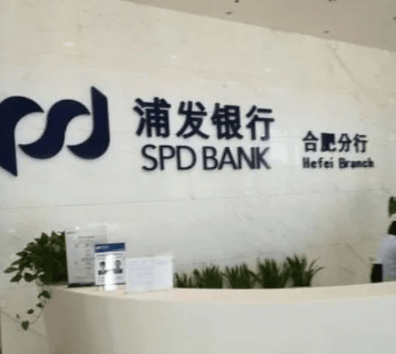
Core Viewpoint - The launch of the offshore yen direct lending business by Pudong Development Bank's Hefei branch provides a new cross-border financing channel for enterprises, helping them reduce costs and optimize their financial structure [1] Group 1: Business Development - Pudong Development Bank's Hefei branch successfully issued 216 million yen to Anhui Jinyu Agricultural Technology Development Co., Ltd., marking a significant step in internationalization [1] - The offshore direct lending business offers notable advantages over traditional domestic loans, including significant cost benefits, flexible terms, and the ability to mitigate exchange rate risks [1] Group 2: Market Trends - The ongoing dual opening of China's financial industry is expected to create broader development opportunities for offshore direct lending businesses [1] - The successful implementation of the yen offshore direct lending business signifies an enhancement in Pudong Development Bank's capabilities in international financial services [1] Group 3: Strategic Focus - The bank aims to continue focusing on customer needs by providing professional and agile financial solutions to inject continuous cross-border financial support into the real economy [1]
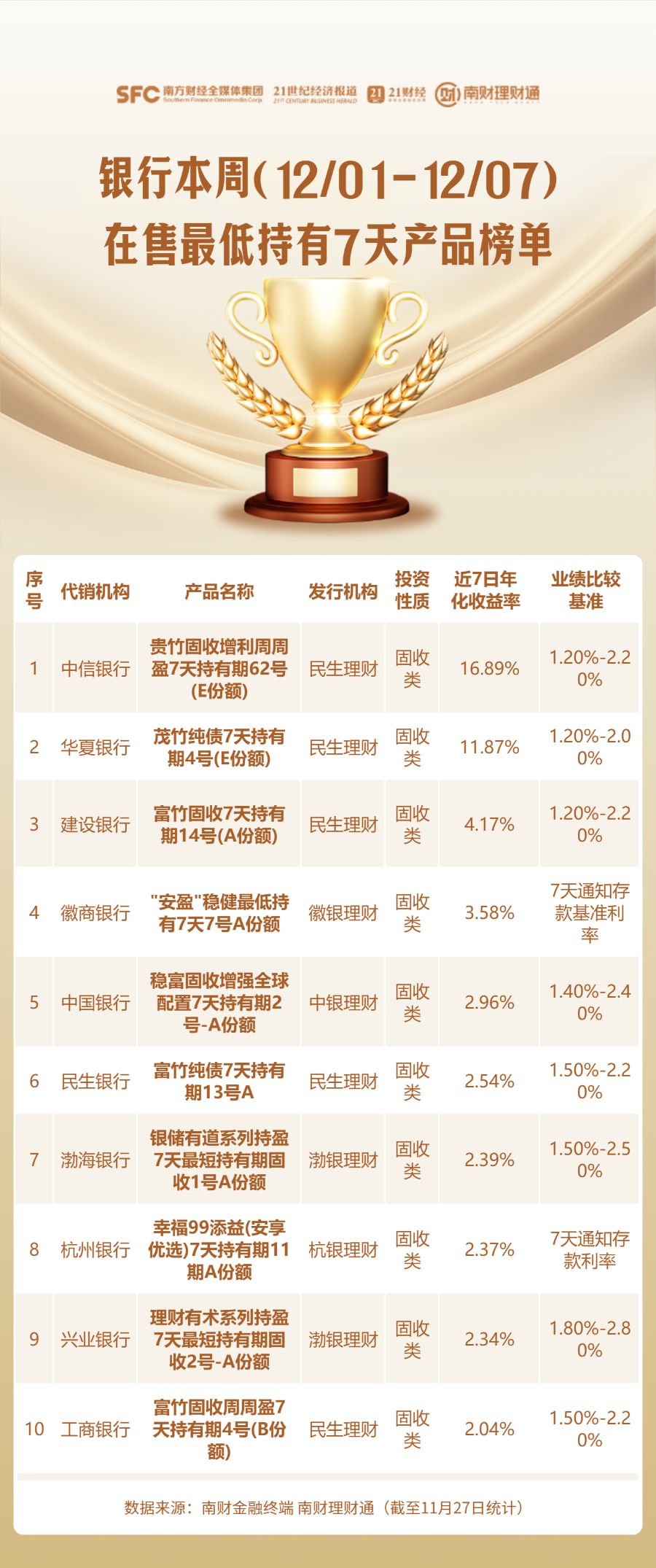
哪家商业银行最低持有期理财产品收益更高?
2 1 Shi Ji Jing Ji Bao Dao· 2025-12-02 10:37
Core Insights - The article focuses on the performance of minimum holding period RMB public offering products, ranking them based on annualized returns for holding periods of 7, 14, 30, and 60 days [1][4][12] Group 1: 7-Day Holding Period Products - The top-performing product is from Minsheng Bank with an annualized return of 4.17% [3] - Other notable products include: - Huishang Bank with 3.58% [3] - Bank of China with 2.96% [3] - Minsheng Bank's Fuzhu Pure Bond with 2.54% [3] - Bohai Bank with 2.39% [3] Group 2: 14-Day Holding Period Products - Minsheng Bank's product "Jingxiang Fixed Income Incremental Dual-Week" leads with a return of 34.68% [5] - Other significant products include: - Minsheng Bank's Fuzhu Pure Bond with 5.66% [5] - WeBank's "Anying" Stable Income with 4.47% [5] - SPDB's "Wealth Management Series" with 2.33% [5] Group 3: 30-Day Holding Period Products - Minsheng Bank's "Guizhu Fixed Income Incremental Monthly" tops the list with a return of 21.23% [9] - Other key products include: - Minsheng Bank's Fuzhu Fixed Income with 13.53% [9] - Bank of China with 7.64% [9] - Huishang Bank's "Happiness 99" with 6.07% [9] Group 4: 60-Day Holding Period Products - The leading product is from Minsheng Bank with a return of 15.12% [13] - Other notable products include: - CITIC Bank's Fuzhu Pure Bond with 8.94% [14] - Bank of China with 4.57% [14] - Huishang Bank's product with 3.46% [14]






股份制银行板块12月2日跌0.26%,浦发银行领跌,主力资金净流出4.26亿元
Zheng Xing Xing Ye Ri Bao· 2025-12-02 09:05
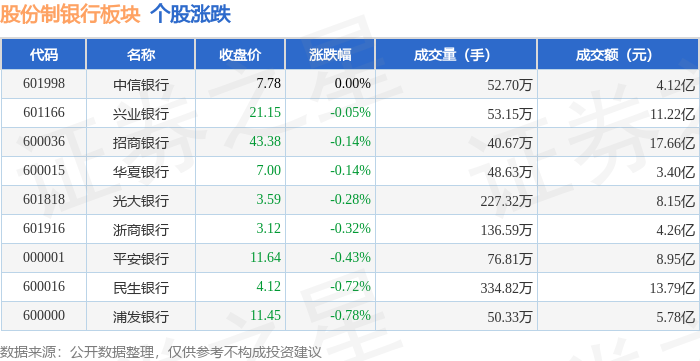
Market Overview - On December 2, the shareholding banks sector declined by 0.26% compared to the previous trading day, with Pudong Development Bank leading the decline [1] - The Shanghai Composite Index closed at 3897.71, down 0.42%, while the Shenzhen Component Index closed at 13056.7, down 0.68% [1] Individual Bank Performance - Citic Bank (601998) closed at 7.78 with no change in price, trading volume of 527,000 shares, and a transaction value of 412 million yuan [1] - Industrial Bank (601166) closed at 21.15, down 0.05%, with a trading volume of 531,500 shares and a transaction value of 1.122 billion yuan [1] - China Merchants Bank (600036) closed at 43.38, down 0.14%, with a trading volume of 406,700 shares and a transaction value of 1.766 billion yuan [1] - Huaxia Bank (600015) closed at 7.00, down 0.14%, with a trading volume of 486,300 shares and a transaction value of 340 million yuan [1] - Everbright Bank (601818) closed at 3.59, down 0.28%, with a trading volume of 2.2732 million shares and a transaction value of 815 million yuan [1] - Zhejiang Commercial Bank (601916) closed at 3.12, down 0.32%, with a trading volume of 1.3659 million shares and a transaction value of 426 million yuan [1] - Ping An Bank (000001) closed at 11.64, down 0.43%, with a trading volume of 768,100 shares and a transaction value of 895 million yuan [1] - Minsheng Bank (600016) closed at 4.12, down 0.72%, with a trading volume of 3.3482 million shares and a transaction value of 1.379 billion yuan [1] - Pudong Development Bank (600000) closed at 11.45, down 0.78%, with a trading volume of 503,300 shares and a transaction value of 578 million yuan [1] Capital Flow Analysis - The shareholding banks sector experienced a net outflow of 426 million yuan from main funds, while speculative funds saw a net inflow of 242 million yuan, and retail investors had a net inflow of 183 million yuan [1] - Citic Bank had a main fund net inflow of 56.67 million yuan, while retail investors contributed a net inflow of 8.34 million yuan [2] - Huaxia Bank saw a main fund net inflow of 20.20 million yuan, but retail investors had a net outflow of 1.99 million yuan [2] - Pudong Development Bank experienced a main fund net inflow of 0.89 million yuan, with a net outflow from retail investors of 32.71 million yuan [2] - Minsheng Bank had a significant main fund net outflow of 96.31 million yuan, while speculative funds saw a net inflow of 61.08 million yuan [2] - Industrial Bank faced a main fund net outflow of 101 million yuan, but retail investors contributed a net inflow of 82.80 million yuan [2]




民营经济促进条例密集落地 金融机构加快完善服务体系
Zhong Guo Jing Ying Bao· 2025-12-02 09:04
Core Viewpoint - The Chinese government is emphasizing the promotion of high-quality development of the private economy, with a focus on expanding market access, strengthening support for resources, and protecting legal rights to stimulate private investment [1]. Group 1: Policy Initiatives - The "Private Economy Promotion Law" officially took effect on May 20, 2023, with multiple regions launching related regulations to support private economic growth [2]. - Gansu and Tianjin have passed local regulations to implement the Private Economy Promotion Law, effective from January 1, 2026, which encourages banks to optimize credit evaluation mechanisms for private enterprises [2]. - Shandong's new regulation, also effective from January 1, 2026, aims to enhance financial support for private economic organizations through various loan products and services tailored to their characteristics [2]. Group 2: Banking Sector's Role - The banking sector is shifting from policy-driven support to capability-driven support for the private economy, focusing on enhancing credit service capabilities and utilizing digital technology for innovative financial solutions [3]. - Key strategies include implementing no-repayment renewal policies, leveraging digital technology for supply chain finance, and promoting collaboration between credit and equity financing [3]. Group 3: Comprehensive Financial Services - The China Banking Association and the All-China Federation of Industry and Commerce have issued an initiative to enhance financial services for private enterprises, emphasizing product innovation and tailored support for different stages of enterprise development [4]. - Banks like SPDB and GF Bank are developing specialized financial products and services to meet the diverse needs of private enterprises, particularly in technology and innovation sectors [5]. - There is a call for banks to build a comprehensive financial service system that covers the entire lifecycle of enterprises, transitioning from mere fund providers to comprehensive service partners for the private economy [6].
再添整合案例!泽州浦发村镇银行获批解散,全部业务将由浦发银行承接
Bei Jing Shang Bao· 2025-12-02 08:17
批复明确,接此批复文件后,泽州浦发村镇银行应立即停止一切经营活动,于15个工作日内向晋城金融 监管分局缴回许可证,并按照有关法律法规要求办理相关手续。未尽事宜按照金融监管总局有关规定办 理。 北京商报讯(记者 孟凡霞 周义力)12月2日,国家金融监督管理总局山西监管局发布《关于泽州浦发村 镇银行股份有限公司解散的批复》,同意解散泽州浦发村镇银行,泽州浦发村镇银行全部资产、负债、 业务、网点、人员及其他权利义务将由上海浦东发展银行承接。 ...
金工定期报告20251202:预期高股息组合跟踪
Soochow Securities· 2025-12-02 06:35
Quantitative Models and Construction Methods 1. **Model Name: Expected High Dividend Portfolio** - **Model Construction Idea**: The model is constructed using a two-stage process to create an expected dividend yield indicator. The first stage calculates the dividend yield based on annual report profit distribution, and the second stage predicts and calculates the dividend yield using historical dividends and fundamental indicators. Additionally, two short-term factors affecting dividend yield—reversal factor and profitability factor—are used to assist in screening. The model selects stocks from the CSI 300 constituents to construct the expected high dividend portfolio, which holds 30 stocks and rebalances monthly[3][8]. - **Model Construction Process**: 1. Exclude suspended and limit-up stocks from the CSI 300 constituents to form the candidate stock pool[9]. 2. Exclude the top 20% of stocks with the highest short-term momentum (21-day cumulative increase)[13]. 3. Exclude stocks with declining profitability (quarterly net profit growth rate less than 0)[13]. 4. Rank the remaining stocks in the pool by expected dividend yield and select the top 30 stocks to construct the portfolio with equal weight[9]. - **Model Evaluation**: The model's historical performance is impressive, with a cumulative return of 358.90% and a cumulative excess return of 107.44% relative to the CSI 300 Total Return Index. The annualized excess return is 8.87%, with a maximum rolling one-year drawdown of only 12.26% and a monthly excess win rate of 60.19%[11]. Model Backtest Results 1. **Expected High Dividend Portfolio** - **Average Return (November 2025)**: 0.70%[14] - **Excess Return Relative to CSI 300 Index**: 3.08%[14] - **Excess Return Relative to CSI Dividend Index**: 2.31%[14] - **Cumulative Return (2009-2017)**: 358.90%[11] - **Cumulative Excess Return (2009-2017)**: 107.44%[11] - **Annualized Excess Return (2009-2017)**: 8.87%[11] - **Maximum Rolling One-Year Drawdown**: 12.26%[11] - **Monthly Excess Win Rate**: 60.19%[11] Quantitative Factors and Construction Methods 1. **Factor Name: Expected Dividend Yield Factor** - **Factor Construction Idea**: The factor is constructed using a two-stage process. The first stage calculates the dividend yield based on annual report profit distribution, and the second stage predicts and calculates the dividend yield using historical dividends and fundamental indicators. Two short-term factors—reversal factor and profitability factor—are used to assist in screening[3][8]. - **Factor Construction Process**: 1. Calculate the dividend yield based on annual report profit distribution[8]. 2. Predict and calculate the dividend yield using historical dividends and fundamental indicators[8]. 3. Use the reversal factor and profitability factor to assist in screening[8]. - **Factor Evaluation**: The factor effectively identifies high dividend yield stocks, contributing to the construction of a high-performing portfolio[3][8]. Factor Backtest Results 1. **Expected Dividend Yield Factor** - **Average Return (November 2025)**: 0.70%[14] - **Excess Return Relative to CSI 300 Index**: 3.08%[14] - **Excess Return Relative to CSI Dividend Index**: 2.31%[14] - **Cumulative Return (2009-2017)**: 358.90%[11] - **Cumulative Excess Return (2009-2017)**: 107.44%[11] - **Annualized Excess Return (2009-2017)**: 8.87%[11] - **Maximum Rolling One-Year Drawdown**: 12.26%[11] - **Monthly Excess Win Rate**: 60.19%[11]

泽州浦发村镇银行获批解散 浦发银行承接其全部资产负债
Xin Lang Cai Jing· 2025-12-02 05:52
12月2日金融一线消息,国家金融监督管理总局山西监管局发布关于泽州浦发村镇银行股份有限公司解 散的批复,同意解散泽州浦发村镇银行股份有限公司,泽州浦发村镇银行全部资产、负债、业务、网 点、人员及其他权利义务将由上海浦东发展银行股份有限公司承接。 责任编辑:秦艺 12月2日金融一线消息,国家金融监督管理总局山西监管局发布关于泽州浦发村镇银行股份有限公司解 散的批复,同意解散泽州浦发村镇银行股份有限公司,泽州浦发村镇银行全部资产、负债、业务、网 点、人员及其他权利义务将由上海浦东发展银行股份有限公司承接。 责任编辑:秦艺 ...
