宁波银行

Search documents
银行行业:公募业绩基准改革引导配置均衡化,银行板块较受益
Dongxing Securities· 2025-11-12 08:21
Investment Rating - The industry investment rating is "Positive" [1] Core Viewpoints - The recent reform of public fund performance benchmarks is expected to guide balanced allocation, benefiting the banking sector [1][9] - The reform aims to enhance the stability of fund investment styles and improve the decision-making process for benchmark selection [2][3] - The banking sector is currently underweighted in active equity fund holdings, presenting a potential opportunity for reallocation as the new benchmarks are implemented [9] Summary by Sections Benchmark Selection and Management - The new guidelines require benchmarks to accurately reflect the investment style of funds, with a focus on compliance with investment objectives and strategies [2] - A comprehensive control mechanism for benchmark selection and monitoring is mandated, with accountability placed on management [2] - An independent department must monitor deviations from benchmarks, ensuring timely adjustments and oversight of fund managers [2] Impact Outlook - The selection and adjustment of benchmarks will become more precise, reflecting the true investment styles and strategies of funds [4] - The effective use of benchmarks is expected to stabilize fund investment behaviors and prevent style drift, correcting short-term investment tendencies [4] - The banking sector is currently underrepresented in active fund portfolios, with only 1.82% allocation compared to 12.5% in the CSI 300 index, indicating a potential for increased investment following the benchmark reforms [9] Market Dynamics - The banking sector is anticipated to benefit from the reform, as it encourages a more balanced allocation of funds, particularly in a low-interest-rate environment where high dividends remain attractive [9] - The fundamental resilience of banks is supported by stabilizing net interest margins and improving asset quality, suggesting a favorable outlook for valuation recovery in the banking sector [9]
宁波银行(002142) - 2025年11月12日投资者关系活动记录表
2025-11-12 08:16
Group 1: Competitive Advantage and Business Strategy - The company adopts a differentiated business strategy to adapt to changes in the operating environment, focusing on high-quality development through four main approaches: deepening operational lines, strengthening core advantages, accelerating technological transformation, and ensuring risk management [2]. - The company aims to maintain a good asset quality level despite economic fluctuations and challenges, leveraging its unique "Four Transformations and Five Supports" service system to assist key economic sectors [2]. Group 2: Loan Growth and Economic Support - The company has focused on supporting private small and micro enterprises, manufacturing, import-export businesses, and consumer sectors, leading to a steady increase in loan volume [2]. - Future loan growth is expected to be sustained as policies promoting domestic demand and consumption continue to be implemented, enhancing financial service coverage to meet the needs of the real economy [3]. Group 3: Risk Management and Credit Policies - The company emphasizes strict credit approval processes and prudent lending policies to manage credit risk effectively, ensuring stable operations [2]. - Continuous improvement of the credit risk management process is prioritized, utilizing financial technology to enhance risk monitoring systems [2].

首次,有银行取消五年期定期存款产品,还下调了其他期限的利率,什么情况?
Mei Ri Jing Ji Xin Wen· 2025-11-12 03:28
Core Viewpoint - The announcement by Inner Mongolia's Tuyuqi Mengyin Village Bank to cancel its five-year fixed deposit product starting November 5, 2025, marks a significant shift in the banking industry, reflecting ongoing pressure on net interest margins and prompting other banks to adjust their deposit rates and products accordingly [1][5][12]. Summary by Category Product Adjustments - Tuyuqi Mengyin Village Bank is the first commercial bank to explicitly announce the removal of the five-year fixed deposit product, alongside lowering interest rates for other deposit terms [1][5]. - The bank has reduced the interest rates for various deposit terms: three-month from 1.15% to 1.10%, six-month from 1.35% to 1.30%, one-year from 1.50% to 1.45%, two-year from 1.60% to 1.55%, and three-year from 1.95% to 1.85% [3][6]. - Similar actions have been observed in other banks, with some private banks reporting "sold out" or removal of mid to long-term deposit products [1][7]. Market Context - The adjustments in deposit products are a response to the persistent pressure on net interest margins faced by banks, particularly smaller banks that are more sensitive to funding costs [4][8]. - The overall trend shows that many banks are actively lowering deposit rates to manage their liabilities and improve their financial stability amid a challenging interest rate environment [7][9]. Implications for the Banking Sector - The cancellation of long-term deposit products and the reduction of interest rates are seen as proactive measures by banks to optimize their balance sheets and mitigate the impact of declining asset yields [11][12]. - This shift may lead to a "deposit migration" effect, where funds move from traditional bank deposits to capital markets, potentially increasing liquidity in stocks, bonds, and funds [12][13]. - Analysts suggest that the market is witnessing a more pronounced adjustment mechanism for deposit rates, indicating a trend towards stabilizing net interest margins in the banking sector [13].

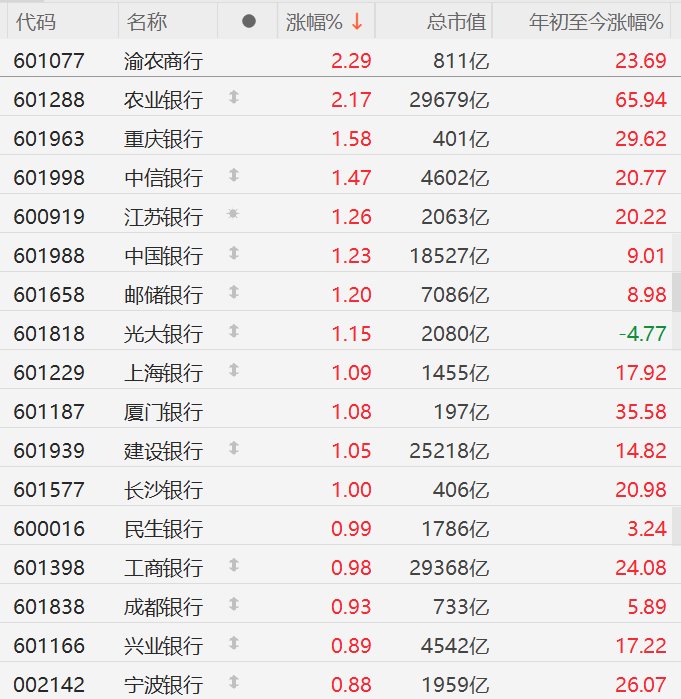
农业银行涨超2%,再创历史新高
Ge Long Hui A P P· 2025-11-12 01:51
Core Insights - The A-share market has seen a rise in bank stocks, with notable increases in shares of Chongqing Rural Commercial Bank and Agricultural Bank, both rising over 2% [1] - Agricultural Bank has reached a historical high, with its total market capitalization approaching 3 trillion yuan [1] Summary by Category Stock Performance - Chongqing Rural Commercial Bank (601077) increased by 2.29%, with a total market capitalization of 81.1 billion yuan and a year-to-date increase of 23.69% [2] - Agricultural Bank (601288) rose by 2.17%, reaching a market capitalization of 2,967.9 billion yuan and a year-to-date increase of 65.94% [2] - Other banks such as Chongqing Bank (601963), CITIC Bank (601998), and Jiangsu Bank (600919) also saw increases of over 1% [2] Market Capitalization - The total market capitalization of Agricultural Bank is nearing 3 trillion yuan, marking a significant milestone [1] - Other banks like China Bank (601988) and Postal Savings Bank (601658) have market capitalizations of 1,852.7 billion yuan and 708.6 billion yuan, respectively [2] Year-to-Date Performance - The year-to-date performance of various banks shows significant growth, with Agricultural Bank leading at 65.94%, followed by Chongqing Bank at 29.62% and Jiangsu Bank at 20.22% [2]

浙江航民股份有限公司关于担保进展的公告
Shang Hai Zheng Quan Bao· 2025-11-11 19:38
Core Points - The company has signed guarantee agreements to support the business development needs of its subsidiaries, providing a maximum guarantee of RMB 10 million for Hangzhou Haimin Kear Jewelry Co., Ltd. and RMB 5 million for Hangzhou Shangjinyuan Jewelry Co., Ltd. [1][4][6] - The board of directors approved the guarantee limits for the subsidiaries during meetings held on March 27, 2025, and April 22, 2025, with the approved limits being RMB 20 million for Hangzhou Haimin Kear Jewelry and RMB 30 million for Hangzhou Shangjinyuan Jewelry [2][7] - The total external guarantee amount provided by the company is RMB 176,950.06 million, which accounts for 27.74% of the company's latest audited net assets, with no overdue guarantees reported [7][8] Guarantee Details - The guarantee for Hangzhou Haimin Kear Jewelry includes a joint liability guarantee covering principal, interest, overdue interest, penalties, and other related costs, with a guarantee period of two years from the debt maturity date [4][5] - The guarantee for Hangzhou Shangjinyuan Jewelry also includes a joint liability guarantee covering similar costs, with a guarantee period of three years from the debt maturity date [6][7] - The company has not provided guarantees for its controlling shareholders or related parties, ensuring that all guarantees are directed towards its subsidiaries [7][8] Rationale and Approval - The guarantees are deemed necessary and reasonable to support the subsidiaries' operational needs, contributing to their stable operation and long-term development, aligning with the company's overall interests and strategic goals [7] - The board of directors, after reviewing the subsidiaries' operational and credit conditions, believes that the subsidiaries have sufficient capacity to repay the debts, thus approving the guarantee limits [7][8]

深圳中科飞测科技股份有限公司关于签订募集资金专户存储三方、四方监管协议的公告
Shang Hai Zheng Quan Bao· 2025-11-11 19:24
Group 1 - The company has signed agreements for the storage and supervision of raised funds, ensuring compliance with regulations and protecting investors' rights [3][4][8] - The company plans to issue 28,571,428 A-shares at a price of 87.50 yuan per share, raising a total of 250 million yuan, with a net amount of approximately 248.08 million yuan after deducting issuance costs [2][4] - The raised funds will be allocated to specific projects, including the development of high-end semiconductor quality control equipment and the upgrade of headquarters and R&D centers [4][8] Group 2 - The three-party supervision agreement involves the company, several banks, and the underwriting institution, outlining the management and usage of the raised funds [4][5] - The four-party supervision agreement includes the company and its wholly-owned subsidiary, with similar stipulations regarding fund management and usage [8][9] - Both agreements require regular reporting and oversight, including monthly account statements and conditions for withdrawal of funds exceeding certain thresholds [6][11]

三季度公募含“银”量创五年新低,四季度银行股修复动能渐显
第一财经· 2025-11-11 14:59
Core Viewpoint - The article highlights the significant changes in the banking sector, particularly focusing on the increasing shareholding of local state-owned enterprises and insurance funds in various banks, while public funds and northbound capital are reducing their holdings. The overall market sentiment for bank stocks is showing signs of recovery in the fourth quarter after a challenging third quarter [3][10][12]. Group 1: Shareholding Changes - Action Person's total shareholding ratio has risen to 19.17%, making it the largest shareholder of Qingdao Bank [3]. - Many city commercial banks and national banks have disclosed shareholding increase plans or have already implemented them, including Chengdu Bank, Nanjing Bank, and Postal Savings Bank [3]. - The number of shareholders in banks like China Merchants Bank and Beijing Bank has increased significantly, indicating a rise in retail investor participation alongside a decline in institutional holdings [5][6]. Group 2: Fund Holdings and Market Performance - Public funds' exposure to bank stocks has dropped to a five-year low, with a decrease in their overall holdings [4][6]. - The banking sector saw a decline of 8.68% in the third quarter but rebounded with an increase of 8.23% in the fourth quarter as of November 11 [3]. - Northbound capital inflow into banks decreased by 31.66% in the third quarter, with only a few banks like Ningbo Bank and Chengdu Bank seeing net inflows [7]. Group 3: Institutional Investment Trends - Insurance funds and state-owned capital have maintained relatively stable holdings in bank stocks, with state-owned funds holding a total market value of 4.5 trillion yuan [8]. - The increase in local state-owned capital investments in city commercial banks reflects a strategy to strengthen regional financial resource control and capitalize on low valuations [9]. - The investment sentiment in the banking sector is expected to improve in the fourth quarter, with several banks announcing share buyback plans [10][11]. Group 4: Future Outlook - The article suggests that the banking sector may experience structural recovery opportunities in the fourth quarter, driven by high dividend yields and the resilience of regional banks [10][12]. - Analysts believe that the combination of increased institutional investment and favorable market conditions could lead to a stabilization phase for bank stocks [11][12].


三季度公募含“银”量创五年新低 四季度银行股修复动能渐显
Di Yi Cai Jing· 2025-11-11 13:51
Core Viewpoint - Qingdao Guoxin Financial Holdings has become the largest shareholder of Qingdao Bank with a total holding of 19.17% [1] - The banking sector is experiencing a mixed performance with increased shareholder activity, particularly from local state-owned and industrial capital, while facing pressure from public funds and northbound capital [1][2] Group 1: Shareholder Activity - Multiple city commercial banks and national banks have reported significant shareholder increases this year, including Chengdu Bank, Nanjing Bank, and Postal Savings Bank [1] - Public funds have reduced their holdings in bank stocks, with the proportion of public fund investment in bank stocks dropping to 1.78%, the lowest level in five years [2][3] - Northbound capital has also decreased its investment in banks, with a 31.66% decline in total market value held by northbound funds [3] Group 2: Market Performance - The banking sector saw an 8.68% decline in Q3 but rebounded with an 8.23% increase in Q4 as of November 11 [1] - The overall market style shift has led to a significant reallocation of funds from low-volatility bank stocks to high-growth sectors, with the Wind All A Index rising by 19.5% during the same period [4] Group 3: Institutional Investment Trends - Insurance and state-owned funds have maintained stable holdings in bank stocks, with state-owned funds holding a total market value of 4.5 trillion yuan [5][6] - Local state-owned and industrial capital are increasingly investing in city commercial banks, driven by regional financial resource integration needs and attractive valuations [6] Group 4: Future Outlook - There is a growing sentiment of recovery in the banking sector, with several banks announcing share buyback plans and improved core revenue capabilities [7] - Analysts suggest that Q4 presents structural recovery opportunities, particularly for quality regional banks and high-dividend state-owned banks [8]
三季度公募含“银”量创五年新低,四季度银行股修复动能渐显
Di Yi Cai Jing· 2025-11-11 13:40
Core Viewpoint - Qingdao Guoxin Chanin Holdings has become the largest shareholder of Qingdao Bank with a total holding of 19.17% [1] - The banking sector is experiencing a mixed performance with significant shareholder activity, particularly in the context of third-quarter financial reports [1][2] Shareholder Activity - Multiple city commercial banks and national banks have reported shareholding increases, including Chengdu Bank, Nanjing Bank, and Postal Savings Bank [1] - Public funds have reduced their holdings in bank stocks, with the proportion of public funds in bank stocks dropping to 1.78%, a decrease of 2.55 percentage points [2][3] Market Performance - The banking sector saw a decline of 8.68% in the third quarter but rebounded with an increase of 8.23% in the fourth quarter as of November 11 [1] - The overall market style shift has led to a significant reallocation of funds from low-volatility bank stocks to high-growth sectors [4] Fund Composition - Active funds have reduced their positions in major banks like China Merchants Bank and Jiangsu Bank, while some banks like Ningbo Bank and Chengdu Bank saw an increase in holdings [3] - Passive funds also exhibited a reduction in bank stock holdings, with a total market value of 841.12 billion yuan, down 5.67 percentage points [3] Institutional Investment Trends - Insurance and state-owned funds have maintained stable holdings in bank stocks, with state-owned funds holding a total market value of 4.5 trillion yuan [5][6] - Local state-owned capital is increasingly investing in city commercial banks, driven by regional financial resource integration needs and attractive valuations [6] Future Outlook - The fourth quarter has seen a wave of share buyback announcements from bank executives and major shareholders, signaling positive investment sentiment [7] - Analysts believe there are structural recovery opportunities in the banking sector, particularly for regional banks and high-dividend state-owned banks [7][8]
消金贷款利率上限不得超20%,有机构暂停发贷
2 1 Shi Ji Jing Ji Bao Dao· 2025-11-11 13:40
Core Viewpoint - The implementation of new regulations in the consumer finance and lending industry is leading to a significant reduction in interest rates, with licensed consumer finance institutions required to lower their average financing costs to 20% or below starting from Q1 of next year [1][7]. Group 1: Regulatory Changes - The new "lending regulations" require licensed consumer finance institutions to reduce the average comprehensive financing cost of newly issued loans to 20% or below [1]. - There is a shift in the regulatory approach, providing a buffer period compared to previous requirements, which has put pressure on consumer finance and lending industries [1][9]. - The small loan industry is also facing potential interest rate cap reductions, indicating a broader regulatory tightening [1]. Group 2: Industry Impact - Many institutions are postponing financing plans or halting new loan issuances in response to the regulatory changes [1][9]. - The consensus in the industry is that "cost reduction" will be a key focus moving forward, as the previous model of expanding market size through lending to lower-tier customers may no longer be sustainable [1][7]. - The average loan interest rates across various consumer finance institutions have generally fallen below the 24% threshold, but some institutions still have over 50% of their products with rates above 20% [5][12]. Group 3: Cost Structure and Challenges - The cost structure for consumer finance institutions includes funding costs, customer acquisition costs, risk costs, and operational costs, with funding costs having decreased significantly in recent years [7][8]. - The current low-interest environment has created favorable conditions for financing, with many institutions reporting weighted financing costs between 2.5% and 3.0% [9]. - However, the rising customer acquisition and risk costs pose challenges, necessitating a transformation in business models to maintain profitability [10][12]. Group 4: Business Model Transformation - Consumer finance companies are exploring various customer acquisition channels, including online and offline methods, with different cost implications for each model [10][11]. - The need to enhance self-acquisition capabilities is critical for reducing customer acquisition and risk costs in the current market environment [12]. - The recent regulatory changes have led to concerns about the sustainability of high-interest lending practices, prompting institutions to rethink their strategies [13].