宁波银行

Search documents
多家银行宣布,上调积存金起购门槛
新华网财经· 2025-11-11 11:44
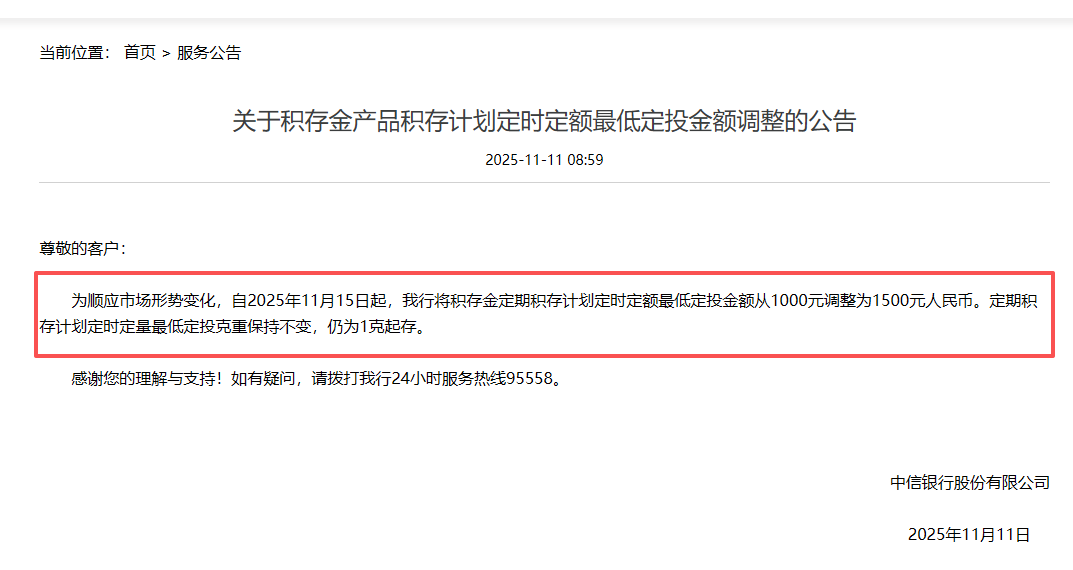
Core Viewpoint - The recent adjustments in gold accumulation business thresholds by banks are likely a response to the rising international gold prices, aimed at mitigating market risks [4][6][11]. Group 1: Bank Adjustments - On November 11, China CITIC Bank announced an increase in the minimum investment amount for its gold accumulation plan from 1000 RMB to 1500 RMB, effective from November 15, 2025, while maintaining the minimum weight requirement at 1 gram [1][7]. - China Construction Bank also revised its gold accumulation business rules, raising the daily accumulation starting amount from 1000 RMB to 1200 RMB, effective from November 15, 2025 [2][3][8]. - This marks the second adjustment by China Construction Bank in 2023, having previously raised the starting amount from 800 RMB to 1000 RMB in April [9]. Group 2: Market Context - The adjustments coincide with a significant rise in international gold prices, with spot gold reaching approximately 4140 USD per ounce as of November 11 [6][11]. - Industry experts suggest that these changes are intended to control potential risks associated with increased trading activity in the gold market, particularly to prevent irrational trading behaviors among small investors [4][9]. Group 3: Historical Trends - The adjustments reflect a broader trend in the banking sector, with multiple banks raising their gold accumulation thresholds throughout 2023, indicating a shift towards higher entry points for investors [11][12]. - Since March 2023, several banks, including China Construction Bank and others, have progressively increased their minimum investment amounts, with some banks raising thresholds from as low as 600 RMB to over 1000 RMB [11][12].




黄金又爆了!零售金价已超1300元/克,银行再度上调积存金起购门槛
Sou Hu Cai Jing· 2025-11-11 10:13
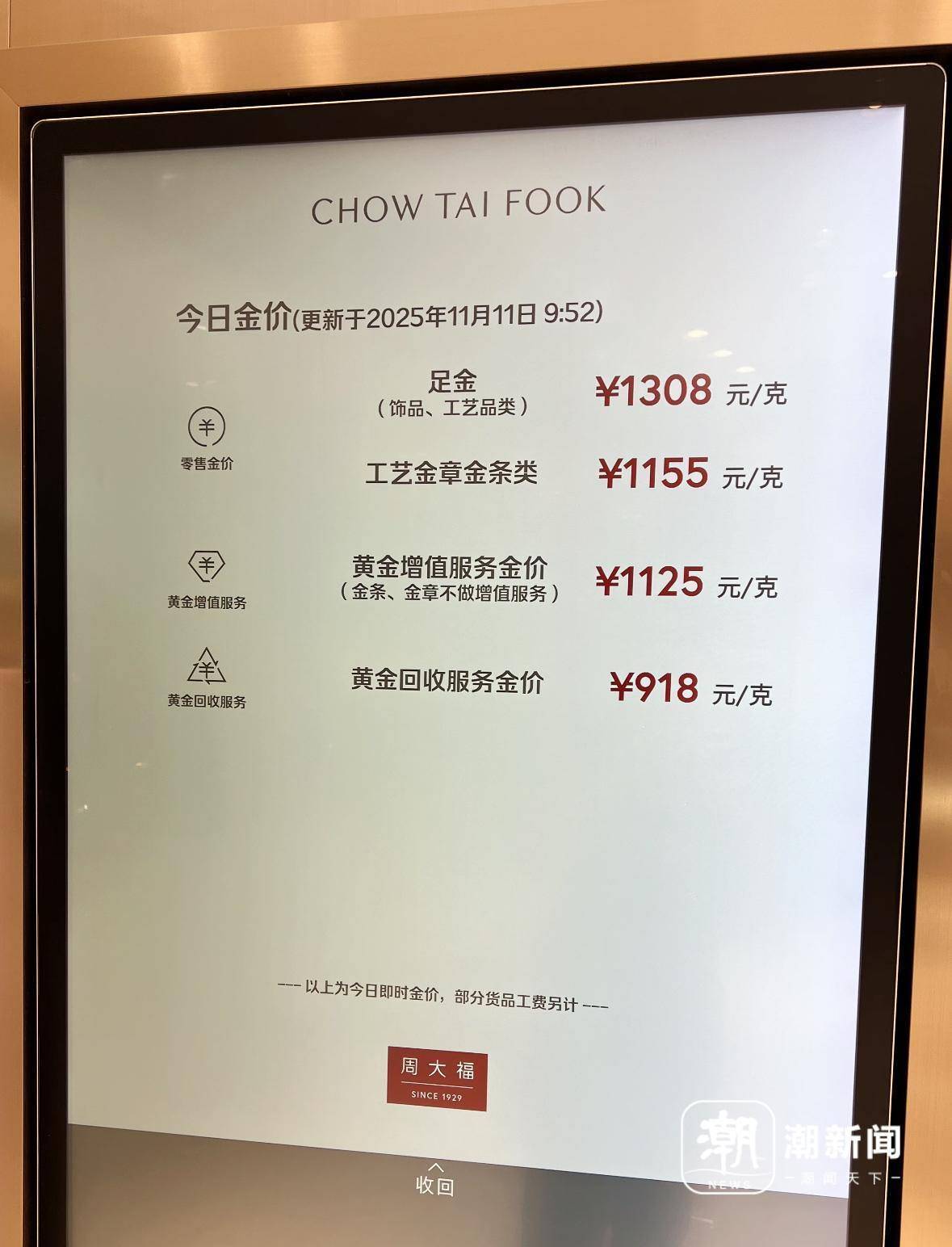
Core Viewpoint - The recent surge in gold prices, surpassing $4100 per ounce, has led to increased retail prices and higher minimum purchase thresholds for gold accumulation plans at various banks, indicating a shift in market dynamics and investor sentiment [1][3][5]. Price Movements - On November 10, the spot gold price rose by 2.88%, reaching over $4100 per ounce for the first time since October 27, while silver prices increased by 4.48%, exceeding $50 per ounce [1]. - Retail gold prices have seen significant increases, with brands like Chow Tai Fook and Chao Hong Ji reporting prices of 1308 RMB per gram [2]. Bank Policy Changes - Following the rise in international gold prices, several banks have adjusted their minimum purchase thresholds for gold accumulation plans. For instance, China CITIC Bank announced an increase from 1000 RMB to 1500 RMB starting November 15, 2025 [3]. - China Construction Bank also revised its minimum investment amount for gold accumulation plans from 1000 RMB to 1200 RMB, effective the same date [5]. - Other banks, including Industrial and Commercial Bank of China and China Merchants Bank, have similarly raised their thresholds multiple times this year, reflecting a trend in the banking sector [5]. Investment Strategy Insights - Analysts suggest that the recent price surge is driven by a shift in market logic rather than just geopolitical tensions, with expectations of a potential interest rate cut by the Federal Reserve in December [6][7]. - Investors are advised to avoid chasing prices during rapid increases and instead wait for pullbacks to support levels for better entry points, particularly in the context of gold's price fluctuations [6][7]. - The long-term outlook remains positive due to systemic increases in gold reserves by global central banks and anticipated monetary easing, although short-term volatility is expected as the market adjusts [7].
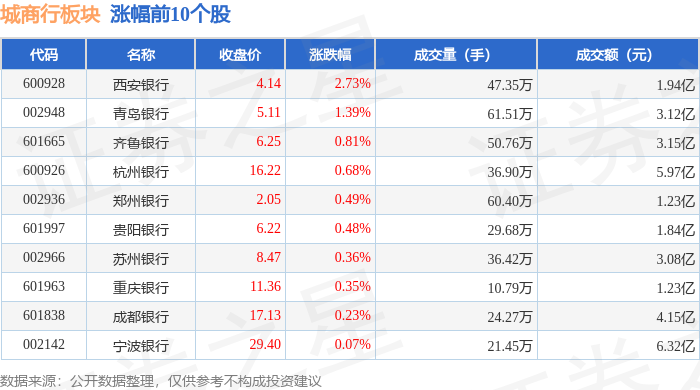
城商行板块11月11日跌0%,上海银行领跌,主力资金净流入2.41亿元
Zheng Xing Xing Ye Ri Bao· 2025-11-11 08:46
Market Overview - The city commercial bank sector experienced a slight decline of 0.0% on November 11, with Shanghai Bank leading the drop [1] - The Shanghai Composite Index closed at 4002.76, down 0.39%, while the Shenzhen Component Index closed at 13289.0, down 1.03% [1] Individual Bank Performance - Xi'an Bank saw the highest increase in share price, closing at 4.14 with a rise of 2.73% [1] - Qingdao Bank and Qilu Bank also reported positive performance, with increases of 1.39% and 0.81% respectively [1] - Shanghai Bank, on the other hand, closed at 10.13, down 0.98%, indicating a significant decline in its stock price [2] Trading Volume and Capital Flow - The city commercial bank sector recorded a net inflow of 241 million yuan from institutional investors, while retail investors saw a net outflow of 290 million yuan [2] - Jiangsu Bank attracted the highest net inflow from institutional investors at 113 million yuan, representing 11.75% of its trading volume [3] - In contrast, Zhengzhou Bank experienced a net outflow of 421,280 yuan from institutional investors, indicating a negative sentiment towards its stock [3]




多家银行宣布,上调积存金起购门槛
财联社· 2025-11-11 08:19
Core Viewpoint - The recent adjustments in gold accumulation business thresholds by banks are a response to the rising international gold prices, aimed at mitigating potential market risks [6][8]. Group 1: Bank Adjustments - On November 11, China CITIC Bank announced an increase in the minimum investment amount for its gold accumulation plan from 1000 RMB to 1500 RMB, effective from November 15, 2025 [1][8]. - China Construction Bank also revised its gold accumulation business rules, raising the daily accumulation starting amount from 1000 RMB to 1200 RMB, effective from November 15, 2025 [3][4]. - This marks the second adjustment by China Construction Bank within the year, having previously raised the minimum amount from 800 RMB to 1000 RMB in April 2023 [10]. Group 2: Market Context - The adjustments coincide with a significant rise in international gold prices, with spot gold reaching approximately 4140 USD per ounce as of November 11 [7][8]. - Industry experts suggest that these changes are intended to control potential risks associated with increased trading activity in the gold market, particularly to prevent irrational trading behaviors among smaller investors [10][11]. Group 3: Historical Trends - Throughout 2023, banks have progressively raised the thresholds for gold accumulation, with notable increases from 600 RMB to 650 RMB or 700 RMB earlier in the year, and further adjustments in the latter half of the year [11][12]. - The current adjustments have set new historical highs for the minimum investment amounts in gold accumulation plans across the banking sector [13].

宁波银行(002142) - 2025年11月11日投资者关系活动记录表
2025-11-11 08:14
Group 1: Capital Measurement and Regulatory Compliance - The bank is actively researching and following the requirements for implementing advanced capital measurement methods as per the regulations issued by the National Financial Regulatory Administration in November 2024 [2] - The bank is closely monitoring regulatory dynamics and the application progress of peers regarding advanced capital measurement [2] Group 2: Financing and Internal Growth - The company emphasizes the long-term relationship between dividends and internal capital growth, aiming to create greater value through internal capital [2] - The bank is committed to enhancing performance and maintaining steady growth of internal capital to provide higher returns to shareholders [2] Group 3: Loan Growth and Economic Support - The bank has focused on supporting key sectors such as private small and micro enterprises, manufacturing, import-export businesses, and consumer spending, leading to steady loan growth [2] - Future loan growth is expected to be sustained by ongoing policy benefits aimed at expanding domestic demand and promoting consumption [2] Group 4: Investor Communication and Disclosure - During the investor communication, the bank ensured compliance with disclosure regulations, confirming that no undisclosed significant information was leaked [2]
最高至1500元,国际金价重回4100美元后,多家银行再上调积存金起购门槛
Feng Huang Wang· 2025-11-11 07:20
Core Viewpoint - The recent increase in international gold prices has prompted banks to raise the minimum investment thresholds for gold accumulation products, indicating a strategy to mitigate market risks associated with gold investments [2][4][8]. Group 1: Bank Adjustments - China CITIC Bank announced an increase in the minimum investment amount for its gold accumulation plan from 1,000 RMB to 1,500 RMB, effective November 15, 2025 [1][5]. - China Construction Bank revised its gold accumulation product rules, raising the minimum daily accumulation amount from 1,000 RMB to 1,200 RMB, also effective November 15, 2025 [3][6]. - This marks the second adjustment by China Construction Bank in 2023, having previously raised the minimum amount from 800 RMB to 1,000 RMB in April [7]. Group 2: Market Context - As of November 11, 2023, spot gold prices surged nearly 3% to reach approximately 4,120 USD per ounce, with further increases noted [4][8]. - The adjustments in minimum investment thresholds by banks coincide with a notable rise in gold market activity, suggesting a proactive approach to manage potential risks from increased volatility [2][6][8]. Group 3: Industry Trends - The trend of raising minimum investment thresholds for gold accumulation products has been observed across multiple banks, with many increasing their thresholds from 600 RMB to 650 RMB or 700 RMB earlier in the year [9][10]. - The cumulative effect of these adjustments has led to record-high minimum purchase amounts for gold accumulation products in the industry [11].
中信建投:资金面和市场因素共同引导 稳健+高股息属性银行更受青睐
智通财经网· 2025-11-11 03:48
Core Viewpoint - The macroeconomic environment in 2025 is expected to continue a weak recovery, with no significant improvement in the banking sector's fundamentals, leading to a sustained focus on high dividend strategies [1][2] Economic Environment - The A-share market has shown a significant divergence between "dividend" and "technology growth" styles, creating a "seesaw pattern" [2] - In uncertain external conditions, funds are flowing into stable cash flow and high-dividend sectors for immediate certainty, while risk appetite recovery leads to a shift towards technology growth for future high returns [2] Banking Sector Fundamentals - The banking sector's fundamentals are expected to continue bottoming out, with credit growth maintaining around 7%-8% and a gradual slowdown in the trend of deposit regularization [2] - Cost optimization on the liability side is expected to mitigate the impact of policy interest rate cuts, leading to a further narrowing of interest margin declines [2] - Non-interest income is anticipated to improve due to a recovering capital market, although other non-interest income may be dragged down by low bond market volatility and high baselines [2] - Asset quality is stable, with non-performing loan ratios remaining steady, but retail risks are still emerging, particularly concerning real estate-related risks [2] Dividend Strategy - Several banks have successfully implemented mid-term dividends, showcasing stability and sustainability in their dividend policies [2] - The focus remains on high dividend yield strategies, with specific recommendations for state-owned banks and high-yield private banks such as China Merchants Bank and regional banks like Hangzhou Bank and Jiangsu Bank [3] - There is an emphasis on banks with limited refinancing dilution risks and those that can quickly recover through profit releases, as well as those with strong cyclical attributes [3]

台州银行业绩“换挡”!“小微金融标杆”如何破解路径依赖?
Nan Fang Du Shi Bao· 2025-11-11 03:38
Core Viewpoint - Taizhou Bank, known for its microfinance services, has reported a significant decline in both revenue and net profit for the first three quarters of 2025, marking the first negative growth in nearly a decade [2][3]. Financial Performance - For the first three quarters of 2025, Taizhou Bank achieved revenue of 8.432 billion yuan, a year-on-year decrease of 11.44% [3]. - Net profit fell by 22.59% to 2.904 billion yuan, continuing a downward trend from the previous year [2][3]. - The bank's revenue and net profit have both declined for the first time in nearly ten years [3]. Loan Distribution - As of the end of 2024, Taizhou Bank's total loans and advances amounted to 238.96 billion yuan, with 78.53% concentrated in five key industries: manufacturing, wholesale and retail, construction, agriculture, and leasing and business services [3][4]. - The breakdown of loan balances by industry shows that manufacturing accounts for 30.93%, wholesale and retail for 28.92%, and construction for 10.69% [4]. Competitive Landscape - Taizhou Bank faces increasing competition from larger banks that are expanding their services to micro and small enterprises, often at lower interest rates [6]. - The average interest rate for new microenterprise loans from major state-owned banks was reported to be just above 3%, significantly lower than Taizhou Bank's net interest margin of 2.83% [6]. Operational Challenges - The bank's reliance on a large workforce (over 12,000 employees) has led to high operational costs, with business and management expenses reaching 3.508 billion yuan, accounting for 41.61% of revenue [8]. - In response to performance pressures, the total compensation for the bank's directors and senior management decreased by nearly 30% in 2024 [7][8]. Strategic Shifts - The bank's traditional "human resource-intensive" model is being challenged by advancements in digital technology, which allow for more efficient customer acquisition and risk management [9][10]. - Other regional banks, such as Ningbo Bank and Hangzhou Bank, are successfully leveraging technology to enhance their competitive edge in the microfinance sector [10]. Future Outlook - The bank's transition path is seen as a potential industry benchmark, emphasizing the need for regional microfinance institutions to innovate and adapt to changing market conditions [11].

2025年第三季度中国手机银行APP流量监测报告
艾瑞咨询· 2025-11-11 00:05
Core Viewpoint - The mobile banking app has become a crucial platform for commercial banks to expand service boundaries, optimize user experience, and enhance market competitiveness. The industry is shifting from user expansion to refined operations and value extraction from existing users as user engagement declines and traffic stabilizes [1][2][3]. Industry Development - The banking industry is facing profound changes in the operating environment, with narrowing interest margins and intensified competition. The integration of AI technology and data value is becoming essential for banks to build core competitiveness [2][3]. - Since the launch of the first banking app in 2009, the industry has transitioned to online operations, now entering a phase that requires refined management. As of 2023, the overall traffic of mobile banking apps in China fluctuates between 650 million and 720 million, with daily effective usage time dropping from 4.93 minutes to 2.95 minutes [2][3]. Operational Strategies - Banks need to adopt refined operational models to tap into existing user value. A three-layer strategy is proposed: 1. **Foundation Layer**: Build a comprehensive user segmentation and profiling system using big data and AI technologies for optimal resource allocation [3]. 2. **Key Layer**: Deepen the integration of high-frequency life scenarios with financial functions to create a "finance + scenario" ecosystem [3]. 3. **Goal Layer**: Establish emotional connections with users through immersive interactions, enhancing user retention and value accumulation [3]. Mobile Banking App Rankings - In Q3 2025, the top 50 mobile banking apps in China were ranked based on average monthly active users (MAU). The Agricultural Bank of China leads with over 250 million MAU, followed by the Industrial and Commercial Bank of China and the China Construction Bank [5][7]. - State-owned banks showed positive growth, with increases ranging from 1.6% to 6.1%. Among the 10 listed joint-stock banks, 8 experienced growth, with Everbright Bank seeing an increase of over 10% [5][7]. Performance of State-owned Banks - The six major state-owned banks maintained strong performance in Q3 2025, with the Agricultural Bank of China leading the MAU rankings. The Industrial and Commercial Bank of China and the China Construction Bank also performed well, with significant growth rates [7][9]. Performance of Joint-stock Banks - Joint-stock banks performed well in Q3 2025, with China Merchants Bank leading with over 70 million MAU. The overall MAU for joint-stock banks increased, with Everbright Bank showing an 11% growth [13][14][16]. Performance of City Commercial Banks - City commercial banks had a notable performance, with 17 banks entering the top 50 list. Ningbo Bank led with 364.4 million MAU, achieving a 43.9% growth rate [19][21]. Performance of Rural Commercial Banks - In Q3 2025, 17 rural commercial banks and rural credit cooperatives made it to the top 50 list, with Fujian Rural Credit leading at 781.6 million MAU. Most banks showed positive growth, with Sichuan Rural Credit and Fengshou Interconnection exceeding 10% growth [24][25]. Future Outlook - The future development of banking apps will heavily rely on data and AI technologies, with AI digital financial advisors expected to become core service providers. The transition from standardized to personalized services will enhance user experience and accessibility [27][28].





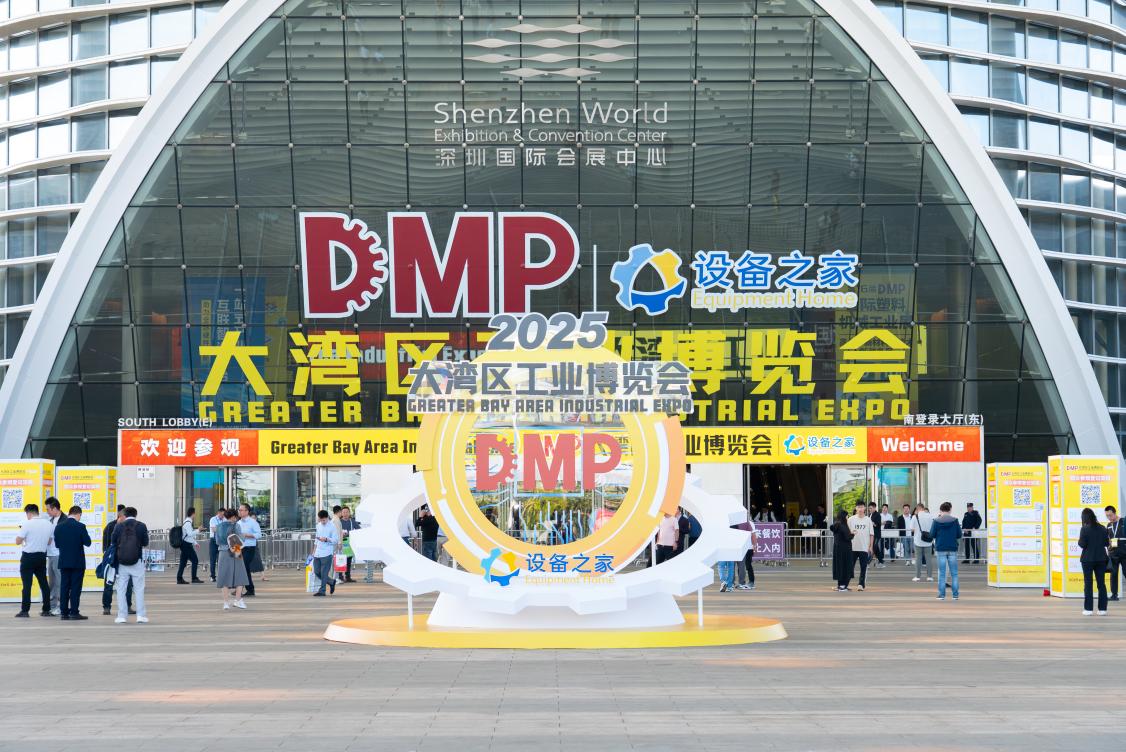
设备之家携手DMP工博会 共促装备产业生态融合与国产机床品牌崛起
Zhong Guo Jing Ji Wang· 2025-11-10 09:34
Core Insights - The 26th DMP Greater Bay Area Industrial Expo was held in Shenzhen from November 5 to 8, 2025, featuring a collaboration between Yongying Financial Leasing Co., Ltd. and the expo to showcase a "National Trend Brand Machine Tool Exhibition" [1][3] - The exhibition highlighted advancements in domestic high-end equipment, including seven-axis five-linkage machine tools and high-rigidity turning-milling composite centers, emphasizing China's self-sufficiency in precision processing and intelligent control [3] Group 1: Exhibition Highlights - The "National Trend Brand Machine Tool Exhibition" was co-planned by Yongying Financial Leasing and the expo organizers, showcasing advanced domestic equipment and self-developed CNC systems [3] - The exhibition provided a platform for domestic machine tool companies to display their brands and facilitated direct understanding of intelligent advancements in domestic machine tools for attendees and buyers [3] Group 2: Innovative Service Models - The "Equipment Without Boundaries: Ecological Interconnection" theme area covered 600 square meters, addressing core pain points in equipment procurement and operation, offering integrated solutions for buying, leasing, and vendor empowerment [5] - Attendees were offered a "cash gift package" worth 10,000 yuan for equipment purchases during the expo, applicable to over 500 mainstream brands, and an additional equipment property insurance coverage of up to 3 million yuan [5] Group 3: Online Engagement - For clients unable to attend in person, an "online exhibition hall" was launched, integrating brand displays, live interviews, procurement connections, and financing leasing services, operational until the end of the year [7] Group 4: Industry Networking - Yongying Financial Leasing hosted a new media supply-demand matchmaking event on November 5, attracting over 200 representatives from equipment manufacturers and new media influencers, promoting collaboration and resource integration in the manufacturing sector [8] Group 5: Strategic Collaboration - This collaboration marks the first deep integration of the Equipment Home platform with a professional exhibition, enhancing market exposure for domestic equipment and providing comprehensive support for the intelligent upgrade of the manufacturing industry [10] Group 6: Company Overview - Yongying Financial Leasing, established in May 2015 and wholly owned by Ningbo Bank, has a registered capital of 7 billion yuan and has become one of the top ten financial leasing companies in the industry, with leasing assets nearing 150 billion yuan [11] - The "Equipment Home" platform, launched in April last year, integrates industry resources covering the entire lifecycle of equipment transactions, attracting nearly 6,000 partners and facilitating over 22,000 transactions [12]