平安银行

Search documents
合计被罚超2亿元!5家银行领千万级罚单
Zhong Guo Zheng Quan Bao - Zhong Zheng Wang· 2025-10-31 15:14
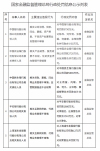
Core Points - Five banks in China, including Bank of China, Minsheng Bank, Agricultural Bank of China, Ping An Bank, and Shanghai Pudong Development Bank, were fined a total of 215.25 million yuan for various violations [1][4] - The violations involved multiple business areas such as non-performing asset disposal, product sales, loan management, and regulatory data reporting [1][4] Summary by Bank - **Bank of China**: Fined 97.9 million yuan for issues related to corporate governance, loans, interbank transactions, bills, asset quality, and non-performing asset disposal. Five responsible personnel received warnings and fines totaling 300,000 yuan [2][4] - **Agricultural Bank of China**: Fined 27.2 million yuan for non-compliance in product sales, service charges, and imprudent management of credit fund flows. One responsible personnel, Zhang Qing, received a warning and a fine of 100,000 yuan [4] - **Minsheng Bank**: Fined 58.65 million yuan for imprudent management of loans, bills, interbank transactions, and non-compliance in regulatory data reporting. Six responsible personnel received warnings and fines totaling 360,000 yuan [3][4] - **Ping An Bank**: Fined 18.8 million yuan for imprudent management of internet loans and agency sales. Two responsible personnel received warnings and fines totaling 100,000 yuan, and one received a warning [4] - **Shanghai Pudong Development Bank**: Fined 12.7 million yuan for imprudent management of internet loans and agency sales. One responsible personnel, He Rong, received a warning and a fine of 70,000 yuan [4] Regulatory Context - The China Banking and Insurance Regulatory Commission emphasized its focus on key issues affecting financial stability, key individuals causing major financial risks, and key behaviors disrupting market order during the "14th Five-Year Plan" period [4]

涉贷款、票据等业务违规 5家银行领2.15亿元罚单
Mei Ri Jing Ji Xin Wen· 2025-10-31 15:02
Summary of Key Points Core Viewpoint - Five major Chinese banks, including Bank of China, Agricultural Bank of China, Minsheng Bank, Ping An Bank, and Shanghai Pudong Development Bank, received fines totaling over 215 million yuan due to imprudent business management practices across various sectors such as loans, interbank transactions, bills, and sales [1][2]. Group 1: Penalties and Amounts - Bank of China was fined 97.9 million yuan for issues related to corporate governance, loans, interbank transactions, bills, asset quality, and non-performing asset disposal [1]. - Agricultural Bank of China faced a penalty of 27.2 million yuan for non-compliance in product sales, service charges, and imprudent management of credit fund flows [1]. - Minsheng Bank was fined 58.65 million yuan for multiple violations including imprudent management of loans, bills, interbank transactions, and non-compliance in regulatory data reporting [1]. - Ping An Bank received a fine of 18.8 million yuan for imprudent management in internet loans and agency sales [2]. - Shanghai Pudong Development Bank was fined 12.7 million yuan for similar issues in internet loan management [2]. Group 2: Responsible Personnel - In total, five responsible personnel from Bank of China were warned and fined a combined 300,000 yuan [1]. - One responsible personnel from Agricultural Bank of China was warned and fined 100,000 yuan [1]. - Six personnel from Minsheng Bank received warnings and were fined a total of 360,000 yuan [1]. - Three personnel from Ping An Bank were warned, with two receiving fines totaling 100,000 yuan [2]. - One personnel from Shanghai Pudong Development Bank was warned and fined 70,000 yuan [2].
银行业绩下行周期接近尾声 资产质量改善趋势确立
Jing Ji Guan Cha Wang· 2025-10-31 11:50
Core Viewpoint - The apparent stability of bank non-performing loan (NPL) ratios conceals deeper structural changes, indicating that the era of "soft landing" achieved through provisioning adjustments and risk rotation is nearing its end [2][8] Group 1: Banking Performance - China Construction Bank reported a 1.44% year-on-year increase in operating income to 560.281 billion yuan for the first three quarters of 2025, with net profit rising by 0.52% to 258.446 billion yuan [3] - The bank's asset quality remains robust, with a non-performing loan ratio of 1.32%, down 0.02 percentage points from the end of the previous year, and a provisioning coverage ratio of 235.05%, up 1.45 percentage points [3] - Other major banks, such as China Bank and Postal Savings Bank, also show varying levels of asset quality, with China Bank's NPL ratio at 1.24% and Postal Savings Bank's NPL ratio at 0.94% [4] Group 2: Risk Assessment - Some joint-stock banks are experiencing thinner provisioning buffers, with Everbright Bank's NPL ratio at 1.26% and a provisioning coverage ratio of 168.92%, nearing regulatory warning lines [5] - In contrast, certain regional banks demonstrate stronger risk resilience, such as Chengdu Bank with an NPL ratio of only 0.68% and a provisioning coverage ratio of 433.08% [6] - The focus of risk has shifted from corporate to retail, with banks like China Merchants Bank reporting an increase in attention loans, indicating rising concerns in personal lending sectors [7] Group 3: Future Outlook - The banking industry is expected to face a genuine stress test as excess provisioning space narrows and retail risks continue to emerge, marking a transition from scale expansion to quality prioritization [2][8] - The ability to balance risk clearance and sustainable profits will determine the future restructuring of the industry [8]






“息差保卫战”出战绩,8家上市银行息差环比二季度扩大
Hua Xia Shi Bao· 2025-10-31 11:15
Core Viewpoint - The overall net interest margin (NIM) of A-share listed banks shows signs of stabilization and recovery, reflecting positive trends in the banking sector's performance in Q3 [2][3][5]. Group 1: Net Interest Margin Trends - Among the 26 listed banks that disclosed NIM data, 12 banks reported stable or improved NIM, indicating a significant expansion in the stabilization [3][5]. - Notably, smaller banks such as Guiyang Bank and Minsheng Bank showed the most significant improvements, with Guiyang Bank's NIM increasing by 0.04 percentage points [3][4]. - The number of banks with stable or rising NIM in Q3 is markedly higher compared to the previous two quarters, suggesting a positive shift in the banking sector [3][5]. Group 2: Factors Influencing NIM - The stabilization of NIM is attributed to banks' proactive management of liabilities and the delayed effects of monetary policy [2][4]. - Banks have optimized deposit structures and managed high-interest deposits effectively, alleviating funding cost pressures [4][5]. - The "policy bottom" established by previous monetary and fiscal measures has reinforced the stability of the financial system [4]. Group 3: Profitability and Asset Quality - In Q3, 35 out of 42 listed banks reported year-on-year net profit growth, with 16 banks achieving growth rates exceeding 5% [7]. - The fastest-growing banks in terms of net profit include Qilu Bank and Qingdao Bank, with growth rates of 16.14% and 15.86%, respectively [7]. - Asset quality has also improved, with 32 banks reporting stable or reduced non-performing loan (NPL) ratios compared to the beginning of the year [7][8].

债市“收官战”,无虑银行兑现浮盈
Changjiang Securities· 2025-10-31 11:12
1. Report's Industry Investment Rating No information about the industry investment rating is provided in the report. 2. Core Viewpoints of the Report - The report analyzes the self - investment performance of banks in 2025 based on the semi - annual report and forecasts their behavior in the fourth quarter. It concludes that bond allocation is expected to support bank expansion, and although there is still room for banks to realize floating profits, the impact on the bond market is expected to be relatively mild [4][11][12]. 3. Summary According to the Directory 3.1 From the 2025 Semi - annual Report: Bank Self - investment Performance 3.1.1 Financial Market Returns: Increased Contribution of Realized Floating Profits - The revenue contribution of banks' self - investment business fluctuates upward. Since 2023, the proportion of investment income and fair - value changes in revenue has increased. In the first half of 2025, banks sold old bonds to realize floating profits to cope with the rising bond - market yields [20][23][26]. 3.1.2 Asset Allocation: Financial Investment Drives Balance - sheet Expansion - Since 2024, the year - on - year growth rate of bank financial investment has been rising, and its proportion in total assets has also increased. By the end of June 2025, the year - on - year growth rate of listed banks' financial investment was 14.9%. The OCI account's proportion has been increasing, and large state - owned banks have continuously increased their allocation of government bonds [31]. - In terms of duration, the overall duration of bank financial investment has been extended, but the space for continuous extension may be limited. Structurally, state - owned banks' AC accounts maintain a high duration, and joint - stock banks' OCI accounts have a more obvious duration - extension action [57][59][74]. 3.1.3 Liability Side: Decreased Liability Cost Rate and Declined Inter - bank Certificate of Deposit Balance in Q3 - In the first half of 2025, the weighted average interest - bearing liability cost rate of banks decreased by about 29BP compared with 2024, mainly due to the concentrated maturity and repricing of deposits. The deposit cost rate decreased by 25BP [86]. - Since the second quarter, the central bank's liquidity injection has been abundant, and the balance of inter - bank certificates of deposit has declined. Large state - owned banks have reduced their reliance on inter - bank certificates of deposit, while small and medium - sized banks have shortened the issuance term of inter - bank certificates of deposit to control costs [101][103][115]. 3.2 Outlook for Banks' Behavior in Q4 2025 3.2.1 Asset Side: Bond Allocation Expected to Continue Supporting Balance - sheet Expansion - In the fourth quarter, credit growth is expected to remain weak, and financial investment will still be the main driving force for bank balance - sheet expansion. The decline in liability cost rate has opened up space for bank bond allocation, and the current high spread between 10 - year treasury bonds and 1 - year inter - bank certificates of deposit has increased banks' willingness to allocate bonds [118][121][122]. - Large state - owned banks' pressure to undertake government bond issuance is expected to weaken, and small and medium - sized banks will continue to tilt available funds towards bond investment [128][131]. 3.2.2 Liability Side: Focus on the Issuance Scale of Banks' Inter - bank Certificates of Deposit - Banks may face "deposit migration" pressure in the fourth quarter, and some deposits will mature. Banks may issue inter - bank certificates of deposit preventively when liquidity is relatively loose. The issuance term of large state - owned banks is expected to be longer, while that of small and medium - sized banks is expected to be medium - short [136][138]. 3.2.3 Realizing Floating Profits: Still Some Space, but Limited Impact on the Bond Market - Banks need to smooth their performance in the fourth quarter, and there is still pressure to sell old bonds, but the impact on the bond market is expected to be relatively mild. There are limitations in selling old bonds, including accounting classification rationality, reinvestment pressure, and performance base pressure for 2026 [142][143]. - There is still some demand for banks to realize floating profits in Q4 2025, but the amount of floating profits that can be realized is limited. AC accounts have some selling constraints, and excessive realization of floating profits in OCI accounts may increase the performance base pressure for 2026 [144][151].
上市银行三季度财富管理大盘点,中收最高增两成达206.7亿,呈现私行、代销驱动等四大特征
Xin Lang Cai Jing· 2025-10-31 11:09
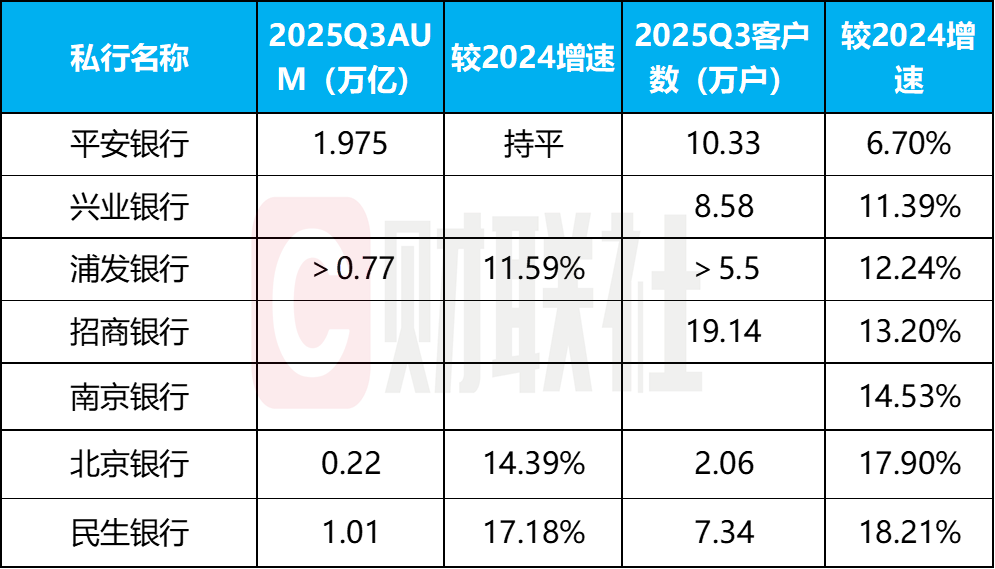
Core Insights - The wealth management business of banks has shown significant growth in Q3 2025, characterized by "private banking leadership, agency sales driving, digital empowerment, and cross-border expansion" [1][2][4] - Most banks are building retail financial service systems driven by wealth management, with rapid increases in business scale, customer numbers, and fee income [2][3] Group 1: Wealth Management Performance - Wealth management client numbers have steadily increased, with Nanjing Bank's wealth clients growing by 16.31% compared to the end of the previous year [2] - Citic Bank achieved its highest annual growth in Assets Under Management (AUM) in nearly three years [1] - China Merchants Bank's wealth management fee and commission income reached 20.67 billion yuan, a year-on-year increase of 18.76% [3] Group 2: Private Banking as a Growth Engine - Private banking clients have become a core growth engine, with most banks reporting over 10% growth in private banking client numbers since the beginning of the year [4][5] - Specific banks like Shanghai Pudong Development Bank and Beijing Bank have also seen over 10% growth in private banking AUM [5][6] Group 3: Agency Sales Driving Growth - Agency sales, including insurance, funds, and wealth management products, are the main growth drivers for banks [8] - Ping An Bank's agency insurance income grew by 48.7%, while China Merchants Bank's agency fund income increased by 38.76% [8] Group 4: Digital and Professional Services Integration - Banks are enhancing customer engagement through digital and professional services, with Shanghai Pudong Development Bank focusing on wealth management needs and launching a global wealth management platform [9] - Beijing Bank is leveraging its "Retail Crystal Ball System" to drive value creation through data-driven insights [9] Group 5: Cross-Border Wealth Management Demand - There is a growing demand for cross-border wealth management, with Standard Chartered Bank reporting a 30% increase in wealth management business due to strong market performance and cross-border demand [10][11] - The bank's affluent client base and AUM have seen significant growth, indicating a robust long-term outlook for wealth management revenue [11]
恒鼎实业(01393) - 有关解决核数师出具不发表意见所实施的行动计划之季度更新
2025-10-31 10:58
香港交易及結算所有限公司及香港聯合交易所有限公司對本公告的內容概不負責,對其 準確性或完整性亦不發表任何聲明,並明確表示,概不對因本公告全部或任何部分內容 而產生或因倚賴該等內容而引致的任何損失承擔任何責任。 (i) 二零二四年,民生銀行及平安銀行(合計持有本公司約70%銀行借款)將其債權轉讓 給一家境內金融機構。本公司已向該境內金融機構提交經修訂的還款建議及主要商 業條款,豁免償還部份本金及全數應付利息,並將餘下本金展期至一年以上及五年 Hidili Industry International Development Limited 01393 有關解決核數師出具不發表意見 所實施的行動計劃之季度更新 本公告乃由恒鼎實業國際發展有限公司(「本公司」)根據香港聯合交易所有限公司證券上 市規則(「上市規則」)第13.09(1)條以及香港法例第571章證券及期貨條例第XIVA部之內幕 消息條文(定義見上市規則)而作出。 茲提述本公司於二零二五年四月三十日發佈截至二零二四年十二月三十一日止年度的年 報(「年報」)及本公司日期為二零二五年七月三十一日的公告(「七月公告」)。除文義另有 所指外,本公告所用詞匯與年報及 ...
中行农行收巨额罚单
Bei Jing Ri Bao Ke Hu Duan· 2025-10-31 10:12
Group 1 - The National Financial Supervision Administration has imposed significant fines on several major banks in China for various regulatory violations [1] - China Bank was fined 97.9 million yuan for issues related to corporate governance, loan management, and asset quality [1] - Agricultural Bank of China received a fine of 27.2 million yuan for non-compliance in product sales and credit fund management [1] Group 2 - China Minsheng Bank was fined 58.65 million yuan for imprudent management of loans and regulatory data reporting [1] - Ping An Bank faced a fine of 18.8 million yuan due to issues in internet loans and related business management [1] - Shanghai Pudong Development Bank was fined 12.7 million yuan for similar violations in internet loan management [1]
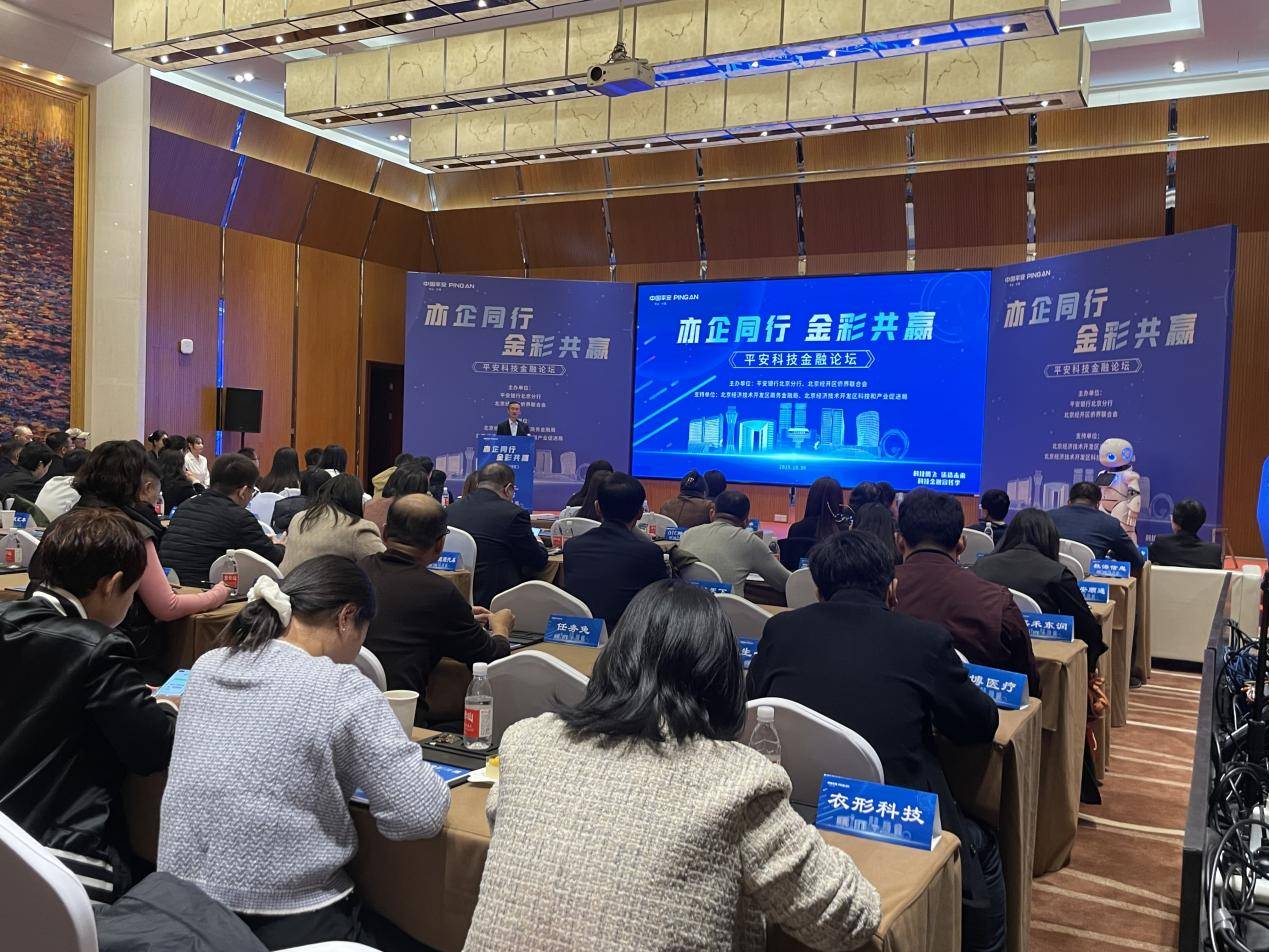
平安银行北京分行在经开区成功举办“亦企同行·金彩共赢”平安科技金融论坛
Cai Fu Zai Xian· 2025-10-31 09:15
Core Insights - The forum "Yiqi Tongxing · Jincai Gongying" organized by Ping An Bank's Beijing branch focused on the integration of technology and finance, attracting over 90 quality tech innovation enterprises for in-depth discussions and exchanges [1][3]. Group 1: Event Overview - The event was part of Ping An Bank's "Technology Soaring, Building the Future" promotional season, supported by various governmental bodies [1]. - The forum emphasized the importance of finance as a core support for technological innovation and aimed to enhance the collaborative environment between government, enterprises, and banks [3]. Group 2: Strategic Initiatives - Ping An Bank's Beijing branch outlined its strategic layout and innovative practices in the technology finance sector over the past year, aiming to provide comprehensive financial solutions for enterprises at all stages of development [5]. - The launch of the "Technology Financial Service Package" for the Beijing region was a key highlight, designed to offer precise financial support to local tech innovation enterprises [9]. Group 3: Policy and Financial Support - Experts from the Economic and Technological Development Zone provided insights on policies related to foreign investment, financial support systems, and the "Twenty Articles on Industrial Finance" and "Twenty Articles on Technological Innovation" [11]. - Ping An Bank showcased its technology finance support system and core products like "Tech Innovation Loans" and "Specialized and New Loans" to meet diverse enterprise needs [11]. Group 4: Future Directions - The forum concluded with presentations from industry leaders showcasing advancements in wireless communication and innovative antibody drug development, highlighting the potential of tech innovation [11]. - Ping An Bank plans to continuously upgrade its technology finance service system to align with enterprise needs and contribute to high-quality regional economic development [11].

股份制银行板块10月31日跌0.73%,光大银行领跌,主力资金净流出3.81亿元
Zheng Xing Xing Ye Ri Bao· 2025-10-31 08:42
Market Overview - On October 31, the share price of the banking sector fell by 0.73% compared to the previous trading day, with Everbright Bank leading the decline [1] - The Shanghai Composite Index closed at 3954.79, down 0.81%, while the Shenzhen Component Index closed at 13378.21, down 1.14% [1] Individual Bank Performance - Industrial Bank (601166) saw a closing price of 20.23, with an increase of 1.00% and a trading volume of 887,900 shares, totaling 1.793 billion yuan [1] - Huaxia Bank (600015) remained unchanged at 6.81, with a trading volume of 670,600 shares, totaling 45.6 million yuan [1] - Ping An Bank (000001) closed at 11.32, down 0.53%, with a trading volume of 970,200 shares, totaling 1.099 billion yuan [1] - China Merchants Bank (600036) closed at 40.89, down 0.75%, with a trading volume of 702,600 shares, totaling 2.882 billion yuan [1] - Zheshang Bank (601916) closed at 2.99, down 0.99%, with a trading volume of 1.6683 million shares, totaling 501 million yuan [1] - Minsheng Bank (600016) closed at 3.91, down 1.01%, with a trading volume of 4.6781 million shares, totaling 1.834 billion yuan [1] - CITIC Bank (601998) closed at 7.74, down 1.28%, with a trading volume of 915,000 shares, totaling 705 million yuan [1] - Shanghai Pudong Development Bank (600000) closed at 11.49, down 1.29%, with a trading volume of 1.4353 million shares, totaling 1.658 billion yuan [1] - Everbright Bank (601818) closed at 3.34, down 3.19%, with a trading volume of 5.9154 million shares, totaling 1.987 billion yuan [1] Capital Flow Analysis - The banking sector experienced a net outflow of 381 million yuan from main funds, while speculative funds saw a net inflow of 433 million yuan, and retail investors had a net outflow of 51.53 million yuan [1] - Specific capital flows for individual banks indicate varying trends, with Shanghai Pudong Development Bank experiencing a main fund net inflow of 241 million yuan but a net outflow from retail investors of 181 million yuan [2] - Industrial Bank had a main fund net inflow of 56.7 million yuan, while retail investors saw a net outflow of 48.09 million yuan [2] - CITIC Bank recorded a main fund net inflow of 30.28 million yuan, with a net outflow from retail investors of 47.03 million yuan [2] - Everbright Bank faced a significant main fund net outflow of 65.63 million yuan, despite a net inflow from speculative funds of 111 million yuan [2] - China Merchants Bank had a substantial main fund net outflow of 2.71 billion yuan, while speculative funds saw a net inflow of 3.15 billion yuan [2] - Minsheng Bank experienced a main fund net outflow of 3.17 billion yuan, with a net inflow from retail investors of 2.37 billion yuan [2]