平安银行

Search documents
多家银行调整积存金起投门槛
Jing Ji Wang· 2025-10-30 02:12
Core Viewpoint - The international gold price has been fluctuating at high levels, leading banks to adjust their precious metal business strategies, particularly by optimizing the minimum investment thresholds for gold accumulation products [1][2]. Group 1: Strategy Adjustments by Banks - Many banks have recently optimized the minimum investment thresholds for gold accumulation products in response to the current high volatility in gold prices and increased market risks [1][4]. - The Bank of Communications has introduced a floating mechanism for its gold accumulation plan, where the minimum investment amount will be adjusted according to real-time gold prices starting from October 27, 2025 [2][3]. - Other banks, including Agricultural Bank of China, have also announced similar adjustments to their gold accumulation products, moving towards a model that reflects real-time market conditions [2][4]. Group 2: Market Trends and Compliance - The floating mechanism linked to real-time gold prices helps avoid frequent manual adjustments and aligns with regulatory requirements, thus enhancing risk management and compliance [3][4]. - Several banks, including ICBC and Bank of China, have raised their minimum investment amounts for gold accumulation products in October, reflecting the need to ensure compliance and manage risks associated with rising gold prices [4][5]. - The increase in minimum investment thresholds is seen as a measure to curb speculative behavior among investors amid rising gold prices [4][6]. Group 3: Investor Education and Risk Management - Banks are also intensifying investor education by issuing risk warnings, advising clients to pay attention to market changes and manage their positions carefully [5][6]. - The combination of adjusting investment thresholds and providing risk warnings is aimed at enhancing risk control while ensuring compliance and protecting consumer rights [6].



银行抢抓“双11”购物节营销
Jing Ji Wang· 2025-10-30 02:12
Core Insights - The upcoming "Double 11" shopping festival has prompted multiple banks to launch credit and debit card binding promotions, including interest-free installments and cashback offers [2][3] - Financial institutions are collaborating with e-commerce platforms to enhance customer acquisition and empower the consumer market, laying the groundwork for future service upgrades [2][4] Group 1: Bank Promotions - Major banks such as Bank of China, China Merchants Bank, and Ping An Bank are offering various binding promotions for credit and debit cards, including interest-free installments and cashback [3] - Bank of China has introduced a "惠聚中行日" promotion, providing random discounts for transactions over 1,000 yuan on platforms like Taobao and Tmall, along with up to 24 months of interest-free installments [3] - China Merchants Bank is focusing on cashback offers, allowing users to receive up to 1,111 yuan in cashback for qualifying transactions during the promotional period [3] Group 2: Consumer Loan Products - Consumer loan products are gaining popularity, with some banks offering annual interest rates as low as 3% for new users [5][6] - Jiangsu Bank is promoting a consumer loan with a maximum limit of 1 million yuan and an annual interest rate ranging from 3% to 18% [6] - Consumer finance companies are also targeting the shopping festival, with promotional offers such as interest-free loans for specific purchases [6] Group 3: Market Trends and Future Outlook - Analysts suggest that binding cards allows banks to directly reach consumers in high-frequency spending scenarios, enhancing data accumulation for targeted marketing [4][7] - The competition in retail banking is expected to shift from merely offering lower rates to understanding consumer scenarios and integrating financial services seamlessly into daily life [9] - Future strategies may include deepening scenario integration and creating differentiated financial products tailored to specific consumer groups [9]


工行、光大宣布调整!
Jin Rong Shi Bao· 2025-10-30 02:12
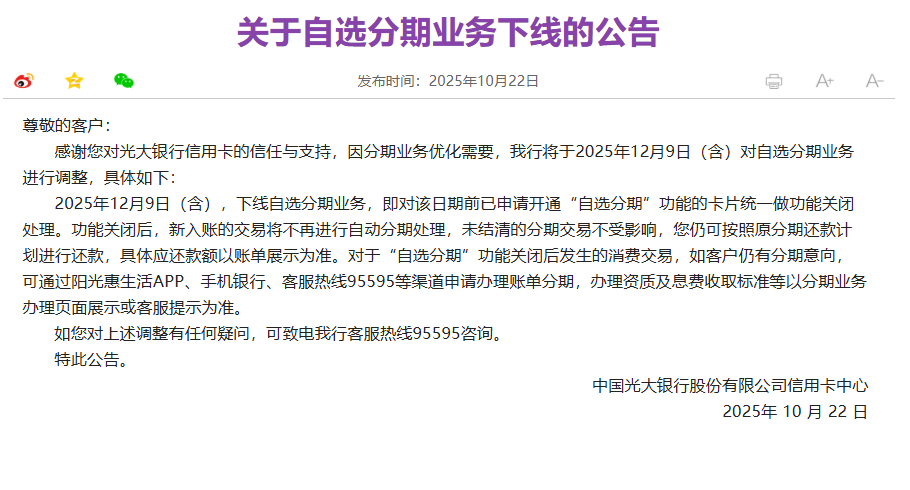
Core Insights - Recent adjustments in credit card installment business rules by several banks, including Industrial and Commercial Bank of China (ICBC) and China Everbright Bank, have raised significant market attention regarding the implications for the industry [1][4][7] Group 1: Changes in Credit Card Installment Services - China Everbright Bank announced the discontinuation of its "self-selected installment" feature effective December 9, 2025, which previously allowed automatic installment for all transactions over 100 RMB or 20 USD/EUR into 12 monthly payments with fees ranging from 0.5% to 0.8% [1][4] - ICBC will stop offering installment options longer than 36 months starting December 5, 2023, eliminating the previous 48 and 60-month options while retaining 1-36 month choices for new transactions [4][5] - Longjiang Bank had already ceased its credit card flexible installment service earlier in June 2023, indicating a broader trend across various types of banks [7] Group 2: Industry Implications and Consumer Impact - The adjustments are driven by the need to adapt to current market conditions, as long-term installment options have contributed to credit card risk, and the shift aligns with deepening financial consumer protection principles [7][8] - Analysts suggest that these changes may lead to a short-term loss of credit card installment business and a slowdown in installment fee growth, but they are expected to promote a transformation in credit card services towards higher quality [7][8] - The reduction in long-term installment options encourages consumers to reassess their spending habits and manage their debt more responsibly, fostering a healthier credit culture [7][8] Group 3: Rising Credit Card Delinquency Rates - The People's Bank of China reported that the total amount of credit card loans overdue for more than six months reached 123.964 billion RMB by the end of 2024, marking a 26.31% year-on-year increase [8] - The market has seen a significant rise in the transfer of non-performing loans, with a 190.46% year-on-year increase in the first quarter of 2023, particularly in credit card non-performing loans, which surged by 879.25% [8] - Major banks, including China Construction Bank and China Everbright Bank, have been actively transferring non-performing credit card loans, indicating a critical need for banks to manage their credit risk more effectively [8]

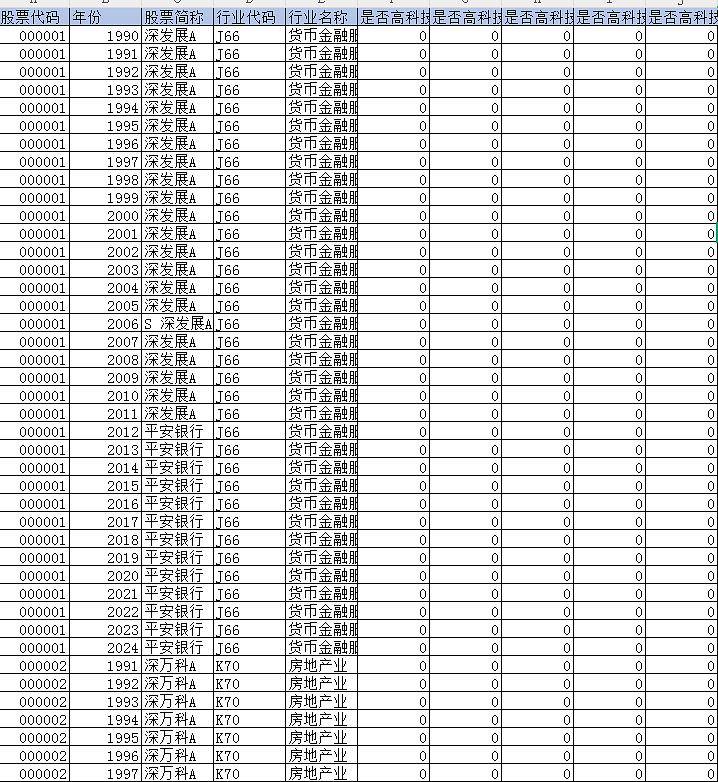
上市公司是否为高科技行业数据+stata代码1990-2024年
Sou Hu Cai Jing· 2025-10-30 01:40
Group 1 - The high-tech industry is defined as a collection of sectors that engage in research, production, and services using advanced scientific knowledge and innovative technologies [1] - The assessment criteria for high-tech industries include technology field classification, innovation capability indicators, economic characteristics and policy orientation, and comparisons of international and domestic standards [1] Group 2 - The data encompasses five classifications of high-tech industries, including stock codes, years, stock names, industry codes, and whether they are classified as high-tech across multiple criteria [2] - The dataset spans from 1990 to 2024, providing a comprehensive overview of companies' classifications in the high-tech sector [2]
盈峰环境科技集团股份有限公司
Shang Hai Zheng Quan Bao· 2025-10-29 22:29
Group 1 - The company plans to conduct forward foreign exchange settlement and other foreign exchange derivative transactions to mitigate foreign exchange market risks and enhance financial stability, utilizing up to $15 million of idle funds [3][8][12] - The board of directors and supervisory board approved the proposal on October 28, 2025, and it does not involve related party transactions [3][11] - The transactions will include various products such as forward foreign exchange settlements, foreign exchange options, and currency swaps, with a maximum contract value of $15 million at any given time [3][7][8] Group 2 - The company aims to use the foreign exchange derivatives for hedging purposes, not for speculation, and will follow legal and prudent principles [4][12] - The funding for these transactions will come from the company's own idle funds, and the transactions are authorized for a period of 12 months from the board's approval [10][9] - The company will monitor international market conditions and adjust strategies to minimize foreign exchange losses [15] Group 3 - The company has also announced an increase in its asset pool business credit limit from 2 billion RMB to 3.5 billion RMB, allowing for more flexible financing options [19][23] - The asset pool business will enable the company to manage and utilize its financial assets more effectively, improving liquidity and financial structure [25][29] - The company has established various risk control measures to manage liquidity and operational risks associated with the asset pool business [26][27] Group 4 - The company has reported a total of 182.98 million RMB in asset impairment provisions for the first three quarters of 2025, reflecting a cautious approach to asset valuation [65][66] - The impairment provisions are based on expected credit losses and are in line with accounting standards to ensure accurate financial reporting [67][70] - This provision will reduce the company's pre-tax profit for the third quarter of 2025 by the same amount, emphasizing the importance of prudent financial management [69][70]

银行抢抓“双11”购物节营销 联动电商平台提升金融服务体验
Zheng Quan Shi Bao· 2025-10-29 19:00
Core Insights - The upcoming "Double 11" shopping festival has prompted multiple banks to launch promotional offers for credit and debit card binding, installment payments, and cashback incentives, aiming to enhance consumer engagement and financial service upgrades [1][2][4] Group 1: Bank Promotions - Several commercial banks, including Bank of China, China Merchants Bank, and Ping An Bank, have introduced binding offers for credit and debit cards, featuring interest-free installments, discounts, and cashback [2][3] - Bank of China has launched a "惠聚中行日" campaign, offering random discounts for transactions over 1,000 yuan on platforms like Taobao and Tmall, along with up to 24 months of interest-free installments [2] - China Merchants Bank is focusing on cashback promotions, allowing users to receive up to 1,111 yuan in cashback for qualifying transactions during the event [2] Group 2: Consumer Loan Products - Consumer loan products are gaining traction, with some banks offering annual interest rates as low as 3% for new users, such as Hangzhou Bank's "宝石贷" [5][6] - Jiangsu Bank is promoting a consumer loan with a maximum limit of 1 million yuan and an interest rate range of 3% to 18%, along with incentives like "苏银豆" for new customers [5] - Consumer finance companies are also targeting the shopping festival, with promotional offers like interest-free loans for specific purchases [5] Group 3: Strategic Importance of Card Binding - The trend of card binding allows banks to directly reach consumers in high-frequency spending scenarios, enhancing data accumulation and enabling targeted marketing strategies [4] - Card binding is seen as a method for banks to activate dormant accounts and create a closed loop of "user-data-scenario" [4] Group 4: Future Trends in Retail Banking - Industry experts predict that the competition in retail banking will shift from simple price subsidies to deeper integration of financial services into consumer scenarios [8] - Future strategies may include enhancing scenario-based financial services, creating products that combine policy subsidies with bank benefits, and developing differentiated services for specific demographics like Generation Z [8]
银行抢抓“双11”购物节营销联动电商平台提升金融服务体验
Zheng Quan Shi Bao· 2025-10-29 18:47
Core Insights - The upcoming "Double 11" shopping festival has prompted banks to launch various promotional offers for credit and debit card binding, installment payments, and cashback incentives to attract consumers [1][2]. Group 1: Bank Promotions - Multiple banks, including Bank of China, China Merchants Bank, and Ping An Bank, have introduced "binding card" promotions for the "Double 11" shopping festival, featuring interest-free installments, discounts, and cashback offers [2]. - Bank of China has launched a "Huiju Zhonghang Day" promotion, offering random discounts for transactions over 1,000 yuan on platforms like Taobao and Tmall, along with up to 24 months of interest-free installments on select products [2]. - China Merchants Bank is focusing on cashback promotions, allowing users to receive up to 1,111 yuan in cashback for qualifying transactions during the promotional period [2]. Group 2: Consumer Loan Trends - Consumer loan products are gaining popularity, with some banks offering annual interest rates as low as 3% for new users, such as Hangzhou Bank's "Gem Loan" [4]. - Jiangsu Bank is promoting a consumer loan with a maximum limit of 1 million yuan and an annual interest rate ranging from 3% to 18%, along with additional incentives like "Suyin Beans" for new customers [4]. - Consumer finance companies are also targeting the shopping festival, with promotional activities such as interest-free loans for specific purchases [4]. Group 3: Strategic Insights - The "binding card" strategy allows banks to directly engage with users in high-frequency consumption scenarios, enhancing their ability to collect transaction data and create consumer profiles for targeted marketing [3]. - Experts suggest that the future of retail banking competition will focus on understanding consumer scenarios and integrating financial services seamlessly into daily life, rather than merely competing on interest rates [7]. - The collaboration between banks and e-commerce platforms during major promotional events is seen as a key strategy to drive consumer engagement and enhance the overall financial service experience [6].
金价波动加剧 多家银行调整积存金起投门槛
Zheng Quan Ri Bao Zhi Sheng· 2025-10-29 17:11
Core Insights - The international gold price has been experiencing significant fluctuations at high levels, leading commercial banks to adjust their precious metal business strategies, particularly by optimizing the investment thresholds for gold accumulation products [1][4] - Several banks have raised the minimum investment amounts for gold accumulation products, with the Bank of Communications implementing a floating adjustment mechanism linked to real-time gold prices [2][4] Summary by Category Market Trends - The current high volatility in gold prices has prompted banks to adapt their strategies to enhance service precision and risk management capabilities [1][3] - More financial institutions are expected to follow suit in adjusting their investment thresholds to provide investors with more flexible options that align with market changes [1][3] Bank Adjustments - The Bank of Communications announced that starting from October 27, 2025, its gold accumulation plan will have a minimum investment amount that fluctuates with real-time gold prices, requiring the investment to be at least equal to the current gold price [2] - Other banks, including Industrial and Commercial Bank of China, Bank of China, and Ping An Bank, have also raised their minimum investment amounts for gold accumulation products in October [4] Regulatory Compliance and Risk Management - The floating mechanism linked to real-time gold prices helps avoid frequent manual adjustments and aligns with regulatory requirements, ensuring compliance while managing risks effectively [3] - Banks are also focusing on investor education by issuing risk alerts to enhance awareness and encourage prudent investment behavior [5][6]
10/29财经夜宵:得知基金净值排名及选基策略,赶紧告知大家
Sou Hu Cai Jing· 2025-10-29 15:58
Core Insights - The article provides an overview of the performance of various funds, highlighting the top and bottom performers in terms of net asset value updates as of October 29, 2025 [3][4]. Fund Performance Summary - The top 10 funds with the highest net value growth include: 1. 永赢新兴产业智选混合发起A with a net value of 1.0001, up from 0.9028 [3] 2. 永赢新兴产业智选混合发起C with a net value of 0.9993, up from 0.9021 [3] 3. 汇添富北交所创新精选两年定开混合A with a net value of 2.1742, up from 2.0057 [3] 4. 汇添富北交所创新精选两年定开混合C with a net value of 2.1390, up from 1.9733 [3] 5. 景顺长城北交所精选两年定开混合C with a net value of 2.0755, up from 1.9175 [3] 6. 景顺长城北交所精选两年定开混合A with a net value of 2.1097, up from 1.9491 [3] 7. 鹏扬北证50成份指数A with a net value of 1.5445, up from 1.4297 [3] 8. 鹏扬北证50成份指数C with a net value of 1.5290, up from 1.4154 [3] 9. 天弘北证50成份指数发起C with a net value of 1.3287, up from 1.2300 [3] 10. 天弘北证50成份指数发起A with a net value of 1.3314, up from 1.2325 [3] - The bottom 10 funds with the lowest net value growth include: 1. 南方中证银行ETF with a net value of 1.6412, down from 1.6760 [4] 2. 富国中证800银行ETF with a net value of 1.3213, down from 1.3493 [4] 3. 天弘中证银行ETF with a net value of 1.4558, down from 1.4866 [4] 4. 华夏中证银行ETF with a net value of 1.7225, down from 1.7588 [4] 5. 中证银行ETF with a net value of 1.4246, down from 1.4546 [4] 6. 易方达中证银行ETF with a net value of 1.3396, down from 1.3678 [4] 7. 华宝中证银行ETF with a net value of 0.8124, down from 0.8294 [4] 8. 东财中证银行指数E with a net value of 1.3164, down from 1.3439 [4] 9. 东财中证银行指数A with a net value of 1.3217, down from 1.3493 [4] 10. 华安中证银行ETF with a net value of 1.3816, down from 1.4104 [4] Market Analysis - The Shanghai Composite Index showed a slight upward trend, with a trading volume of 2.29 trillion, and a market breadth of 2672 gainers to 2621 losers [6]. - Leading sectors included electrical equipment and non-ferrous metals, both rising over 4% [6]. - The fund 永赢新兴产业智选混合发起A demonstrated significant net value growth, indicating strong performance in the market [6].

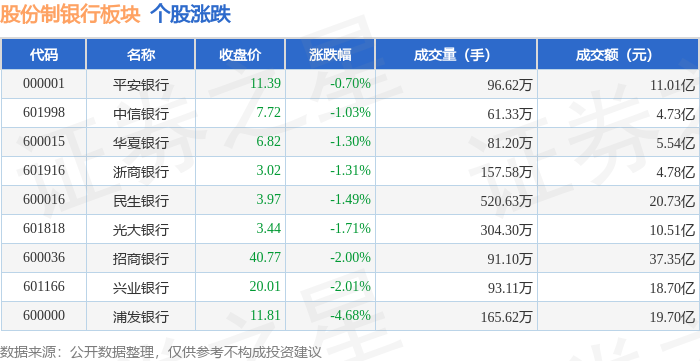
股份制银行板块10月29日跌2.1%,浦发银行领跌,主力资金净流出15.67亿元
Zheng Xing Xing Ye Ri Bao· 2025-10-29 08:41
Core Insights - The banking sector experienced a decline of 2.1% on October 29, with Shanghai Pudong Development Bank leading the drop [1] - The Shanghai Composite Index closed at 4016.33, up 0.7%, while the Shenzhen Component Index closed at 13691.38, up 1.95% [1] Banking Sector Performance - Ping An Bank closed at 11.39, down 0.70% with a trading volume of 966,200 shares and a transaction value of 1.101 billion [1] - CITIC Bank closed at 7.72, down 1.03% with a trading volume of 613,300 shares and a transaction value of 473 million [1] - Huaxia Bank closed at 6.82, down 1.30% with a trading volume of 812,000 shares and a transaction value of 554 million [1] - Zhejiang Commercial Bank closed at 3.02, down 1.31% with a trading volume of 1,575,800 shares and a transaction value of 478 million [1] - Minsheng Bank closed at 3.97, down 1.49% with a trading volume of 5,206,300 shares and a transaction value of 2.073 billion [1] - Everbright Bank closed at 3.44, down 1.71% with a trading volume of 3,043,000 shares and a transaction value of 1.051 billion [1] - China Merchants Bank closed at 40.77, down 2.00% with a trading volume of 911,000 shares and a transaction value of 3.735 billion [1] - Industrial Bank closed at 20.01, down 2.01% with a trading volume of 931,100 shares and a transaction value of 1.870 billion [1] - Shanghai Pudong Development Bank closed at 11.81, down 4.68% with a trading volume of 1,656,200 shares and a transaction value of 1.970 billion [1] Capital Flow Analysis - The banking sector saw a net outflow of 1.567 billion from major funds, while retail investors contributed a net inflow of 1.297 billion [1] - CITIC Bank had a net inflow of 104 million from major funds, but a net outflow of 69.77 million from speculative funds [2] - Huaxia Bank experienced a net inflow of 24.95 million from major funds, with a negligible outflow from speculative funds [2] - Ping An Bank had a net outflow of 17.16 million from major funds, but a net inflow of 62.38 million from retail investors [2] - Zhejiang Commercial Bank saw a net outflow of 61.17 million from major funds, with a net inflow of 5.468 million from retail investors [2] - Everbright Bank had a net outflow of 63.94 million from major funds, but a net inflow of 5.508 million from retail investors [2] - Industrial Bank experienced a net outflow of 166 million from major funds, with a net inflow of 114 million from retail investors [2] - Shanghai Pudong Development Bank had a significant net outflow of 171 million from major funds, but a net inflow of 29.47 million from retail investors [2] - Minsheng Bank faced a net outflow of 411 million from major funds, with a net inflow of 24.5 million from retail investors [2] - China Merchants Bank had a substantial net outflow of 806 million from major funds, while retail investors contributed a net inflow of 531 million [2]