软银集团

Search documents
金融市场兴起对冲AI泡沫新玩法 押注重金投AI的甲骨文债务违约
Xin Lang Cai Jing· 2025-11-21 03:30
Group 1 - Oracle is becoming a barometer for AI risk in the credit market, having borrowed hundreds of billions and tying its fate to the AI boom [1] - The cost of Oracle's credit default swaps (CDS) has doubled in recent months, reaching approximately 1.11% on November 19, which translates to about $111,000 for insuring $10 million in principal [1] - CDS trading volume for Oracle surged to around $5 billion over seven weeks, compared to just over $200 million in the same period last year [1] Group 2 - Despite concerns, few believe Oracle will default soon, but a loss of investor confidence in AI could lead to further increases in Oracle's CDS prices, benefiting those who bought the derivatives [2] - Oracle is one of the largest investors in AI, participating in key initiatives like the "Stargate" project alongside OpenAI and SoftBank [2] - Morgan Stanley analysts project Oracle's adjusted net debt will more than double to approximately $290 billion by fiscal year 2028, recommending investors buy its five-year CDS and bonds [2]

速递|从芯片到机架:OpenAI与富士康合作,深入掌控AI硬件供应链
Z Potentials· 2025-11-21 03:15
Core Viewpoint - OpenAI is collaborating with Foxconn to design and produce data center hardware to meet the increasing infrastructure demands of AI systems [2][3][4]. Group 1: Collaboration Details - Foxconn will work with OpenAI to develop data center server racks and aims to ensure large-scale production in the United States [3]. - The agreement does not include specific procurement commitments [4]. - Foxconn plans to produce cables, power systems, and other critical equipment for data center facilities in the U.S. [4]. Group 2: Strategic Implications - OpenAI has recently signed multiple agreements worth billions with cloud service providers and chip manufacturers, significantly expanding its data center capacity [6]. - The collaboration with Foxconn highlights Foxconn's long-term intention to enhance its role in the AI ecosystem, reducing reliance on assembling iPhones for Apple [6]. - OpenAI's CEO, Sam Altman, stated that this partnership is a crucial step in building core AI technologies domestically in the U.S. [6]. Group 3: Financial Commitments - OpenAI has committed to investing $500 billion in U.S. data centers and AI infrastructure over the coming years [6]. - Altman previously mentioned a total commitment of $1.4 trillion for AI infrastructure, a significant amount for a startup that has yet to become profitable [8]. Group 4: Additional Ventures - Foxconn announced a joint venture with Intrinsic to explore AI data center business opportunities [9].


鸿海与OpenAI合作,将共同设计数据中心的硬件
硬AI· 2025-11-21 03:03
Group 1 - OpenAI and Hon Hai (Foxconn) have announced a partnership to design and develop AI data center hardware, including server racks, with production planned in the United States [2][3] - This collaboration is part of OpenAI's broader infrastructure investment strategy, which aims to secure substantial computing power for its AI services, with a reported investment of $500 billion over the coming years [6] - OpenAI's CEO, Sam Altman, emphasized that this partnership is a step towards building core AI technologies domestically in the U.S., aligning with recent initiatives to strengthen local AI infrastructure [3][4] Group 2 - OpenAI's efforts to expand its computing capabilities also include partnerships with Oracle and SoftBank, as well as significant deals with chip manufacturers like NVIDIA and AMD, indicating a push to scale its data center operations [6] - The collaboration with Hon Hai is seen as a strategic move to enhance control over the AI supply chain, following a previous agreement with Broadcom for custom chips and network components [8] - Concerns have been raised regarding OpenAI's high spending rate, with Altman previously stating a commitment of $1.4 trillion to AI infrastructure, raising questions about the sustainability of its business model given its current unprofitability [8]

亚太股市,全线重挫
Zheng Quan Shi Bao· 2025-11-21 03:02
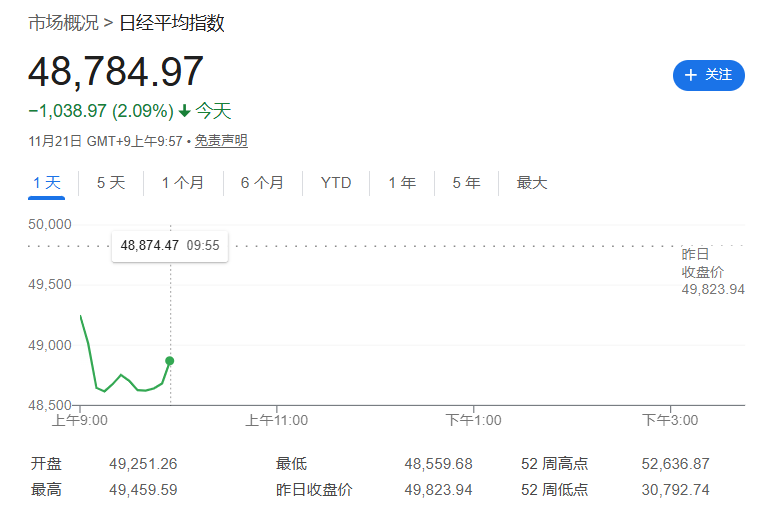
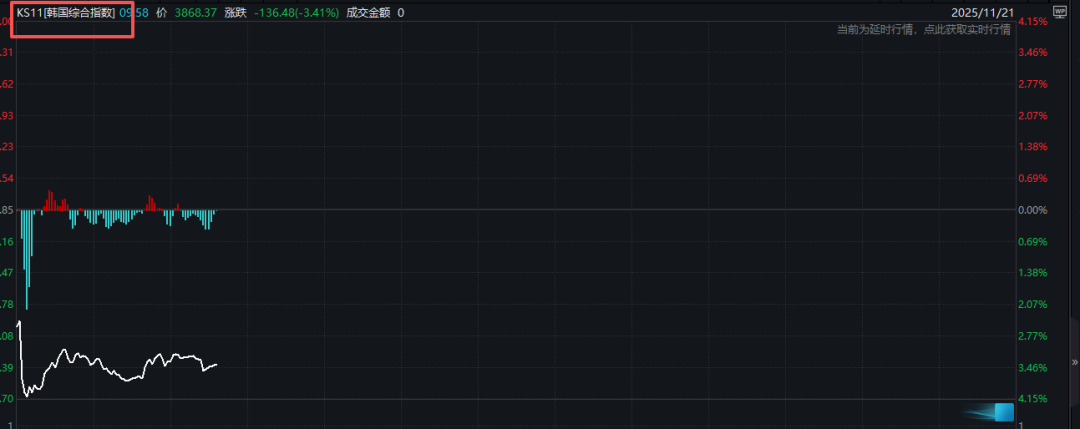
Group 1 - The Asia-Pacific stock markets experienced a significant decline, with the South Korean Composite Index showing a particularly sharp drop, falling over 4% during trading [1][2][3] - Concerns over the high valuations of artificial intelligence and technology-related stocks intensified, leading to a sell-off in tech stocks [1][3] - The South Korean Composite Index opened lower and fell below the key psychological levels of 4000 and 3900 points, with a decline exceeding 100 points at one point [3] Group 2 - In South Korea, major stocks such as SK Hynix and Samsung Electronics faced substantial losses, with SK Hynix dropping over 9% and Samsung Electronics declining more than 5% during trading [3] - The Japanese stock market also saw significant declines, with the Nikkei 225 index dropping over 2% and falling below the 49000-point mark, with a decline exceeding 1000 points [5] - Kioxia, a global leader in storage solutions, experienced a rare drop of over 16% in its stock price [5] - SoftBank Group's stock also faced a sharp decline, with a drop exceeding 10% during trading [6] Group 3 - The A-share market opened lower, with the Shanghai Composite Index falling 0.87% and breaking below the 3900-point mark [7][8] - The Shenzhen Component Index opened down 1.76%, while the ChiNext Index opened down 2.07% [8] - Sectors such as non-ferrous metals, power equipment, telecommunications, and electricity saw the largest declines, while agriculture, food, and beverage sectors remained relatively resilient [9]
SoftBank sinks over 10% as Nvidia-fueled rout sweeps Asian chip names
CNBC· 2025-11-21 02:25
Core Insights - A sector-wide pullback in Asian chip stocks was triggered by a significant decline in SoftBank, following Nvidia's unexpected drop despite strong earnings and a positive outlook [1][4] Company-Specific Summary - SoftBank's stock fell over 10% in Tokyo after it recently sold its Nvidia shares, although it still retains control of British semiconductor company Arm, which provides chip architecture and designs for Nvidia [2] - SK Hynix, a major supplier of high-bandwidth memory for AI applications, saw its stock decline nearly 10%, while Samsung Electronics, another supplier, dropped over 5% [3] - Taiwan Semiconductor Manufacturing Company, the largest contract chipmaker and manufacturer of Nvidia's chip designs, experienced a decline of over 4% [3] - Renesas Electronics, a key supplier for Nvidia, fell by 2.3%, and Tokyo Electron, which supplies essential chipmaking equipment, was down 5.32% [5] Industry Overview - The overall retreat in major Asian semiconductor companies followed Nvidia's decline of over 3% in the U.S., despite the company beating Wall Street expectations for its third-quarter earnings and providing a stronger-than-expected fourth-quarter sales guidance [4]


日本股市,又跳水了!日经225指数跌超2%,软银股价一度下跌11%!日本财务大臣发声
Sou Hu Cai Jing· 2025-11-21 02:24
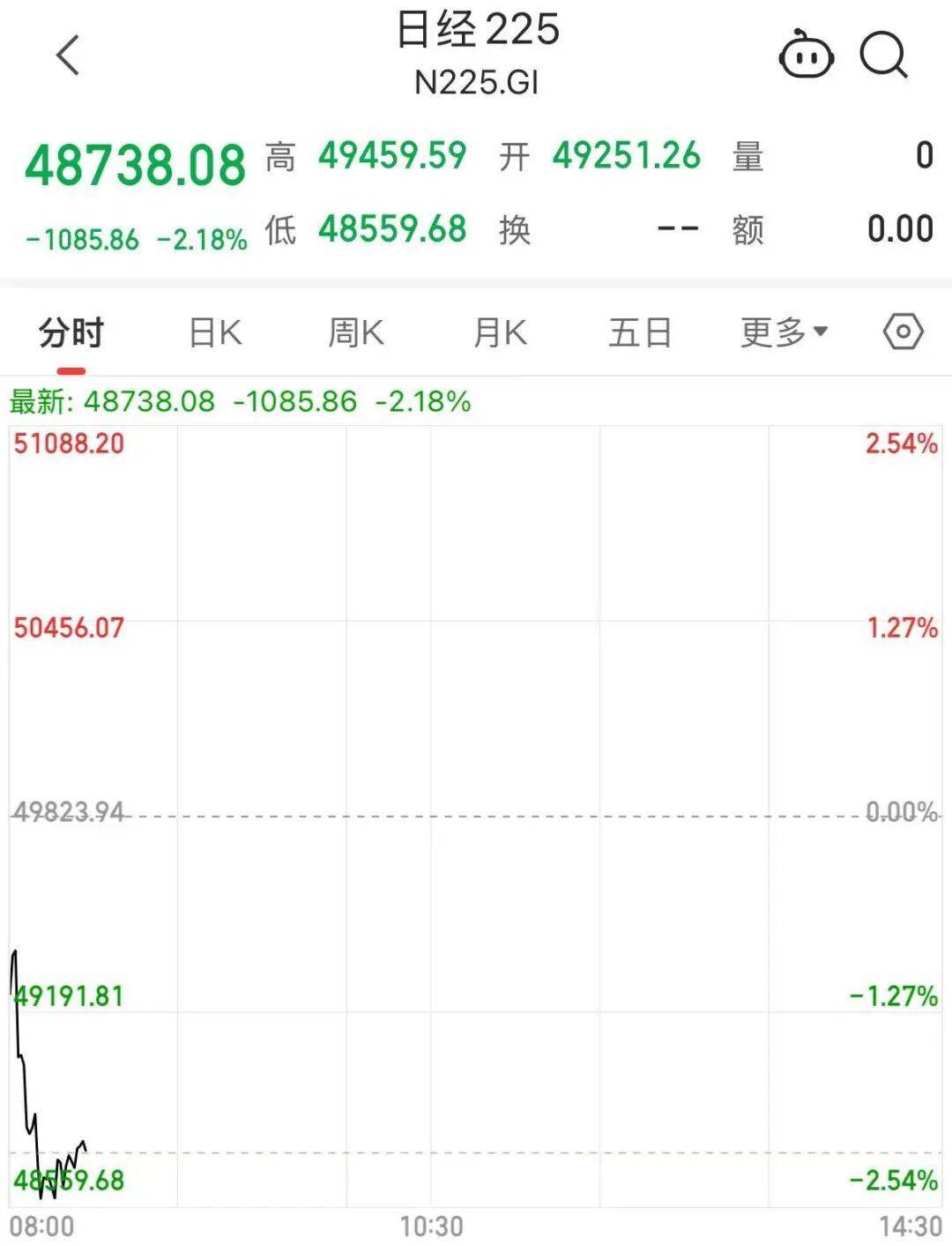
每经编辑|陈柯名 21日,日本股市低开低走,日经225指数迅速击穿49000点。截至发稿,日经225指数跌超2%报48738点,再度跌超千点。此前在本周二(18日),日经225指 数就出现了开盘跳水跌超千点的市况。 热门个股上,软银股价一度下跌11%,创11月5日以来最大跌幅。日本铠侠股价一度下跌16%。消息面上,日本11月份标普全球制造业PMI报48.8。 | < | 日轻 225 | | © Q | | --- | --- | --- | --- | | N225.GI | | | | | 0 48738.08 高 49459.59 开 49251.26 量 | | | | | i -1085.86 -2.18% 低 48559.68 换 -- 18 | | 额 | 0.00 | | 分时 | | | | | 最新: 48738.08 -1085.86 -2.18% | | | | | 51088.20 | | | 2.54% | | 50456.07 | | | 1.27% | | 49823.94 | | | - 0.00%- | | 49191.81 | | | -1.27% | | 485 69. ...
亚太股市 全线重挫!
Zheng Quan Shi Bao· 2025-11-21 02:13
Group 1 - The Asia-Pacific stock markets experienced a significant decline, with the South Korean Composite Index showing the most pronounced drop, falling over 4% during intraday trading [1][2] - Concerns over the high valuations of artificial intelligence and technology-related stocks intensified, leading to a sell-off in tech stocks [1][2] - The South Korean Composite Index opened lower and fell below the key psychological levels of 4000 and 3900 points, with a decline exceeding 100 points at one point [2] Group 2 - In Japan, the Nikkei 225 index also saw a substantial drop, with intraday losses exceeding 2%, falling below the 49000-point mark [4] - Kioxia, a global leader in storage solutions, experienced a rare drop of over 16% in its stock price [4] - SoftBank Group's stock also faced a significant decline, with intraday losses surpassing 10% [4] Group 3 - The A-share market opened lower, with the Shanghai Composite Index dropping 0.87% and falling below the 3900-point threshold [6] - The Shenzhen Component Index opened down 1.76% and was down 1.71% at the time of reporting, while the ChiNext Index opened down 2.07% and remained nearly 2% lower [6][7] - Sectors such as non-ferrous metals, power equipment, telecommunications, and electricity saw the largest declines, while agriculture, food, and beverage sectors were relatively resilient [8]

亚太股市,全线重挫!
Zheng Quan Shi Bao· 2025-11-21 01:59
Group 1 - The Asia-Pacific stock markets experienced a significant decline, with the South Korean Composite Index dropping over 4% during the session [1][2] - Concerns over high valuations of artificial intelligence and technology-related stocks intensified, leading to a sell-off in tech stocks [1][2] - The South Korean stock market saw major declines, with SK Hynix's stock plummeting over 9% and Samsung Electronics falling more than 5% [2] Group 2 - The Japanese stock market also faced a sharp decline, with the Nikkei 225 index dropping over 2% and falling below the 49,000-point mark, with a drop of over 1,000 points [4] - Kioxia's stock experienced a rare decline, dropping over 16%, highlighting volatility in the semiconductor sector [4] - SoftBank Group's stock also saw a significant drop, with intraday losses exceeding 10% [5] Group 3 - The A-share market opened lower, with the Shanghai Composite Index falling 0.87% and breaking below the 3,900-point mark [6] - The Shenzhen Component Index and the ChiNext Index also experienced declines of 1.76% and 2.07%, respectively [6][7] - Sectors such as non-ferrous metals, power equipment, and telecommunications saw the largest declines, while agriculture and food sectors showed relative resilience [8]

亚太股市,全线重挫!
证券时报· 2025-11-21 01:56
Market Overview - The Asia-Pacific stock markets experienced a significant decline, with the South Korean Composite Index showing a particularly sharp drop, falling over 4% during intraday trading [1][3][5]. Technology Sector Concerns - There is growing concern regarding the overvaluation of stocks related to artificial intelligence and technology sectors, leading to a sell-off in tech stocks [2]. South Korean Market Details - The South Korean stock market opened lower, with the Composite Index breaking through key psychological levels of 4000 and 3900 points, dropping more than 100 points at one point, with a decline exceeding 4% before slightly narrowing [5]. - Major stocks in the South Korean market, such as SK Hynix, saw a significant drop, with its price falling over 9%. Samsung Electronics, another leading tech stock, also experienced a substantial decline, with intraday losses exceeding 5% [6]. Japanese Market Performance - The Japanese stock market mirrored the downward trend, with the Nikkei 225 index dropping over 2% and falling below the 49000-point mark, with intraday losses exceeding 1000 points [8]. - Kioxia, a global leader in storage solutions, faced a rare decline, with its stock price dropping over 16% [8]. A-Share Market Movement - The A-share market opened lower, with the Shanghai Composite Index falling by 0.87% and breaking below the 3900-point threshold. The Shenzhen Component Index opened down 1.76%, and the ChiNext Index opened down 2.07% [10][11]. - As of the latest update, sectors such as non-ferrous metals, power equipment, telecommunications, and electricity saw the largest declines, while agriculture, food, and beverage sectors remained relatively resilient [13].

日本股债汇"三杀",德银:相比美股波动,日本市场更令人担忧!
Hua Er Jie Jian Wen· 2025-11-21 01:43
Core Viewpoint - The Japanese financial market is experiencing a "triple whammy" of declines in stocks, bonds, and currency, raising concerns about potential capital flight similar to the 2022 UK bond market crisis [1][11]. Market Performance - The Nikkei 225 index saw a significant drop, falling nearly 3% on Thursday, with notable declines in individual stocks such as SoftBank, which fell 11%, and Kioxia, which saw a 16% drop [1]. - The Japanese yen has reached its lowest level since January, approaching a threshold that may prompt intervention from the Bank of Japan [1]. Bond Market Dynamics - The yield on 30-year Japanese government bonds has surged to levels not seen in decades, exceeding 3.35%, compared to around 3% earlier in the month [4][10]. - This increase in bond yields is occurring while other global fixed income markets are rebounding, highlighting Japan's unique market challenges [8]. Government Fiscal Policy Concerns - The turmoil is largely attributed to concerns over the new government's fiscal policy, which includes plans for the largest fiscal spending since the pandemic [7]. - Analysts warn that the combination of substantial fiscal stimulus and the Bank of Japan's dovish stance is eroding investor confidence in Japan's fiscal health [7][13]. Investor Sentiment and Risks - Deutsche Bank analysts have compared the current situation in Japan to the 2022 UK crisis, indicating a loss of confidence in domestic assets [12]. - If investors lose faith in the government's commitment to maintaining low inflation, the rationale for holding Japanese government bonds may disappear, leading to intensified capital outflows [12][14]. Future Monitoring - Analysts will closely observe for signs of broader capital flight, particularly if the current price trends affect the weak stock market and if Japanese bonds continue to decouple from global fixed income trends [14].