
闪存

Search documents
存储芯片,突发大消息!机构:上车机会
天天基金网· 2026-03-28 01:53
Core Viewpoint - Google's new algorithm, TurboQuant, has raised concerns about its impact on memory chip demand, leading to significant stock price fluctuations in the memory chip sector [2][3][4]. Group 1: Market Reaction - On Thursday, major memory chip stocks experienced a sharp decline, with SanDisk dropping over 11%, Micron Technology nearly 7%, and SK Hynix over 6%, resulting in a total market value loss exceeding $90 billion for major memory manufacturers [3][4]. - Conversely, on Friday, memory chip stocks rebounded, with SanDisk rising over 2% and Micron Technology up 0.50%, despite the previous day's sell-off [2][3]. Group 2: Algorithm Impact - TurboQuant, which utilizes PolarQuant and QJL technologies, claims to compress KV Cache memory usage by at least six times while achieving up to eight times performance improvement on H100 GPU accelerators [4][5]. - Analysts suggest that the algorithm primarily affects the inference stage's key-value cache and does not impact high-bandwidth memory (HBM) used for model weights, indicating that overall memory demand remains robust [5][6]. Group 3: Analyst Perspectives - Morgan Stanley noted that the market may have misinterpreted the algorithm's implications, emphasizing that the efficiency gains do not equate to a reduction in total storage demand but rather enhance throughput per GPU [5][6]. - Analysts from Lynx Equity Strategies and Wells Fargo echoed similar sentiments, asserting that the algorithm does not fundamentally alter the overall scale of hardware procurement and may actually lower service costs, facilitating broader AI deployment [6][7]. Group 4: Long-term Outlook - The memory chip supply is expected to remain tight until 2030, with significant investments in data centers projected, amounting to approximately $650 billion this year from major players like Amazon and Google [6][7]. - The anticipated growth in server DRAM demand by 39% and HBM demand by 58% by 2026 suggests that the TurboQuant optimization effects may be overshadowed by industry growth trends [6][7].

资金动向 | 北水抛售港股逾73亿港元,连续7日扫货美团
Ge Long Hui A P P· 2026-02-26 11:25
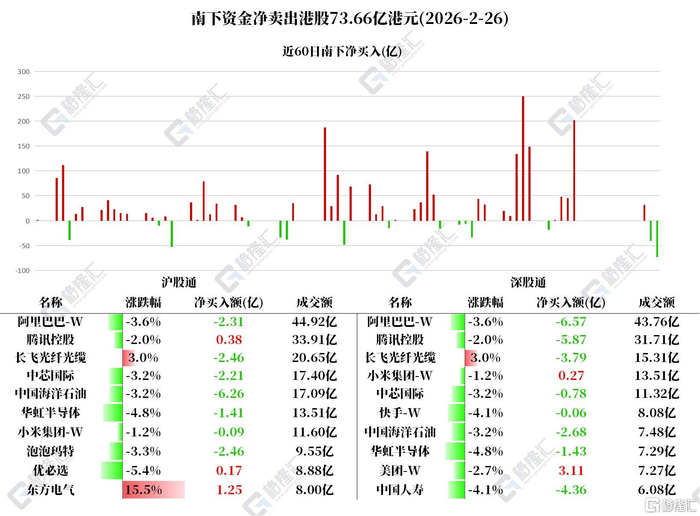
Group 1 - Southbound funds recorded a net sell of HKD 73.66 million in Hong Kong stocks today, marking the second consecutive day of net selling [1] - Notable net purchases included Meituan-W at HKD 311 million and Dongfang Electric at HKD 125 million, while significant net sales were observed in CNOOC at HKD 893 million and Alibaba-W at HKD 888 million [1] - Southbound funds have net bought Meituan for seven consecutive days, totaling HKD 3.61242 billion, and Xiaomi for five consecutive days, totaling HKD 3.22538 billion [3] Group 2 - Demand for optical fibers is surging due to AI requirements, with G.652.D optical fiber prices in China reaching a near seven-year high of HKD 35 per core kilometer, reflecting a 79% month-on-month increase and a 92% year-on-year increase as of January 2026 [4] - China plans to increase the production capacity of 7nm and 5nm chips from less than 20,000 wafers per month to approximately 100,000 by around 2028, with long-term goals to reach 500,000 wafers per month by 2030, primarily through SMIC [4] - Huahong Semiconductor is projected to achieve revenue of USD 660 million in Q4 2025, representing a year-on-year growth of 22.4%, driven by ASP improvements and cost reduction efforts [4]

交银国际:维持华虹半导体(01347)“买入”评级 上调目标价到120港元
智通财经网· 2026-02-24 06:56
Core Viewpoint - The report from CMB International predicts that Huahong Semiconductor (01347) will achieve revenue of $655 million and a gross margin of 14.0% in Q1 2026, with a high certainty of continued capacity expansion in 2027 [1] Group 1: Financial Performance - Q4 2025 revenue reached $659.9 million, a 3.9% increase quarter-on-quarter, nearing the upper limit of previous guidance [1] - Gross margin for Q4 2025 was 13.0%, aligning with the median of the previous guidance range of 12-14%, but down 0.5 percentage points quarter-on-quarter [1] - Management has guided Q1 2026 revenue to be between $650 million and $660 million, with a gross margin forecast of 13-15% [1] Group 2: Capacity Expansion - As of the end of 2025, the capacity is projected to be 486 kWpm equivalent for 8-inch wafers, with an increase of 42 kWpm in 12-inch equivalent capacity from the new factory [2] - The management indicated that the first phase of the new factory is expected to achieve full production in less than two years, with total capacity projected to reach 83 kWpm by the end of 2026 [2] - The total investment for the first phase is $6.7 billion, with approximately $1.3 billion remaining for capacity expansion in 2026 [2] Group 3: Demand Outlook - The capacity utilization rate for 2025 is expected to be at a high of 106.1%, driven by strong demand for AI-related PMIC products and embedded NVM memory related to MCUs [2] - The overall demand is positively influenced by AI, with a spillover effect from the shortage of memory benefiting Huahong's logic and memory foundry business [2]
研报掘金丨国海证券:维持华虹半导体买入评级
Ge Long Hui A P P· 2026-02-24 05:51
Core Viewpoint - Guohai Securities maintains a "Buy" rating for Huahong Semiconductor (1347.HK), projecting a revenue of $660 million in Q4 2025, representing a year-on-year increase of 22.4% with a gross margin of 13.0% driven by ASP improvements and cost reduction efforts [1] Group 1 - Revenue growth is supported by power management and flash memory products [1] - The 12-inch product line is expected to have pricing power in 2026, with new factory capacity and the "China for China" trend supporting both volume and price increases [1] - Depreciation pressure remains a concern despite the positive outlook [1] Group 2 - Projected EPS for 2026-2028 is $0.08, $0.10, and $0.11 respectively [1]

中美关税大战: 最大成果不是中国胜了, 而是美国再无手段控制中国
Sou Hu Cai Jing· 2026-02-22 08:18
Group 1 - The trade friction between the US and China began in 2018, initiated by the Trump administration's tariffs on steel and aluminum, which were set at 25% and 10% respectively [1] - China responded quickly by imposing tariffs on US goods worth $3 billion, including fruits and pork, aiming to stabilize its supply chain [1] - By 2019, the US expanded tariffs to $200 billion worth of goods, leading to a Chinese countermeasure of $60 billion, which prompted US farmers to face declining incomes and empty retail shelves [3] Group 2 - In 2023, the US further tightened controls by banning exports of chip equipment below 7 nanometers to China, while Chinese companies improved production yields through domestic technology [4] - The US attempted to unite allies against China, but China had reduced its reliance on the US market, leading to a series of escalating tariffs from both sides [4][5] - The cumulative tariff rate reached 145%, with China responding by restricting rare earth exports, impacting the US military industry [5] Group 3 - The promotion of RMB settlement has seen 23 countries incorporate it into their reserve currency systems, challenging the dominance of the US dollar [7] - The EU's lack of full support for US policies, along with significant declines in the German automotive sector, indicates a fracture among US allies [7] - China has effectively utilized market data to respond to US measures, achieving technological self-sufficiency and diversifying trade to bypass the dollar system [8] Group 4 - A temporary agreement was reached in May 2025, reducing tariffs significantly, with the US lowering tariffs to 30% and China to 10%, while China committed to purchasing US soybeans [9] - The ongoing negotiations and agreements have led to a shift in US-China relations from confrontation to managing differences and mutual cooperation [10] - The global market is gradually recovering, with the EU adjusting its technology policies in response to the evolving trade dynamics [10]
一文看懂存储芯片
半导体行业观察· 2026-02-20 03:46
Core Viewpoint - The article emphasizes the importance of understanding various types of computer memory, including ROM, DRAM, SRAM, and flash memory, and their unique trade-offs in speed, cost, power consumption, and data persistence [2][3]. Group 1: Memory Types Overview - Computer memory is categorized into volatile and non-volatile types, with volatile memory requiring power to maintain data and non-volatile memory retaining data without power [6][7]. - Volatile memory includes DRAM and SRAM, while non-volatile memory includes ROM and flash memory [6][7]. Group 2: Memory Hierarchy - Modern computing systems utilize a hierarchical structure of memory types to balance speed, capacity, cost, and data persistence, with SRAM and DRAM serving as fast, temporary storage, and ROM and flash memory providing long-term storage [9][70]. - The memory hierarchy includes registers, cache, main memory (DRAM), and non-volatile storage, addressing the speed disparity between processors and memory [9]. Group 3: Key Memory Attributes - Key attributes defining memory technology include speed, latency, bandwidth, capacity, cost per bit, persistence, and energy consumption [10]. - No single memory type excels in all attributes, necessitating a combination of different memory technologies in modern systems [10]. Group 4: ROM Characteristics - ROM is a non-volatile memory type used to store firmware and essential data, with various subtypes like Mask ROM, PROM, EPROM, and EEPROM, each having distinct advantages and disadvantages [12][26]. - ROM is primarily used for firmware storage, with applications in embedded systems and early gaming cartridges [15][25]. Group 5: DRAM Characteristics - DRAM is the dominant form of main memory in computing systems, requiring periodic refreshing to maintain data, making it cost-effective for large capacity storage [27][28]. - DRAM is widely used in desktops, laptops, and servers, balancing performance and cost [31]. Group 6: SRAM Characteristics - SRAM is known for its speed and low latency, making it suitable for cache memory in CPUs and GPUs, despite its higher cost and lower density compared to DRAM [55][59]. - SRAM is utilized in performance-critical applications where speed is paramount [61]. Group 7: Flash Memory Characteristics - Flash memory is a non-volatile storage technology that retains data without power, with two main types: NOR and NAND, each suited for different applications [63][64]. - NAND flash is commonly used in SSDs and other storage devices due to its high density and cost-effectiveness, while NOR flash is used for firmware storage [66][68]. Group 8: Future Trends in Memory Technology - The semiconductor industry is exploring next-generation memory technologies, such as Z-axis memory, MRAM, ReRAM, and PCM, to address the limitations of current memory types and enhance performance, efficiency, and capacity [72][73][74][76].
国海证券:维持华虹半导体(01347)“买入”评级 2026年12英寸晶圆仍存涨价空间
智通财经网· 2026-02-20 01:30
Core Viewpoint - Guohai Securities maintains a "Buy" rating for Huahong Semiconductor (01347), optimistic about the company's growth in wafer volume and price under the "China for China" trend, with improved profitability and valuation from quality asset injections [1] Group 1: Financial Performance - In Q4 2025, the company achieved revenue of $660 million, a quarter-over-quarter increase of 3.9% and a year-over-year increase of 22.4% [2][3] - The net profit attributable to the parent company was $17 million, a decrease of 32.2% quarter-over-quarter, compared to a net loss of $25 million in the same period last year [2][3] - The wafer shipment volume was 1.45 million equivalent eight-inch wafers, with a capacity utilization rate of 103.8% [2][3] Group 2: Margin and Cost Structure - The gross margin for Q4 2025 was 13.0%, down 0.5 percentage points quarter-over-quarter but up 1.6 percentage points year-over-year, primarily due to ASP optimization and cost reduction efforts [3] - The company expects gross margin for Q1 2026 to be between 13% and 15%, with market expectations at 13.2% [4] Group 3: Future Guidance - For Q1 2026, the company anticipates revenue between $650 million and $660 million, which is below market expectations of $695 million [4] - The company expects significant capacity growth in 2027, with the new Fab9B expected to start equipment installation in October 2026 [4] Group 4: Market Trends and Product Demand - The demand for embedded non-volatile memory increased by 31.3% year-over-year, driven by the demand for MCU and smart card chips [3] - The revenue from standalone non-volatile memory grew by 22.9% year-over-year, supported by strong demand for flash products [3] - The power management chip segment showed robust growth, with a year-over-year increase of 40.7% in Q4 2025 [3]
闪存芯片,越来越缺
半导体行业观察· 2026-02-18 01:13
Core Viewpoint - The DRAM and flash memory markets are experiencing significant volatility, with prices recently surging due to demand from AI data centers, despite a previous downturn caused by oversupply and reduced IT demand [2]. Group 1: DRAM Market Insights - Over half of global servers require hundreds of GB of HBM stacked memory, which consumes multiple DRAM chips, leading to production challenges and low yields [3]. - The DRAM shortage is exacerbated by the high demand for HBM, which diverts chips away from high-performance DDR5 memory production [3]. Group 2: Flash Memory Market Dynamics - The flash memory market is recovering from a severe downturn in 2023, with significant demand expected to drive revenue growth for manufacturers like Solidigm in 2024 and beyond [4][5]. - Flash memory prices have increased by 50% to 70% due to demand exceeding supply, particularly for applications in AI supercomputers [5]. Group 3: AI Supercomputer Storage Architecture - NVIDIA's AI supercomputer architecture includes a four-layer storage system, with HBM and DRAM playing critical roles in processing large datasets [6]. - The architecture emphasizes the importance of regular checkpoint maintenance to prevent data loss during computations, highlighting the need for substantial flash storage [6]. Group 4: Future Demand Projections - For a 1 Gbps system using NVIDIA GPUs, the estimated internal flash storage requirement is 8.5 exabytes, with an additional 16.5 exabytes needed for external network storage, totaling 25 exabytes [8]. - The demand for flash memory is projected to grow significantly, with estimates of 135 exabytes consumed in 2023, 315 exabytes in 2024, and 450 exabytes in 2025, indicating a substantial market opportunity for manufacturers [8][9].

华虹半导体(01347.HK):4Q25业绩符合预期 电源类平台增长较快
Ge Long Hui· 2026-02-17 01:19
Core Viewpoint - The company's 4Q25 performance met expectations, with significant revenue growth driven by increased wafer shipments and improved average selling prices (ASP) [1] Group 1: 4Q25 Performance - The company's H-share revenue for 4Q25 was $660 million, representing a year-over-year increase of 22.4% and a quarter-over-quarter increase of 3.9% [1] - Gross margin for 4Q25 was 13%, up 1.6 percentage points year-over-year, attributed to ASP improvements and cost reductions, although it decreased by 0.5 percentage points quarter-over-quarter due to rising labor costs [1] - The net profit attributable to shareholders was $17 million, marking a return to profitability year-over-year, but a slight decline quarter-over-quarter [1] - The company guided for 1Q26 revenue between $650 million and $660 million, with an expected gross margin of 13% to 15% [1] Group 2: Revenue Analysis - Revenue from embedded products in 4Q25 increased by 31.3% year-over-year; independent non-volatile memory revenue rose by 22.9%; power revenue grew by 2.4%; RF logic revenue increased by 19.2%; and analog and power management revenue surged by 40.7% [1] - Overall, demand for MCUs, smart chips, flash memory, and power management chips remained strong, with computing product revenue increasing by 69.9% year-over-year and communication revenue rising by 29.1% [1] - Regional revenue growth for 2025 showed a year-over-year increase of 19.6% in China, 51.3% in North America, and 35.6% in Europe [1] Group 3: Annual Review and Outlook - As of the end of 4Q25, the company's total capacity was 486,000 wafers per month, an increase of 95,000 wafers per month year-over-year [2] - The company expects to complete most of the capacity ramp-up for FAB9A in 2026, with FAB9B starting equipment installation in 2027 [2] - The total revenue for 2025 is projected to be $2.4 billion, reflecting a year-over-year increase of 19.9%, primarily due to increased wafer shipments [2] - The gross margin for 2025 is expected to be 11.8%, up 1.6 percentage points year-over-year, driven by ASP improvements and cost reductions, although rising depreciation costs partially offset this advantage [2] - The company anticipates continued growth in power management chip demand driven by computing chip growth in 2026 and 2027, although there are concerns about declining sales expectations for some consumer products due to rising storage chip prices [2] Group 4: Profit Forecast and Valuation - The company has adjusted its 2026 revenue and profit forecasts down by 2.5% and 37% to $289.7 million and $13.7 million, respectively, and introduced 2027 revenue and profit estimates of $320.4 million and $16.6 million [2] - The current stock price corresponds to a 3.3x P/B for 2026 estimates, with a target price of HKD 110, reflecting a 3.6x P/B for 2026 estimates and an 11% upside potential [2]
板块异动 | 存储芯片表现活跃 存储巨头业绩超预期驱动板块景气上行
Xin Lang Cai Jing· 2026-02-13 03:49
Group 1 - The A-share storage chip sector showed strong activity, rising over 1%, with notable companies like Zhaoyi Innovation, Demingli, and Jiangbolong experiencing gains [1] - Kioxia's annual performance report exceeded market expectations for both revenue and net profit, highlighting expanding demand for data center and enterprise-level AI application servers, alongside strong demand from PCs and smartphones due to new AI models [1] - Kioxia emphasized that the surge in data center demand is expected to outstrip supply [1] Group 2 - Deutsche Bank forecasts that the DRAM supply tightness will persist until 2027 or even 2028, driven by a surge in demand for high-bandwidth memory due to the AI boom [2]