
天弘基金

Search documents
“含航量”最高的航空航天ETF天弘(159241)实时净申购900万份,连续3日“吸金”,规模续创历史新高,年内份额新增率居同标的第一
2 1 Shi Ji Jing Ji Bao Dao· 2025-08-12 03:17
Group 1 - Aerospace ETF Tianhong (159241) experienced a decline of 1.86% as of August 12, with a turnover rate exceeding 8% and a transaction volume surpassing 41 million yuan [1] - The ETF has seen a net subscription of 9 million units recently, with a cumulative net inflow of over 35 million yuan in the last three trading days [1] - As of August 11, the latest scale of Aerospace ETF Tianhong reached 506 million yuan, with a total of 410 million units, both marking new highs since its inception [1] Group 2 - Aerospace ETF Tianhong closely tracks the Guozheng Aerospace Index, which has a significant weight of nearly 98% in the defense and military industry, making it the index with the highest military content in the market [1] - The Guozheng Aerospace Index has a high "aircraft content," with the aerospace and aviation equipment sectors accounting for nearly 67% of its weight, focusing on key areas such as large aircraft manufacturing, low-altitude economy, and commercial aerospace [1] Group 3 - Aerospace Yuxing Technology Co., Ltd. completed a C+ round financing of 430 million yuan, attracting several well-known institutions, with funds primarily aimed at developing key technologies for satellite internet ground infrastructure [2] - The company has completed 10 rounds of financing since its establishment, raising over 1 billion yuan in total [2] - Pacific Securities predicts that the military industry is expected to recover from a two-year downturn by 2025, entering a phase of performance improvement and valuation enhancement [2]
年内自购的公募基金管理人,突破100家
21世纪经济报道· 2025-08-12 02:58
Core Viewpoint - Several public fund companies have recently announced self-purchase plans, indicating confidence in the current market valuations and long-term investment potential in China's capital market [1][6][9]. Group 1: Self-Purchase Announcements - On August 11, Southern Fund announced a self-purchase of at least 230 million yuan across three equity funds, committing to hold for at least one year [1][3]. - Four public fund companies, including Southern Fund, Industrial Bank of China Credit Fund, Taikang Fund, and Founder Fubon Fund, have initiated self-purchases since July 28, with total investments exceeding 260 million yuan [2][3]. - Southern Fund's self-purchase plan includes investments in specific equity funds, highlighting its commitment to the market [3][5]. Group 2: Market Sentiment and Valuation - The self-purchase actions by multiple fund companies are seen as a positive signal, reflecting institutional recognition of current market valuations [6][9]. - As of August 6, the price-to-earnings ratios for the CSI 300 and Hang Seng indices were 13.93 and 11.83, respectively, both lower than major mature markets, indicating a valuation advantage for Chinese stocks [6][9]. - The self-purchase trend is viewed as a strategy to stabilize investor sentiment and demonstrate confidence in the market's long-term health [6][9]. Group 3: Historical Context and Trends - The self-purchase trend has been ongoing, with over 100 public fund managers having implemented self-purchases in 2023 alone [8][9]. - Notably, some fund companies have made multiple self-purchase announcements within the year, indicating a sustained commitment to their products [8][9]. - The China Securities Regulatory Commission's policy encouraging fund companies to self-purchase a portion of their profits has contributed to this trend [9]. Group 4: Investor Considerations - While self-purchase is a positive indicator, it should not be the sole criterion for investment decisions, as it does not guarantee future performance [10][11]. - Investors are advised to consider the scale of self-purchases, the duration of holding commitments, and the credibility of the purchasing entity [10][11]. - Monitoring changes in holdings and fund performance through regular reports is recommended to avoid impulsive investment decisions [10][11].

8.12犀牛财经早报:3万亿商业保理行业望迎新规 娃哈哈回应砍掉年销低于300万元的经销商
Xi Niu Cai Jing· 2025-08-12 01:41
Group 1 - 44 A-share companies plan to distribute over 72 billion yuan in cash dividends [1] - The commercial factoring industry, valued at 3 trillion yuan, is expected to undergo significant regulatory changes, prohibiting "grey area" consumer loan activities [1] - Multiple bond funds have resumed large-scale subscriptions for institutional investors, with 19 funds making similar announcements since July [1] Group 2 - The issuance of technology innovation bonds has expanded significantly, with 684 bonds issued and a total scale of 880.6 billion yuan since May 7, 2025 [2] - Nearly 400 A-share companies have disclosed share buyback progress since July, involving over 60 billion yuan, but 17 companies have announced extensions of their buyback periods [2] - The semiconductor industry in China saw an investment of approximately 455 billion yuan in the first half of 2025, with a year-on-year decline of 9.8%, a significant improvement from a 41.6% decline last year [3] Group 3 - China continues to lead the world in industrial robot production and installation, with humanoid robot development gaining international attention [4] - A new type of solid oxide fuel cell (SOFC) has been developed to operate efficiently at 300°C, potentially accelerating commercialization [5] - Satellite Chemical reported a net profit of 2.744 billion yuan for the first half of 2025, a year-on-year increase of 33.44% [8]
基金早班车丨沪指再上三千六,年内翻倍基增至四十三只
Sou Hu Cai Jing· 2025-08-12 00:50
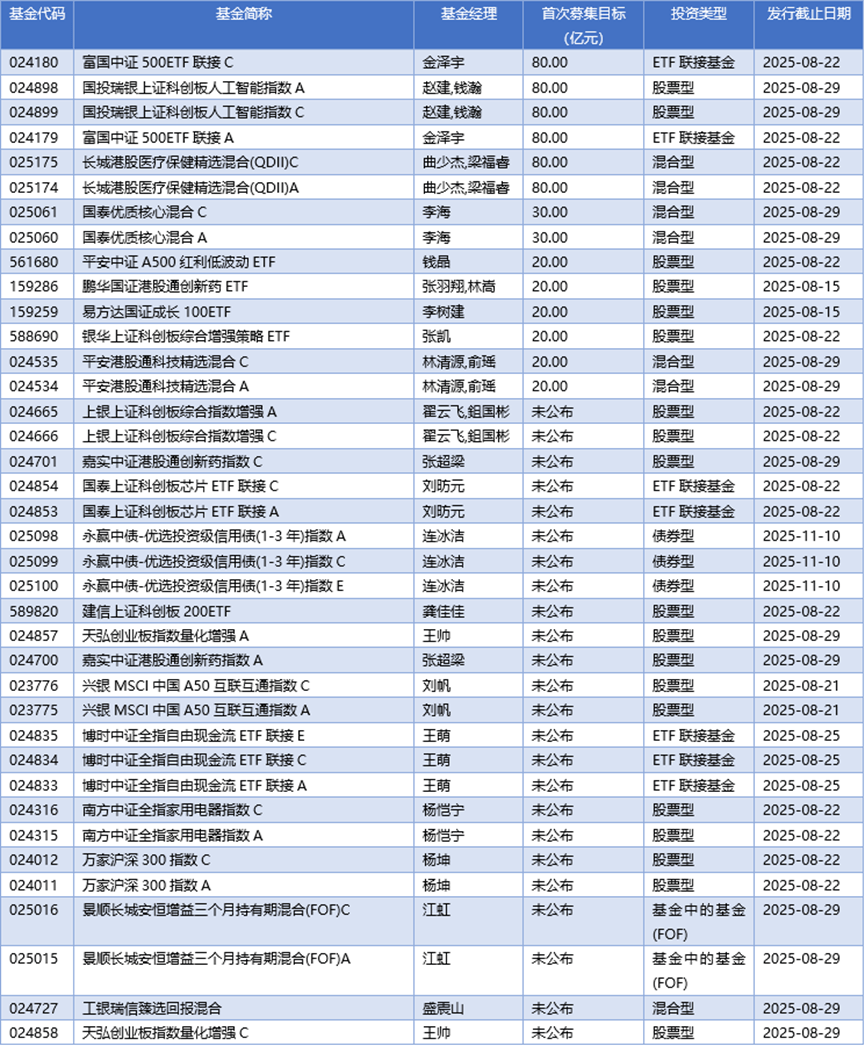
一、交易提示 7月以来沪指突破3600点,为2007年、2015年、2021年后第四次站稳该关口。行情回暖带动主动权益基金全面反弹,数据显 示,今年以来九成主动权益基金产品实现正收益,4300多只主动权益基金年内平均收益近14%。截至8月6日的近一年内, 市场上有43只主动权益基金涨幅超100%。 金融界8月11日消息 A股三大指数集体收涨,沪指六连阳,收盘再创年内新高,截至收盘,沪指涨0.34%,报3647.55点,深成指涨 1.46%,报11291.43点,创业板指涨1.96%,报2379.82点,科创50指数涨0.59%,报1049.73点。沪深两市合计成交额18269.73亿元。 二、基金要闻 (1)08月11日新发基金共有38只,主要为股票型基金和混合型基金,其中富国中证500ETF联接C募集目标金额达80.00亿 元亿元;基金分红25只,多为债券型,派发红利最多的基金是富国天丰强化收益债券型证券投资基金,每10份基金份额派 发红利0.2100元。 (2)8月11日至17日,全市场31只新基启动募集,连续第三周单周不少于30只。其中权益类占八成以上,股票型基金成为 绝对主力,渠道反馈认购热度维持高位 ...
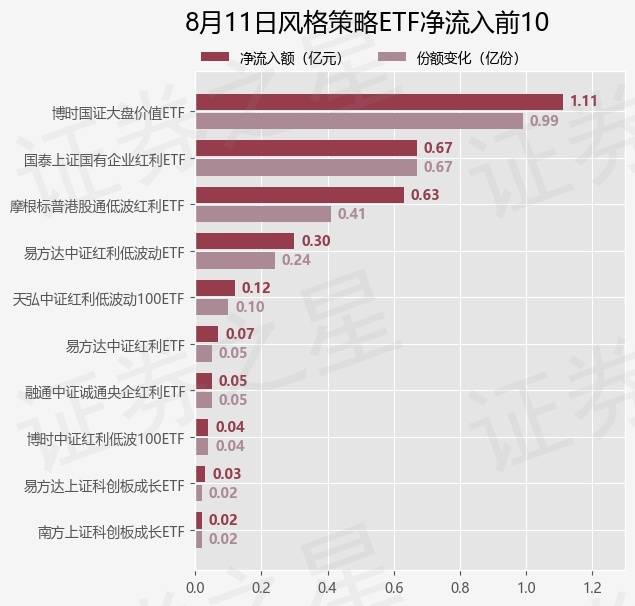
【ETF观察】8月11日风格策略ETF净流出6.94亿元
Sou Hu Cai Jing· 2025-08-12 00:02
Summary of Key Points Core Viewpoint - On August 11, style strategy ETFs experienced a net outflow of 694 million yuan, with a cumulative net outflow of 707 million yuan over the past five trading days, indicating a trend of capital withdrawal from these funds [1]. Fund Performance - A total of 15 style strategy ETFs saw net inflows on the same day, with the highest inflow recorded for the Bosera National Index Large Cap Value ETF (159391), which increased by 99 million shares and had a net inflow of 111 million yuan [1][3]. - Conversely, 17 style strategy ETFs experienced net outflows, with the Huatai-PB CSI Dividend Low Volatility ETF (512890) leading the outflows, decreasing by 369 million shares and resulting in a net outflow of 443 million yuan [1][4]. Detailed Fund Data - The top 10 ETFs by net outflow on August 11 included: - Huatai-PB CSI Dividend Low Volatility ETF (512890): -443 million yuan, -369 million shares - Huatai-PB SSE Dividend ETF (510880): -232 million yuan, -71 million shares - Harvest CSI 300 Dividend Low Volatility ETF (515300): -117 million yuan, -84 million shares - Southern Dividend Low 50 ETF (515450): -97 million yuan, -68 million shares - Others included various ETFs with smaller outflows [4][5]. Overall Market Trends - The overall trend indicates a cautious sentiment among investors in the style strategy ETF segment, as evidenced by the significant net outflows and the mixed performance of individual funds [1][4].
“真金白银”力挺A股 公募“接力”自购权益基金
2 1 Shi Ji Jing Ji Bao Dao· 2025-08-11 23:59
Core Viewpoint - Several large public fund companies have recently announced self-purchase plans, indicating confidence in the long-term stability and health of the Chinese capital market [1][4]. Group 1: Self-Purchase Announcements - On August 11, Southern Fund announced a self-purchase plan involving an investment of at least 230 million yuan in three equity funds, committing to hold for at least one year [1][2]. - In the past two weeks, four public fund companies, including Southern Fund, ICBC Credit Suisse Fund, Taikang Fund, and Founder Fubon Fund, have disclosed self-purchase plans, with total investments exceeding 260 million yuan [2][7]. - Southern Fund's self-purchase plan is particularly notable, targeting specific equity funds such as the Southern CSI A500 ETF and the Southern S&P China A-Share Large Cap Dividend Low Volatility ETF [2][3]. Group 2: Market Sentiment and Valuation - The self-purchase actions by multiple fund companies signal their recognition of the current market valuation's reasonableness and their confidence in the medium to long-term investment value [4][8]. - According to Wind data, as of August 6, the price-to-earnings ratios of the CSI 300 Index and the Hang Seng Index are 13.93 and 11.83, respectively, both lower than major mature market indices, indicating that the Chinese stock market is in a "valuation pit" [3][4]. Group 3: Implications for Investors - Fund companies' self-purchases are seen as a way to enhance trust and stabilize investor sentiment, as they align their interests with those of investors [4][9]. - While self-purchase can be a positive signal, it should not be the sole criterion for investment decisions; investors are advised to consider other factors such as fund manager capability and investment strategy [8][9]. - The trend of self-purchases has been ongoing, with over 100 fund management companies having implemented self-purchases this year, reflecting a regulatory push to encourage such actions [6][7].
多只债基恢复机构大额申购
Zheng Quan Ri Bao· 2025-08-11 16:19
Group 1 - Multiple bond funds have resumed large-scale subscriptions for institutional investors, with 19 funds making similar announcements since July, including 11 bond funds [1] - The resumption of large subscriptions is attributed to supportive policies, improved market conditions, and adjustments in fund management strategies, reflecting ample liquidity in the bond market and ongoing institutional demand [1] - In July, the total trading volume of bonds in the market reached 2.56 trillion yuan, a month-on-month increase of 40.89% and a year-on-year increase of 45.08%, indicating heightened trading activity [1] Group 2 - The overall trading frequency in the secondary bond market has increased, with a notable rise in institutional demand for bond assets and greater market participation [2] - The resumption of large subscriptions is seen as a proactive response from fund managers to the current "low interest rate + stable growth" environment, which is expected to provide short-term benefits to the bond market [2] - Fund managers previously limited subscriptions to reduce reliance on a few large institutional investors, thereby optimizing the holder structure and enhancing the long-term stability of fund operations [2]
基金市场与ESG产品周报:周期主题基金表现占优,被动资金加仓金融地产、周期ETF-20250811
EBSCN· 2025-08-11 14:27
2025 年 8 月 11 日 总量研究 周期主题基金表现占优,被动资金加仓金融地产、周期 ETF ——基金市场与 ESG 产品周报 20250811 要点 市场表现综述:大类资产方面,本周(下文如无特殊说明,本周均指代 2025.8.4-2025.8.8)国内权益市场指数集体上涨,原油价格大跌。行业方 面,本周各申万一级行业多数上涨,国防军工、有色金属、机械设备行业涨 幅居前,医药生物、计算机、商贸零售行业跌幅居前。基金市场方面,本周 权益市场表现较好,各类基金净值均呈现上涨,偏股混合型基金涨幅为 1.73%。 基金产品发行情况:本周国内新基市场热度较高,新成立基金 34 只,合计 发行份额为 397.4 亿份。其中债券型基金 11 只、股票型基金 13 只、混合型 基金 7 只、FOF 基金 3 只。全市场新发行基金 38 只,从类型来看,股票型 基金 19 只、混合型基金 9 只、债券型基金 8 只、FOF 基金 2 只。 基金产品表现跟踪:行业主题基金方面,近期各板块基金轮动表现,本周除 医药主题外,其余各主题基金均呈现上涨,周期主题基金表现占优,净值上 涨 4.42%。截至 2025 年 8 月 8 ...
近一年翟相栋、马龙等三位顶流基金经理同时离职,招商基金陷大换血,新总经理钟文岳如何改革?
Sou Hu Cai Jing· 2025-08-11 13:17
Group 1 - The departure of three prominent fund managers, including Zhai Xiangdong and Ma Long, has created significant turmoil within China Merchants Fund, raising concerns about the company's future stability and performance [2][3][5] - Zhai Xiangdong, known for his exceptional investment strategies, managed to grow the "China Merchants Advantage Enterprise Mixed Fund" from 0.4 billion to over 10 billion in just three years, achieving a return of 122.95% [3][4] - Ma Long, a key figure in fixed income, managed assets worth 876 billion, contributing significantly to the company's solid reputation in this sector, but he has begun to resign from his managed products and will leave entirely by April 2025 [5][6] Group 2 - The departures of these fund managers reflect deeper issues within China Merchants Fund, particularly related to its salary and compensation policies, which have led to dissatisfaction among employees [7][8] - The company's rigid salary structure has been identified as a major factor contributing to the talent crisis, as it fails to align with the market value and contributions of high-performing fund managers [8][10] - New General Manager Zhong Wenyue faces the daunting task of stabilizing the company and restoring investor confidence amid these significant leadership changes [13][14] Group 3 - Zhong Wenyue's experience in the financial sector may not be sufficient to navigate the current challenges, as he must quickly implement reforms to address the issues stemming from the recent departures [13][14] - The effectiveness of potential reforms, particularly in salary structures and talent acquisition, remains uncertain, as the company must adapt to a rapidly changing market environment [14]
“真金白银”力挺A股,公募“接力”自购权益基金
2 1 Shi Ji Jing Ji Bao Dao· 2025-08-11 11:39
Core Viewpoint - Several large public fund companies have recently announced self-purchase plans, indicating confidence in the long-term stability and health of the Chinese capital market [1][4]. Group 1: Self-Purchase Announcements - On August 11, Southern Fund announced a self-purchase plan involving an investment of at least 230 million yuan in three equity funds, committing to hold for at least one year [1][2]. - Four public fund companies, including Southern Fund, Industrial Bank of China Credit Fund, Taikang Fund, and Founder Fubon Fund, have announced self-purchase plans since July 28, with a total investment exceeding 260 million yuan [1][2]. - Southern Fund's self-purchase plan is particularly notable, with a commitment to invest in specific equity funds [2]. Group 2: Market Sentiment and Valuation - The self-purchase actions by multiple fund companies signal a recognition of the current market's reasonable valuations and a belief in the long-term investment value [4][8]. - According to Wind data, as of August 6, the price-to-earnings ratios for the CSI 300 Index and the Hang Seng Index were 13.93 and 11.83, respectively, both lower than major mature market indices, indicating a valuation advantage for Chinese stocks [3]. Group 3: Implications for Investors - Fund companies' self-purchases are seen as a way to enhance trust and stabilize investor sentiment, as they align the interests of fund companies with those of investors [4][9]. - While self-purchase can be a positive signal, it should not be the sole criterion for investment decisions; investors are advised to consider other factors such as fund manager capability and investment strategy [8][9]. - The trend of self-purchases has been ongoing, with over 100 fund management companies having implemented self-purchases this year, reflecting a broader industry movement [6][7].