
Scale AI

Search documents
19岁亚裔女孩,做“赏金猎人”,融了1个亿
虎嗅APP· 2025-11-08 09:29
Core Insights - Datacurve is a new company in the high-quality data labeling sector, aiming to challenge established players like Scale AI, with a unique "gamified labeling" approach that has attracted significant investment and participation from skilled engineers [3][4][12]. Group 1: Company Overview - Datacurve has raised a total of $17.7 million (approximately 120 million RMB) in funding, with a recent $15 million Series A round led by notable investors from top AI companies [4][12]. - The company operates a platform called Shipd, which gamifies data labeling tasks by packaging them as "quests" that engineers can complete for cash rewards [3][10]. Group 2: Unique Business Model - The platform has attracted over 14,000 engineers, who are motivated by the challenge and gaming experience rather than just monetary compensation [7][8]. - Datacurve emphasizes an "engineer-first culture," creating a community that values recognition and professional identity, distinguishing it from traditional data labeling platforms [11][12]. Group 3: User Experience Optimization - The tasks on Shipd are designed to be technically challenging, with multiple validation mechanisms to ensure high data quality [8][10]. - The platform incorporates competitive elements such as leaderboards and rewards for consecutive task completions, enhancing engagement among participants [10][11]. Group 4: Market Position and Competition - Datacurve faces competition from other data labeling companies like Surge AI, which also focus on high-quality data, but Datacurve's unique model may provide a competitive edge if it can maintain data quality and engineer participation [25]. - The company is not solely reliant on data labeling for its future; it plans to expand into other verticals such as finance, medicine, and marketing [25].


Election results, McDonald's earnings, AI valuation fears and more in Morning Squawk
CNBC· 2025-11-05 12:49
Election Results - Democrats achieved significant victories in key races across New York, New Jersey, and Virginia, with self-described democratic socialist Zohran Mamdani projected to become the next mayor of New York City, defeating former Governor Andrew Cuomo [2][4] - In New Jersey, Democrat Mikie Sherrill is projected to become the next governor, marking a critical moment for the GOP, which had made inroads in the state in 2024 [3] - Abigail Spanberger is projected to become the first female governor of Virginia, alongside Democratic nominee Jay Jones winning the attorney general race, despite not being the favorite [4] Corporate Earnings - McDonald's reported third-quarter revenue of $7.08 billion, a 3% increase year-over-year, but slightly below analysts' expectations of $7.1 billion [5] - Despite missing expectations, McDonald's shares rose approximately 1%, with same-store sales growing 3.6% globally and 2.4% in the U.S., indicating sustainable growth in a challenging environment [6] Layoffs and Employment Trends - A wave of layoffs is affecting major corporations, including IBM, Amazon, and Meta, raising concerns about the impact of AI on employment [7][8] - Job openings have reached their lowest level in over four years, with Indeed's Job Posting Index falling to 101.9 in October, the lowest since February 2021 [9] K-Pop Industry Impact - Netflix's "KPop Demon Hunters" has generated $10 billion for the K-pop music industry, significantly boosting shares of major K-pop companies like HYBE and JYP Entertainment, which have seen double-digit gains this year [11] - The film's popularity may also lead to increased consumption of Korean cosmetics and foods, with potential political ramifications in China [12]


AI真的能干活吗?硅谷用一场真实打工实验,给出了尴尬的答案
3 6 Ke· 2025-11-05 00:44
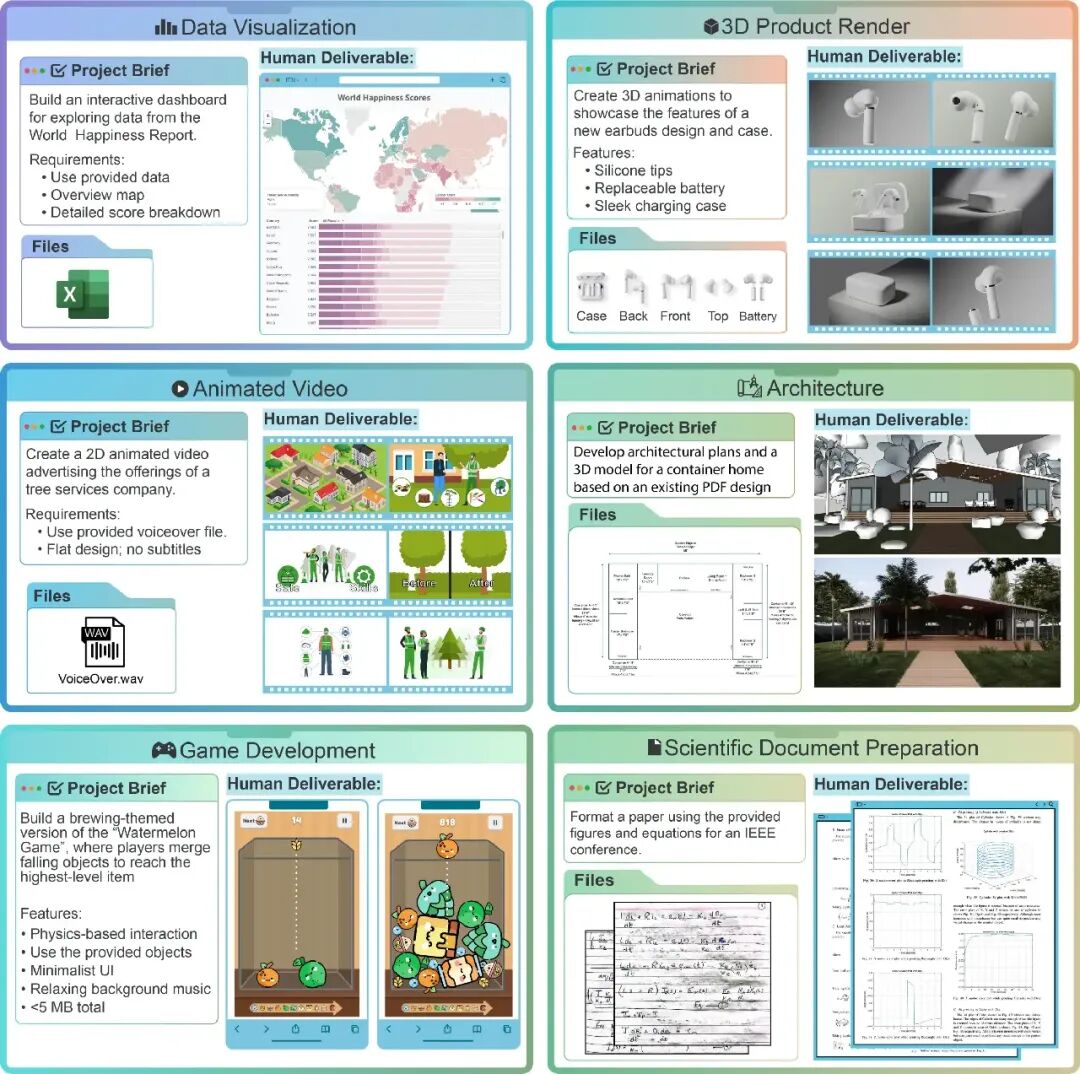
Core Insights - The experiment conducted by Scale AI, named "Remote Labor Index" (RLI), aimed to evaluate whether AI models can effectively perform freelance tasks, revealing a stark contrast between AI's theoretical capabilities and practical performance [1][3][20] - The results showed a dismal success rate of only 2.5% for the best-performing model, Manus, which completed just 6 out of 240 tasks, earning $1,720, significantly below the average earnings of human freelancers [1][8][21] Group 1: Experiment Overview - The RLI was designed to measure AI's ability to complete real-world tasks by using actual freelance projects from Upwork, totaling 240 tasks equivalent to 6,000 hours of human work, with a total potential payout of $144,000 [6][20] - The tasks were selected to be independent and complete, focusing on areas such as writing, 3D modeling, video animation, architectural design, and game development, excluding tasks requiring ongoing communication or teamwork [4][6] Group 2: Performance Metrics - The overall automation rate for the AI models was below 3%, with the best model, Manus, achieving a success rate of 2.5%, while other models like Grok 4 and Claude Sonnet 4.5 had rates of 2.1%, and GPT-5 at 1.7% [8][10] - The primary reasons for failure included low quality (45.6%), incompleteness or formatting errors (35.7%), technical issues (17.6%), and severe visual or logical inconsistencies (14.8%) [10][12] Group 3: Implications for AI in the Workforce - The findings indicate that while AI can generate content quickly, the quality often fails to meet professional standards, with human workers completing projects in an average of 28.9 hours compared to AI's equivalent computational time yielding mostly unqualified results [14][21] - The RLI suggests a trend where work is being "disaggregated" rather than directly replaced by AI, with lower-level tasks (L1-L2) showing a higher success rate of 25%-30%, while more complex tasks (L4-L5) had rates below 5% [15][21] Group 4: Future Outlook - The research team plans to continuously update the RLI to include new dimensions such as multimodal capabilities and long-term memory, aiming to convert model capabilities into measurable economic value [16][20] - The introduction of AI is reshaping job structures, with a noted 7.7% decline in entry-level job postings in sectors like retail and administrative support, indicating a shift in required skills towards those that integrate AI effectively [22][23]
Scale AI's life after Meta deal has been rocky, but CFO insists it's not a 'zombie company'
CNBC· 2025-11-04 15:30
Core Insights - Meta's $14.3 billion investment in Scale AI raised concerns about the company's future, but Scale AI's CFO Dennis Cinelli asserts that the company is thriving and has secured significant contracts recently [1][2][3] Company Overview - Scale AI, founded in 2016, specializes in preparing data for AI training and competes with firms like Appen and Surge AI [3] - The company has two main business segments: data services and applications, with a focus on custom AI solutions for large enterprises and government [3][12] Financial Performance - Scale AI generated nearly $1 billion in revenue last year and is currently bringing in revenue "well into the nine figures" [5][12] - The U.S. Department of Defense awarded Scale contracts worth $99 million in August and $100 million in September [3] Business Developments - Despite initial doubts following the Meta deal, Scale AI has signed significant contracts and continues to work with major AI labs and tech companies [9][10] - The applications business has doubled in the second half of 2025 compared to the first half, indicating strong growth potential [12] Workforce Changes - Scale AI laid off 200 employees, approximately 14% of its workforce, in July to become more agile, but is now looking to hire 200 new employees [13] - The company is expanding its office presence in major cities, including New York and London [13][15] Strategic Direction - Under new leadership, Scale AI has shifted its mission to focus on developing reliable AI systems for critical decisions, moving away from its previous mission [16] - The company maintains a strong financial position with $1 billion on its balance sheet, reducing the immediate need for further fundraising [15]


三位AI天才白手起家,刷新全球最年轻亿万富豪纪录
Sou Hu Cai Jing· 2025-11-03 09:45
Core Insights - Mercor, an AI recruitment startup, has reached a valuation of $10 billion after securing $350 million in funding, making its three 22-year-old founders the youngest self-made billionaires in history, surpassing Mark Zuckerberg's record [1][2][3] Company Overview - Mercor specializes in providing model training support for top AI labs in Silicon Valley and has developed a recruitment platform that uses AI avatars for job interviews, connecting candidates with companies in need of talent [1][3] - The company was founded in 2023 with the initial mission of bridging Indian engineers and freelance programmers with American companies [3][4] Founders' Background - The founders, Brendan Foody, Adarsh Hiremath, and Surya Midha, are all Thiel Fellows, receiving $100,000 to forgo college education, which has positioned them as role models for young entrepreneurs in the AI era [2][3] - They have a strong connection to the tech environment of the Bay Area, with all three founders having parents who are software engineers [4][5] Financial Performance - Following the recent funding round, the company reported an annual revenue of $500 million, a significant increase from $100 million earlier in the year [3][4] Industry Context - The data labeling industry has seen significant changes, with major players like Meta acquiring stakes in competitors, prompting smaller firms to seize opportunities [4] - Mercor faces competition and legal challenges, including a lawsuit from Scale AI alleging theft of trade secrets, which the founders have downplayed [4][5]
马斯克:未来手机没有操作系统和APP/ Ilya称奥特曼惯性撒谎 / AI正在拥有自我反省能力|Hunt Good周报
Sou Hu Cai Jing· 2025-11-02 02:25
Core Insights - OpenAI's valuation is projected to reach $1 trillion, but CEO Sam Altman regrets not acquiring equity in the company, which would have clarified his motivations [1][4][5] - Character.AI is implementing new restrictions for minors due to lawsuits linking the platform to youth suicides and mental health issues [6][8] - Nvidia's new framework, Multi-Agent Evolve (MAE), allows large language models to self-improve without relying on human-annotated data [11][17] - Google reported a significant increase in active users for its Gemini platform, reaching 650 million, contributing to record revenue of $102.35 billion [18][21][22] - Amazon's CEO clarified that recent layoffs were not driven by AI considerations but were part of a cultural shift within the company [23][25][26] - Altman and Microsoft CEO Satya Nadella discussed their partnership and future AI plans, emphasizing the need for substantial computational resources [27][30][33] - A study revealed that current AI agents struggle with complex tasks, indicating limitations in their capabilities [34][40][42] - Concerns about AI's potential self-awareness and introspective capabilities were raised following a new study from Anthropic [76][77][82] Group 1 - OpenAI's valuation is projected to reach $1 trillion, but CEO Sam Altman regrets not acquiring equity in the company, which would have clarified his motivations [1][4][5] - Character.AI is implementing new restrictions for minors due to lawsuits linking the platform to youth suicides and mental health issues [6][8] - Nvidia's new framework, Multi-Agent Evolve (MAE), allows large language models to self-improve without relying on human-annotated data [11][17] Group 2 - Google reported a significant increase in active users for its Gemini platform, reaching 650 million, contributing to record revenue of $102.35 billion [18][21][22] - Amazon's CEO clarified that recent layoffs were not driven by AI considerations but were part of a cultural shift within the company [23][25][26] - Altman and Microsoft CEO Satya Nadella discussed their partnership and future AI plans, emphasizing the need for substantial computational resources [27][30][33] Group 3 - A study revealed that current AI agents struggle with complex tasks, indicating limitations in their capabilities [34][40][42] - Concerns about AI's potential self-awareness and introspective capabilities were raised following a new study from Anthropic [76][77][82]




还在辩 AI 是不是泡沫?泡沫早已泄气 OpenAI 恐面临2种命运
Jing Ji Ri Bao· 2025-11-01 23:29
投资人此刻最想问的是,人工智能(AI)究竟是不是泡沫,会不会爆?财经评论员认为,这根本问错 问题,事实上,AI泡沫早已开始泄气了,只是不像当年达康泡沫那样猛烈爆开。 财经评论员杜莫维奇表示,此刻AI泡沫确实存在,但独立研究机构MacroStrategy Partnership估计,AI泡 沫比2000年爆掉的达康泡沫大17倍,绝对是误导人,那项分析衡量的是所有资产类别的总资本配置,并 不是针对AI而已。 更重要的是,众人都问错问题。这场辩论不应是"AI泡沫会不会爆"--事实上早已发生,只是泡沫慢慢泄 气,不像轰然大爆炸那般引人瞩目。然而,一连串慢动作泄气,正悄悄重塑整个AI市场生态。 杜莫维奇指出,伤亡数字正日积月累。2024年,新创公司关门家数暴增;2025年,有95%的企业AI试验 计划未能在推出六个月内,达成可评量的损益(P&L)目标;而且,今年来,募资失败率占所有创业投 资交易比率达到15.9%,是十年来最高。 但相较于2000年达康泡沫爆破,AI泡沫的威胁不是被夸大,就是被误解。AI泡沫并非达康泡沫翻版, 反倒更有趣且获利前景更可观,但必须押对宝。 超大规模云端服务业者(hyperscalers)指 ...
The AI boom is over — here’s your bubble survival guide
Yahoo Finance· 2025-10-31 11:31
Core Insights - The AI bubble is deflating gradually, with significant differences in outcomes for various market tiers, leading to a separation of winners and losers in the next 18 to 24 months [3][30] - Tier 1 hyperscalers like Microsoft, Alphabet, and Amazon are well-positioned due to their substantial capital expenditures and strong cash flows, allowing them to weather disappointing AI returns [2][9][10][11] - Tier 2 companies, including unicorns like OpenAI and Anthropic, face existential questions regarding their ability to justify high valuations amidst competition from hyperscalers and cheaper models [1][3] - Tier 3 companies are experiencing mass casualties, with increased startup shutdowns and failed AI pilots, indicating a challenging environment for less established firms [6][28] Tier 1 Hyperscalers - Microsoft is projected to have a $13 billion annual run rate in AI, with a 175% year-over-year increase, supported by $72 billion in annual free cash flow [9] - Amazon's AWS is growing at 17.5% year over year, reaching a $123 billion annual run rate, allowing for significant investment in AI infrastructure [10] - Alphabet's revenue is heavily reliant on internet-search advertising, with an operating margin of 32.4% and estimated capital expenditures of $85 billion for AI and data-center infrastructure [11] Tier 2 Unicorns - Companies like OpenAI are valued at $500 billion, but face scrutiny over whether they can deliver returns that justify such valuations [1][7] - The AI bubble is not comparable to the dot-com crash, as the current situation involves a slow deflation rather than a sudden collapse [4][3] Tier 3 Companies - Startup shutdowns surged by 26% year over year in 2024, and 95% of enterprise AI pilots failed to show measurable P&L impact within six months of launch [6][3] - The number of down rounds in venture deals reached a decade high at 15.9% in 2025, indicating a challenging funding environment [3] Investment Strategies - Investors are advised to buy Tier 1 hyperscalers during corrections of 15% to 20%, as these companies have strong fundamentals and cash flow to support AI investments [9][10][11] - Investing in data centers is recommended due to projected power constraints, with Gartner forecasting that 40% of AI data centers could face power-availability issues by 2027 [13][14] - Companies like Dominion Energy are positioning themselves as essential players in the AI infrastructure landscape, with significant investments planned [15][20] Profitable Companies - Companies that automate back-office processes, such as UiPath and BlackLine, are highlighted for their strong ROI and profitability, making them attractive investment opportunities [21][22] - Enterprise SaaS leaders like Atlassian and DocuSign are leveraging AI to enhance their products, maintaining strong customer bases and financial performance [23][25][26]



速递|ARR破5亿美元速度超Cursor,AI专家平台Mercor估值冲上100亿美元,融资3.5亿美元
Z Potentials· 2025-10-29 05:16
Core Insights - Mercor has successfully completed a $350 million financing round, raising its valuation to $10 billion [1] - The company initially started as an AI-driven recruitment platform but has pivoted to providing domain experts for AI model training [1][2] - Mercor's annual recurring revenue is projected to exceed $500 million, outpacing competitors [2] Financing and Valuation - Felicis Ventures led the previous $100 million Series B round at a $2 billion valuation and continues to lead the current round [1] - The company had previously set a target of $8 billion for its Series C round but has since increased it to $10 billion due to strong investor interest [1] Business Model and Operations - Mercor charges for talent recommendation and matching services based on hourly work from domain experts [1] - The company currently pays contractors over $1.5 million daily and has a talent pool of over 30,000 experts, with an average hourly income exceeding $85 [4] - The focus areas for Mercor include expanding its talent network, optimizing contractor-client matching systems, and developing new products for greater process automation [4] Market Context - The shift in partnerships among leading AI labs, such as OpenAI and Google DeepMind, has created opportunities for Mercor, especially after Scale AI lost significant contracts [2] - The rapid development of AI technology poses challenges in understanding the economic value of work, which Mercor aims to address [2]

3位00后,估值700亿
3 6 Ke· 2025-10-28 12:09
Core Insights - Mercor, an AI recruitment startup, has raised $250 million in new funding, achieving a valuation of $10 billion, which is five times its previous valuation of $2 billion earlier this year [1][3] - Founded in 2023 by three college dropouts, Mercor has developed a large professional talent network and has seen its annual recurring revenue grow from $1 to $500 million in just 17 months [1][3] Company Overview - Mercor specializes in AI-driven recruitment, utilizing AI to screen resumes and match candidates to job positions quickly [3][5] - The company has expanded its services to include data annotation and large model evaluation, leveraging its extensive network of 30,000 experts [3][9] - The startup's revenue has quadrupled since the turmoil at Scale AI, a competitor, leading to an influx of Scale's former employees and clients [13][14] Business Model and Revenue - Mercor's annual recurring revenue reached $70 million by February, driven by its new business in large model evaluation [3][9] - The company manages a network of experts who can earn significant daily wages, with total earnings exceeding $1.5 million daily [9][10] - The new funding will be allocated to expanding the talent network, enhancing the matching system, and improving delivery speed [3][4] Competitive Landscape - Mercor's main competitor, Scale AI, faced challenges after being acquired by Meta, which led to concerns about data neutrality and client trust [13][14] - The controversy surrounding Scale AI has inadvertently benefited Mercor, resulting in a significant increase in its revenue and client base [14][15] Future Prospects - Mercor's AI-driven recruitment model has positioned it as a key player in the large model evaluation space, filling a critical gap in the industry [15][16] - The company aims to continue leveraging its talent network to support the growing demand for high-quality data and expert feedback in AI model development [16]
