Tapestry

Search documents
How is Tapestry Strengthening Customer Engagement Through Omnichannel?
ZACKS· 2025-07-09 16:10
Core Insights - Tapestry, Inc.'s omnichannel strategy enhances customer engagement and drives revenue growth and profitability through the integration of digital and physical retail channels [1][6] Financial Performance - In Q3 of fiscal 2025, direct-to-consumer sales increased by 9% year-over-year, with digital sales growing in the mid-teens and brick-and-mortar sales seeing mid-single-digit growth [2] - Total net sales reached $1,584.6 million, marking a 6.9% year-over-year increase and an 8% growth on a constant-currency basis [2] Customer Engagement - The omnichannel model improves customer experience and captures full-price demand across various touchpoints, particularly appealing to Gen Z consumers through innovative retail formats [3] - Tapestry acquired over 1.2 million customers in North America in Q3, with two-thirds being Gen Z and Millennials, indicating strong future lifetime value [5] Marketing Strategy - Marketing investments have increased to nearly 10% of sales, up from 3-4% pre-pandemic, focusing on effective media planning and emotional storytelling [4] Valuation Metrics - Tapestry is currently trading at a forward P/E multiple of 16.93X, which is lower than the Retail-Apparel and Shoes industry's average of 17.99X and the Retail-Wholesale sector's average of 24.97X [7] Stock Performance - Tapestry's shares have risen by 44.3% over the past three months, outperforming the Zacks industry growth of 25.5% and the S&P 500 index's growth of 18.2% during the same period [11] - The stock closed at $92.21, near its 52-week high of $93.48, and is trading above its 50 and 200-day SMAs of $80.65 and $67.92, respectively [14] Earnings Estimates - The Zacks Consensus Estimate for Tapestry's earnings has increased by seven cents to $5.05 per share for the current fiscal year, indicating a year-over-year growth of 17.7% [16]


How Coach got its cool back
CNBC· 2025-06-25 12:00
Core Insights - Coach has successfully rebranded and attracted younger consumers, with over two-thirds of nearly 900,000 new customers in North America being Gen Z and millennials [1][2] - The company reported a 15% revenue growth year-over-year and achieved a gross margin of 77.1% [2] - Coach's market capitalization increased by approximately 140% from January 2020 to January 2025 [5] Brand Strategy - The focus on the "timeless Gen Z client" has led to positive outcomes for Coach, enhancing its brand image and market presence [1][2] - Successful product launches, such as the Brooklyn, Tabby, and Rogue handbags, have contributed to Coach's resurgence, with the Brooklyn being named the hottest fashion product of Q4 last year [3] - Demand for Coach products on the global shopping platform Lyst increased by 332% year-over-year [3] Customization and Innovation - Coach has embraced customization, allowing customers to purchase and create personalized bag charms, with searches for related items on Pinterest growing significantly [4] - The introduction of immersive concept stores, Coach Play, and the expansion into hospitality with Coach Coffee shops reflect the brand's innovative approach [4] Market Position - Coach is recognized for transforming from a mediocre mall brand to a credible luxury contender, showcasing its ability to elevate brand perception in a competitive market [3][6] - The timing of Coach's strategy aligns well with consumer sentiments regarding value for money in luxury goods [6]
Why Gen Z Fell In Love With Coach
CNBC· 2025-06-23 16:00
Brand Revival & Market Position - Coach experienced a significant decline in market cap, losing approximately 60% between its 2012 peak and mid-2014, but has since rebounded [1] - In 2024, Coach surpassed Michael Kors to secure the second position in the US luxury handbag market [2] - Coach was recognized as the fifth hottest fashion brand in Q4 2025, marking a climb of ten spots from its previous ranking [2] Strategic Shifts & Initiatives - Coach shifted its focus towards Gen Z consumers, recognizing their influence on fashion trends [2] - The company hired Stuart Vevers as executive creative director to introduce a more youthful aesthetic and move away from heavy logo designs [7] - Coach closed underperforming stores and reduced discounting to rebuild brand equity [8] - Tapestry acquired Stuart Weitzman for $574 million in 2015 and Kate Spade for $24 billion in 2017 [9] - The holding company Coach Incorporated was renamed Tapestry in October [9] Financial Performance & Growth - In 2021, Coach's sales grew by 16% year-over-year and 15% compared to pre-pandemic levels [10] - Coach accounted for 74% of Tapestry's revenue that year [11] - Tapestry's market cap has expanded by approximately 140% over the last five years [11] - Coach's revenue increased by 15% in Q3 2025 compared to the same quarter of the previous year [14] Market Dynamics & Future Opportunities - Demand for Coach's products increased by 332% year-over-year [15] - Coach generates about 60% of its sales in North America, with growing international appeal, especially in Asia [17] - The brand sees significant growth potential with the increasing number of women globally who can afford a handbag over $100 [21]

Coach Powers Tapestry's Momentum: Find Out What's Driving it
ZACKS· 2025-06-17 15:51
Core Insights - Tapestry, Inc.'s Coach brand reported strong performance in Q3 of fiscal 2025, with net sales reaching $1.29 billion, marking a 13% year-over-year increase on a reported basis and 15% growth on a constant-currency basis, reinforcing its leadership in the accessible luxury segment [1][9] Financial Performance - Coach achieved a record gross margin of 79% in Q3, driven by operational efficiency and premium pricing power, with Average Unit Retail (AUR) growing in the mid-teens and now approximately 70% higher than in 2019 [2][9] - The leather goods segment experienced strong double-digit growth, particularly from the Tabby and New York collections, with key products selling out quickly [3][9] Strategic Initiatives - The "One Coach" strategy, which aligns product and pricing across outlet and full-price channels, has enhanced consumer engagement and margin expansion [3] - Tapestry has upgraded its fiscal 2025 revenue guidance to $6.95 billion, indicating a 4% growth from the previous year, surpassing earlier expectations of 3% growth [4] Regional Performance - Sales growth expectations include 3-4% in North America, around 30% in Europe, low-single digits in Greater China, and high-single digits in other parts of Asia, with an anticipated operating margin expansion of 100 basis points year-over-year [5] Earnings Forecast - Earnings per share are projected to be $5.00, reflecting high-teens percentage growth from the previous year, exceeding earlier estimates of $4.85-$4.90 [5] - The Zacks Consensus Estimate for the current fiscal year's earnings has increased to $5.05 per share, indicating year-over-year growth of 17.7% [12] Stock Performance - Tapestry's shares have increased by 27.1% over the past six months, outperforming the broader Retail-Apparel and Shoes industry, which declined by 16.8% [6] - The stock is currently trading above its 50 and 200-day simple moving averages, indicating positive market sentiment and investor confidence [10]
Coach Bags A 32% Upside, But Kate Spade Lags Behind In Tapestry's Playbook
Benzinga· 2025-06-16 16:18
Core Insights - Tapestry Inc is experiencing a growth split between its key brands, with Coach showing significant recovery and projected 32% upside for the overall company stock by year-end, while Kate Spade is underperforming [1][6] Group 1: Coach's Performance - Coach is the primary driver of Tapestry's growth, benefiting from a balanced multi-year revenue increase due to average unit retail price hikes and sustainable unit sales growth [2] - Handbag prices for Coach are increasing, supported by improved full-price selling and innovative product lines, reversing previous declines in unit sales [3] - The brand is attracting younger customers, particularly Gen-Z and Millennials, who are spending more and frequently returning, which also encourages older customers to re-engage [4] Group 2: Kate Spade's Challenges - Kate Spade has faced revenue declines this year, with management adopting a cautious approach due to uncertain macroeconomic conditions, and its fourth quarter guidance indicates a sales drop [5] - The brand is currently in a supporting role within Tapestry's portfolio, contrasting with Coach's expected low-double-digit growth [5] Group 3: Overall Outlook for Tapestry - Tapestry's potential upside is largely contingent on Coach's revival, driven by pricing power, customer rejuvenation, and category expansion, with a price target of $104 for investors to monitor [6]
从Burberry到Gucci,“即看即买”重回聚光灯,奢侈品的速度革命开始了吗?
Jing Ji Guan Cha Bao· 2025-06-13 07:28
Core Insights - The article discusses the resurgence of the "see now, buy now" model in luxury fashion, particularly through Gucci's upcoming collection under new creative director Demna, which aims to shorten product launch cycles and convert media buzz into sales [1][4] - The luxury industry is undergoing a transformation, with brands like Gucci and Burberry exploring new strategies to balance speed and exclusivity in response to changing consumer preferences [5][8] Group 1: Gucci's Strategy - Gucci plans to launch its new collection in September using the "see now, buy now" model, bypassing the traditional six-month product launch cycle [1] - The initiative is supported by Gucci's new CEO Stefano Cantino and Kering Group's Francesca Bellettini, reflecting a strong commitment to the brand's transformation amid Kering's €10.5 billion debt pressure [1] - Demna's appointment marks a shift from the previous creative direction, aiming to inject a more commercially viable approach into Gucci's offerings [4] Group 2: Burberry's Experience - Burberry was the first luxury brand to implement the "see now, buy now" model in 2016, allowing immediate consumer access to runway collections [2] - While initially successful, Burberry faced challenges such as increased pressure on design teams and a dilution of the brand's exclusivity, leading to a gradual retreat from the model [2][6] - The brand's experience serves as a cautionary tale for Gucci, highlighting the need for a balanced approach to speed and brand value [8] Group 3: Industry Trends - The luxury sector is collectively rethinking its strategies, with brands like Canada Goose and Coach adapting to market changes by enhancing product offerings and brand positioning [6] - The current market environment necessitates a focus on operational efficiency and consumer engagement, with brands needing to find a balance between rapid product launches and maintaining brand prestige [7][9] - The competition in luxury fashion is shifting from design aesthetics to operational speed and market responsiveness, emphasizing the importance of a cohesive brand strategy [8]

Tapestry: Gen Z And Millennials Sponsoring The Resurgence
Seeking Alpha· 2025-06-12 06:01
Group 1 - Tapestry (NYSE: TPR) owns three fashion brands: Coach, Kate Spade New York, and Stuart Weitzman, primarily focusing on purses [1] - The brands under Tapestry have different product lines but share a common emphasis on handbags [1] Group 2 - The article does not provide specific financial data or performance metrics related to Tapestry or its brands [1]
当中国“智慧零售”成为外企高管们的必修课
21世纪经济报道· 2025-06-11 23:26
Core Viewpoint - The article highlights the successful adaptation and innovative strategies of Sika BFM China in the Chinese market, showcasing its digital transformation and community engagement as a model for multinational companies operating in China [2][10][12]. Group 1: Company Overview - Sika Group entered the Chinese market in 1993, with Sika BFM China established in 2019 as the third division focusing on civil construction materials [2]. - Sika BFM China has developed a robust distribution network with over 3,000 exclusive stores and nearly 28,000 distribution points, along with a community of nearly 10,000 renovation workers [2][10]. Group 2: Market Strategy - Sika BFM China identified a significant market opportunity in the tile adhesive category, which was largely untapped in the Chinese renovation industry [3][5]. - The company initiated a tile adhesive competition in 2014 to educate and train workers, which has evolved into a platform for promoting the benefits of tile adhesives over traditional methods [5][6]. Group 3: Digital Transformation - The COVID-19 pandemic accelerated Sika BFM China's digital transformation, leading to the development of the "Good Craftsman" membership platform and collaboration with Tencent for cloud-based retail solutions [6][10]. - The digital platform allows for rapid response to market changes, enabling efficient management of sales and inventory across various channels [10][11]. Group 4: Industry Context - The home decoration industry is facing challenges, with projections indicating a decline in total industry value to 25.9 trillion yuan in 2024, a year-on-year decrease of 6.49% [8][9]. - Despite the industry downturn, Sika BFM China has recognized the need for agility and responsiveness to market dynamics [9][10]. Group 5: Future Outlook - Sika Group views the Chinese market as a critical area for growth, with potential in all three business divisions: infrastructure, industrial, and civil construction [11][12]. - The successful digital transformation of Sika BFM China serves as a reference for other foreign companies seeking to enhance their performance in China [15].


奢侈品为什么卖不动了?十年购买力下降超30%,中产被挤出局!
Hua Er Jie Jian Wen· 2025-06-04 12:41
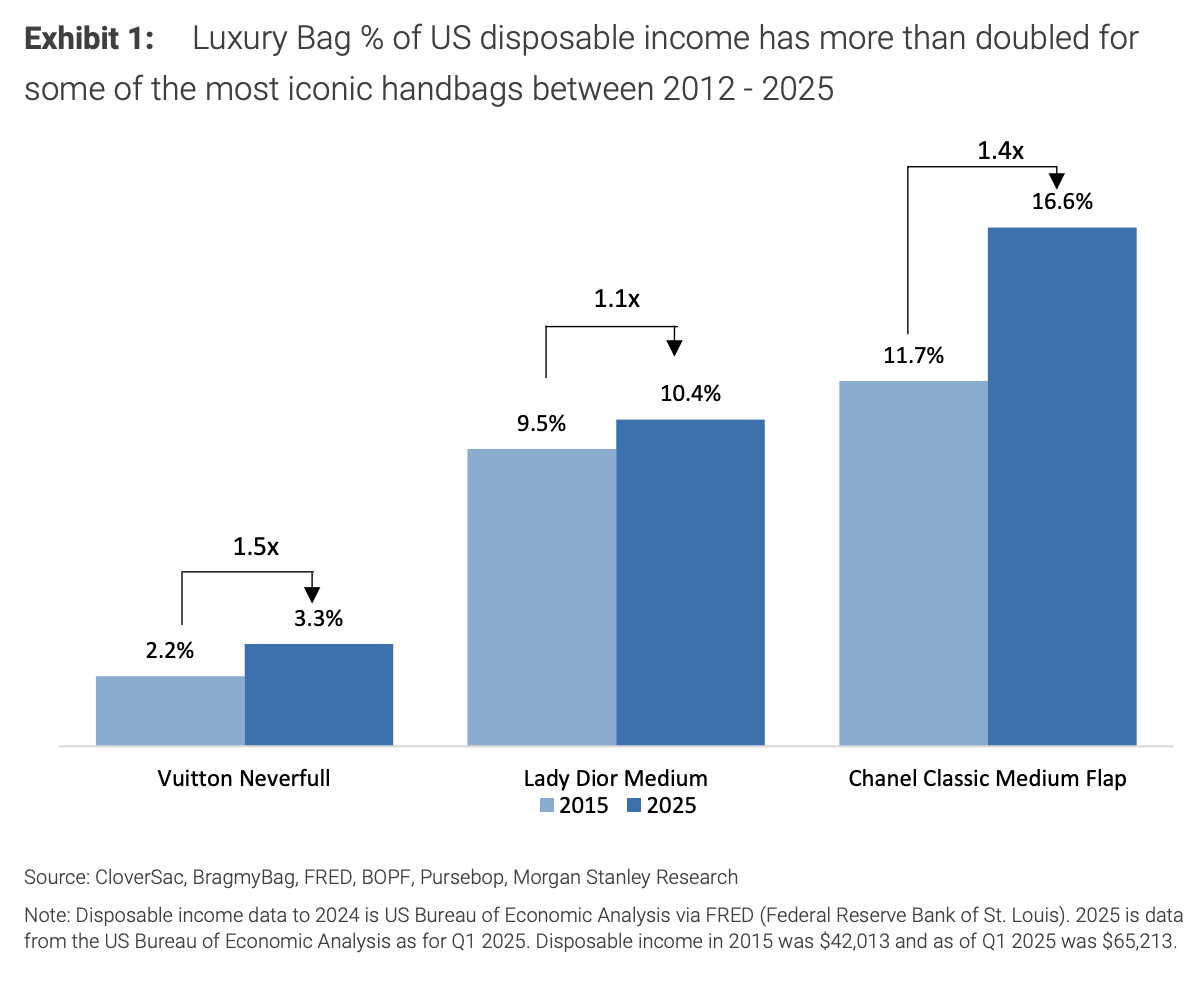
Core Insights - The luxury goods sector is experiencing a significant decline in sales, primarily due to the increasing unaffordability of iconic handbags, which have seen a 10%-33% decrease in affordability over the past decade [1][2] - Middle-income consumers are being priced out of the luxury market, leading to a shift towards more affordable brands like Coach, which reported a 15% same-store sales growth in the first quarter [1][5] - Major luxury brands are facing a growth bottleneck, with simultaneous declines in demand from consumers in China, Europe, and the U.S. for the first time in over 30 years [1][6] Affordability Trends - The price of luxury handbags has risen significantly compared to disposable income growth in the U.S. For instance, the Louis Vuitton Neverfull bag has seen an 8.5% annual compound growth rate in price, while disposable income has only increased by 4.5% [2][4] - Specific examples include: - Louis Vuitton Neverfull: Price increased 1.5 times relative to average disposable income over the past decade [4] - Dior Lady Dior: Price increased 1.1 times [4] - Chanel Classic Flap: Price increased 1.4 times [4] Market Dynamics - The shift in consumer purchasing power is creating opportunities for more price-competitive brands, as evidenced by the strong growth of brands like Coach [5] - The traditional growth model for luxury brands is under pressure, as relying solely on high-net-worth individuals is insufficient to sustain historical growth rates [6] - The luxury sector's strategy of raising prices during economic downturns, which previously worked, is no longer effective in the current market environment [6] Recovery Outlook - The recovery of affordability for luxury handbags is projected to take several years. For example, if prices grow at an average of 2% annually and disposable income continues to grow at 4.5%, it will take approximately 5 years for Dior and Louis Vuitton handbags to return to 2015 affordability levels, and 8 years for Chanel [7]

海外品牌加码天猫618 任天堂Switch2、獭祭登龙门等5万款新品尖货上新
Zhong Guo Jing Ji Wang· 2025-06-03 03:18
Group 1 - Tmall's 618 event has seen a significant increase in overseas brand participation, with nearly 50,000 new products launched on Tmall International [1][3] - The first hour of sales recorded a doubling in transactions for 374 overseas brands, with 109 brands exceeding 10 million in sales during the initial phase [3] - New Zealand's A2 milk brand experienced a 55% increase in sales during the first phase, prompting an early arrival of 100,000 units of popular stock [3] Group 2 - The second-generation red light mask sales increased by 198% compared to last year's Double 11 event, leading to a 20% increase in stock for CurrentBody [4] - KAGAMI, a Japanese whiskey glass brand, reported a 30% increase in sales by May 27, with stock levels for 618 being more than double that of the previous year [4] - VAPE, a mosquito repellent brand, achieved the top sales in the mosquito liquid category on Tmall International, with stock levels also doubling compared to last year [4] Group 3 - Many overseas brands attribute their sales success to simplified discount mechanisms and transparent pricing during the 618 event [6] - Gotukola, an Israeli hair care brand, anticipates a 268% increase in sales, with a target of 27 million [6] - WHC, a Belgian fish oil brand, aims for 130 million in sales, reflecting a 97% year-on-year growth, aided by a 15% official discount [6] Group 4 - On June 3, Tmall's 618 Import Day featured over 1,500 global buyers conducting live streams from 15 countries, showcasing nearly 20,000 imported products at discounted prices [8] - Major discounts were offered on luxury items, such as Louis Vuitton and Coach products, with significant price reductions during the live streams [8] - Tmall International introduced various import category coupons, providing discounts up to 420 yuan for purchases over specified amounts [9]