中信银行

Search documents
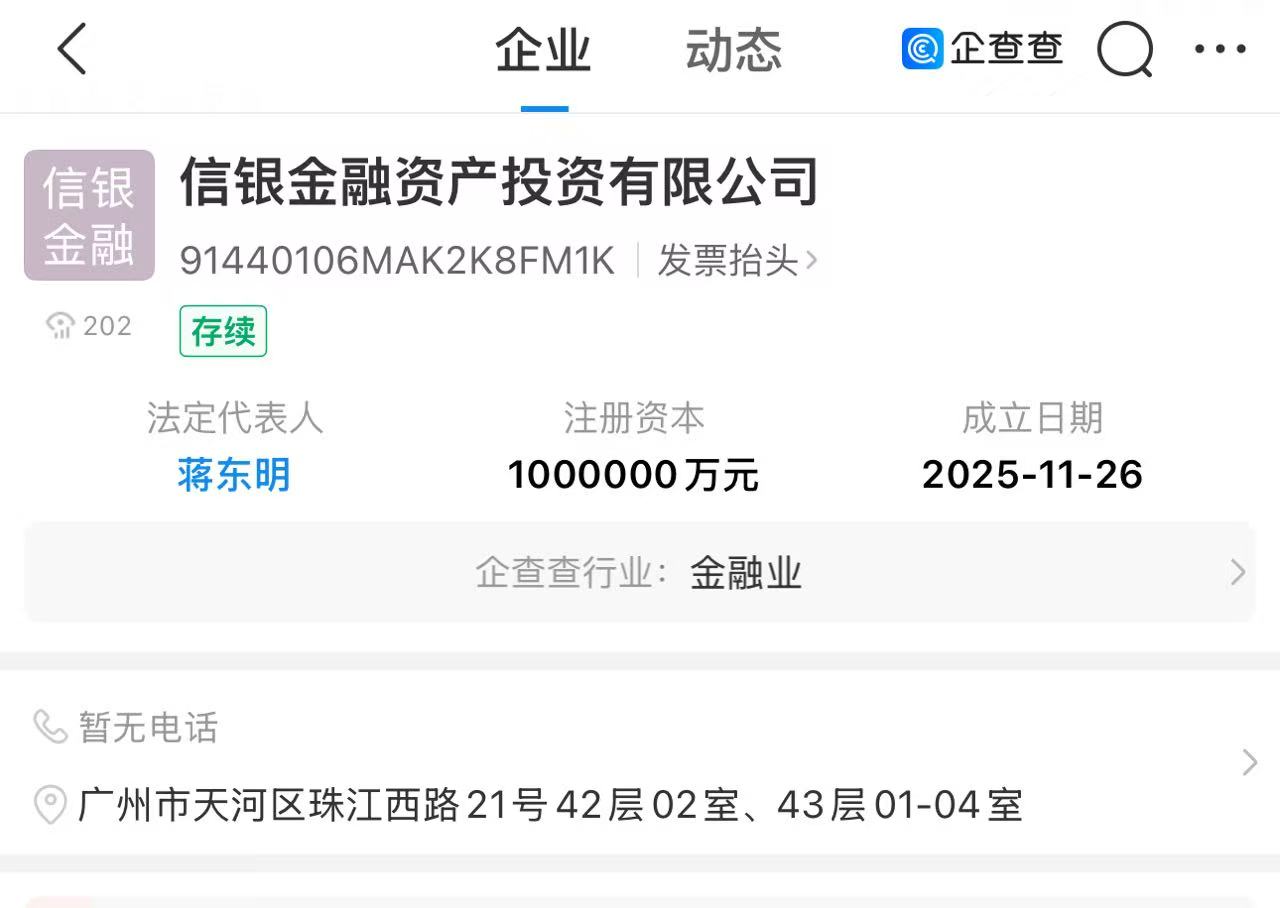
中信系百亿AIC正式落子广州 中信 “老将”出任法定代表人
2 1 Shi Ji Jing Ji Bao Dao· 2025-11-28 01:08
Core Points - The establishment of Xinyin Financial Asset Investment Co., Ltd. has been officially announced, with the company being a wholly-owned subsidiary of CITIC Bank [2][3] - The company was registered on November 26, 2025, with a registered capital of 10 billion yuan, located in Tianhe District, Guangzhou [1][2] - Jiang Dongming, who has a long tenure at CITIC Bank, is the legal representative of the new company [2][3] Company Information - Jiang Dongming has held various positions within CITIC Bank, including Deputy General Manager of the Shenzhen Branch and President of the Guiyang Branch since 2021 [2][3] - As of the report date, Jiang Dongming still holds the position of President at the Guiyang Branch [2] - CITIC Bank's announcement on November 23 confirmed that Xinyin Financial Asset Investment Co., Ltd. has been approved to commence operations, making it the second AIC (Asset Investment Company) among joint-stock banks in China [2][3] Industry Context - There are currently nine approved AICs in China, which include six state-owned banks (Agricultural Bank, Industrial and Commercial Bank, China Construction Bank, Bank of China, China Postal Savings Bank, and China Everbright Bank) and three joint-stock banks (CITIC Bank, Industrial Bank, and China Merchants Bank) [2][3]


索通发展股份有限公司关于2025年11月份提供担保的公告
Zhong Guo Zheng Quan Bao - Zhong Zheng Wang· 2025-11-28 00:35
Core Points - The company has provided guarantees for its subsidiaries and affiliates to support their financing needs, with a total guarantee limit of RMB 12 billion for 2025 [1][2][17] - As of the announcement date, the total amount of guarantees provided by the company and its subsidiaries is RMB 159.26 billion, which is 308.01% of the company's audited net assets for 2024 [17] - The company has no overdue guarantees as of the announcement date [18] Summary of Guarantee Details Guarantee Objects and Basic Information - The company has provided guarantees for several subsidiaries, including Liming Suotong International Trade Co., Ltd., Suotong Qili Carbon Material Co., Ltd., Chongqing Jinqi Carbon Co., Ltd., and others [1][3][17] Cumulative Guarantee Situation - The total guarantee balance for Liming Suotong is RMB 398.50 million, with an unused guarantee limit of RMB 138 million [3] - The total guarantee balance for Suotong Qili is RMB 449.20 million, with an unused guarantee limit of RMB 490 million [3] - The total guarantee balance for Chongqing Jinqi is RMB 175.50 million, with an unused guarantee limit of RMB 273 million [3] - The total guarantee balance for Hubei Suotong is RMB 571.50 million, with an unused guarantee limit of RMB 650 million [3] - The total guarantee balance for Yunnan Suotong Yun Aluminum is RMB 1.56 billion, with an unused guarantee limit of RMB 200 million [3] - The total guarantee balance for Jiayuguan Prebaked Anode is RMB 515 million, with an unused guarantee limit of RMB 812 million [3] - The total guarantee balance for Jiayuguan Carbon Material is RMB 641.10 million, with an unused guarantee limit of RMB 657 million [3] - The total guarantee balance for Tiandong Baikuang is RMB 345.35 million, with an unused guarantee limit of RMB 1.25 billion [3] Internal Decision-Making Process - The guarantee limit for 2025 was approved by the company's board and shareholders, allowing for the guarantees to be used within the approved limit [1][2][17] Necessity and Reasonableness of Guarantees - The guarantees are deemed necessary to support the subsidiaries' operational needs and are aligned with the company's overall strategic interests [17] - The company maintains control over the subsidiaries' management and financial aspects, ensuring that the guarantee risks are manageable [17] Board of Directors' Opinion - The board believes that the guarantees will not adversely affect the company's operations or financial stability, as the subsidiaries have good creditworthiness [17]

中信银行股份有限公司 关于2025年“三农”专项金融债券(债券通)发行完毕的公告
Zhong Guo Zheng Quan Bao - Zhong Zheng Wang· 2025-11-28 00:35
Core Points - The announcement details the completion of the issuance of the 2025 "Three Rural" special financial bonds by CITIC Bank, with a total issuance scale of RMB 60 billion [1] - The bonds are 3-year floating rate bonds with an initial interest rate of 1.87% and a fixed spread of -1.13% [1] - The funds raised from this bond issuance will be specifically used for agricultural loans, in accordance with applicable laws and regulatory approvals [1] Summary by Sections - **Bond Issuance Approval** - CITIC Bank has been authorized by the People's Bank of China to issue financial bonds, with a new balance not exceeding RMB 60 billion for 2025 and a year-end balance not exceeding RMB 400 billion [1] - **Bond Details** - The bonds were recorded on November 25, 2025, and fully issued on November 27, 2025, in the national interbank bond market [1] - The bonds are categorized as 3-year floating rate bonds, with the first interest adjustment period set at 1.87% [1] - **Use of Proceeds** - The proceeds from the bond issuance will be allocated specifically for agricultural loans, subject to legal and regulatory approvals [1]
我国将采取针对性举措做好信用修复; 多家银行年末加码推广个人养老金缴存业务 | 金融早参
Sou Hu Cai Jing· 2025-11-28 00:02
Group 1 - The National Development and Reform Commission of China will enhance credit repair measures, simplifying application materials and improving efficiency, while no longer publicly disclosing minor credit violations [1] - The credit repair system is essential for safeguarding the legal rights of credit subjects, allowing them to restore their credit status after correcting mistakes and fulfilling obligations [1] Group 2 - Several banks are intensifying the promotion of personal pension deposit services, offering exclusive incentives such as cash rewards to attract customers as the year-end approaches [2] - The maximum annual contribution limit of 12,000 yuan can yield up to 600 yuan in subsidies for customers, indicating a shift from merely increasing account numbers to enhancing deposit amounts [2] - With the personal pension system having been implemented for three years, banks are focusing on increasing customer engagement and loyalty as market competition stabilizes [2] Group 3 - Many banks are expanding their distribution channels for wealth management products, with a rapid increase in the weight of agency sales [3] - Some small and medium-sized banks are exploring cooperative models like "joint creation of wealth management" to retain certain investment research capabilities within regulatory frameworks [3] - The wealth management business of small and medium-sized banks is evolving towards a "light asset management, light investment research" model, reflecting changes in regulatory guidance and operational environments [3] Group 4 - Citic Bank has completed the issuance of 60 billion yuan in 2025 "Three Rural" special financial bonds, enhancing its financing capabilities and market competitiveness [4] - The issuance aligns with national strategies to support the "Three Rural" sectors and aims to improve the rural financial environment, contributing to rural revitalization [4] - The total new balance of financial bonds for 2025 is capped at 600 billion yuan, with an end-of-year balance not exceeding 4 trillion yuan [4]
银行上调代销公募基金风险等级 对投资者影响几何?
Nan Fang Du Shi Bao· 2025-11-27 23:14
Core Viewpoint - Recently, China Construction Bank announced an increase in the risk levels of 87 mutual fund products, following similar actions by Postal Savings Bank and Citic Bank. This move is seen as a response to regulatory requirements aimed at enhancing investor protection rather than an indication of an overall rise in market risk [2][4]. Summary by Sections Risk Level Adjustments - China Construction Bank adjusted the risk levels of 87 mutual fund products, with 32 moving from "R2—Medium-Low Risk" to "R3—Medium Risk" and 55 from "R3—Medium Risk" to "R4—Medium-High Risk" [3]. - Postal Savings Bank also made similar adjustments, changing the risk levels of 80 products on October 29, with 52 moving to "Medium-High Risk" and others adjusted accordingly. Another adjustment on November 6 affected 6 products [3]. - Citic Bank made adjustments to its asset management products in October, emphasizing compliance with regulatory requirements and the need for appropriate investor management [3]. Regulatory Compliance and Market Conditions - The adjustments are primarily driven by regulatory compliance pressures, the need to reflect the actual risk levels of certain funds, and to mitigate potential legal and reputational risks [5]. - Experts indicate that the changes focus on high-volatility products, particularly equity funds, and are a response to increased market fluctuations and asset valuation pressures [4][5]. Long-term Benefits for Investors - While investors may face limited choices in the short term, the long-term benefits include clearer risk warnings and more rational investment decisions, particularly for low-risk preference groups [6]. - The adjustments are expected to promote a shift in the wealth management industry from product selling to service selling, encouraging fund companies to enhance their research capabilities and fostering a healthier market ecosystem [6].



多家银行下架中长期存款产品
Zheng Quan Ri Bao· 2025-11-27 15:49
Core Viewpoint - Major state-owned banks and some joint-stock banks in China have recently suspended the sale of 5-year large-denomination time deposits, with current offerings primarily focused on 1-month to 3-year products [1] Group 1: Bank Actions - Six major state-owned banks, including ICBC, ABC, BOC, CCB, BOCOM, and PSBC, along with several joint-stock banks, have withdrawn long-term deposit products [1] - Many small and medium-sized banks have also announced the suspension of 3-year and 5-year fixed deposit products while simultaneously lowering interest rates across various deposit terms [1] - The remaining large-denomination time deposits are mostly concentrated in 1-month, 3-month, and 3-year terms, with 3-year products becoming the primary long-term offering [1] Group 2: Interest Rate Trends - The interest rates for 3-year large-denomination time deposits generally range from 1.5% to 1.75%, with reports of "tight quotas" and "sold out" situations being common [1] - The average net interest margin for commercial banks has dropped to a historical low of 1.42% in Q3, reflecting the pressure on bank profitability [2] Group 3: Strategic Adjustments - The adjustments in long-term deposit products are a response to the narrowing net interest margin, aimed at alleviating profitability pressures [2][3] - The shift indicates a transition from a focus on scale expansion to a more refined approach that emphasizes the quality of liabilities [3] Group 4: Future Outlook - There is potential for further reductions in deposit rates as banks continue to adjust high-cost deposit products [4] - Investors are advised to monitor market dynamics closely, including LPR adjustments and regulatory changes, while diversifying their asset allocation based on risk preferences [4]




股份行AIC扩围:三家机构开业,加速打通股权投资通道
Di Yi Cai Jing· 2025-11-27 12:43
Core Insights - The establishment of AICs (Asset Investment Companies) by major banks marks a significant expansion in the banking sector, allowing for market-oriented debt-to-equity swaps and equity investments, which are crucial for addressing financing challenges faced by innovative enterprises [1][2][4] Group 1: AIC Establishment and Operations - Three major banks, including Industrial Bank, China CITIC Bank, and China Merchants Bank, have launched their AICs, with registered capital reaching 100 billion to 150 billion yuan [2] - The establishment of AICs by these banks signifies a shift from exploration to expansion, enhancing the investment landscape and providing new tools for financing [2][4] - AICs are expected to play a vital role in alleviating the financing difficulties of technology-driven enterprises and optimizing the capital structure of the real economy [1][4] Group 2: Investment Focus and Strategy - The AICs are focusing on strategic emerging industries and "specialized, refined, distinctive, and innovative" enterprises, utilizing a "debt-equity" linkage model to overcome traditional credit constraints [3][4] - The investment strategy of these banks emphasizes technology innovation and green low-carbon initiatives, aligning with national development goals [3][5] Group 3: Financial and Operational Implications - AICs are seen as a mechanism for banks to optimize their asset structures and enhance long-term operational capabilities, particularly in light of economic fluctuations and credit risks [5][6] - The AIC model allows banks to transition from being mere fund providers to becoming value-creating partners within the industry chain [3][6] Group 4: Challenges and Constraints - Despite the potential of AICs, banks face challenges such as low tolerance for non-performing loans, mismatched funding sources, and regulatory constraints that limit their ability to engage in equity investments [7][8] - The reliance on traditional collateral-based lending has created a cultural bias within banks, making it difficult to adapt to the nuances of equity investment [8]
从卷规模到卷服务:汽车金融行业如何“破局”增长?
Zheng Quan Ri Bao Wang· 2025-11-27 12:27
Core Viewpoint - The domestic automotive industry is undergoing a deep adjustment period towards high-quality development, and the automotive finance sector is transitioning from scale expansion to quality and efficiency improvement [1] Group 1: Industry Trends - The automotive finance industry is entering a rational development phase, shifting from traditional credit growth and price competition to structural optimization and product innovation [2] - The market is experiencing a transition from "high returns" competition to "low returns" rational development, with increasing pressure on market participants [2] - The demand for innovative financial products is rising, extending beyond traditional car loans to include battery leasing, charging rights, and after-sales leasing [2] Group 2: Market Challenges - The automotive finance market is facing intensified competition, leading to compressed profit margins and increased complexity in risk management [2] - Regulatory measures have positively influenced the market's move towards standardized development, impacting the structure of automotive consumer loans [2] - The friction costs in automotive transactions are challenging banks' digital risk control and operational capabilities [2] Group 3: Opportunities in New Markets - The trend of new energy vehicles (NEVs) going global is creating new financial service demands, particularly in international settlement and risk management for small enterprises [3] - Banks are exploring ways to provide quality financial services to NEV companies expanding overseas, focusing on financing needs arising from international trade [3] Group 4: Strategic Directions - The automotive finance industry is moving towards quality improvement and efficiency, with a focus on digital operations and customer service ecosystems [4] - Future competition will be characterized by diversification of participants and a strong emphasis on service rather than just price and scale [4] - Key strategies for high-quality development include deep integration with the automotive lifecycle, technology-driven innovation, and promoting green finance products [4] Group 5: Operational Enhancements - Banks need to enhance their operational systems, professional capabilities, product offerings, and digital risk control abilities to meet the evolving demands of the automotive finance market [5] - The integration of resources between technology and risk control departments is crucial for improving digital risk management and operational capabilities [6] - Compliance remains a fundamental operational baseline for automotive finance market participants, with effective risk management being essential for sustainable development [6]
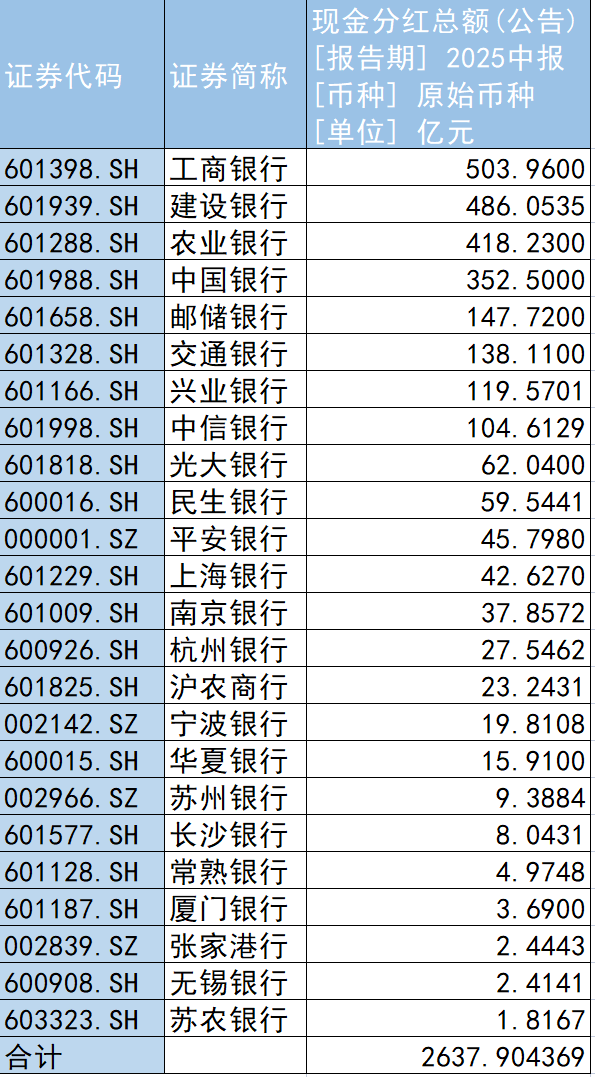
超2600亿“红包”落地!13家银行中期分红,六大行贡献七成
Xin Jing Bao· 2025-11-27 12:05
Core Viewpoint - The mid-term dividends of listed banks have exceeded 260 billion yuan, reflecting a trend towards enhancing shareholder returns and stabilizing market confidence [1][2][5]. Group 1: Dividend Distribution - As of November 26, 2025, 42 A-share listed banks have distributed a total of 263.79 billion yuan in mid-term dividends, with 13 banks having completed their distributions [1][2]. - The six major state-owned banks contributed over 70% of the total mid-term dividends, amounting to 204.66 billion yuan, with Industrial and Commercial Bank of China leading at 50.40 billion yuan [2][3]. - Several banks, including Shanghai Bank and Nanjing Bank, have also participated in mid-term dividends, with total distributions from city commercial banks reaching 3.10 billion yuan [2][4]. Group 2: Market Impact and Investor Confidence - The implementation of mid-term dividends is seen as a signal of stable operations, enhancing market confidence and attracting long-term capital [1][5][9]. - First-time dividend issuers have experienced positive short-term stock performance, indicating that dividends can boost shareholder confidence and improve capital efficiency [5][9]. - The trend of mid-term dividends is aligned with regulatory encouragement for banks to optimize dividend policies and improve shareholder returns [1][6]. Group 3: Future Outlook and Strategic Considerations - The decision to implement mid-term dividends reflects banks' strong financial performance and stable profit models, which provide a solid foundation for such distributions [6][9]. - Analysts suggest that banks should balance short-term dividend payouts with long-term growth strategies, ensuring that capital is adequately retained for future development [9]. - The ongoing trend of mid-term dividends is viewed as a sign of the maturation of China's capital markets and a shift towards greater emphasis on investor returns [9].

稳稳「穿越四季」:「低利率」时代的财富密码
新浪财经· 2025-11-27 11:48
Core Viewpoint - The article discusses the shift in investment strategies among Chinese investors from a focus on single asset types to diversified asset allocation in response to changing economic conditions and declining deposit interest rates [2][5]. Group 1: Change in Investment Perspective - The traditional investment mindset has been dominated by high returns from real estate and rigid financial products, leading to a neglect of the importance of asset allocation [5]. - Current low returns on fixed-income products and high volatility in equity markets necessitate a diversified approach to meet investor needs [5]. Group 2: Common Pitfalls in Asset Allocation - Investors transitioning from traditional "capital preservation" strategies struggle with the volatility of net asset value products, leading to a reluctance to embrace diversified asset allocation [7]. - A common misconception is that holding multiple products equates to diversification; for example, owning several funds in the same sector does not provide true diversification and can lead to concentrated risk [7][6]. Group 3: Effective Asset Allocation Strategies - The "Four Seasons Portfolio" strategy, based on Harry Browne's "Permanent Portfolio," allocates assets equally among stocks, bonds, cash, and gold, achieving over 7% annualized returns with less than 10% maximum drawdown [9][10]. - This strategy allows investors to navigate different economic cycles without needing to predict market conditions, providing a safety net during downturns and capturing opportunities during upturns [10][11]. - The "Four Seasons Portfolio" is designed for ease of use, allowing investors to select based on risk tolerance and investment goals, with automatic rebalancing to maintain the desired asset allocation [11].