5年期定期存款

Search documents
回望2025,盘点银行业十大关键词
Xin Lang Cai Jing· 2026-01-04 01:17
Core Viewpoint - In 2025, the Chinese banking industry is entering a transformative phase focused on high-quality development, with a clear strategic direction to accelerate the construction of a financial powerhouse and empower new productive forces [1] Policy Level Summary - The government has implemented targeted measures for risk resolution and transformation of local small and medium financial institutions, emphasizing market-oriented and legal approaches [1] - The Financial Regulatory Bureau has intensified efforts to address "involution" competition, guiding the industry to shift from "scale competition" to "value creation" [1] - The Central Economic Work Conference has set priorities for 2026, focusing on the "reduction and quality improvement" of small and medium financial institutions [1] Industry Practice Summary - State-owned banks are experiencing a new wave of capital replenishment supported by special government bonds, enhancing their risk resistance and credit issuance capabilities [2] - The adjustment of deposit interest rates has deepened, entering the "1 era," with high-interest long-term products gradually being phased out [2] - The governance structure of banks has undergone historic reforms, with many banks abolishing supervisory boards and transferring oversight functions to audit committees [2] - The banking sector has seen a significant revaluation of undervalued bank stocks, with a notable increase in stock prices across the board [2] Financial for the People Summary - Policies aimed at improving financial services for the public have been implemented, such as exempting large cash withdrawals from registration, enhancing service efficiency and safeguarding individual financial autonomy [2] - A personal credit repair policy has been introduced to assist individuals with credit damage due to non-malicious overdue situations, facilitating their reintegration into economic activities [2] Key Terms Summary - **Involution Competition Rectification**: The banking industry has reached a consensus on combating "involution," with associations issuing self-regulatory agreements to promote healthy development [3] - **Reduction and Quality Improvement of Small Financial Institutions**: Over 400 financial institutions have exited the market in 2025, with a focus on optimizing structure and enhancing service capabilities [4] - **Bank Stock Value Revaluation**: The banking sector has seen a significant increase in stock prices, with 35 out of 42 A-share listed banks reporting positive growth [5] - **Declining Deposit Rates**: The net interest margin for commercial banks has decreased to 1.42%, leading to a widespread reduction in deposit rates [6][7] - **Exit of Supervisory Boards**: A wave of governance reforms has led to the abolition of supervisory boards in favor of audit committees, enhancing governance efficiency [8][9] - **Core Capital Supplementation for Major Banks**: Major state-owned banks have initiated a new round of capital replenishment, with plans to raise significant funds through stock issuance [10] - **Expansion of AIC**: The issuance of AIC licenses has resumed, allowing more banks to establish financial asset investment companies [11][12] - **Exemption from Registration for Withdrawals Over 50,000**: New regulations will simplify the process for large withdrawals, balancing financial security and service convenience [13] - **Personal Credit Repair Policy Implementation**: A one-time credit repair policy has been introduced to support individuals with overdue credit issues [14][15] - **Deepening the "Five Major Articles"**: The financial sector has made significant progress in implementing the "Five Major Articles" strategy, with a notable increase in loans to key areas [16][17]


洞察2025|降息扩围、长端离场!低息时代下银行揽存分化
Bei Jing Shang Bao· 2025-12-30 04:32
Group 1 - The core adjustment wave in 2025 focuses on "comprehensive interest rate cuts" and the exit of long-term products, leading to a restructuring of the bank deposit market [1][10] - Major state-owned banks initiated the interest rate cuts, with a full coverage of the "interest rate reduction" category by small and medium-sized banks following suit, resulting in a more balanced market interest rate structure [3][4] - The trend of "deposit migration" is evident as funds shift towards wealth management, precious metals, and insurance due to declining deposit rates and the disappearance of long-term yield advantages [1][9] Group 2 - In May 2025, six major state-owned banks lowered their deposit rates, with a reduction of 5 basis points for demand deposits and up to 25 basis points for long-term deposits [3][4] - Small and medium-sized banks have shifted their interest rate reduction logic to cover all categories, with some banks reducing rates by up to 80 basis points, leading to a gradual equilibrium in the deposit market [4][5] - The exit of long-term deposit products is primarily driven by smaller banks, with some banks removing 5-year term deposits from their offerings entirely [4][5] Group 3 - The continuous narrowing of net interest margins due to structural changes in financing demand and declining loan rates has pressured banks to lower deposit costs and optimize their liability structures [7][10] - The current net interest margin for commercial banks is at a historical low of 1.42%, with state-owned banks, joint-stock banks, and rural commercial banks showing varying margins [7] - Banks are expected to enhance their asset allocation and increase the proportion of high-yield assets to improve returns while managing interest rate risks through various financial tools [5][7] Group 4 - The "deposit migration" trend is expected to continue into 2026, driven by the persistent low interest rate environment and the ongoing search for higher returns by depositors [9][10] - The wealth management market has become a primary destination for funds, with the scale of existing wealth management products reaching 32.13 trillion yuan, reflecting a shift in residents' investment mindset [9] - Different types of banks will focus on varying strategies, with state-owned banks likely emphasizing wealth management to counter cost pressures, while smaller banks may adjust deposit rates more frequently to attract funds [10]


从“高息揽储”到“超车式降息”,2025年中小银行大幅下调存款利率|2025中国经济年报
Hua Xia Shi Bao· 2025-12-25 05:20
Core Viewpoint - The banking industry is experiencing a significant shift in deposit interest rates, with small and medium-sized banks leading aggressive rate cuts, marking a departure from their previous role as followers in the interest rate adjustment process [2][3][4]. Group 1: Interest Rate Trends - In 2025, small and medium-sized banks are implementing frequent and substantial interest rate cuts, with some banks adjusting rates more than seven times within the year [4]. - For example, Shanghai Huari Bank has adopted a "monthly reduction" strategy, lowering its three-year deposit rate from 2.8% to 2.15% [4]. - In contrast, state-owned banks have only made one collective rate cut in May 2025, with overall adjustments remaining significantly lower than those of smaller banks [4][5]. Group 2: Rate Cut Magnitude - Small and medium-sized banks are achieving drastic reductions, with some products seeing cuts of up to 80 basis points, while state-owned banks typically reduce rates by only 10 to 20 basis points [5]. - For instance, Zhejiang Pingyang Pudong Rural Bank reduced its three-year and five-year deposit rates from 2.1% and 2.15% to 1.3% and 1.35%, respectively, entering the "1% era" [5]. Group 3: Product Structure Changes - The product offerings of small and medium-sized banks are shifting, with long-term deposit products like three-year and five-year fixed deposits being phased out [6]. - Nine out of 19 private banks have removed five-year deposit products from their apps, indicating a significant reduction in long-term high-interest offerings [6]. Group 4: Interest Rate Inversion - The phenomenon of "interest rate inversion" is becoming widespread, where shorter-term deposit rates exceed those of longer-term deposits, indicating a loss of yield advantage for long-term products [6][7]. - For example, the three-year deposit rate at Dalian Lushunkou Mengyin Village Bank is now 1.80%, higher than the five-year rate of 1.60% [7]. Group 5: Cost Management Strategies - The operational pressures faced by small and medium-sized banks are driving the current wave of aggressive rate cuts, as they seek to lower funding costs [8]. - Data shows that net interest margins for city commercial banks, private banks, and rural commercial banks have decreased compared to the previous year, necessitating a shift in deposit strategies [8]. Group 6: Asset Allocation Shifts - The ongoing decline in deposit rates is influencing residents' asset allocation, with a noticeable slowdown in the growth of fixed-term deposits [9]. - As of September, the growth rate of resident deposits has turned negative, while non-bank deposits have increased significantly, indicating a shift towards financial assets [9].

年末揽储一线:“三年期利率1.9%”,银行逆势上浮存款利率,多家银行五年期定存在售
Xin Lang Cai Jing· 2025-12-09 12:00
Core Viewpoint - The current highest deposit interest rate in Beijing is 1.9% for a three-year term, with banks increasing rates and offering promotional activities as year-end approaches [1][9]. Group 1: Deposit Rates - Many banks have raised deposit rates as the year-end approaches, with promotional activities such as WeChat and Alipay bonuses [1][9]. - The interest rate for a one-year fixed deposit is 1.65%, which can increase to 1.75% for payroll or new fund clients [6][15]. - The five-year fixed deposit is still available at major banks, despite reports of some banks withdrawing these products [2][10]. Group 2: Regional and Product Variability - There are significant differences in deposit rates not only between banks but also among branches of the same bank and different scenarios [6][15]. - For example, a three-year deposit for new funds at Hangzhou Bank starts at 1.9%, while the rate for non-new funds is 1.8% [6][15]. Group 3: Financial Products - For clients dissatisfied with low deposit rates, stable financial products with a recent annualized rate of around 1.5% are available, along with short-term flexible products offering rates between 4.3% and 4.9% [7][16]. - One-year closed-end financial products have a performance benchmark around 2%, differing from deposits as they do not guarantee capital preservation [7][16]. Group 4: Market Dynamics - Some banks are facing pressure to attract deposits, particularly smaller regional banks, leading to potential temporary increases in deposit rates [8][17]. - The net interest margin for commercial banks was reported at 1.42% as of the third quarter, indicating a slight decline from the previous year [8][17]. - Long-term, banks may continue to lower funding costs, suggesting potential downward adjustments in deposit rates [9][18].

风向变了!银行集体下架5年期定存!对普通人的钱包有啥影响?
Sou Hu Cai Jing· 2025-12-02 01:43
Group 1 - Recent months have seen a trend of banks, including small and medium-sized banks as well as major state-owned banks, reducing their 5-year fixed deposit and large certificate of deposit products, with small banks leading the way with cuts of up to 80 basis points [1][2] - The current round of deposit rate cuts is primarily a decentralized adjustment by small banks and does not yet reflect a comprehensive reduction led by major state-owned banks [2] - The People's Bank of China (PBOC) is expected to lower interest rates in January to support the 2026 growth target, with indications that deposit rates may decrease before the Loan Prime Rate (LPR) [5][6] Group 2 - As deposit rates decline, some funds are likely to shift from low-yield deposits to equity markets, indicating a potential change in investment behavior [7] - The government is showing unprecedented support for the stock market, with the approval of the first batch of seven dual-innovation artificial intelligence ETFs set to launch on November 28 [8] - The reduction in deposit rates, with current rates at 0.95% for 1-year and 1.05% for 2-year deposits, is expected to encourage residents to invest in the stock market and index funds [10] Group 3 - The dual inflow of resident and institutional funds into the market signifies a significant shift in investment patterns, moving away from traditional bank deposits and real estate towards equity markets [11]





从跨省赚息到无利可逐 “存款特种兵”偃旗息鼓
Bei Jing Shang Bao· 2025-11-30 15:43
Core Insights - The phenomenon of "deposit special forces" has faded, with depositors no longer actively seeking high-interest deposits across provinces, marking the end of a trend that began in 2023 [1][2][3] Group 1: Market Trends - The rise of "deposit special forces" was driven by significant interest rate differentiation in the banking sector, where smaller banks offered higher rates compared to state-owned banks [2][3] - A downward trend in deposit rates has been observed since 2025, with major banks and smaller institutions alike reducing their rates, leading to a decrease in the appeal of high-interest deposits [1][4] Group 2: Changes in Deposit Products - Long-term deposit products are disappearing from the market, with several banks announcing the removal of 5-year and even 3-year fixed deposit options [5][6] - The reduction in long-term deposit offerings is attributed to banks facing pressure on their net interest margins, which have reached historical lows [6][7] Group 3: Implications for Depositors - Depositors are now challenged to shift from a single deposit strategy to a diversified asset allocation approach, balancing safety and returns in a low-interest environment [1][4] - The cost of pursuing high-interest deposits across regions has become less justifiable as the interest rate differentials narrow, reducing the incentive for depositors to travel for better rates [4][7]
从跨省赚息到无利可逐!“存款特种兵”偃旗息鼓
Bei Jing Shang Bao· 2025-11-30 12:46
Core Viewpoint - The phenomenon of "deposit special forces" has faded as the high-interest deposit rates that attracted savers have diminished, leading to a shift towards a low-interest era in wealth management [1][5][8]. Group 1: Market Trends - In 2023, there was a significant differentiation in deposit rates, with state-owned banks lowering rates while some regional and small banks maintained higher rates to attract deposits [3][4]. - By 2025, a new wave of interest rate cuts began, with many banks, including state-owned and small banks, reducing their deposit rates, leading to a decline in the popularity of "deposit special forces" [4][5]. - The disappearance of long-term deposit products, such as 5-year and 3-year fixed deposits, has been noted, with several banks announcing the removal of these products from their offerings [6][7]. Group 2: Impact on Savers - Savers are now faced with the challenge of wealth preservation and growth in a low-interest environment, necessitating a shift from a single deposit strategy to a diversified asset allocation approach [8][9]. - Recommendations for savers include prioritizing liquidity and safety for short-term needs, while considering structured deposits and insurance products for medium-term goals, and exploring higher-risk investments for long-term growth [8][10]. - The data indicates a growing interest in net value-based financial products, which offer a risk-return profile between deposits and stocks, reflecting a shift in asset allocation strategies among residents [9]. Group 3: Financial Literacy - It is emphasized that savers should enhance their financial literacy, carefully reviewing product details and understanding risk levels and investment strategies before making decisions [10]. - A balanced approach to risk and return is advised, with a focus on aligning investment choices with individual risk tolerance and financial goals [10].

多家银行下架中长期存款产品
Zheng Quan Ri Bao· 2025-11-27 15:49
Core Viewpoint - Major state-owned banks and some joint-stock banks in China have recently suspended the sale of 5-year large-denomination time deposits, with current offerings primarily focused on 1-month to 3-year products [1] Group 1: Bank Actions - Six major state-owned banks, including ICBC, ABC, BOC, CCB, BOCOM, and PSBC, along with several joint-stock banks, have withdrawn long-term deposit products [1] - Many small and medium-sized banks have also announced the suspension of 3-year and 5-year fixed deposit products while simultaneously lowering interest rates across various deposit terms [1] - The remaining large-denomination time deposits are mostly concentrated in 1-month, 3-month, and 3-year terms, with 3-year products becoming the primary long-term offering [1] Group 2: Interest Rate Trends - The interest rates for 3-year large-denomination time deposits generally range from 1.5% to 1.75%, with reports of "tight quotas" and "sold out" situations being common [1] - The average net interest margin for commercial banks has dropped to a historical low of 1.42% in Q3, reflecting the pressure on bank profitability [2] Group 3: Strategic Adjustments - The adjustments in long-term deposit products are a response to the narrowing net interest margin, aimed at alleviating profitability pressures [2][3] - The shift indicates a transition from a focus on scale expansion to a more refined approach that emphasizes the quality of liabilities [3] Group 4: Future Outlook - There is potential for further reductions in deposit rates as banks continue to adjust high-cost deposit products [4] - Investors are advised to monitor market dynamics closely, including LPR adjustments and regulatory changes, while diversifying their asset allocation based on risk preferences [4]
不揽储了?有民营银行阶段性停售所有期限存款
Di Yi Cai Jing· 2025-11-27 09:24
Core Viewpoint - The banking sector, particularly small and medium-sized banks, is experiencing a significant reduction in deposit offerings, with some banks like Blue Ocean Bank suspending various term deposits due to pressure on net interest margins and high funding costs [1][6]. Group 1: Deposit Trends - Blue Ocean Bank has completely sold out of all its deposit products, including 3-month, 6-month, 1-year, 2-year, 3-year, and 5-year term deposits, indicating a severe limitation on deposit acceptance [2][4]. - The bank's customer service stated that the 2-year, 3-year, and 5-year term deposits are currently full, with no indication of when new quotas will be available [4]. Group 2: Interest Rate Dynamics - The bank's deposit rates for various terms are as follows: 3-month (1.35%), 6-month (1.55%), 1-year (1.65%), 2-year (1.85%), and both 3-year and 5-year at 2% [4]. - The net interest margin for Blue Ocean Bank has decreased from 4.34% to 2.35% over the year, reflecting a significant drop of 1.99 percentage points [5]. Group 3: Market Context - The trend of suspending long-term deposits is not isolated to Blue Ocean Bank; other small and medium-sized banks are also withdrawing similar products, indicating a broader industry shift [6][8]. - The overall environment of declining deposit rates and weak credit demand has led banks to limit high-cost deposit acceptance to manage their balance sheets effectively [7][8].

再现官宣停售5年定期存款,中小银行正集体“告别”长期高息存款
Di Yi Cai Jing· 2025-11-21 14:59
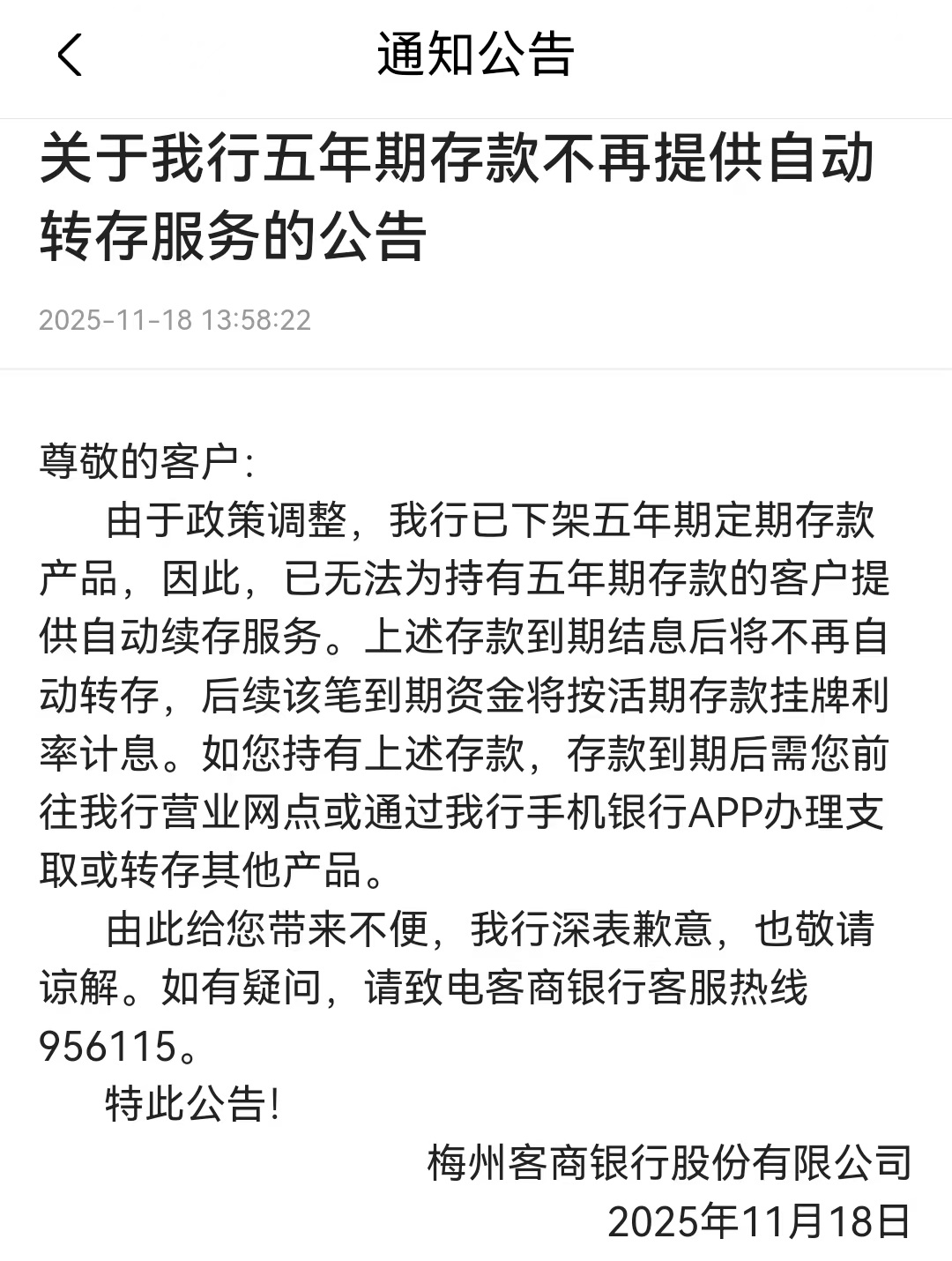
Core Viewpoint - The trend of small and medium-sized banks discontinuing long-term deposit products and lowering interest rates is closing the door on the "interest-earning era" for depositors [1][2]. Group 1: Discontinuation of Long-Term Deposit Products - Meizhou Commercial Bank announced the discontinuation of its five-year fixed deposit product and the termination of automatic renewal services due to policy adjustments [2]. - Several small and medium-sized banks have been phasing out five-year fixed deposit products, with notable examples including the announcement from Tuyuqi Mengyin Village Bank, which explicitly canceled its five-year fixed deposit product [5]. - A total of seven banks have removed five-year fixed deposits from their offerings, including Meizhou Commercial Bank and Zhongguancun Bank, with some also discontinuing three-year fixed deposits [6]. Group 2: Interest Rate Reductions - Many small and medium-sized banks have entered a new round of interest rate cuts to address the pressure on net interest margins, with significant reductions observed in recent months [8]. - For instance, Pingyang Pudong Village Bank reduced its three-year and five-year fixed deposit rates from 2.1% and 2.15% to 1.3% and 1.35%, respectively, marking a drop of 80 basis points [8]. - The overall trend shows that banks are aligning their deposit rates with larger institutions, leading to a flattening of previously higher rates [11]. Group 3: Impact on Banking Sector - The net interest margin for banks has been under pressure, with state-owned, joint-stock, private, and foreign banks all experiencing a narrowing of their margins compared to the previous year [12]. - Analysts suggest that the current low levels of net interest margins may deter banks from further reducing loan rates, as it could threaten their profitability [13]. - There is speculation that monetary policy may initiate a new round of interest rate cuts, which could lead to a further decline in deposit rates [14].