南京银行

Search documents
浦发银行南京银行跌约2% 垫底银行板块
Zhong Guo Jing Ji Wang· 2025-09-16 08:16
Group 1 - The core viewpoint of the article highlights the decline in stock prices of major banks, specifically Shanghai Pudong Development Bank and Nanjing Bank, amidst a broader downturn in the banking sector [1] - Shanghai Pudong Development Bank closed at 13.16 yuan, experiencing a drop of 2.01% [1] - Nanjing Bank closed at 10.82 yuan, with a decline of 1.99% [1] - The banking sector overall saw a decrease of 0.63% on the same day [1]


南京银行跌2.08%,成交额6.45亿元,主力资金净流出7518.15万元
Xin Lang Cai Jing· 2025-09-16 06:44
Core Viewpoint - Nanjing Bank's stock has experienced a decline in recent trading sessions, with a notable drop in both price and trading volume, indicating potential investor concerns and market volatility [1][2]. Financial Performance - As of June 30, 2025, Nanjing Bank reported a net profit of 12.619 billion yuan, reflecting a year-on-year growth of 8.84% [2]. - The bank's cumulative cash distribution since its A-share listing amounts to 45.939 billion yuan, with 17.128 billion yuan distributed over the past three years [3]. Stock Market Activity - On September 16, Nanjing Bank's stock price fell by 2.08%, closing at 10.81 yuan per share, with a total market capitalization of 133.65 billion yuan [1]. - The stock has seen a year-to-date increase of 3.44%, but has declined by 3.14% over the last five trading days, 5.01% over the last 20 days, and 7.69% over the last 60 days [1]. Shareholder Information - The number of shareholders as of June 30, 2025, was 75,500, a decrease of 5.26% from the previous period, while the average number of circulating shares per person increased by 29.37% to 161,432 shares [2]. - Hong Kong Central Clearing Limited is the ninth largest circulating shareholder, holding 351 million shares, an increase of 51.727 million shares from the previous period [3]. Business Overview - Nanjing Bank, established on February 6, 1996, and listed on July 19, 2007, primarily engages in various banking activities, including loans, bills, bond investments, and settlement services [1]. - The bank's revenue composition includes 48.79% from banking operations, 25.90% from funding operations, 24.98% from personal banking, and 0.33% from other services [1].
2.8亿落地!易点云可持续发展银团资金规模再升级
Cai Fu Zai Xian· 2025-09-16 06:28
Core Insights - Epoint Cloud has secured 280 million yuan in sustainable financing from eight banks, led by Fubon Bank, marking a significant step in its sustainable finance collaboration [1][3] - The financing amount represents a notable increase from the previous 220 million yuan syndicated loan, with the number of participating banks rising from five to eight, indicating broader financial support and recognition of Epoint Cloud's business model [3] Financing Details - The financing will primarily focus on enhancing Epoint Cloud's self-owned brand and technology research and development, strengthening its core competitiveness [4] - Epoint Cloud has already launched self-developed products like the AI01 integrated machine and AH21 workstation, which cater to the IT needs of small and medium-sized enterprises (SMEs) [4][6] Service Expansion - Epoint Cloud's core business direction is to serve SMEs, addressing their challenges with IT equipment costs, maintenance difficulties, and slow iterations through a subscription model and one-stop IT services [7] - The company has served over 52,000 SMEs and managed over 1.48 million devices, aiming to expand its service range and improve response efficiency with the new financing [7] Environmental Impact - Epoint Cloud's IT equipment recycling model has led to a cumulative carbon reduction of 254,000 tons, equivalent to planting 13.91 million trees, aligning with national carbon neutrality goals [7] - The company plans to explore "green supply chain cooperation" with its banking partners to enhance its recycling efforts across more industry segments [7] Market Position - The office IT comprehensive solution market has reached a scale of over 100 billion yuan and continues to grow steadily, with the new financing serving as a crucial support for Epoint Cloud's market expansion and technological advancement [9]

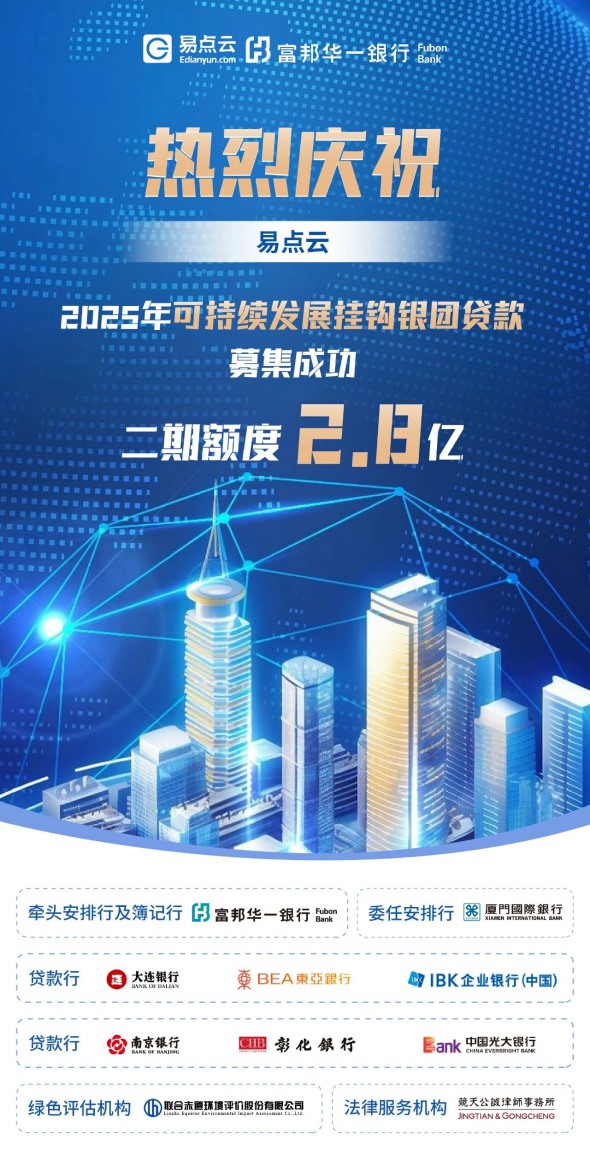
易点云签约8家银行获2.8亿可持续发展银团资金
Cai Fu Zai Xian· 2025-09-16 06:28
Core Insights - E-Dian Cloud has secured a sustainable development-linked syndicate financing of 280 million, led by Fubon Bank and supported by several other banks, indicating strong market recognition of its business model and growth potential [1][2] - The financing amount represents a nearly 30% increase from last year's 220 million, with the number of participating banks rising from 5 to 8, showcasing growing confidence in the company's innovative business model [2][4] Business Development and Market Position - E-Dian Cloud, a leader in the domestic office IT subscription service industry, has over 52,000 active enterprise clients, reflecting a year-on-year growth of 5.3%, and has serviced over 1.48 million devices, with an 11.3% increase in service equipment [5][6] - The company's subscription service model helps small and medium-sized enterprises reduce costs and enhance efficiency, aligning with the sustainable development goals pursued by financial institutions [5][8] Technological Innovation and Product Development - Since its establishment in 2014, E-Dian Cloud has focused on office IT services, investing heavily in technology research and development to create a strong competitive advantage [6] - The company has developed various proprietary technologies and products, including an intelligent scheduling system and a re-manufacturing factory detection robot model, which will be further enhanced by the new financing [6][10] Commitment to Sustainability - E-Dian Cloud integrates social responsibility into its business strategy, offering subscription services that alleviate the financial burden of IT procurement for SMEs, enabling over 80% of its partners to achieve digital transformation [8][10] - The company has achieved significant carbon reduction through its IT equipment recycling model, totaling 254,485 tons over the past decade, equivalent to planting over 13 million trees, setting a benchmark for green development in the office IT industry [10]
A股银行股普跌,宁波银行跌2%
Ge Long Hui· 2025-09-16 02:22
Core Viewpoint - The A-share market experienced a widespread decline in bank stocks, with several banks showing significant drops in their share prices [1] Group 1: Stock Performance - Ningbo Bank's stock fell by 2% [1] - Qingdao Bank, Chongqing Rural Commercial Bank, Changshu Bank, Nanjing Bank, Shanghai Pudong Development Bank, Jiangyin Bank, and CITIC Bank all saw declines of over 1% [1]

认可长期投资价值 上市银行掀起增持潮
Shen Zhen Shang Bao· 2025-09-15 23:00
Group 1 - The core viewpoint is that several listed banks in China, including Everbright Bank and Nanjing Bank, have seen significant share buybacks by their major shareholders, indicating confidence in the banks' future development and long-term investment value [1][2] - Since September, a total of eight listed banks have experienced intensive share buybacks from shareholders or executives, reflecting a trend in the banking sector [1] - Everbright Bank's major shareholder, Everbright Group, plans to increase its stake in the bank by investing between 50 million to 100 million yuan, with a current buyback of 13.97 million shares, representing 0.02% of the total share capital [1] Group 2 - Nanjing Bank's major shareholder, Nanjing Zijin Investment Group, has increased its stake through its subsidiary, Zijin Trust, acquiring 56.78 million shares, which raised its total holding from 12.56% to 13.02% [1] - The rationale behind these buybacks is attributed to the shareholders' and management's confidence in the banks' future prospects and recognition of their long-term investment value [2] - Market analysts view the frequent buybacks by insiders as a positive signal, suggesting that they believe in the current value proposition of the banking sector [2]

谁在给银行股“站台”?股东高管集体出手,多家银行迎增持
Nan Fang Du Shi Bao· 2025-09-15 11:55
Core Viewpoint - Recent months have seen a surge in share buybacks by major shareholders and executives of listed banks, reflecting confidence in the banks' future prospects and long-term investment value [2][12]. Group 1: Share Buybacks - Multiple listed banks, including Huaxia Bank, Suzhou Bank, Nanjing Bank, and Everbright Bank, have announced significant share buybacks by shareholders and executives since September [2]. - Everbright Bank's major shareholder, Everbright Group, plans to increase its stake by investing between 50 million and 100 million yuan, with a reported increase of 13.97 million shares, representing 0.02% of the total share capital [3]. - Nanjing Bank's major shareholder, Zijin Investment Group, increased its stake by 5.68 million shares, raising its total holding from 12.56% to 13.02% [5][7]. - Huaxia Bank reported that its executives completed a share buyback plan, acquiring 4.23 million shares for 31.90 million yuan, exceeding the original plan [8]. - Suzhou Bank's executives, including the chairman and president, plan to buy at least 4.2 million yuan worth of shares, funded by their own resources [10]. Group 2: Financial Performance - In the first half of the year, 42 listed banks reported a combined revenue of approximately 2.92 trillion yuan and a net profit of over 1.1 trillion yuan, with more than 60% of institutions achieving growth in both revenue and profit [2][15]. - The banking sector has shown resilience, with significant growth in wealth management and other light capital businesses, supporting the buyback actions by shareholders and management [2][13]. - The banking sector has become one of the best-performing sectors in the A-share market, with the China Securities Bank Index rising by 15.6% [15]. - The majority of listed banks have increased their mid-term dividends, enhancing investor confidence and creating a positive cycle of performance recovery, increased dividends, and rising stock prices [15].

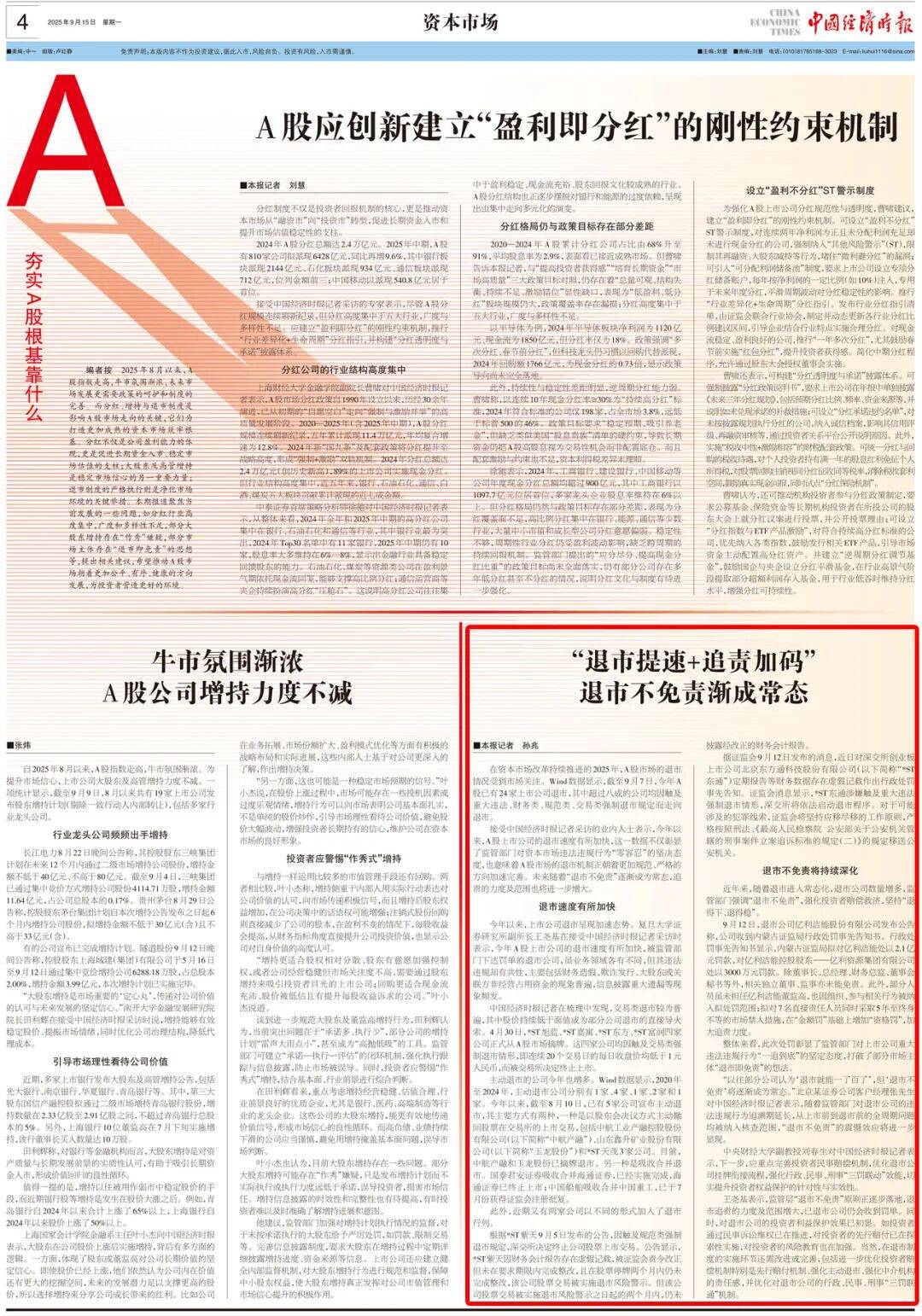
资本市场丨牛市氛围渐浓 A股公司增持力度不减
Sou Hu Cai Jing· 2025-09-15 05:56
Group 1: Market Overview - Since August 2025, the A-share index has been rising, creating a bullish market atmosphere, which requires policy support and institutional improvements for future development [1][3][13] - The focus is on dividends, share buybacks, and delisting systems as key factors influencing the direction of the A-share market [1][3] Group 2: Shareholder Actions - As of September 9, 2025, 19 listed companies announced shareholder buyback plans, including several industry leaders [3][13] - Major shareholders and executives have been actively increasing their stakes, with significant announcements from companies like China Yangtze Power and Kweichow Moutai, indicating confidence in their long-term value [4][5][13] Group 3: Dividend Trends - In 2024, total dividends from A-shares reached 2.4 trillion yuan, with 89% of listed companies distributing dividends, although the distribution remains concentrated in five major industries [10][11] - The banking sector has been a significant contributor to dividends, with major banks consistently ranking high in dividend payouts [10][11] Group 4: Regulatory Environment - The A-share market is seeing an acceleration in delisting, with 24 companies delisted by September 7, 2025, primarily due to financial misconduct and regulatory violations [16][18] - The trend of "delisting without exemption" is becoming more common, indicating a stricter regulatory environment aimed at enhancing market integrity [16][19] Group 5: Recommendations for Improvement - Experts suggest establishing a rigid "profit equals dividend" mechanism to enhance the dividend culture and ensure more equitable distribution among companies [10][12] - There is a call for improved transparency and accountability in shareholder buyback and dividend announcements to prevent misleading practices and enhance investor confidence [8][9][12]


6股获杠杆资金大幅抢筹
Zheng Quan Shi Bao Wang· 2025-09-15 05:33
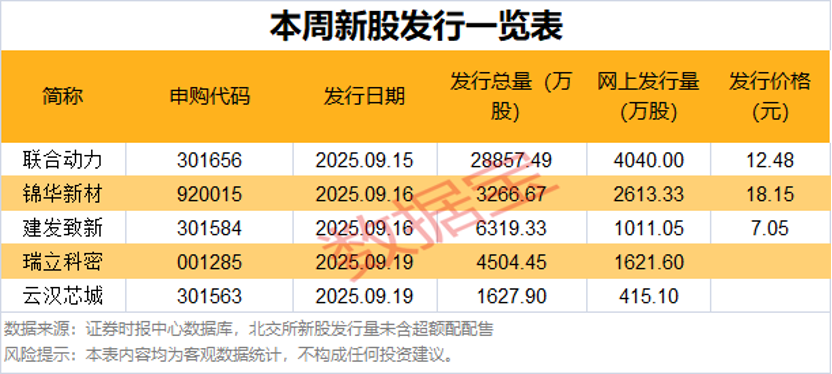
Market Overview - Major market indices opened higher collectively on September 15, with significant gains in the automotive parts sector, highlighted by Haoen Automotive's stock hitting the daily limit up [1] - The smart driving concept stocks performed strongly, with Zhejiang Shibao and Luchang Technology also reaching the daily limit up [1] - The battery sector saw notable increases, with stocks like Baile Technology and Tianci Materials hitting the daily limit up, while companies like Hunan Youneng and Ningde Times rose over 10% [1] Automotive Industry - The China Automotive Industry Association released the "Supplier Payment Norms Initiative" on September 15, which aims to standardize payment practices within the automotive supply chain [1] - The Ministry of Industry and Information Technology, along with eight other departments, issued the "Automotive Industry Stabilization Growth Work Plan (2025-2026)," promoting the industrial application of smart connected technologies and the trial production of L3-level vehicles [1] Semiconductor Sector - The semiconductor sector showed active performance, with Shanghai Beiling's stock hitting the daily limit up, and other companies like Shengbang Co. and SIRUI Technology rising over 10% [2] New Stock Offerings - Five new stocks are set to be issued this week, with United Power available for subscription on September 15. United Power is a leading player in the new energy vehicle power system sector, focusing on electric drive systems and power systems [3][4] Financing Activities - As of September 12, the total market financing balance reached 2.33 trillion yuan, increasing by 11.28 billion yuan from the previous trading day, marking six consecutive days of growth [5] - Six stocks recorded net financing purchases exceeding 500 million yuan, with Chip Origin leading at 964 million yuan, followed by Cambrian and Luxshare Precision [6][7] Shareholder Activity - In the past five trading days, 26 companies saw significant shareholder increases, totaling 2.37 billion shares and 2.1 billion yuan in value. Nanjing Bank had the highest increase, with 56.78 million shares and 639.34 million yuan [8][9]
资本市场丨“退市提速+追责加码” 退市不免责渐成常态
Sou Hu Cai Jing· 2025-09-15 04:33
Core Viewpoint - The A-share market is experiencing a bullish trend since August 2025, necessitating policy support and institutional improvements to foster a mature capital market. Key factors influencing the market include dividend policies, share buybacks, and strict delisting regulations, which are essential for stabilizing market valuations and attracting long-term capital [1][2][15]. Dividend Policies - The total dividend payout in A-shares reached 2.4 trillion yuan in 2024, with 810 companies planning to distribute 642.8 billion yuan in the first half of 2025, a 9.6% increase year-on-year. The banking sector accounted for 214.4 billion yuan, while the petrochemical sector contributed 93.4 billion yuan [9][10]. - Despite record-high dividends, the distribution is highly concentrated in five industries, indicating a lack of diversity and breadth in dividend payments. The establishment of a "profit equals dividend" mechanism is suggested to enhance transparency and encourage broader participation in dividend distribution [9][10][11]. Delisting Mechanism - As of September 7, 2025, 24 companies have been delisted from the A-share market, with over 80% due to severe violations, including financial fraud and regulatory non-compliance. This reflects a stricter and more standardized delisting mechanism being implemented by regulatory authorities [2][15][17]. - The trend of voluntary delisting has also increased, with five companies opting for this route in 2025, compared to previous years where the numbers were significantly lower [4][15]. Share Buybacks and Stake Increases - Since August 2025, there has been a notable increase in share buyback announcements and stake increases by major shareholders and executives, aimed at boosting market confidence. For instance, major shareholders of companies like Yangtze Power and Kweichow Moutai have announced substantial buyback plans [12][13]. - The increase in share buybacks is seen as a stabilizing factor for stock prices and a signal of confidence in the company's long-term value, especially following significant price increases in the banking sector [12][14]. Regulatory Environment - The regulatory environment is evolving towards a "delisting does not exempt from liability" principle, which emphasizes accountability for companies that are delisted due to misconduct. This includes potential penalties and legal actions against responsible parties, reinforcing the message that delisting does not absolve companies from their obligations [6][17][18]. - There is a call for improvements in investor compensation mechanisms and the establishment of a more robust framework for handling delisted companies, including civil, administrative, and criminal penalties [7][17].