SpaceX

Search documents
全球卫星航天- 数据中心机遇与电信风险:专家网络研讨会要点-Global Satellite_ Space - Datacentres Opportunity and Telecom Risk — Key Takeaways from our expert webcast
2026-02-24 14:19
Summary of Key Takeaways from the Webcast on "Space - Datacentres Opportunity and Telecom Risk" Industry Overview - The discussion focused on two main themes: the potential for space data centres and the role of satellite connectivity in the telecom market [2][6]. Core Insights 1. **Space Data Centres Viability**: - Space data centres are not yet operational but could become feasible due to unlimited low-cost solar energy, passive radiative cooling, and no real estate costs [3][6]. - Engineering challenges, particularly in cooling solutions, need to be addressed, with a target launch cost of approximately $200/kg or less for viability [3][5]. 2. **Investor Concerns on Satellite Competition**: - Concerns regarding satellite competition to telecoms and tower companies are considered overstated [2][6]. - Satellite technology is expected to complement rather than compete with terrestrial telecom services due to capacity constraints and service quality issues [2][6]. 3. **Rural Connectivity**: - Telcos can utilize satellite technology to extend coverage into rural areas where terrestrial infrastructure is costly [2][6]. - This could lead to modest downside risks for tower companies if rural connectivity shifts to satellite solutions [2][6]. 4. **Market Sentiment and Stock Ratings**: - For tower companies like Cellnex and INWIT, some satellite risks are already reflected in their stock prices, with no immediate catalysts for re-rating [2][6]. - For telecom companies such as T-Mobile US (TMUS), there is potential for a re-rating as investor concerns diminish over time [2][6]. - A bullish outlook is maintained for European telecoms, with recommended stocks including BT, Nordics, Deutsche Telekom (DT), and KPN [2][6]. 5. **Satellite Connectivity Economics**: - Satellite economics depend on launch costs and capacity monetization, with a focus on high-value segments [6]. - Low Earth Orbit (LEO) capacity constraints limit the scalability of satellite services, particularly in densely populated areas [6]. 6. **Complementary Services**: - Both space data centres and satellite connectivity could serve as complementary services to existing terrestrial offerings, potentially bridging the global data centre supply-demand gap [6]. Additional Important Points - The potential for space data centres to charge premium fees for specific use cases, such as geographically sensitive data, was highlighted [6]. - The relatively short lifecycle of satellites (5-7 years) leads to high maintenance and replacement costs, impacting their competitiveness [6]. This summary encapsulates the key points discussed in the webcast, providing insights into the future of space data centres and satellite connectivity within the telecom industry.
太空-Varda 太空制造:轨道制药-Space-Varda Space Space Manufacturing, Pharma Made in Orbit
2026-02-24 14:17
Summary of Varda Space Conference Call Company Overview - **Company**: Varda Space - **Industry**: Space Manufacturing, specifically focusing on pharmaceuticals produced in microgravity environments Key Points and Arguments - **Space Economy Expansion**: The space economy is primarily focused on launch vehicles and satellite communications, but there are broader commercial opportunities emerging, including manufacturing, defense, and exploration [7][8] - **Historical Context**: Manufacturing in space has been explored since the 1970s but has not been commercialized due to high launch costs and regulatory challenges [7][8] - **Unique Manufacturing Benefits**: Microgravity allows for the production of pharmaceuticals with improved size, uniformity, and purity, potentially leading to better drug formulations [7][8] - **Successful Demonstrations**: Varda's W-1 mission successfully manufactured HIV drug Ritonavir crystals in orbit, demonstrating the viability of in-space pharmaceutical manufacturing [15][28] - **Cost Reduction**: Reusable rockets have significantly reduced launch costs, making space manufacturing more economically feasible [7][19] - **Regulatory Challenges**: There are significant hurdles related to FDA approval for drugs manufactured in space, which currently do not exist [33][35] Additional Important Content - **Partnerships and Collaborations**: Varda collaborates with various organizations, including NASA and United Semiconductors, to enhance its manufacturing capabilities and explore new markets [59][65] - **Future Missions**: Varda aims to increase the frequency of its missions, with a goal of achieving near-monthly reentry by the end of 2028 [44][50] - **Market Focus**: The primary focus is on biopharma, specifically the crystallization of existing active pharmaceutical ingredients (APIs) [42][45] - **Potential Competitors**: Other companies like Space Forge and Redwire are also exploring space manufacturing, but Varda's focus on pharmaceuticals sets it apart [60][61] Financial Overview - **Funding**: Varda has raised a total of $328 million, with significant funding rounds occurring in 2021, 2024, and 2025 [65][69] - **Valuation**: Specific valuation details are not disclosed, but the company has attracted notable investors, indicating strong market interest [65] Conclusion Varda Space is positioned at the forefront of a potentially transformative sector within the space economy, focusing on pharmaceutical manufacturing in microgravity. While there are significant challenges ahead, particularly in regulatory approval and market demand, the company's successful demonstrations and strategic partnerships suggest a promising future in this innovative field.
太空算力-以星辰为节点-筑算力新接口
2026-02-24 14:16
Summary of Key Points from the Conference Call on Space Computing Industry Overview - The focus is on space computing, which utilizes near-Earth solar energy and low-temperature environments to outperform terrestrial computing in energy and heat dissipation efficiency. Solar radiation time can reach over 90%, reducing operational costs and enhancing data transmission and computing efficiency [1][2][3]. Core Concepts and Arguments - **Definition of Space Computing**: Space computing refers to deploying computational capabilities in space, allowing for real-time data processing in orbit. This includes integrating radiation-resistant chips and communication terminals to create a distributed orbital computing network [2]. - **Advantages Over Traditional Computing**: Space computing offers significant energy and cooling advantages. The stable energy supply from solar radiation in low Earth orbit and the near-zero temperature environment optimize operational costs compared to traditional data centers, which require extensive energy and complex cooling systems [3]. - **Resource Allocation**: Space computing addresses the uneven distribution of terrestrial computing resources, allowing for flexible resource allocation from space to meet demand in urban areas while alleviating pressure on remote regions [6]. Technological Developments - **Current Focus Areas**: The technology is primarily concentrated on low Earth orbit satellite constellations aimed at optimizing computational efficiency. This approach allows for direct data processing in space, significantly improving data utilization and effectiveness [4][5]. - **Future Trends**: The trend is towards integrated computing between space and Earth, addressing the imbalance between limited terrestrial resources and growing demand [7]. Global AI and Energy Landscape - **AI Demand Growth**: The global demand for computing power is rapidly increasing, with a projected growth rate of 54% in 2023. Energy resources are becoming a limiting factor for the expansion of AI data centers, which are expected to consume 415 TWh of electricity by 2024, representing 1.5% of global electricity consumption [8][9]. - **Energy Supply Challenges**: The current energy supply significantly impacts AI development, with nuclear power being stable but facing safety concerns, while fossil fuels are limited by high carbon emissions. This disconnect necessitates exploring new solutions like space computing [10]. Economic Considerations - **Cost Advantages of Space Data Centers**: Although initial investments in space computing are high, operational costs are expected to decrease as technology matures. In contrast, the costs for terrestrial data centers are likely to rise due to energy supply constraints, potentially making space data centers more economically viable in the long run [14]. International Landscape - **US vs. China in Space Computing**: The US relies on commercial space and tech giants for advancements in space computing, while China is led by government initiatives and collaborative projects. Key US players include SpaceX and Google, while China focuses on projects like the Morning Light satellite constellation and the Star Computing Plan [15]. Development Plans - **Beijing Star Future Space Technology Research Institute**: Plans to establish a space computing center in three phases, focusing on key technology breakthroughs and cost reductions from 2025 to 2035 [16]. - **Zhijiang Laboratory's Goals**: Aiming to launch 1,000 satellites by 2030, achieving a total computing power of 1,000 POPS [17]. Investment Opportunities - **Key Areas for Investors**: Investors should focus on upstream hardware and foundational support, such as rocket launches and satellite platforms, as well as midstream system integration and operations. Downstream applications include various sectors like disaster warning and smart cities. Notable companies to watch include communication and energy firms, as well as space computing operators like SpaceX [20].
商业航天-太空光伏大有可为
2026-02-24 14:16
Summary of Key Points from the Conference Call Industry Overview - The conference call focuses on the commercial aerospace industry, particularly the significance of satellite solar wings due to the rapid increase in satellite numbers and the expansion of individual satellite solar wing areas, driven by urgent domestic needs for satellite internet construction in China [1][3]. Core Insights and Arguments - **Importance of Satellite Solar Wings**: Satellite solar wings are crucial in commercial aerospace for two main reasons: the exponential growth in satellite numbers and the significant increase in the area of solar wings per satellite. This is particularly relevant for traditional communication, navigation, and remote sensing satellites, which have a pressing need for internet networking [3]. - **Space Computing as a Core Variable**: By the end of 2025, space computing will be a core variable in commercial aerospace, enabling AI training and inference in space to become the most cost-effective solution. This will broaden satellite application scenarios and elevate overall expectations for satellite numbers [5]. - **Challenges in Space Computing**: Despite optimism in the industry regarding space computing, challenges such as heat dissipation and cost remain. Long-term solutions may involve cost reduction measures through heavy rockets and engineering validation [6]. - **Technological Approaches**: The U.S. primarily uses the PERC silicon solution, which is cost-effective but has lower efficiency (14%-18%). In contrast, China employs a triple-junction gallium arsenide solution with higher efficiency (30%-33%) but at a significantly higher cost (approximately five times that of silicon) [8]. Emerging Technologies - **Perovskite Solar Cells**: Perovskite solar cells are highlighted for their low cost, reduced material usage, and high specific power. They are flexible, which can help reduce rocket payloads and increase solar wing areas, thus providing more energy supply. Single-junction perovskite cells are seen as having immediate application potential [9]. - **Performance of Perovskite Cells**: Shanghai Port's perovskite cells have shown superior performance in space tests compared to gallium arsenide, with a small area efficiency of around 24%. Successful second-phase verification could lead to large-scale adoption [4][10]. Investment Opportunities - **Key Companies in the Space Photovoltaic Sector**: Investment focus includes both overseas and domestic supply chains. Notable companies include: - **Overseas**: SpaceX, which has a comprehensive supply chain and has passed factory audits with suppliers like Maiwei [12]. - **Domestic**: Companies such as Shanghai Port, Mingyang Smart Energy, and others are recognized for their significant potential in the solar energy sector [12][16]. - **Specific Investment Targets**: Companies with strong technological barriers and market potential include: - Maiwei (heterojunction battery equipment) - Yujing (monocrystalline wafer cutting) - Aotwei (string welding machine leader) - Liancheng CNC (monocrystalline furnace and cutting machine leader) [12]. Additional Insights - **Future Developments**: The second phase of perovskite cell testing is expected to validate their integration into solar wing energy systems, potentially replacing existing expensive technologies within a satellite's lifecycle of approximately five years [11]. - **Tesla's Expectations**: Tesla anticipates large-scale adoption of the TOPCon solution in the photovoltaic sector, which could benefit companies like Jiahui and Yijing [13][14]. This summary encapsulates the critical insights and developments discussed in the conference call, highlighting the commercial aerospace industry's trajectory, technological advancements, and investment opportunities.
国内首次实现一级箭体打捞回收-看好太空光伏国产链机会
2026-02-24 14:16
Summary of Conference Call Notes Industry Overview - The conference call discusses significant advancements in the domestic commercial aerospace sector, particularly focusing on the development of reusable rocket technology, which is expected to lower satellite launch costs and benefit satellite manufacturers such as 电科蓝天 (Electric Science Blue Sky), 君达 (Junda), and 美洋智能 (Meiyang Intelligent) [1][2]. Key Points and Arguments - **Milestone in Reusable Rocket Technology**: The successful recovery of the first stage of a rocket marks a critical breakthrough in reusable technology, enhancing the cost-reduction logic for commercial aerospace and paving the way for scalable applications in space computing [2]. - **Strategic Cooperation in Space Photovoltaics**: 金奥 (Jinao) and 建恒健康认证 (Jianheng Health Certification) have formed a strategic partnership to explore photovoltaic technology for space applications, indicating ongoing efforts by domestic manufacturers in the space photovoltaic sector, although it remains in the early stages [2]. - **Investment Opportunities in Space Photovoltaics**: Investment in space photovoltaics can be categorized into two main lines: overseas and domestic chains. The overseas chain is driven by Tesla and SpaceX's plan to build 200 GW of solar capacity in the U.S., benefiting equipment manufacturers and suppliers [3]. Recommended companies include 迈为 (Maiwei), 双良 (Shuangliang), and 海木星 (Haimuxing) [3]. - **Domestic Chain Development**: The advancement of reusable rocket technology is expected to enhance the value chain for satellite manufacturers, with short-term catalysts arising from these technological developments [3][4]. - **Silver Price Volatility**: Fluctuations in silver prices are squeezing profit margins for small and medium enterprises, accelerating industry consolidation. Leading manufacturers leveraging silver-minimization technology are expected to emerge stronger [7]. - **Regulatory Focus on Industry Competition**: The Ministry of Industry and Information Technology (工信部) has prioritized addressing excessive competition in the photovoltaic industry for 2026, aiming to improve profitability through capacity regulation and technological innovation [7][9]. - **Export Tax Policy Changes**: Changes in export tax policies are anticipated to lead to preemptive stocking and export rushes in Q1 2026, alongside rising silver prices pushing up overseas component prices. This may cause short-term demand fluctuations, but the long-term outlook remains positive [7][9]. Additional Important Insights - **Focus on Core Competitiveness**: It is recommended to prioritize companies with core competitive advantages that can benefit from the discussed trends, including traditional equipment suppliers and emerging materials and component manufacturers [8]. - **Future Trends in Solar and Energy Storage Markets**: The solar and energy storage markets are expected to grow significantly due to the overseas market developments driven by Tesla and SpaceX [6]. This summary encapsulates the key insights and developments discussed in the conference call, highlighting the advancements in the aerospace and photovoltaic industries, investment opportunities, and regulatory changes impacting the market.
太空光伏星辰大海-光伏设备-材料将受益
2026-02-24 14:16
Summary of Key Points from the Conference Call Industry Overview - The conference discusses the emerging field of space photovoltaic technology, driven by the need for sustainable energy solutions amid global electricity shortages, particularly in the US and China [1][2]. Core Insights and Arguments - **Energy Supply Bottleneck**: The US faces significant electricity supply challenges, with gas turbine orders extending to 2030 and slow progress in small nuclear and controlled nuclear fusion alternatives [1][2]. - **Space Photovoltaic Solution**: Elon Musk proposes space photovoltaic technology to harness solar energy in space, leveraging its cooling advantages in a vacuum environment to reduce energy costs significantly [1][2]. - **Production Goals**: Musk aims for SpaceX and Tesla to achieve an annual production capacity of 100 GW of photovoltaic components within the next 3-4 years [1][2]. - **Market Demand Projections**: By 2035-2040, the demand for space photovoltaic installations is expected to reach 200 GW, with a short-term target of 100 GW by 2030 [3][9]. Technological Pathways - **Key Technologies**: The main technological routes include Gallium Arsenide, Heterojunction (HJT), and potentially HJT combined with perovskite tandem technology, with HJT being particularly suitable for space due to its radiation resistance and thin-film capabilities [4][11]. - **Cost Comparison**: The operational cost of a 40 MW data center in space is projected to be around $8 million over 10 years, a 95% reduction compared to a similar facility on Earth costing approximately $167 million [5]. Beneficiary Companies - **Equipment and Material Companies**: Companies such as Mever, Aotaiwei, Jingsheng Mechanical & Electrical, and LONGi Green Energy are positioned to benefit from advancements in space photovoltaic technology [4][8]. - **Major Players**: Key players in the space photovoltaic sector include SpaceX, Blue Origin, and Starcloud, with SpaceX leading in progress [8]. Market Dynamics and Challenges - **Market Growth Potential**: The photovoltaic equipment market is expected to grow significantly, potentially reaching hundreds of billions to trillions in scale, driven by increased demand from data centers and space computing needs [10]. - **Industry Cycles**: The photovoltaic equipment industry has experienced cyclical fluctuations, with a recovery anticipated by 2026 as demand increases [12][13]. Investment Opportunities - **2026 Investment Outlook**: The first half of 2026 presents notable investment opportunities in solar photovoltaic technology, particularly with Musk's plans for a SpaceX IPO and the potential for a market catalyst driven by carbon neutrality initiatives [14]. Conclusion - The space photovoltaic industry is entering a competitive phase, with significant technological advancements and market potential, driven by the urgent need for sustainable energy solutions and the increasing demand for AI computing power.
商业航天-SpaceX复盘-技术与商业的极致平衡
2026-02-24 14:16
Summary of SpaceX Conference Call Industry Overview - The conference call focuses on the commercial space industry, specifically highlighting SpaceX's role in breaking the market monopoly previously held by the United Launch Alliance (ULA) through legal reforms and competitive practices initiated by the U.S. government [1][3]. Key Points and Arguments - **Legal and Market Environment**: The U.S. government revised laws to establish a legal framework for commercial space activities, promoting competition and breaking ULA's monopoly, which was heavily reliant on Boeing and Lockheed Martin [1][3]. - **Initial Funding and Support**: SpaceX benefited from NASA's funding and project support, alongside Elon Musk's personal investment of nearly $100 million, which facilitated the development of the Falcon 1 rocket and subsequent contracts [1][4]. - **Innovative Business Model**: SpaceX adopted a unique approach by focusing on rapid iteration of a single rocket model, aiming for the lowest average cost across the series rather than minimizing marginal costs for individual launches [1][5]. - **Cost Reduction through Reusability**: The company achieved significant cost reductions by mastering reusable rocket technology, which allowed it to secure over 80% of global commercial launch contracts [1][6]. - **Expansion of Market Demand**: SpaceX created new market demand by extending satellite communication services to end consumers, thus increasing launch frequency and leveraging low-cost access to space for scaling operations [1][7][8]. - **Performance Improvement of Falcon 9**: The Falcon 9 rocket improved its capabilities by approximately 30%-40% through high-frequency launches and rapid iterations, effectively controlling costs and enhancing performance [1][9]. - **Next-Generation Starship Innovations**: The Starship system incorporates several core improvements aimed at cost reduction, including full reusability, the use of liquid methane fuel, and advanced manufacturing techniques like 3D printing [1][10]. Additional Important Insights - **External Support for Development**: SpaceX's growth was significantly supported by U.S. policies, funding, and a robust aerospace industrial system, which domestic companies should emulate by seeking similar support and adopting rapid iteration strategies [1][11]. - **Current State of Domestic Commercial Space Industry**: The domestic commercial space industry is primarily focused on mid-to-upstream infrastructure development, with expectations of achieving a good commercial cycle by around 2030, aligning with government targets for satellite communication users [1][12].
Why the exploding secondaries market is hard to pin down
Yahoo Finance· 2026-02-24 11:53
Core Insights - The secondaries market is significantly large and expanding, but its true size remains uncertain due to structural opacity and lack of comprehensive data [1][3][6] Market Size and Estimates - PitchBook estimates that U.S. direct secondaries will trade between $62.5 billion and $120.9 billion in 2025, indicating a substantial margin of error [2] - The midpoint estimate of the secondaries market is $91.7 billion, with an additional $14.6 billion from GP-led venture secondaries, totaling $106.3 billion for U.S. venture secondaries in 2025 [6] Market Dynamics - The secondaries market is characterized by a lack of transparency, with many investors operating with incomplete information, similar to public market behaviors [3][4] - A significant concentration exists within the market, where the top 20 startups on the private stock marketplace Hiive accounted for 86.4% of secondary trading value in Q4 2025, with the top five companies alone making up 55.6% of that volume [5]
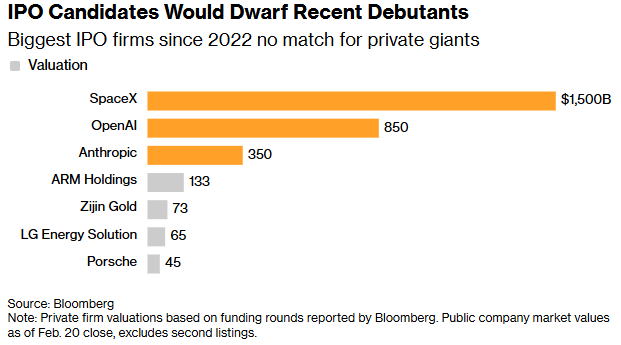
SpaceX 拟开启史上最大规模 IPO:500亿美元吸金效应或引发美股上市“避让潮”
智通财经网· 2026-02-24 11:24
智通财经APP注意到,亿万富翁马斯克正计划为SpaceX进行有史以来规模最大的 IPO ,这对现有投资 者和将获得巨额费用的投行来说是个好消息。 但有一个群体并不感到振奋,那就是其他也计划上市的公司。 SpaceX 可能通过在美国上市融资多达 500 亿美元,这可能为人工智能公司 Anthropic PBC 和 OpenAI Inc. 的 IPO 奠定基础。这两家公司跻身全球估值最高的私营企业之列,今年已采取措施准备上市。 随着马斯克的火箭与卫星制造商计划于 6 月首秀,它和其他潜在的巨额交易可能占据投资者的全部注意 力,并迫使那些权衡规模相对正常的 IPO 的公司设法避开它们。 IPO候选公司规模将远超近期上市的公司 私募股权投资公司 EQT AB 的全球股票资本市场主管马格努斯·托宁认为存在一种风险:如果启动时间 与重磅科技股 IPO 太近,大型资产管理公司可能不会关注规模较小的发行。 托宁在采访中表示,"我认为我们不会愿意出来竞争注意力。"他说,公司将转而尝试将其投资组合公司 的 IPO 时间表提前,至少在像 SpaceX 这样的超级大单出现前一个半月完成。 总部位于斯德哥尔摩的 EQT 正准备最快于今 ...

金丰来:巨型IPO来袭
Sou Hu Cai Jing· 2026-02-24 11:18
Group 1 - The core viewpoint is that SpaceX's planned mega IPO could reshape the capital market dynamics in 2026, with potential fundraising reaching hundreds of billions of dollars, making it one of the largest IPOs in history [1] - The concentration of large tech company IPOs may attract market liquidity and investor attention away from other companies, with AI firms like Anthropic and OpenAI seen as potential heavyweight IPO candidates [3] - Mid-sized companies may need to adjust their issuance windows to avoid direct competition with these massive projects, leading to increased pressure on asset management firms regarding portfolio allocation and cash management [4] Group 2 - Private equity firms face challenges in timing their market entries, as seen with EQT AB, which is planning to push its assets to the public market but must be cautious due to the impending mega IPOs [6] - If large tech companies perform well post-IPO, it could boost overall market sentiment and attract more long-term capital back to the new stock market, benefiting mid-sized and growth companies through a positive spillover effect [6] - The key for the IPO market in the near future will be the rhythm and timing of offerings, requiring companies to balance valuation, liquidity, and investor sentiment to achieve favorable outcomes [8]