中通客车

Search documents
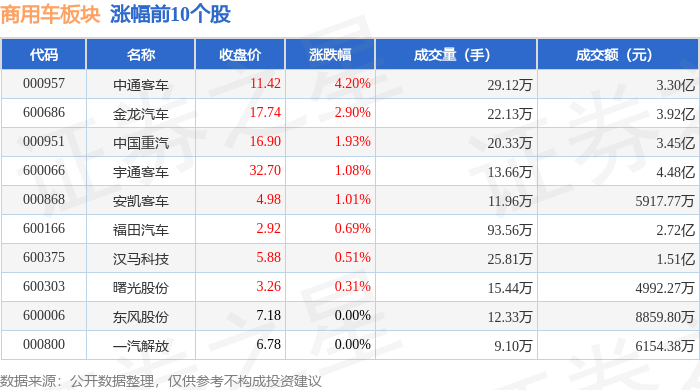
商用车板块12月31日涨0.25%,中通客车领涨,主力资金净流出8846.28万元
Zheng Xing Xing Ye Ri Bao· 2025-12-31 08:59
Group 1 - The commercial vehicle sector increased by 0.25% on December 31, with Zhongtong Bus leading the gains [1] - The Shanghai Composite Index closed at 3968.84, up 0.09%, while the Shenzhen Component Index closed at 13525.02, down 0.58% [1] - Key stocks in the commercial vehicle sector showed varied performance, with Zhongtong Bus closing at 11.42, up 4.20%, and Jinlong Automobile at 17.74, up 2.90% [1] Group 2 - The commercial vehicle sector experienced a net outflow of 88.46 million yuan from institutional investors, while retail investors saw a net inflow of 57.80 million yuan [2] - The trading volume and turnover for key stocks varied, with Jinlong Automobile having a turnover of 3.92 billion yuan and Zhongtong Bus at 3.30 billion yuan [2] - The net inflow from retail investors for several stocks, including Yutong Bus and Ankai Bus, indicated mixed investor sentiment [3]


今日92只个股跨越牛熊分界线
Zheng Quan Shi Bao Wang· 2025-12-31 08:55
Market Overview - The Shanghai Composite Index closed at 3968.84 points, above the annual line, with a slight increase of 0.09% [1] - The total trading volume of A-shares reached 24,617.43 billion yuan [1] Stocks Breaking Annual Line - A total of 92 A-shares have surpassed the annual line today, with notable stocks showing significant deviation rates [1] - The stocks with the highest deviation rates include: - Wajingke (8.82%) - Zhangyue Technology (8.44%) - Suoling Co., Ltd. (7.81%) [1] Detailed Stock Performance - The following stocks have notable performance metrics: - Wajingke: 20.00% increase, turnover rate of 14.94%, latest price at 37.80 yuan [1] - Zhangyue Technology: 10.00% increase, turnover rate of 12.20%, latest price at 22.12 yuan [1] - Suoling Co., Ltd.: 10.00% increase, turnover rate of 10.69%, latest price at 6.05 yuan [1] - Other stocks with significant increases include: - Desheng Technology: 10.03% increase - Nanxing Co., Ltd.: 10.00% increase [1] Additional Stocks with Minor Deviations - Stocks with smaller deviation rates that have just crossed the annual line include: - Guifaxiang - Guangkang Biochemical - Shunwang Technology [1]


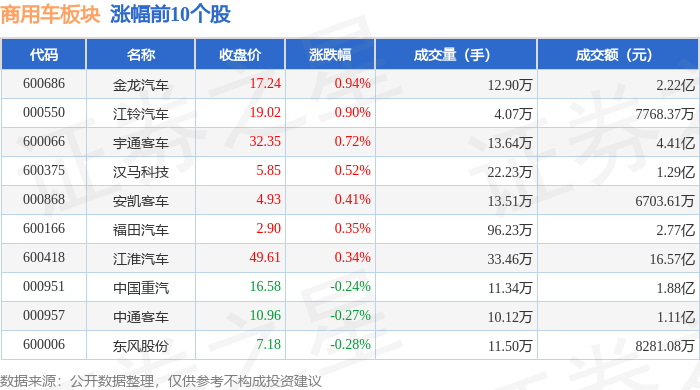
商用车板块12月30日涨0.27%,金龙汽车领涨,主力资金净流出9307.09万元
Zheng Xing Xing Ye Ri Bao· 2025-12-30 09:00
证券之星消息,12月30日商用车板块较上一交易日上涨0.27%,金龙汽车领涨。当日上证指数报收于 3965.12,下跌0.0%。深证成指报收于13604.07,上涨0.49%。商用车板块个股涨跌见下表: 从资金流向上来看,当日商用车板块主力资金净流出9307.09万元,游资资金净流入6316.26万元,散户资 金净流入2990.83万元。商用车板块个股资金流向见下表: | 代码 | 名称 | 主力净流入(元) | 主力净占比 游资净流入 (元) | | 游资净占比 散户净流入 (元) | | 散户净占比 | | --- | --- | --- | --- | --- | --- | --- | --- | | 000951 | 中国車汽 | 2942.02万 | 15.66% | -126.24万 | -0.67% | -2815.78万 | -14.98% | | 600686 | 金龙汽车 | 1813.28万 | 8.16% | 2706.60万 | 12.17% | -4519.88万 | -20.33% | | 000957 | 中通客车 | 946.80万 | 8.54% | 631.50万 | ...



中国巴士风靡东南亚,“曾经我们用日本和欧洲品牌,现在情况已大不相同”
Guan Cha Zhe Wang· 2025-12-30 08:28
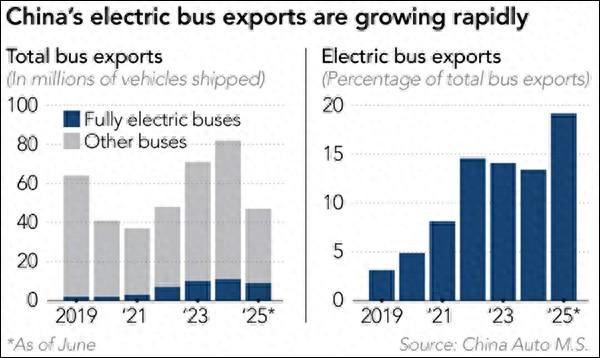
Core Insights - Indonesian public transport company has successfully integrated electric buses into its fleet, with a significant shift from traditional fuel sources to electric vehicles, highlighting the growing acceptance and preference for electric buses among drivers and operators [1] - Chinese electric vehicle manufacturers, particularly BYD, are rapidly expanding their presence in Southeast Asia, capitalizing on the region's increasing demand for electric buses as part of broader decarbonization strategies [1][2] Group 1: Market Trends - In 2024, China is expected to export over 15,000 new energy buses, marking a 25% year-on-year increase, with BYD, Yutong, and Suzhou Jinlong leading the market [2] - By the first half of 2025, China is projected to export approximately 9,000 pure electric buses, a staggering 124% increase compared to the previous year, indicating a robust growth trajectory in the electric bus sector [4] Group 2: Regional Developments - In Indonesia, BYD is collaborating with local company VKTR to establish an electric bus and truck assembly plant, aiming to deliver 50 buses by the end of December and an additional 30 by early 2026 [4] - Malaysia has already deployed at least 146 electric buses, with plans to significantly increase this number in the coming years, reflecting a strong commitment to electric vehicle adoption [5] - Singapore has awarded contracts for electric buses to Chinese manufacturers, with plans to procure over 2,000 electric buses by 2030, further demonstrating the region's shift towards electric public transport [6] Group 3: Local Manufacturing and Policy - VKTR has achieved 40% localization of bus components, qualifying for government incentives aimed at promoting electric vehicle production [4] - The Philippines has enacted legislation requiring government agencies to ensure that at least 5% of their vehicles are electric, which is expected to boost the adoption of electric buses in the country [6] Group 4: Challenges and Perceptions - Despite the positive outlook for Chinese electric buses in Southeast Asia, concerns have been raised regarding cybersecurity risks associated with these vehicles, as highlighted by accusations from European countries [8] - Yutong has denied allegations of remote control risks, emphasizing the technical safeguards in place to protect critical safety systems [9]
中通客车(000957) - 000957中通客车投资者关系管理信息20251230
2025-12-30 06:52
Group 1: Export Business Growth - The company's export business has accelerated significantly since 2022, driven by improvements in China's overall economy and export conditions [2] - The initial breakthrough in export markets was primarily in the Middle East, especially in Saudi Arabia, supported by China's enhanced national strength [2] - Future growth in the export business is expected to be stable, with demand for buses increasing due to global economic development and infrastructure expansion [2] Group 2: Internal Management Improvements - Recent performance growth is attributed to solid internal management enhancements, focusing on three main areas: marketing capability, operational control, and after-sales service efficiency [3] - The company has shifted from solely measuring sales volume to emphasizing operational quality in its marketing strategy [3] - Cost management and detailed oversight of production and operational expenses have been prioritized to drive refined management practices [3]
聊城开发区激发企业育人用人主体活力
Da Zhong Ri Bao· 2025-12-30 02:38
Core Viewpoint - The development of skilled talent in the Liaocheng Development Zone is highlighted through the recognition of individuals like Wang Enkui as "Qilu Chief Technicians," showcasing the region's commitment to enhancing its skilled workforce and aligning talent development with industrial needs [1][2]. Group 1: Talent Development Initiatives - The Liaocheng Development Zone has implemented innovative mechanisms for training and evaluating skilled talent, including a self-evaluation and filing system for enterprises, which simplifies recognition processes and enhances policy coverage [2]. - The focus on practical value in talent training aims to meet production demands and convert talent advantages into industrial and market competitiveness, thereby supporting the construction of a modern industrial system in the region [2]. Group 2: Case Studies of Skilled Technicians - At Zhongtong Bus Co., the innovation of high-skilled talents is evident, with the company nurturing 10 "Qilu Chief Technicians" and 4 provincial technical experts, demonstrating a strong culture of craftsmanship [2]. - A notable example is Qin Shanlei, who developed a new stainless steel handrail punching device that reduced the time for drilling from 5 minutes to 1 minute, significantly cutting costs on drill bits by over 10,000 yuan monthly [2]. Group 3: Future Plans for Talent Cultivation - The Liaocheng Development Zone plans to continue enhancing its talent cultivation policies, focusing on strategic emerging industries and future sectors, aiming to attract and develop more high-skilled talents [2]. - The goal is to build a large-scale, well-structured, high-quality, and distinctive skilled talent team to provide robust support for the high-quality development of the regional economy and society [2].
商用车板块12月29日跌0.33%,中集车辆领跌,主力资金净流出1.85亿元
Zheng Xing Xing Ye Ri Bao· 2025-12-29 09:06
Group 1 - The commercial vehicle sector experienced a decline of 0.33% on December 29, with CIMC Vehicles leading the drop [1] - The Shanghai Composite Index closed at 3965.28, up 0.04%, while the Shenzhen Component Index closed at 13537.1, down 0.49% [1] - Key stocks in the commercial vehicle sector showed varied performance, with Jianghuai Automobile up 1.06% and CIMC Vehicles down 3.09% [2] Group 2 - The net outflow of main funds in the commercial vehicle sector was 185 million yuan, while retail investors saw a net inflow of 179 million yuan [2] - The trading volume for Jianghuai Automobile was 481,400 shares, with a transaction value of 2.399 billion yuan [1] - The stock performance of major companies included a 1.06% increase for Jianghuai Automobile and a 3.09% decrease for CIMC Vehicles [2][3]

中国汽车ABS和ESC系统市场现状研究分析与发展前景预测报告
QYResearch· 2025-12-29 08:18
Core Viewpoint - The article discusses the current status and future trends of the automotive ABS (Antilock Brake System) and ESC (Electronic Stability Control) systems in the Chinese market, highlighting the transition from traditional mechanical braking to electronic and intelligent systems, driven by regulatory requirements and technological advancements [3][10][14]. Market Development Status and Future Trends - The revenue from the automotive ABS and ESC systems in China is projected to reach 12.31 billion yuan in 2024, with an expected decline to 6.022 billion yuan by 2031, indicating a compound annual growth rate (CAGR) of -10.10% from 2025 to 2031 [3]. - The market is experiencing a shift towards electronic hydraulic brake (EHB) systems, particularly the One-Box solution, which integrates multiple functions and is expected to penetrate the market significantly, with over 10 million units installed by 2024 [10][13]. Industry Concentration and Competition Analysis - Major players in the Chinese market include Bosch, Continental, ZF, Aisin, and others, with the top three companies holding approximately 65.25% of the market share in 2024 [7]. Technological Evolution - The transition from traditional hydraulic braking to ABS and ESC systems has been rapid, with ESC installation rates exceeding 90% in new passenger vehicles since 2020 [10]. - In the commercial vehicle sector, the market is primarily dominated by pneumatic braking systems, with a projected EBS penetration rate of 80% by 2025 for key models [11][12]. Driving Factors - Regulatory requirements are a significant driver, with ABS and ESC becoming mandatory for all new passenger and commercial vehicles in China [14]. - The growth in vehicle ownership and sales, particularly in the new energy vehicle segment, is expanding the market for ABS and ESC systems [15]. - The development of intelligent driving and ADAS (Advanced Driver Assistance Systems) is increasing the demand for enhanced vehicle dynamic control systems [16]. Constraints - The industry faces challenges such as reliance on imported high-end chips and core technologies, which creates barriers for domestic manufacturers [18]. - Intense price competition and the pressure on suppliers to reduce costs are compressing profit margins and limiting R&D investments [19]. - The lengthy certification process for new products poses significant entry barriers for new players in the market [20]. Supply Chain Analysis - The supply chain for automotive ABS and ESC systems includes upstream suppliers of raw materials, midstream manufacturers who integrate and assemble the systems, and downstream customers, primarily automotive OEMs [28][29]. - Key components of ABS and ESC systems include electronic control units (ECUs), hydraulic control units (HCUs), and various sensors, with a focus on technological integration and system performance [29][32].
中通客车跌2.04%,成交额1.20亿元,主力资金净流出2262.56万元
Xin Lang Zheng Quan· 2025-12-29 06:33
Core Viewpoint - Zhongtong Bus experienced a decline in stock price, with a current trading price of 11.02 CNY per share and a market capitalization of 6.534 billion CNY, indicating a net outflow of funds from major investors [1] Group 1: Stock Performance - As of December 29, Zhongtong Bus's stock price has increased by 1.37% year-to-date, but has decreased by 5.33% over the last five trading days [1] - The stock has shown a slight increase of 0.46% over the past 20 days and 0.54% over the past 60 days [1] Group 2: Financial Performance - For the period from January to September 2025, Zhongtong Bus reported a revenue of 5.655 billion CNY, representing a year-on-year growth of 33.58% [2] - The net profit attributable to shareholders for the same period was 277 million CNY, reflecting a year-on-year increase of 41.75% [2] Group 3: Shareholder Information - As of September 30, 2025, the number of shareholders for Zhongtong Bus was 70,500, a decrease of 11.29% from the previous period [2] - The average number of circulating shares per shareholder increased by 12.72% to 8,411 shares [2] - The company has distributed a total of 468 million CNY in dividends since its A-share listing, with 96.584 million CNY distributed over the last three years [3]
解放/重汽/东风/潍柴等超20家企业“换帅”,对2026影响几何?| 头条
第一商用车网· 2025-12-28 12:05
Core Viewpoint - The commercial vehicle industry in 2025 has undergone significant leadership changes across major companies, indicating a strategic shift in management amidst intense market competition [1][46]. Group 1: Major Company Leadership Changes - FAW Jiefang appointed Li Sheng as the new chairman, replacing Wu Bilei, and also saw a significant marketing leadership change with Yu Guangjiang taking over as the head of the marketing headquarters [1][9]. - China National Heavy Duty Truck Group (CNHTC) saw multiple leadership adjustments, with Liu Hongyong becoming chairman and Liu Zhengtai appointed as president [9][10]. - Dongfeng Motor Corporation experienced a series of leadership changes, including Zhang Xiaofan becoming chairman and Liu Liceng taking over as general manager [15][16]. - Weichai Power's president, Li Pengcheng, resigned due to work changes [17]. - Anhui Jianghuai Automobile Group announced a new leadership team with Xiang Xingchu as chairman and Li Ming as general manager [18]. Group 2: Other Notable Changes - The China Ordnance Industry Group appointed Zhou Zhiping as chairman [20]. - Beiben Heavy Truck Group appointed Liu Xiaodong as general manager [23]. - Foton Motor renewed the contract of its general manager, Wu Xibin [23]. - Guangzhou Automobile Group saw Feng Xingya take over as chairman, succeeding Zeng Qinghong [25]. - Changan Automobile Group was established as a new central enterprise, with Zhu Huarong as chairman and Zhao Fei as vice chairman [28]. Group 3: International and Joint Ventures - Cummins China announced several managerial changes across its joint ventures, including new appointments for general managers in various subsidiaries [40]. - Volvo Group China appointed Francis Sum as president, overseeing strategic planning and operations [41]. - ZF Group announced a leadership change with Matthias Miedreich becoming the new chairman [42]. - MAN Truck & Bus appointed Andrew O'Brooks as the new president for Greater China [43].