强脑科技

Search documents
周群飞破链攻坚年均投20亿研发 蓝思科技进军AI总市值破2000亿
Chang Jiang Shang Bao· 2026-01-11 23:43
Core Viewpoint - The news highlights the significant financing of approximately 2 billion RMB by BrainCo, a leading player in the brain-computer interface (BCI) sector in China, which has triggered a surge in related stocks, including a notable rise in Lens Technology's share price, reaching a historical high of 38.69 RMB per share, with a total market capitalization of 204.5 billion RMB [1]. Group 1: Company Overview - Lens Technology, led by Zhou Qunfei, has transitioned from being a "fruit chain" leader to a global AI hardware solution provider, with expectations for further achievements [2]. - Zhou Qunfei's journey from a factory worker to the head of a listed company illustrates her determination and strategic vision, which has been pivotal in the company's growth [3]. Group 2: Strategic Partnerships and Growth - The partnership with Apple has been crucial for Lens Technology, with Apple accounting for 70.96% of the company's total revenue in 2022, significantly boosting its financial performance [4]. - Lens Technology's revenue and net profit have seen substantial growth, with net profit reaching 4.896 billion RMB in 2020, although the company faces risks associated with its heavy reliance on a single client [4]. Group 3: Shift to AI and Innovation - In response to the risks of dependency on Apple, Lens Technology has shifted its strategic focus towards AI hardware, establishing a framework for growth that includes consumer electronics manufacturing and advancements in AI smart terminals and smart vehicles [5]. - The company has invested heavily in R&D, with expenditures exceeding 2 billion RMB annually over the past five years, leading to significant advancements in AI-related technologies [6]. Group 4: Financial Performance and Market Response - For the first three quarters of 2025, Lens Technology reported a revenue of 53.663 billion RMB and a net profit of 2.843 billion RMB, reflecting year-on-year growth of 16.08% and 19.91% respectively [7]. - The stock price of Lens Technology has shown a remarkable increase, from a low of 25.85 RMB per share in late November 2025 to a high of 40.05 RMB per share by January 9, 2026 [7]. Group 5: Capital Operations and Future Prospects - Lens Technology successfully raised approximately 4.768 billion HKD through its listing on the Hong Kong Stock Exchange, aimed at expanding AI hardware production capacity and enhancing technological research [8]. - The company is actively transforming from a "fruit chain supplier" to a "global AI hardware solution provider," marking a new phase in its development under Zhou Qunfei's leadership [8].

多重利好叠加释放 脑机接口板块“带飞”持仓基金净值
Zheng Quan Shi Bao· 2026-01-11 16:55
板块热度飙升 Wind数据显示,上周,万得脑机接口概念指数(8841700)大涨18.95%。相关概念股中,创新医疗收获 涨停五连板,南京熊猫、普利特分别录得涨停四连板,美好医疗、三博脑科等也连续4个交易日大涨。 脑机接口板块大涨的背后,是政策、技术、产业与资本的多重利好叠加释放。 2026年开年,脑机接口一跃成为全球科技与资本市场的焦点之一。 近日,特斯拉CEO马斯克宣布,旗下Neuralink公司将于2026年启动脑机接口设备的"大规模生产",并将 转向"更加精简和几乎完全自动化的外科手术流程",这一表态也迅速点燃了市场热情。几乎前后脚,国 内脑机接口独角兽企业强脑科技宣布完成了约20亿元融资,规模位居全球第二。 在海外量产预期、国内政策支持与临床突破的多重共振下,A股脑机接口板块掀起了涨停潮。在板块大 涨的这波行情中,提前埋伏其中的基金也明显受益,净值大幅攀升。 脑机接口,这个一度只存在于科幻作品中的概念,正加速走进现实。 政策、技术与资本共振 1月5日,华银健康生活主题灵活配置单日涨幅达11.8%,领跑全市场基金;长城消费增值混合、国泰创 新医疗混合等单日涨幅也超过10%,位居市场前十。根据2025年 ...
未来产业周报第5期:核聚变技术资本共振,脑机与量子进阶突破,氢能普及提速-20260111
Shenwan Hongyuan Securities· 2026-01-11 14:42
Quantum Technology - The report highlights the clear positioning of the NISQ (Noisy Intermediate-Scale Quantum) era, indicating that current quantum devices are operational but limited in capability, lacking fault tolerance and scalability. Experts estimate that small-scale fault-tolerant quantum computers will take about ten years to develop [8][9] - The collaboration between Argonne National Laboratory and Intel has successfully deployed a 12-qubit silicon-based quantum processor, demonstrating the value of mature silicon technology in scaling quantum computing [10] - D-Wave has showcased a scalable on-chip low-temperature control gate model quantum bit, significantly reducing wiring costs and addressing a major bottleneck in the industry [12][14] Biomanufacturing - Micro Yuan Synthesis has secured nearly 300 million yuan in financing to accelerate the development of methanol biomanufacturing, which addresses the reliance on food-based raw materials in traditional biomanufacturing [15][16] - The first gene-consistent human "lung chip" has been developed, providing a new tool for personalized treatment of respiratory diseases and potentially revolutionizing drug development by reducing reliance on animal models [18] Hydrogen Energy and Nuclear Fusion - Policies in Shanghai and other regions are reducing the operational costs of hydrogen vehicles through subsidies and free highway access, which is expected to significantly boost the adoption of hydrogen fuel cell vehicles [19][20] - The report notes that hydrogen energy is transitioning from being a major electricity consumer to a "regulator" of the grid, enhancing the consumption of renewable energy and long-term storage capabilities [25][28] - The Energy Singularity's "Honghuang 70" nuclear fusion device has achieved a 120-second steady-state operation, marking a significant milestone in commercial nuclear fusion technology [31] - Dongsheng Fusion has completed a multi-hundred million yuan angel round of financing to develop a "deuterium-helium-3" fusion route, which is considered safer and more cost-effective than traditional methods [32][33] Brain-Computer Interface - Strong Brain Technology has raised 2 billion yuan to scale brain-computer interface technology, aiming to help one million disabled individuals regain social functionality within five to ten years [38][39] - Sichuan Province has set maximum prices for brain-computer interface medical services, which will take effect in April 2026, facilitating the clinical application of this technology [40][41] - The first brain-computer interface deep brain stimulator surgery in Southwest China has been successfully performed, providing new treatment options for Parkinson's disease [42][43] Embodied Intelligence - NVIDIA has released several physical AI models and frameworks that support robots in understanding physical laws, enhancing the industrialization of robots across various scenarios [5][13] - Chinese companies represent nearly 25% of robot exhibitors at CES 2026, with humanoid robots making up over 50% of the exhibition area, showcasing the competitive edge of Chinese firms in this sector [5][13] Sixth Generation Mobile Communication (6G) - Nanjing has launched a special plan to build a 6G industrial ecosystem, aiming for full coverage of 6G non-cellular networks by 2027 and the establishment of over 50 vertical industry scenarios [5][14]
具身智能行业研究:上纬启元Q1正式亮相,宇树腾讯战略合作落地
SINOLINK SECURITIES· 2026-01-11 12:50
Investment Rating - The report indicates a positive investment outlook for the humanoid robotics sector, highlighting 2026 as a pivotal year for the realization of humanoid robots from concept to mass production [3][19]. Core Insights - The robotics industry is experiencing accelerated growth, with significant advancements in humanoid robot designs, including the announcement of Tesla's third-generation robot and the unveiling of the world's first fully controllable small humanoid robot, "Shangwei Q1" [1][24]. - Strategic collaborations are forming, such as the partnership between Tencent's Robotics X Lab and Yushun Technology, aimed at enhancing humanoid robot applications in various sectors [1][21]. - The report emphasizes the importance of technological convergence in the development of humanoid robots, with companies like Xiaopeng leveraging their expertise in smart vehicles to enhance robot capabilities [19]. Summary by Sections 1. Robotics - The robotics sector is witnessing a surge in activity, with a focus on commercial applications and ecosystem development. Companies are making strides in integrating AI services into robotics, enhancing their capabilities [8][9]. - The unveiling of the "Shangwei Q1" humanoid robot marks a significant step towards personal and family-oriented robotics, emphasizing portability and user-friendliness [24][26]. - Major industry players are collaborating to create robust ecosystems, as seen in the partnership between Tencent and Yushun Technology, which aims to deploy humanoid robots in cultural and commercial settings [21][22]. 2. Investment Recommendations - 2026 is projected to be a critical year for humanoid robots, with expectations for mass production and significant market penetration. The report identifies key areas for investment, including supply chain consolidation and technological advancements in electric drive systems and smart hands [3][19]. - The report suggests focusing on leading companies in the supply chain and technology sectors, as well as exploring opportunities in both domestic and international markets [3][19]. 3. Key Components - The report highlights the launch of the "CHOHO Hand" by Zhenghe Industrial, showcasing its capabilities and strategic partnerships aimed at enhancing the robotics ecosystem [2][28]. - The emphasis on core component innovation is critical, with companies like Zhishen Technology achieving significant funding to accelerate product development and market entry [28].




这个省社保科创基金的6支专项基金启航了
母基金研究中心· 2026-01-11 07:47
Core Viewpoint - The Zhejiang Social Security Science and Technology Innovation Fund has officially entered a comprehensive investment phase, marking a significant step in supporting technological innovation and economic development in Zhejiang Province [5][6]. Group 1: Fund Launch and Structure - The Zhejiang Social Security Science and Technology Innovation Fund has launched six specialized funds, including the Zhejiang New Industry Science and Technology Mother Fund and the Zhejiang Future Industry Science and Technology Mother Fund, each with a scale of 10 billion [5]. - The total investment amount for the first six projects signed at the conference exceeds 1.6 billion, covering sectors such as quantum science, artificial intelligence, integrated circuits, advanced manufacturing, and new materials [5]. Group 2: Strategic Goals and Future Directions - The fund aims to support national strategies for technological self-reliance and innovation in Zhejiang, emphasizing market-oriented operations and professional decision-making [6]. - The fund is designed to provide long-term, strategic, and patient capital, with a maximum duration of 18 years and an initial investable sub-fund size of nearly 300 billion [8]. Group 3: Collaboration and Investment Opportunities - The conference included a dialogue among scientists, investors, and entrepreneurs, promoting a healthy cycle between technology, industry, and finance [7]. - Zhejiang is positioned as a promising investment destination, with innovation becoming a new trend and artificial intelligence emerging as a key identifier for the region [8].

强脑科技 20 亿融资紧随 Neuralink,脑机接口赛道双线发力
Huafu Securities· 2026-01-10 11:04
Investment Rating - The industry rating is "Outperform the Market," indicating that the overall return of the industry is expected to exceed the market benchmark index by more than 5% in the next 6 months [14]. Core Insights - Strong Brain Technology has completed approximately 2 billion yuan in financing, making it the second-largest in the global brain-computer interface (BCI) sector, following Neuralink. This financing round was led by IDG Capital and Huaden International, with participation from industry chain companies, enabling product scaling through a "capital + manufacturing" model [4][6]. - The company focuses on non-invasive technology, with its core product, the "Super Sensor," capable of capturing brain electrical signals without the need for surgery. This technology has already assisted individuals with disabilities in performing complex movements, with plans to help one million disabled individuals regain mobility and assist ten million patients in rehabilitation over the next 5-10 years [4][6]. - Neuralink, a key player in the BCI field, is set to initiate large-scale production of BCI devices in 2026 and is advancing fully automated surgical solutions. This invasive technology complements Strong Brain Technology's non-invasive approach, collectively driving the commercialization of global BCI technology [5][6]. - The global BCI market is projected to grow rapidly, with an estimated market size of approximately 2.62 billion USD in 2024, expected to reach 2.94 billion USD in 2025, and potentially grow to 12.4 billion USD by 2034, reflecting a compound annual growth rate (CAGR) of 17.35% over the next decade. In China, the BCI market is anticipated to reach 3.2 billion yuan in 2024 and 6.14 billion yuan by 2028 [6]. Summary by Sections Financing and Market Position - Strong Brain Technology has secured around 2 billion yuan in financing, ranking second globally in the BCI sector, just behind Neuralink [4]. - The financing round was led by IDG Capital and Huaden International, with contributions from various industry chain companies [4]. Technology and Product Development - The company's non-invasive "Super Sensor" technology captures brain signals without surgery, aiding individuals with disabilities [4]. - Plans are in place to assist one million disabled individuals and ten million patients in rehabilitation over the next 5-10 years [4]. Market Growth Projections - The global BCI market is expected to grow from 2.62 billion USD in 2024 to 12.4 billion USD by 2034, with a CAGR of 17.35% [6]. - The Chinese BCI market is projected to grow from 3.2 billion yuan in 2024 to 6.14 billion yuan by 2028 [6].
36氪精选:脑机接口虚火?但再不下手就晚了
日经中文网· 2026-01-10 00:34
Core Viewpoint - The brain-computer interface (BCI) sector is expected to experience a significant wave of financing in 2026, driven by advancements in technology and supportive government policies [5][6][9]. Group 1: Market Dynamics - Non-invasive BCI company "Qiangnao Technology" recently completed a financing round of 2 billion yuan, igniting interest in BCI concept stocks [6]. - The BCI sector has seen a strong market response, with companies like Innovation Medical, Nanjing Panda, and Yanshan Technology experiencing stock price surges [7]. - Elon Musk's announcement regarding Neuralink's plans for large-scale production of BCI devices by 2026 has been a major catalyst for the current market enthusiasm [7]. Group 2: Investment Landscape - Major venture capital firms such as Sequoia China, IDG, and Baidu Ventures have invested in various BCI companies, indicating a broadening interest beyond just medical applications to technology and consumer sectors [9]. - The BCI market is transitioning from primarily medical investments to include technology and consumer-focused investments, particularly in consumer healthcare applications [9]. Group 3: Non-Invasive BCI Insights - Non-invasive BCI technology has a wide range of applications, including sleep monitoring, attention tracking, and treatment for mental health disorders, but has faced challenges due to high user education costs and product homogeneity [10][12]. - The technology has limitations in signal quality, as non-invasive methods like EEG struggle with signal clarity and resolution [10]. - Companies are shifting focus from pure brain control to developing smart prosthetics and other applications that utilize muscle signals and AI algorithms for better intent recognition [11]. Group 4: Invasive BCI Developments - Invasive BCI companies are navigating significant challenges, including safety, signal stability, and regulatory compliance, but have still managed to secure funding during market downturns [13]. - The evaluation of BCI companies has shifted from focusing solely on technical capabilities to assessing their overall operational capabilities and clinical trial progress [13]. - Notable invasive BCI companies include Borui Kang, which is pursuing a listing on the Science and Technology Innovation Board, and has reported successful clinical trials with significant patient improvements [14]. Group 5: Key Players and Innovations - Borui Kang has developed a semi-invasive BCI system that has shown promising results in clinical trials, achieving significant improvements in patient functionality [14]. - Ladder Medical focuses on ultra-flexible neural electrode technology and has successfully conducted clinical trials for spinal cord injury patients [15][16]. - Brain Tiger Technology, which aims to compete with Neuralink, utilizes silk protein for its electrodes, enhancing biocompatibility and reducing long-term damage [17]. Group 6: Future Outlook - The year 2026 is anticipated to be a pivotal moment for the BCI industry, with advancements in technology and regulatory support paving the way for broader adoption [22]. - The introduction of independent billing for BCI services by the National Healthcare Security Administration in 2025 reflects a commitment to supporting the industry's growth [22]. - Companies that establish a strong foothold in the BCI sector are likely to gain significant influence over future technologies, products, and standards [23].

嘉事堂:强脑科技相关问题近期已回复
Zheng Quan Ri Bao· 2026-01-09 12:37
Group 1 - The company Jia Shi Tang responded to investor inquiries regarding Qiang Nao Technology on its interactive platform, indicating that related questions have been addressed recently [2]

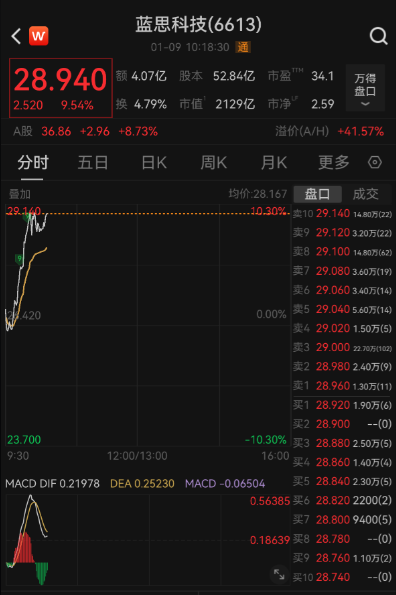
港股异动|助推脑机接口落地 蓝思科技H股涨超9%
Shang Hai Zheng Quan Bao· 2026-01-09 09:20
Group 1 - On January 9, 2023, Lens Technology's H-shares surged by 9.54%, reaching HKD 28.94 per share by 10:18 AM [1] - The company's market capitalization is approximately HKD 212.9 billion, with a price-to-earnings ratio of 34.1 and a price-to-book ratio of 2.59 [2] - The premium of Lens Technology's A-shares over H-shares is 41.57% [2] Group 2 - Lens Technology is a strategic investor in Qiangnao Technology, which recently completed a financing round of approximately RMB 2 billion [3] - The funds raised by Qiangnao Technology will be used to accelerate the research and development of brain-machine interface core technologies and to scale up production [3] - Lens Technology has a long-term partnership with a major North American client, serving as a primary core supplier for over 10 years [3]
蓝思科技联手强脑科技 一场“穿越颅骨”的工业突围
Xin Lang Cai Jing· 2026-01-09 06:43
Core Insights - The brain-computer interface (BCI) sector in China's A-share market has experienced a significant surge, driven by a major funding round of approximately 2 billion RMB for BrainCo, a leading player in the field, marking it as the second-largest single financing in the global BCI sector after Neuralink [2][23][25] - The partnership between BrainCo and Lens Technology signifies a transformative shift in the BCI industry from experimental research to large-scale industrial production, indicating a convergence of soft neural signals and hard manufacturing capabilities [4][26] Company Developments - Lens Technology has positioned itself as a strategic investor and the exclusive manufacturer of core hardware modules for BrainCo, highlighting its ambition to transition from a consumer electronics supplier to a key player in the BCI market [5][27] - The collaboration between Lens Technology and BrainCo is seen as a critical move for Lens, as it seeks new growth avenues amid declining returns from traditional consumer electronics [5][27][30] Market Dynamics - The BCI market in China is projected to reach 3.83 billion RMB by 2025, with non-invasive products accounting for approximately 82% of the market share, indicating a strategic focus on safer, less invasive technologies [9][30] - BrainCo's proprietary dry electrode sensor technology has eliminated the need for conductive gels, facilitating high-precision brain signal acquisition and enabling a wide range of applications from medical to consumer products [9][30][31] Technological Advancements - BrainCo has developed a diverse product matrix, including a brain-machine interface for social communication aimed at children with autism and a sleep aid device that has received FDA certification, showcasing its commercial viability [10][31] - The collaboration between BrainCo and Lens Technology is expected to accelerate the commercialization of BCI technologies, moving beyond research to practical applications that address real-world issues [10][31] Industry Landscape - The BCI industry in China is characterized by a dual-core structure, with significant contributions from institutions in Beijing and Shanghai, fostering a competitive environment for technological advancements [11][32] - Beijing's Brain Science and Brain-like Research Institute is leading in high-throughput semi-invasive wireless brain-machine systems, while Shanghai focuses on brain mapping and clinical applications, creating a robust ecosystem for BCI development [13][35] Future Outlook - The Chinese government aims to establish a reliable BCI industry system by 2030, with plans to cultivate leading global enterprises, indicating strong institutional support for the sector [19][41] - The next three to five years are anticipated to be a period of significant industry reshuffling, with potential volatility in stock prices and technological pathways, as the market matures [20][41]