中信银行

Search documents
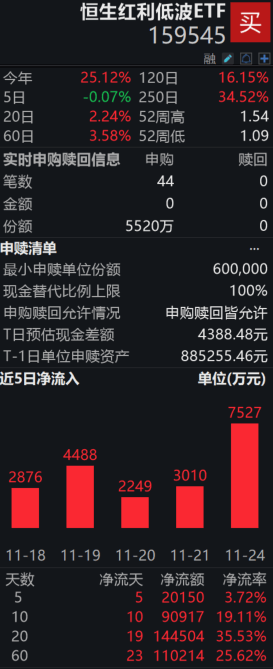
恒生红利低波ETF(159545)盘中资金净申购5520万份;险资巨头权益投资规模超8000亿,青睐高股息资产
Sou Hu Cai Jing· 2025-11-25 07:01
Core Viewpoint - The Hang Seng High Dividend Low Volatility Index (HSHYLV.HI) shows a slight increase of 0.14%, indicating a stable performance in the Hong Kong stock market, with notable movements in key stocks and significant inflows into related ETFs [1][3]. Group 1: Market Performance - The Hang Seng High Dividend Low Volatility Index (HSHYLV.HI) increased by 0.14% as of 13:31, with key stocks like Bank of China rising by 0.5% and North China Water Group increasing by 4.6% [1]. - The index's dividend yield stands at 5.77% as of November 24, reflecting its focus on high dividend-paying stocks [3]. Group 2: ETF Inflows - The Hang Seng Dividend Low Volatility ETF (159545) has attracted significant attention, with net inflows exceeding 200 million in the past five days and over 1.4 billion in the last 20 days [1]. - As of the latest report, the ETF has seen a net subscription of 55.2 million units during the trading session [2]. Group 3: Investment Strategy - Ping An Group's Deputy Chief Investment Officer highlighted the importance of increasing equity asset allocation in a low-interest-rate environment, with a focus on high dividend and growth strategies [3]. - The ETF's structure allows for quarterly evaluations of excess returns and profit distributions, enhancing cash yield stability for investors [4].

三家股份制银行AIC获批开业 能否破解科创企业融资难题?
Sou Hu Cai Jing· 2025-11-25 06:46
Core Viewpoint - The establishment of financial asset investment companies (AICs) by several joint-stock banks marks a significant expansion in China's banking sector, aimed at enhancing capital flow to technology innovation enterprises and optimizing financing structures [9][10][13]. Group 1: Recent Developments - Three joint-stock banks, including CITIC Bank, China Merchants Bank, and Industrial Bank, have recently received approval to establish their AICs, with registered capitals of 10 billion RMB for CITIC and Industrial Banks, and 15 billion RMB for China Merchants Bank [1][3][11]. - The establishment of these AICs is seen as a strategic move to support the development of technology finance and enhance the banks' comprehensive operational capabilities [13][14]. Group 2: Purpose and Function of AICs - AICs are designed to facilitate market-oriented debt-to-equity swaps, primarily aimed at helping enterprises reduce leverage and improve capital structures [9][10]. - The initial focus of AICs was on managing non-performing assets, but they are now evolving into market-driven asset management and investment institutions [10][12]. Group 3: Trends and Future Directions - The regulatory framework for AICs has expanded, allowing for broader investment activities beyond debt-to-equity swaps, including equity investments and corporate restructuring [10][12]. - The approval of AICs from joint-stock banks signifies a shift in the competitive landscape from state-owned banks to a more diversified banking system, enhancing the efficiency of financial resource allocation [14]. Group 4: Impact on Technology and Innovation - AICs are increasingly positioned as long-term capital providers for technology innovation, with a focus on sectors such as semiconductors, new energy, and high-end equipment [15][16]. - The combination of debt-to-equity swaps and equity investments allows AICs to offer comprehensive financial services to technology enterprises, addressing their unique financing challenges [15][16].



中信银行涨2.07%,成交额2.82亿元,主力资金净流入5044.17万元
Xin Lang Cai Jing· 2025-11-25 05:33
11月25日,中信银行盘中上涨2.07%,截至13:05,报7.88元/股,成交2.82亿元,换手率0.09%,总市值 4384.84亿元。 资金流向方面,主力资金净流入5044.17万元,特大单买入2305.28万元,占比8.17%,卖出411.33万元, 占比1.46%;大单买入9278.70万元,占比32.89%,卖出6128.48万元,占比21.72%。 中信银行今年以来股价涨19.03%,近5个交易日涨1.91%,近20日涨3.52%,近60日跌0.15%。 资料显示,中信银行股份有限公司位于北京市朝阳区光华路10号院1号楼6-30层,32-42层,香港九龙柯士 甸道西1号环球贸易广场80层,成立日期1987年4月20日,上市日期2007年4月27日,公司主营业务涉及 公司银行业务、零售银行业务及资金资本市场业务。主营业务收入构成为:公司银行业务46.40%,零 售银行业务38.28%,金融市场业务14.37%,其他业务及未分配项目0.95%。 中信银行所属申万行业为:银行-股份制银行Ⅱ-股份制银行Ⅲ。所属概念板块包括:低市盈率、破净 股、长期破净、中特估、中字头等。 机构持仓方面,截止2025年9 ...
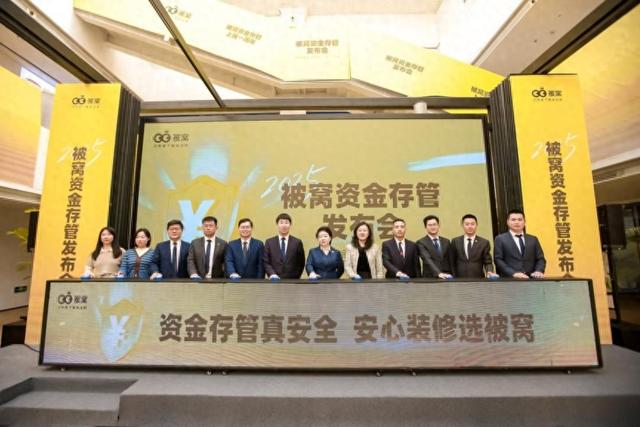
贝壳被窝整装资金存管上线一周年 超2.5万家庭获资金安全保障
Huan Qiu Wang· 2025-11-25 03:45
Core Viewpoint - The launch of the fund custody service by Beike Zhengzhuang marks a significant step towards enhancing consumer protection and promoting transparency in the home decoration industry, addressing long-standing issues related to payment and service quality [1][3][10]. Group 1: Fund Custody Service Overview - The fund custody service has been implemented in 43 cities, providing safety guarantees for over 25,000 families in home decoration [1]. - The service aims to address two main consumer pain points: loss of control after payment and lack of fund supervision, which can lead to misuse or fraud [3][5]. - The service operates through a mechanism involving milestone acceptance and bank disbursement, ensuring funds are released only upon consumer satisfaction at key stages of the renovation [5][7]. Group 2: Consumer Benefits and Industry Impact - The fund custody model allows consumers to have more control over their funds, enhancing their bargaining power and ensuring service quality [5][12]. - The service has led to a significant reduction in customer complaints, with complaints halved since its implementation, indicating improved service quality and consumer satisfaction [12]. - The model has been recognized as a response to national policies aimed at promoting high-quality development in the home decoration sector, contributing to a more trustworthy transaction framework [10][12][13]. Group 3: Future Directions and Industry Transformation - Beike Zhengzhuang plans to continue optimizing the fund custody service and expand its coverage to more cities and demographics, reinforcing its commitment to consumer welfare [13]. - The fund custody mechanism is seen as a catalyst for industry reform, pushing companies to focus on service quality and consumer rights, thereby driving high-quality development in the sector [12][13].
中信银行南昌分行走进老年大学开展“情暖夕阳红 防非金融行”宣传教育活动
Zhong Guo Jin Rong Xin Xi Wang· 2025-11-25 03:45
Core Viewpoint - The event organized by CITIC Bank Nanchang Branch aims to enhance the financial fraud prevention awareness and capabilities of the elderly, ensuring the safety of their retirement funds [1][2] Group 1: Event Overview - CITIC Bank Nanchang Branch conducted an interactive event at Nanchang Senior University, themed "Warm the Sunset Red, Prevent Financial Fraud," engaging over 300 elderly participants through interactive booths, video teaching, and thematic presentations [1] - The event included a quiz segment on fraud prevention knowledge, where participants discussed common risks such as "fake retirement financial products" and "impersonation scams" [1] Group 2: Educational Content - The bank staff presented a series of promotional videos specifically designed for the elderly, highlighting key fraud prevention points such as "any retirement service that requires upfront payment is a trap" and the importance of not disclosing personal banking information [2] - The "three no principles" were emphasized: do not trust unfamiliar information, do not disclose personal passwords, and do not transfer money to unknown accounts [2] Group 3: Future Initiatives - CITIC Bank Nanchang Branch plans to deepen its collaboration with senior universities, aiming to establish the "Warm the Sunset Red, Prevent Financial Fraud" initiative as a regular service brand [2] - The bank intends to provide more tailored promotional formats to meet the needs of the elderly, ensuring professional and caring financial protection services for them [2]
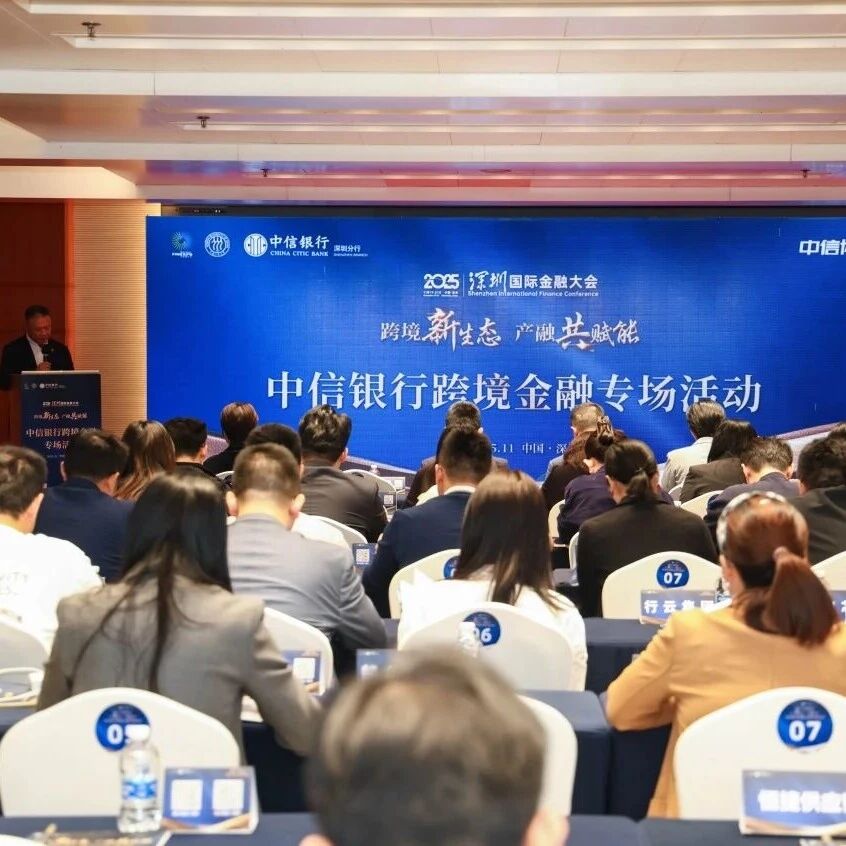
中信银行跨境金融专场活动暨中信银行深圳分行跨境金融中心揭牌仪式成功举办
Zhong Guo Ji Jin Bao· 2025-11-25 03:44
Core Insights - The event "Cross-Border New Ecology: Empowering Industry and Finance" held during the 19th Shenzhen International Financial Expo highlighted the establishment of the CITIC Bank Cross-Border Financial Center, aiming to enhance cross-border financial innovation and support high-quality development of the real economy [1][3][7] Group 1: Cross-Border Financial Center - The CITIC Bank Shenzhen Branch has established a cross-border financial center to provide integrated services for enterprises looking to expand internationally and attract foreign investment [4][5] - The center aims to offer a comprehensive range of services including cross-border settlement, financing, wealth management, and asset custody, facilitating a "one-stop, full-scenario, full-cycle" financial service for various market entities [5][6] Group 2: Policy and Market Context - Shenzhen is positioned as a key hub in the Guangdong-Hong Kong-Macao Greater Bay Area, benefiting from significant policy advantages and a high level of openness in cross-border trade and investment, with an annual import and export volume exceeding 3 trillion yuan [3][5] - The APEC cooperation framework is accelerating the construction of the Asia-Pacific Free Trade Area, with Shenzhen set to become a pivotal city in this initiative, leveraging its unique geographical and industrial advantages [3][6] Group 3: Financial Services and Support - CITIC Bank has provided over 10 billion yuan in cross-border RMB loans to support enterprises going abroad, alleviating financial pressures on overseas operations [5][6] - The bank's international business department emphasizes the integration of domestic and foreign currency services, enhancing the financial support for enterprises' global value chain layout [3][4]
中信银行跨境金融专场活动暨中信银行深圳分行跨境金融中心揭牌仪式成功举办
中国基金报· 2025-11-25 03:08
APEC合作框架下的深圳机遇 中信方案助力企业全球价值链布局 深圳作为中国改革开放的窗口、粤港澳大湾区的核心引擎,正以"前海30条"政策稳步落地形 成的显著制度红利、1700亿美元跨境贸易投资高水平开放试点规模的实践成果、跨境理财通 2.0业务在大湾区占比近半的市场份额、跨境电商业务规模持续领跑全国的成绩持续释放高质 量发展内生动力。 中信银行国际业务部(跨境金融中心)总经理漆文洪表示,当前,APEC合作框架下的亚太自 贸区建设加速推进,深圳即将作为中国APEC第三城,以独特的区位优势和产业活力,成为连 接国内国际双循环的关键枢纽。 为粤港澳大湾区跨境资金融通与全球产业金融中心建设注入强劲动能 11月21日,第十九届深圳国际金融博览会平行大会"跨境新生态·产融共赋能"中信银行跨境 金融专场在深圳福田成功举办,会上还举办了中信银行深圳分行跨境金融中心揭牌仪式。深 圳市委金融办、深圳市贸促会、中国人民银行深圳市分行、深圳市商务局、深圳市前海金融 发展局、中国信保、中信证券、中信银行总分行相关负责人、信银国际等嘉宾参加了会议。 本次活动紧扣金博会"产业金融新高地 科创赋能向未来"主题,以实际行动贯彻落实党的二十 届 ...
中国银行与地产_个人房产抵押贷款风险几何-China Banks and Property_ How risky are individual property-backed loans_
2025-11-25 01:19
Summary of Conference Call on China Banks and Property Industry Overview - The focus is on the Chinese banking sector and the property market, particularly the risks associated with property-backed loans and the implications for banks and borrowers [2][3][4]. Key Points 1. Rising Risks in Property-Backed Loans - Individual property-backed loan risks are increasing due to ongoing declines in property prices, raising concerns about potential defaults on mortgages and business operating loans [2][3]. - Key metrics indicating risk include: - **Foreclosed Properties**: 2.1 million units, or 1.8% of total properties with mortgages or loans [2]. - **Negative Cash Flow**: 1.2% of mortgage holders and 4.8% of all borrowers may have insufficient income to cover their loans [2][3]. - **Negative Equity**: Expected to rise from 0.7 million units in 2025 to 3.3 million units by 2027, with loan losses projected to reach RMB 232 billion [2][9]. 2. Cash Flow as a Key Driver of Defaults - Cash flow issues, rather than property price declines, are seen as the primary driver of potential defaults [3]. - Historical reference from Hong Kong (1997-2003) shows that despite significant property price declines, delinquency rates remained low, indicating that cash flow is a more critical factor [3][16][17]. 3. Regulatory Measures and Their Implications - Anticipated regulatory measures to mitigate risks include: - Personal credit relief policies to remove small defaults from credit reports [4]. - Delivery of over 7.5 million stalled housing units by the end of 2025 [4]. - Potential mortgage rate cuts below 3% [4]. - These measures could lead to increased secondary market listings, putting further pressure on property prices [4]. 4. Implications for Banks - The banking sector is expected to face manageable risks, with a projected NPL ratio of 3% (1.6% for mortgages and 4.8% for MSE/business operating loans) [5]. - Large state-owned banks may need to make additional provisions equivalent to 11-10 basis points of annualized credit cost [5]. - The estimated additional provisioning needed for banks could amount to RMB 0.3 trillion, representing 7.3% of annual PPOP in 2025 [74]. 5. Foreclosure and Refinancing Risks - The number of foreclosed properties is expected to rise significantly, with estimates of 0.64 million units in 2025 and 2.43 million units by 2027 due to refinancing pressures on business operating loans [25][27]. - The outstanding operating loan amount was RMB 29.4 trillion as of the end of 2023, with a significant portion backed by physical property [24]. 6. Market Sentiment and Future Expectations - A significant increase in respondents indicating they will not buy a house in the next two years, rising from 32% in 2024 to 45% in 2025, reflects a pessimistic outlook on the property market [62]. - Property prices are expected to decline by 10% in 2026 and 5% in 2027, following a 12% decline in 2025 [65][68]. 7. Potential Policy Responses - Forbearance measures, such as repayment extensions and penalty waivers, are expected to be implemented to contain defaults [69]. - The PBOC is considering reforms to the personal credit system to alleviate the impact of delinquencies on borrowers [71]. 8. Conclusion - The overall sentiment indicates that while risks in the property market and banking sector are rising, regulatory measures and cash flow management strategies may help mitigate potential defaults and systemic risks [3][4][5][68].

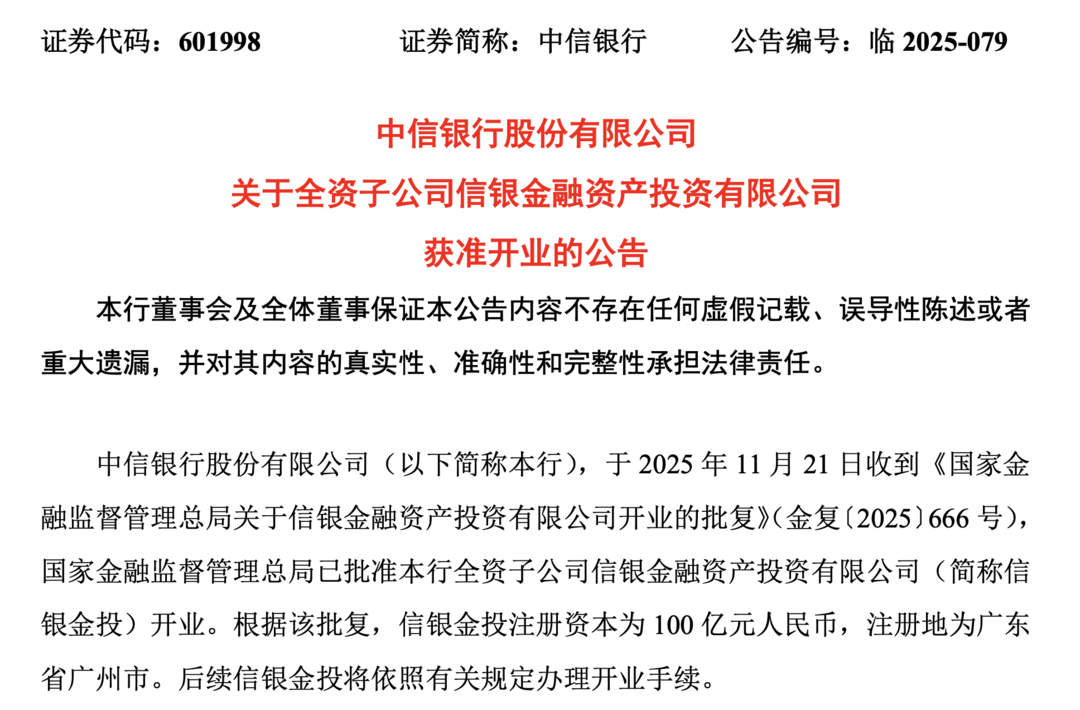
中信AIC落地广州
2 1 Shi Ji Jing Ji Bao Dao· 2025-11-24 23:17
Group 1 - CITIC Bank's wholly-owned subsidiary, Xinyin Financial Asset Investment Co., Ltd., received official approval to commence operations, marking a significant addition to the AIC sector within the banking system [1] - The establishment of Xinyin Financial Investment aligns with the ongoing relaxation of AIC industry pilot policies and represents a strategic move for CITIC Bank in equity investment [1][6] - AICs have evolved from their initial focus on market-oriented debt-to-equity swaps to becoming key players in equity investment, bridging indirect and direct financing [2][6] Group 2 - AICs enjoy a significant capital efficiency advantage, with a capital weight coefficient of 400% compared to 1250% for traditional bank equity investments, allowing for more sustainable long-term investments [3] - The regulatory environment has been favorable for AICs, with increased limits on equity investment ratios and a broader scope for operations, facilitating their growth [3][4] - AICs are positioned to provide a combination of equity and debt services throughout different stages of a company's lifecycle, enhancing their role in supporting industrial upgrades [4][7] Group 3 - The establishment of Xinyin Financial Investment in Guangzhou is strategic, as the city has developed a competitive financial ecosystem and has already seen significant AIC fund activity [5][6] - AICs are not merely an alternative for banks but have become essential for enhancing core competitiveness, particularly for joint-stock banks like CITIC Bank [6][7] - The AIC sector is expected to continue expanding, with predictions of more banks joining the AIC framework, leading to a shift in focus from scale to specialized capabilities [8]
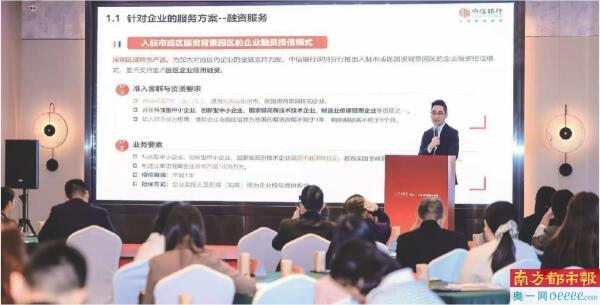
机制革新破壁垒 产品创新提质效 数字赋能拓边界
Nan Fang Du Shi Bao· 2025-11-24 23:11
Core Insights - The development of inclusive finance is crucial for Shenzhen's goal of becoming a global financial innovation center and serves as a link between finance and people's livelihoods, empowering the real economy [2] Group 1: Financing Solutions for Small and Micro Enterprises - The challenges faced by small and micro enterprises in financing include information asymmetry and lengthy service chains, which the bank addresses by creating a collaborative ecosystem involving government, banks, and enterprises [3] - The bank has implemented a "branch contact person" system to streamline the loan process, enhancing service efficiency and allowing businesses to avoid multiple visits and inquiries [3] Group 2: Supply Chain Financing - The bank focuses on supply chain stability by offering products like "Order e-loan" and "Distributor e-loan," which extend the credit of core enterprises to their upstream and downstream small businesses [4] - A tailored "Order e-loan" solution was developed for a leading LED enterprise, enabling its suppliers to access financing quickly upon receiving orders, thus addressing their long-standing financing difficulties [4] Group 3: Digital Empowerment in Foreign Trade - The bank launched "Cross-border Flash Loan" to support inclusive foreign trade enterprises, utilizing customs data and business registration information to automate credit approval and facilitate online operations [5] - An example includes a technology company that received a credit limit of 5 million yuan and accessed its first financing within half an hour of submitting the customs declaration [5] Group 4: Customized Financing Solutions - The bank recognizes the diverse needs of small and micro enterprises in Shenzhen and has developed tailored financing solutions based on specific industry characteristics and requirements [7] - Innovations include a "Credit Card for Inclusive Technology Enterprises" that converts technological capabilities into credit limits and a "Park Credit Model" that provides credit upon entering an industrial park without additional collateral [7] - The bank is committed to deepening the financing coordination mechanism for small and micro enterprises to support high-quality economic development in the Shenzhen region [7]