恒生红利低波ETF

Search documents
告别高息理财时代,如何用“红利全家桶”构建你的现金流防线?
Sou Hu Cai Jing· 2026-01-22 03:20
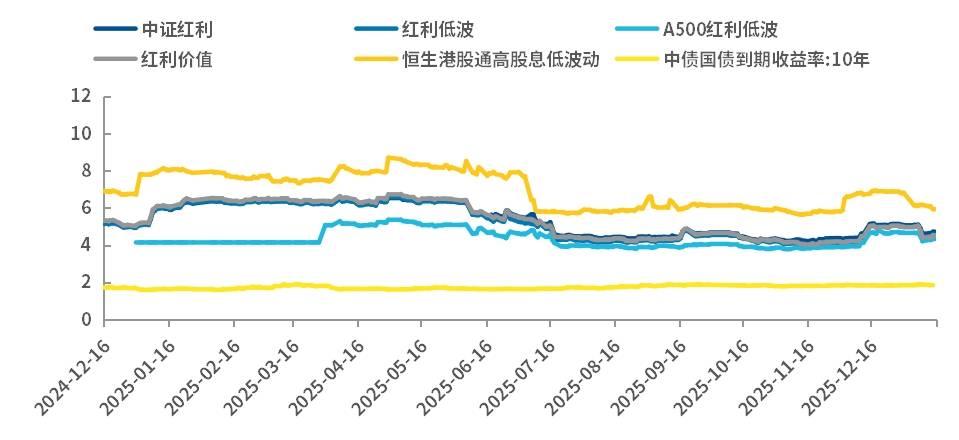
Core Viewpoint - The era of guaranteed returns from bank wealth management products is over, leading to an unprecedented challenge of "asset scarcity" for ordinary individuals in a low-interest, low-growth, and high-volatility environment. The solution lies in "dividend investment" [1]. Group 1: Importance of Dividend Assets - Individuals should shift focus from "pursuing wealth" to "managing cash flow" as certainty is now more valuable than growth in the current economic context [2]. - Current wealth management products exhibit high volatility with low returns, while dividend assets (high dividend stocks) serve as a "quasi-bond" asset, providing stable cash flow through dividends even when the market does not rise [3]. Group 2: Institutional Perspective - Large institutions are transitioning to new accounting standards (IFRS 9), necessitating a search for low-volatility, stable dividend assets to stabilize their financial reports [6]. - Regulatory bodies are guiding long-term funds, such as insurance capital, towards dividend assets, indicating a strong institutional support for these investments [6]. Group 3: Dividend ETF Matrix - E Fund has developed a comprehensive series of dividend ETFs, each serving a unique role to meet diverse investor needs [9]. - The E Fund Dividend ETF (515180) is positioned as a foundational investment, tracking the most classic high-dividend stocks in the market [10][11]. - The E Fund Low Volatility Dividend ETF (563020) focuses on high-dividend stocks with lower volatility, catering to risk-averse investors [14][15]. - The E Fund Value Dividend ETF (563700) targets undervalued stocks with stable dividends, providing a safety margin for investors [17][18]. - The A500 Low Volatility Dividend ETF (563510) selects top dividend stocks from the A500 index, offering a balanced industry distribution [20][21]. - The Hang Seng Low Volatility Dividend ETF (159545) seeks high-dividend offshore assets through the Hong Kong Stock Connect, providing cross-border investment opportunities [22][23]. Group 4: Long-term Considerations - Dividend strategies can yield long-term returns comparable to growth stocks, with the added benefit of compounding through reinvested dividends [26]. - Current dividend indices offer attractive yields and low price-to-earnings ratios, presenting a high safety margin for investors [30]. - Regular investments in dividend ETFs can serve as a source of education funds for children and provide stable income for retirees [33]. Conclusion - In an uncertain world, securing relatively stable cash flow through dividend investments is essential. E Fund's dividend product matrix offers a wealth management solution for investors in a low-interest environment, catering to both conservative and growth-oriented strategies [34][35].

红利板块窄幅震荡,红利ETF易方达(515180)和红利低波动ETF(563020)受资金关注
Sou Hu Cai Jing· 2025-12-25 11:13
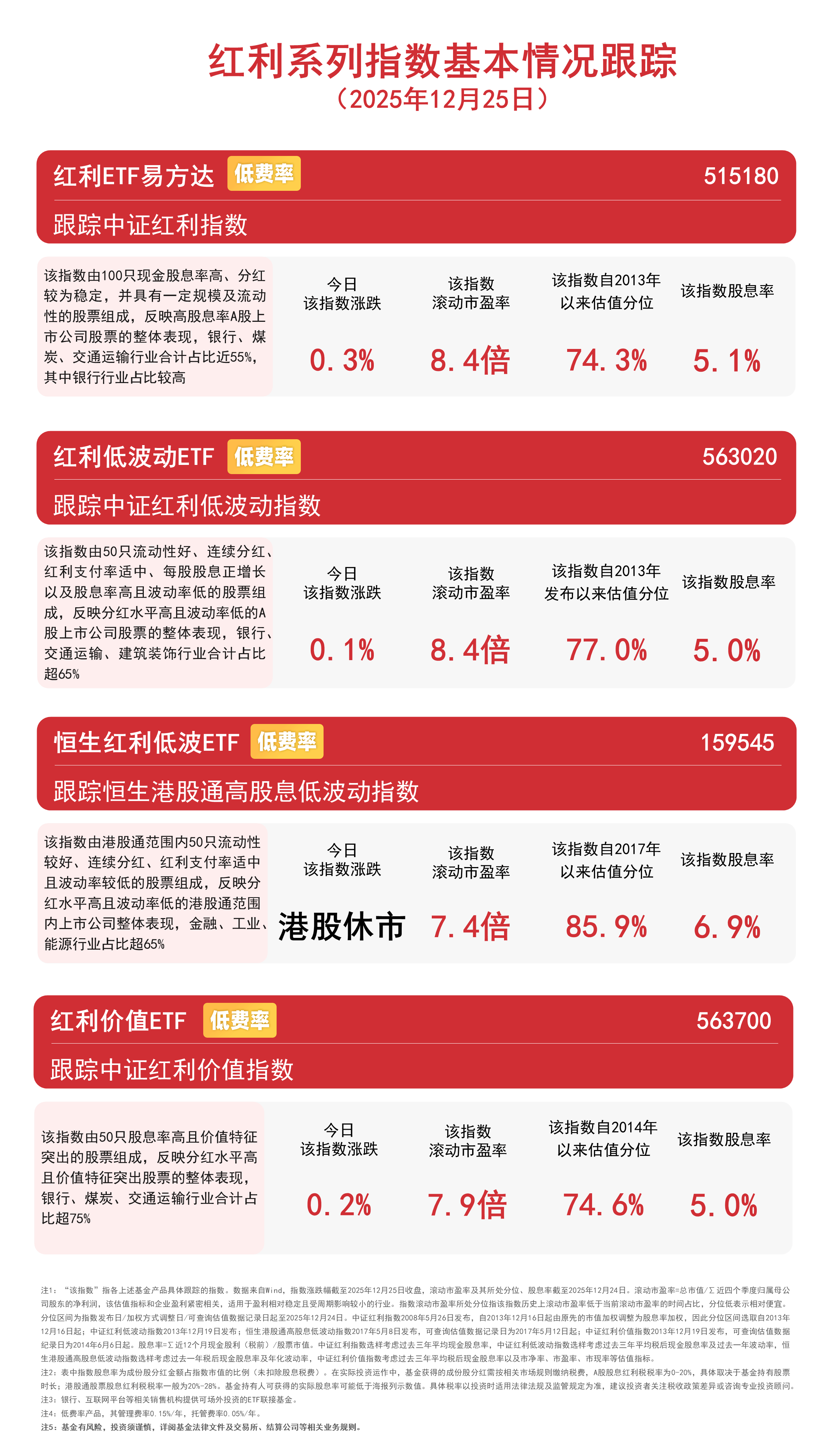
Group 1 - The core index of dividend stocks showed slight fluctuations today, with the CSI Dividend Index rising by 0.3%, the CSI Dividend Value Index increasing by 0.2%, and the CSI Dividend Low Volatility Index up by 0.1% [1] - The dividend ETFs, specifically E Fund Dividend ETF (515180) and Dividend Low Volatility ETF (563020), attracted significant capital inflows of 12 million and 34 million respectively [1] - E Fund is currently the only fund company offering all dividend ETFs at a low fee rate of 0.15% per year, which supports investors in low-cost allocation of high-dividend assets [1] Group 2 - The CSI Dividend Index comprises 50 stocks characterized by good liquidity, continuous dividends, moderate dividend payout ratios, positive growth in earnings per share, and high dividend yields with low volatility, reflecting the overall performance of A-share listed companies with high dividend levels and low volatility [4] - The banking, transportation, and construction decoration sectors collectively account for over 65% of the index [4] - The Hang Seng Dividend Low Volatility ETF tracks the Hang Seng High Dividend Low Volatility Index, which consists of 50 stocks within the Hong Kong Stock Connect that exhibit good liquidity, continuous dividends, moderate payout ratios, and low volatility [7][8]
【今日龙虎榜】平潭发展龙虎榜现外资与量化博弈, 多家实力游资集体出逃华人健康!
摩尔投研精选· 2025-12-19 11:09
Core Viewpoint - The article provides an overview of the trading activities in the Shanghai and Shenzhen stock markets, highlighting significant stock transactions, sector performances, and ETF trading volumes. Trading Summary - The total trading volume for the Shanghai and Shenzhen Stock Connect today reached 198.94 billion yuan, with Zhaoyi Innovation and Zhongji Xuchuang leading in individual stock trading volumes [1][2]. - The Shanghai Stock Connect recorded a total trading amount of 94.04 billion yuan, while the Shenzhen Stock Connect reached 104.89 billion yuan [2]. Top Trading Stocks - In the Shanghai Stock Connect, the top traded stocks included: - Zhaoyi Innovation (23.86 billion yuan) - Zijin Mining (16.87 billion yuan) - Luoyang Molybdenum (15.55 billion yuan) [3]. - In the Shenzhen Stock Connect, the leading stocks were: - Zhongji Xuchuang (26.44 billion yuan) - Sunshine Power (26.09 billion yuan) - Xinyi Technology (25.89 billion yuan) [4]. Sector Performance - The mechanical equipment sector saw the highest net inflow of funds, totaling 38.67 billion yuan, with a net inflow rate of 2.91% [6]. - Other sectors with significant net inflows included non-ferrous metals (35.32 billion yuan) and transportation equipment (31.28 billion yuan) [6]. - Conversely, the electronics sector experienced the largest net outflow, amounting to -57.70 billion yuan, with a net outflow rate of -2.26% [7]. ETF Trading Activity - The top ten ETFs by trading volume included: - A500 ETF Huatai Baichuan (13.37 billion yuan) - Hong Kong Securities ETF (10.43 billion yuan) [13]. - The A500 ETF Huatai Baichuan also saw a trading volume increase of 7.50% compared to the previous trading day [13]. - The ETF with the highest growth in trading volume was the Hang Seng Dividend Low Volatility ETF, which surged by 183% [14]. Market Dynamics - The article notes that AI healthcare stock Huaren Health experienced a pullback after a rise, with significant sell-offs from major trading desks [1][19]. - The stock Pingtan Development saw a dramatic drop from a nearly 5% increase to over a 7% decline, despite some buying activity from institutional investors [1][19].

【今日龙虎榜】实力游资联手量化资金买入雪人集团 ,超9亿元资金逆势抢筹中兴通讯!
摩尔投研精选· 2025-12-17 10:37
Core Viewpoint - The article highlights the trading activities in the Shanghai and Shenzhen stock markets, focusing on significant stock transactions, sector performances, and ETF trading volumes, indicating potential investment opportunities and market trends. Group 1: Trading Volume and Key Stocks - The total trading volume of the Shanghai and Shenzhen Stock Connect reached 212.76 billion, with Cambricon Technologies and NewEase Technology leading in individual stock trading volume [1] - The top stocks traded on the Shanghai Stock Connect included Cambricon Technologies (1.507 billion), Kweichow Moutai (1.443 billion), and Industrial Fulian (1.141 billion) [3] - On the Shenzhen Stock Connect, NewEase Technology (2.878 billion), CATL (2.850 billion), and Zhongji Xuchuang (2.755 billion) were the top traded stocks [4] Group 2: Sector Performance - The communication sector saw the highest net inflow of funds, totaling 5.625 billion, with a net inflow rate of 3.79% [6] - Other sectors with notable net inflows included non-ferrous metals (4.226 billion, 3.62%) and computing (3.238 billion, 1.07%) [6] - Conversely, the defense and military sector experienced the largest net outflow, amounting to -5.429 billion, with a net outflow rate of -5.73% [7] Group 3: ETF Trading - The software ETF (515230) saw a remarkable trading volume increase of 370% compared to the previous trading day, reaching 5.2323 billion [14] - The top ETFs by trading volume included A50 ETF Huatai Baichuan (14.1181 billion) and Hong Kong Securities ETF (13.6380 billion) [13] Group 4: Institutional and Retail Trading - Institutional trading was active, with significant purchases in stocks like Shenzhen South Circuit (2.21 billion) and Huazhong Cable (1.25 billion) [15] - Retail investors showed high activity in lithium battery electrolyte stocks, with Tianji Co. reaching the daily limit and receiving substantial purchases from retail investors [19]

易方达基金:建立全流程管理机制 精准控制指数基金跟踪误差
Zhong Zheng Wang· 2025-12-05 12:17
Core Insights - E Fund has established a standardized full-process management mechanism for index fund management, leading the industry in tracking error control capabilities [1][2] - As of Q3 2025, E Fund's A-share ETFs have a scale-weighted tracking error of 0.14% relative to the total return index, ranking among the top in the industry [1] - The company has reduced management fees for over 110 index products to the lowest tier of 0.15% per year, enhancing cost efficiency for investors [1][2] Group 1 - E Fund's index products, including the Robot ETF and Hong Kong Stock Connect ETFs, have demonstrated leading tracking errors within their categories [1] - The company has implemented a liquidity compensation strategy through inquiry transfer, resulting in over 100 events in the A-share market this year, nearly doubling from the previous year [2] - E Fund's Star Market 50 ETF has achieved the highest excess returns among comparable products in the first three quarters of this year [2] Group 2 - The full-process management mechanism includes comprehensive research on index targets, investment methods, and operational scenarios, enhancing investment management efficiency [2] - The standardized management ensures stable operation of products across different market environments, translating professional capabilities into tangible value for investors [2] - The CSI 300 ETF has maintained stable operations since its listing in 2013, demonstrating the effectiveness of E Fund's management approach [2]
港股红利板块逆势走强,恒生红利低波ETF(159545)全天净申购超1亿份
Mei Ri Jing Ji Xin Wen· 2025-12-02 11:15
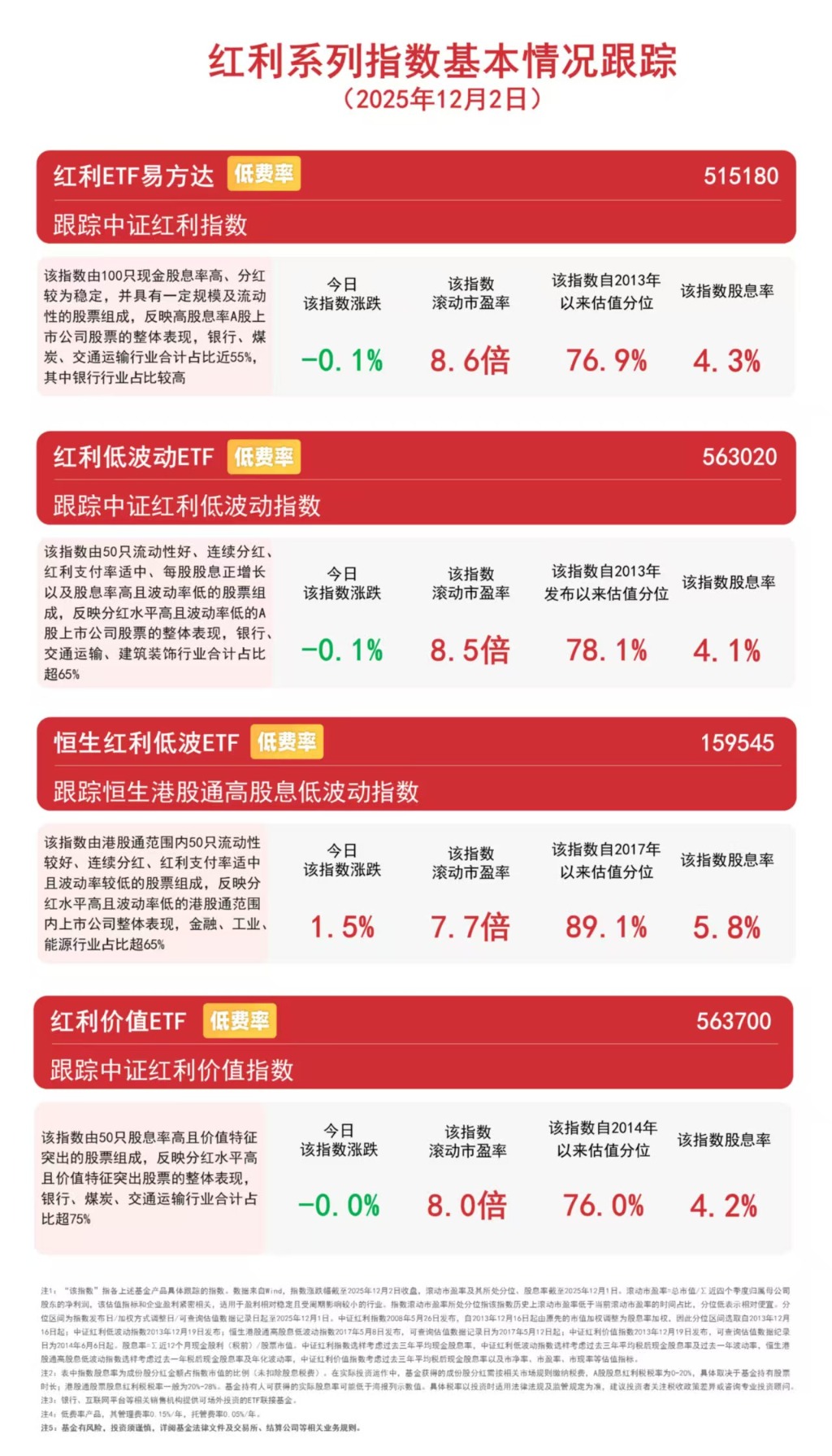
Group 1 - The Hong Kong dividend sector showed resilience with Jiangnan Buyi rising over 6% and China Gas increasing over 4%, while the Hang Seng High Dividend Low Volatility Index rose by 1.5% [1] - In contrast, the A-share dividend sector remained volatile, with the CSI Dividend Value Index down by 0.01% and both the CSI Dividend Index and CSI Low Volatility Dividend Index down by 0.1% [1] - There is a clear trend of capital allocation, as the Hang Seng Low Dividend ETF (159545) saw a net subscription of over 100 million units throughout the day [1] Group 2 - E Fund is currently the only fund company offering all its dividend ETFs at a low fee rate, with management fees for various products including the Hang Seng Low Dividend ETF (159545) set at 0.15% per year [1] - The E Fund Dividend ETF (515180) tracks the CSI Dividend Index, which consists of 100 stocks with high cash dividend yields and stable dividends, with the banking, coal, and transportation sectors accounting for nearly 55% of the index [3] - The E Fund Low Volatility Dividend ETF (563020) tracks the CSI Low Volatility Dividend Index, composed of 50 stocks with good liquidity and continuous dividends, with the banking, transportation, and construction sectors making up a significant portion of the index [3][7]
ETF今日收评 | 标普消费ETF涨超2%,传媒ETF跌超2%
Sou Hu Cai Jing· 2025-12-02 07:37
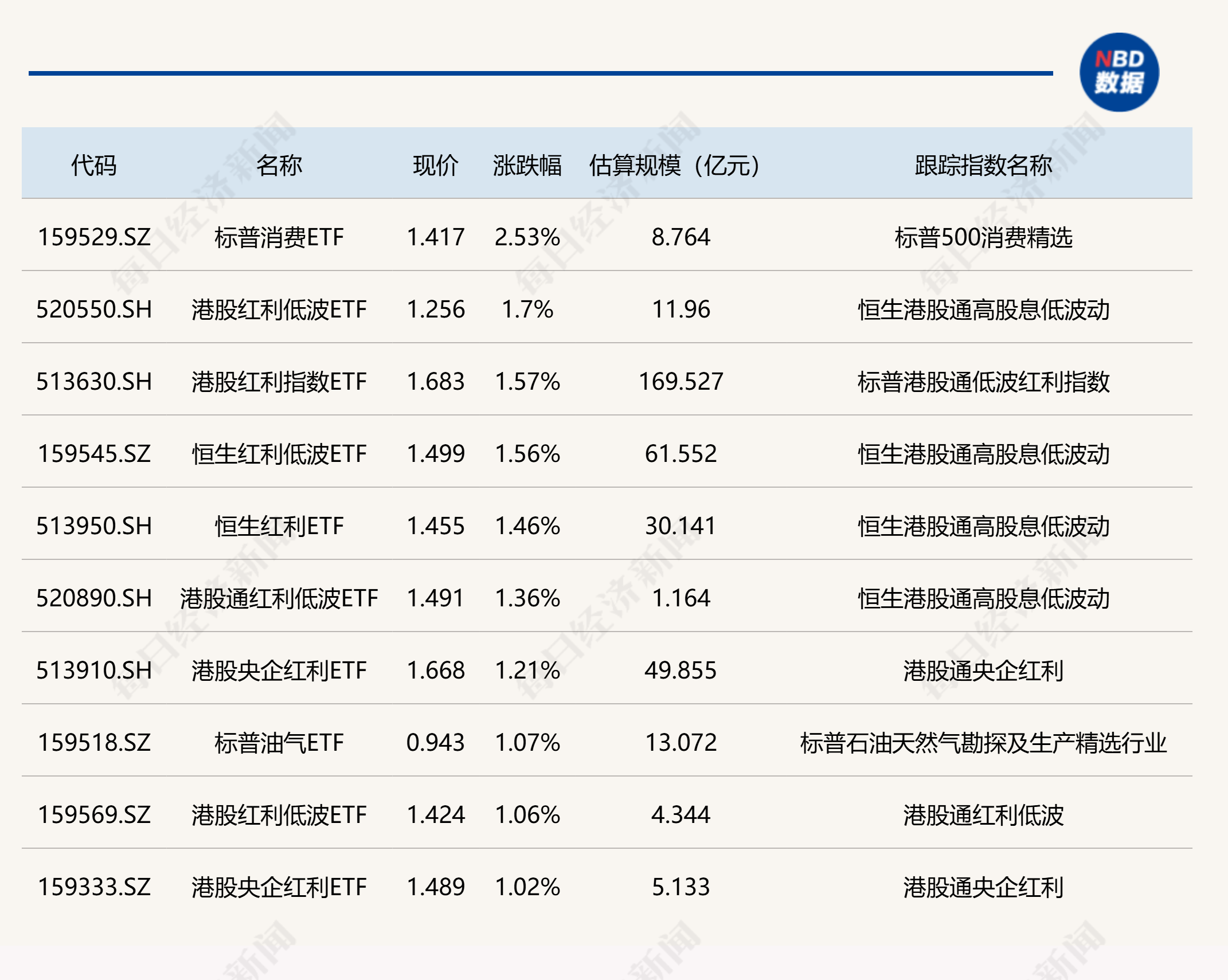
Market Overview - The market experienced fluctuations throughout the day, with both the Shenzhen Component Index and the ChiNext Index dropping over 1% at one point [1] - The Fujian sector showed strong performance, while the battery and shipping sectors faced declines [1] ETF Performance - The S&P Consumer ETF rose by over 2%, with several dividend-related ETFs increasing by more than 1% [1][2] - Specific ETFs and their performance include: - S&P Consumer ETF: 1.417, up 2.53% [2] - Hong Kong Dividend Low Volatility ETF: up 1.7% [2] - Hong Kong Dividend Index ETF: 1.683, up 1.57% [2] - Other notable ETFs include the Hang Seng Dividend Low Volatility ETF and the Hang Seng Dividend ETF, both showing increases [2] Institutional Behavior - Analysts suggest that some institutions may sell high-valuation, volatile growth stocks to lock in annual returns, shifting focus to high-dividend, high-margin safety stocks in the Hong Kong dividend sector [3] - The period from December to January is noted as a peak for insurance premiums, leading some insurance funds to quickly build positions in high-dividend assets to match liability costs, creating a rigid buying pressure [3] Sector Declines - The Media ETF experienced a decline of over 2% [3][4] - Other ETFs in the media and technology sectors also reported losses, including: - Media ETF: down 2.3% [4] - S&P Biotechnology ETF: down 2.2% [4] - Various other ETFs in the entertainment and technology sectors also showed declines [4][5]
港股红利低波ETF、港股通红利低波ETF、恒生红利低波ETF逆势上涨,外资加仓科技,内资加仓红利
Ge Long Hui· 2025-12-02 03:52
Group 1 - The core viewpoint of the articles highlights the contrasting trends in the Hong Kong and A-share markets, with Hong Kong dividend ETFs rising while A-shares experience a decline [1][2] - The A-share market saw a collective adjustment with major indices dropping, including the Shanghai Composite Index down 0.55% to 3892.55 points, and a total market turnover of 105.6 billion yuan, a decrease of 18.07 billion yuan from the previous day [1] - In the Hong Kong market, various dividend ETFs, including the Hong Kong Dividend Low Volatility ETF and the Hang Seng Dividend ETF, saw gains exceeding 1%, indicating strong performance amid broader market adjustments [1] Group 2 - Recent data indicates that foreign capital has increased its holdings in technology sectors, while domestic investors are focusing on dividend stocks, with a total inflow of 16.4 billion HKD into the Hong Kong stock market over the past week [2] - The inflow of foreign capital was primarily directed towards software services, electrical equipment, and pharmaceutical sectors, while domestic capital saw outflows [2] - Analysts suggest that the current low interest rate environment and weak economic recovery favor dividend strategies, with Hong Kong dividend stocks offering attractive valuation and yield advantages [2] Group 3 - The overseas market is expected to enter a Christmas rally in December, with systemic risks becoming clearer and a significant inflow of 4.3 billion USD into emerging market ETFs this week [3] - The focus remains on high dividend and large-cap value styles, with expectations for a rebound in the domestic market as institutions lock in profits towards the end of the year [3] - Morgan Stanley has raised its target for the China stock index to 4840 points by December 2026, while JPMorgan upgraded its rating on Chinese stocks to "overweight," indicating a favorable outlook for the market driven by AI adoption, consumer stimulus, and governance reforms [3]
ETF市场周报 | 市场反弹行情演绎,小市值因子占优!前期热门ETF再度走强
Sou Hu Cai Jing· 2025-11-28 09:28
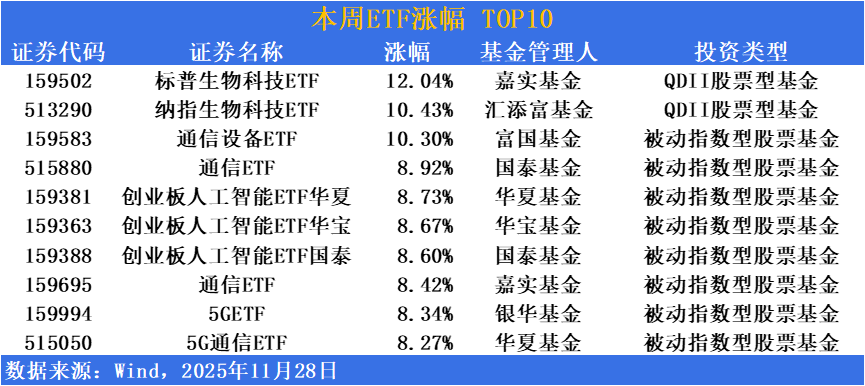
Market Overview - The stock market experienced a rebound during the week of November 24-28, 2025, with major indices showing positive performance: Shanghai Composite Index up 1.40%, Shenzhen Component Index up 3.56%, and ChiNext Index up 4.54% [1] - Trading volume remained low, with daily turnover around 1.8 trillion, indicating weak enthusiasm from external investors [1] - The market showed a trend of small-cap stocks outperforming larger ones, with gains increasing from the CSI 300 to the CSI 2000 [1] ETF Performance - Growth sectors saw significant rebounds, with the top-performing ETFs showing gains over 10%: S&P Biotechnology ETF up 12.04% and NASDAQ Biotechnology ETF up 10.43% [2] - The average gain for all ETFs was 2.42%, driven by a rebound in sectors like CPO and telecommunications [2] - The top ten ETFs by gain were all related to growth sectors, indicating a strong recovery in previously popular themes [2] Fund Flow Trends - Overall, there was a net outflow of 279.76 billion, with stock ETFs experiencing a significant outflow of 362.95 billion [6] - In contrast, money market ETFs and cross-border ETFs saw net inflows, indicating a shift towards safer investments [6] - The top inflow ETFs included the Huabao Qiyi ETF with 36.91 billion and the Benchmark Treasury ETF with 29.45 billion [8] Economic Indicators - Fiscal revenue showed a year-on-year increase of 3.16%, driven by higher tax income, while land transfer income continued to decline [5] - General fiscal expenditure fell by 9.78%, reflecting a significant drop compared to the previous month [5] - The real estate sector remains under pressure, with calls for new policies to stimulate the market [5] Upcoming ETF Listings - Two new ETFs are set to launch next week: Penghua Hang Seng Technology ETF and E Fund CSI A500 Dividend Low Volatility ETF, both targeting specific growth and dividend strategies [11][12] - The Hang Seng Technology ETF will focus on major tech stocks in Hong Kong, while the A500 Dividend ETF aims to provide stable returns through high dividend-paying stocks [11][12]
超55亿元,“跑了”!
Zhong Guo Ji Jin Bao· 2025-11-28 05:46
Group 1 - On November 27, the A-share market showed mixed performance with the stock ETF market continuing a trend of net outflows, totaling over 5.5 billion yuan [2] - The total scale of the stock ETF market reached 4.54 trillion yuan, with a reduction of 2.678 billion fund shares on the same day, leading to a net outflow of 5.575 billion yuan [3] - The Hong Kong stock market ETFs and strategy style ETFs saw significant net inflows of 496 million yuan and 298 million yuan respectively, with the CSI A500 index products leading with a net inflow of 1 billion yuan [3] Group 2 - Major fund companies continued to attract net inflows into their ETFs, with E Fund's Hang Seng Dividend Low Volatility ETF seeing a net inflow of 146 million yuan, reaching a record high of 6.101 billion yuan [4] - The latest scale of the Huaxia Fund's Shanghai Stock Exchange 50 ETF and A500 ETF reached 180.191 billion yuan and 20.138 billion yuan respectively, indicating strong investor interest [4] - Industry theme ETFs experienced the largest net outflows, totaling 3.581 billion yuan, with the Sci-Tech 50 index products leading the outflows at 1.321 billion yuan [5]