
Anthropic

Search documents
Anthropic完成300亿美元G轮融资,投后估值达3800亿美元
Sou Hu Cai Jing· 2026-02-13 02:56
Core Insights - Anthropic has completed a Series G funding round totaling $30 billion, raising its post-money valuation to $380 billion, approximately 2.63 trillion yuan [1] - The lead investors in this round are Singapore's sovereign wealth fund GIC and technology hedge fund Coatue [1] Financial Performance - Anthropic's annualized revenue has reached $14 billion, doubling for three consecutive years [3] - The number of clients spending over $100,000 annually on Claude has increased sevenfold in one year, with over 500 clients now exceeding $1 million in annual spending [3] Product Development - Claude Code, Anthropic's programming assistant, has achieved an annualized revenue of $2.5 billion, with both annualized revenue and weekly active user numbers doubling since the beginning of the year [6] - The number of enterprise subscription users for Claude Code has quadrupled since the start of the year, with enterprise user revenue now accounting for over half of Claude Code's total revenue [6]


AI投资人:1-5年内AI将消灭 50%入门级白领岗位
阿尔法工场研究院· 2026-02-13 02:33
Core Viewpoint - The article emphasizes that the release of GPT-5.3 Codex and Claude Opus 4.6 on February 5, 2026, marks a critical turning point in AI capabilities, impacting knowledge workers sooner and more broadly than anticipated [2]. Group 1: AI's Rapid Advancement - The author compares the current perception of AI to the early days of the COVID-19 pandemic, suggesting that many are underestimating the scale and speed of AI advancements [3]. - The pace of AI improvements has accelerated significantly, with new models showing substantial enhancements in capabilities and shorter intervals between releases [4]. - The author describes a personal experience where AI independently completed tasks with high quality, indicating a shift in how AI can be utilized in various fields [4]. Group 2: Implications for Knowledge Work - AI's ability to write code is seen as a strategic advantage, enabling the development of more advanced AI systems, which could eventually impact all knowledge work sectors, including law, finance, and healthcare [5]. - The article discusses the ongoing debate about AI's progress, asserting that those who claim AI has hit a wall are likely using outdated models or have a vested interest in downplaying its capabilities [7]. - A timeline of AI advancements is provided, illustrating rapid progress from basic arithmetic capabilities in 2022 to the potential for AI to handle significant coding tasks by 2025 [7][8]. Group 3: Future Workforce Changes - Predictions suggest that AI could eliminate 50% of entry-level white-collar jobs within 1-5 years, with the author noting that this is a conservative estimate [11]. - The article highlights that AI is a general substitute for cognitive work, making it challenging for workers to transition to new roles as AI continues to improve across various domains [11]. - The author emphasizes that the latest AI models exhibit decision-making capabilities that resemble human judgment, raising concerns about job security for many roles that involve computer-based tasks [11]. Group 4: Practical Recommendations - The article provides actionable advice, urging individuals to subscribe to paid versions of AI tools and actively integrate them into their work processes [13][15]. - It encourages users to experiment with AI daily, suggesting that hands-on experience will enhance understanding and adaptability to ongoing changes in the industry [15]. - The author warns that many professionals are currently ignoring AI's potential, and those who leverage it effectively will gain a competitive advantage [14]. Group 5: Broader Implications of AI - The article concludes with a discussion on the potential societal impacts of AI, including both positive advancements in fields like medicine and negative consequences such as increased surveillance and security threats [17]. - The author presents a thought experiment about a hypothetical nation with super-intelligent citizens, highlighting the dual-edged nature of AI advancements [17].


未知机构:前两天市场热议的Pony终于官宣并非DeepSeekV4而是智-20260213
未知机构· 2026-02-13 02:30
前两天市场热议的 "Pony"终于官宣,并非 DeepSeek V4,而是智谱的 GLM-5。 中国 AI 公司智谱(Zhipu)即将发布其旗舰大语言模型 GLM-5,该模型参数数量是前代的两倍,旨在应对复杂 的编码和智能体任务,并已与 Anthropic 的 Claude Opus 系列进行直接对比测试。 此举意在抢在 DeepSeek 于农历新年期间发布下一代架构之前抢占先机 前两天市场热议的 "Pony"终于官宣,并非 DeepSeek V4,而是智谱的 GLM-5。 中国 AI 公司智谱(Zhipu)即将发布其旗舰大语言模型 GLM-5,该模型参数数量是前代的两倍,旨在应对复杂 的编码和智能体任务,并已与 Anthropic 的 Claude Opus 系列进行直接对比测试。 此举意在抢在 DeepSeek 于农历新年期间发布下一代架构之前抢占先机,加速国内 AI 竞赛。 智谱科技今年初上市后,本周股价已飙升超 50%,公司正从为中国企业客户提供定制化 AI 方案,转向向全球 用户提供服务。 ...
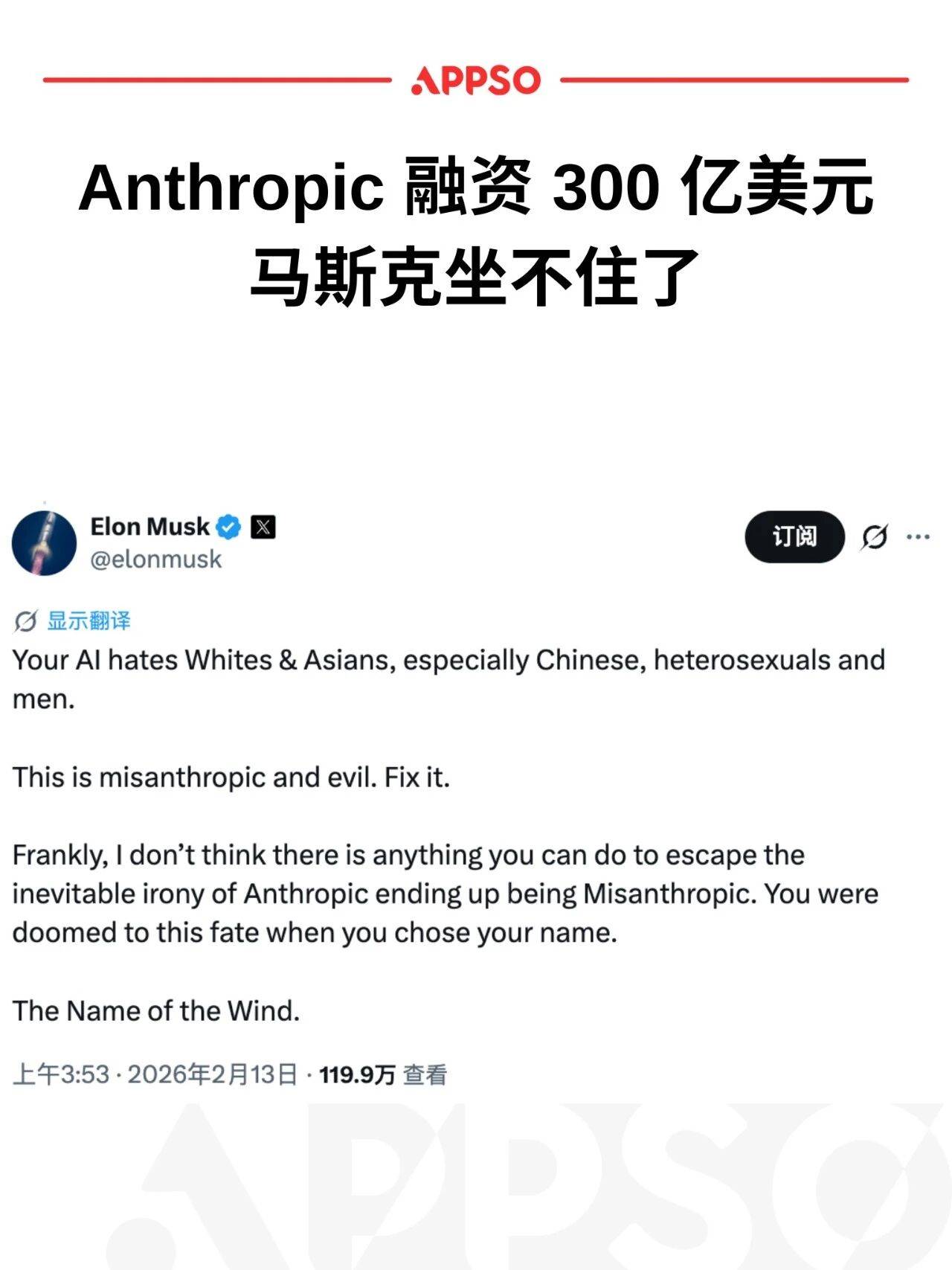
刚刚,一个2.6万亿AI独角兽诞生,英伟达微软押注,马斯克急了
3 6 Ke· 2026-02-13 02:28
Core Insights - Anthropic has completed a $30 billion Series G funding round, achieving a post-money valuation of $38 billion and an annual recurring revenue of $14 billion, with an average growth rate exceeding 10 times over the past three years [1][2]. Funding and Investment - The funding will support advanced research, product development, and infrastructure expansion, with Claude being the only AI model available on major cloud platforms: Amazon Web Services, Google Cloud, and Microsoft Azure [2]. - Key investors in this round include the Ontario Teachers' Pension Plan and Coatue, along with significant contributions from firms like Blackstone, Goldman Sachs, JPMorgan, and Sequoia Capital [4][5]. Customer Growth and Revenue - The number of Claude customers spending over $100,000 annually has increased sevenfold in the past year, with over 500 clients now spending more than $1 million annually, including 8 out of the top 10 Fortune 500 companies [6]. - Claude Code, launched in 2025, has generated over $2.5 billion in annual recurring revenue, doubling its growth since early 2026, and now accounts for more than half of total revenue [6][11]. Product Development and Features - Anthropic has released the Claude Opus 4.6 model, which features a 1 million token context window, enhancing its capabilities in long-context queries and reasoning [7][10]. - Claude Code has become a popular tool among developers, allowing for automated engineering tasks and code management, with a graphical UI version called Cowork launched to cater to non-technical users [9][10]. Market Position and Strategy - Unlike OpenAI's consumer-focused approach, Anthropic emphasizes the B2B market, achieving significant commercial success with a focus on transforming technological advancements into market advantages [11]. - The company is preparing for an IPO, potentially in 2026, having engaged legal and investment banking firms for preliminary preparations [10].
速递|Anthropic完成300亿美元融资,估值达3800亿美元,员工兑现股权同步落地
Z Potentials· 2026-02-13 02:27
Core Viewpoint - Anthropic has secured $30 billion in funding at a valuation of $380 billion, significantly enhancing its competitive position against OpenAI in the AI sector [1]. Group 1: Funding and Valuation - The recent funding round was led by GIC and Coatue Management, with participation from notable investors including D.E. Shaw & Co., Dragoneer Investment Group, Founders Fund, and others [1]. - Anthropic's valuation has nearly doubled since its last funding round, positioning it among the world's most valuable private companies [1]. - The company had previously raised $13 billion and is now competing with OpenAI, which is pursuing a $100 billion funding plan [1]. Group 2: Revenue Growth and Business Focus - Anthropic's annual revenue has surged from over $9 billion to $14 billion, reflecting strong demand for its enterprise-level products [2]. - The company emphasizes "safety and responsible technology development" and focuses on high-value sectors such as software engineering, finance, and healthcare [2]. Group 3: Infrastructure Investments - Anthropic plans to invest $50 billion in building data centers in the U.S. and will utilize AI chips from Alphabet Inc. valued at several billion dollars [3]. - However, these investments are modest compared to OpenAI's commitment of over $1.4 trillion for AI infrastructure development [3]. Group 4: Market Dynamics and Concerns - Both Anthropic and OpenAI rely on investments from large chip manufacturers and cloud service providers, raising concerns about potential circular trading within the industry [4]. - Microsoft and NVIDIA have indicated plans to invest up to $15 billion in Anthropic, with Microsoft also being a major supporter of OpenAI [6].

速递|AI新贵与传统巨头对决:希尔顿CTO称三年磨一Agent,不会为概念买单
Z Potentials· 2026-02-13 02:27
Core Insights - The article discusses the competitive landscape of AI agents, highlighting how traditional software companies are racing to develop AI products that can automate tasks previously performed by human workers [1][3][8] Group 1: AI Agent Development - Companies like Microsoft, ServiceNow, and Snowflake are launching AI agent products to help clients create customized AI agents that can interact with various enterprise applications [1][3] - The emergence of AI agent management dashboards raises questions about the necessity of multiple dashboards, suggesting that each client may ultimately only need one [2] Group 2: Key Players and Products - Major players in the AI agent space include Anthropic, OpenAI, and Google, with products designed to automate tasks across different applications [3][5] - OpenAI's Frontier project aims to assist companies like Uber and Thermo Fisher Scientific in developing multiple AI collaborative assistants [9][10] Group 3: Market Dynamics and Challenges - Microsoft CEO Satya Nadella predicts that traditional software applications will collapse in the era of AI agents, as they are merely databases with business logic [8] - Despite the potential of AI agents, significant security concerns and operational challenges remain, such as the risk of credential leaks and the high operational threshold for current products [8][11] Group 4: Industry Sentiment - Executives from traditional software companies express a mix of caution and optimism regarding the integration of AI agents, with some companies already utilizing AI technologies from OpenAI and Anthropic [11][12] - The sentiment in the industry is that software leaders feel they must either achieve a trillion-dollar valuation or face extinction due to the disruptive nature of AI [12]


Anthropic 300亿融资创纪录,马斯克急眼了
Sou Hu Cai Jing· 2026-02-13 02:13
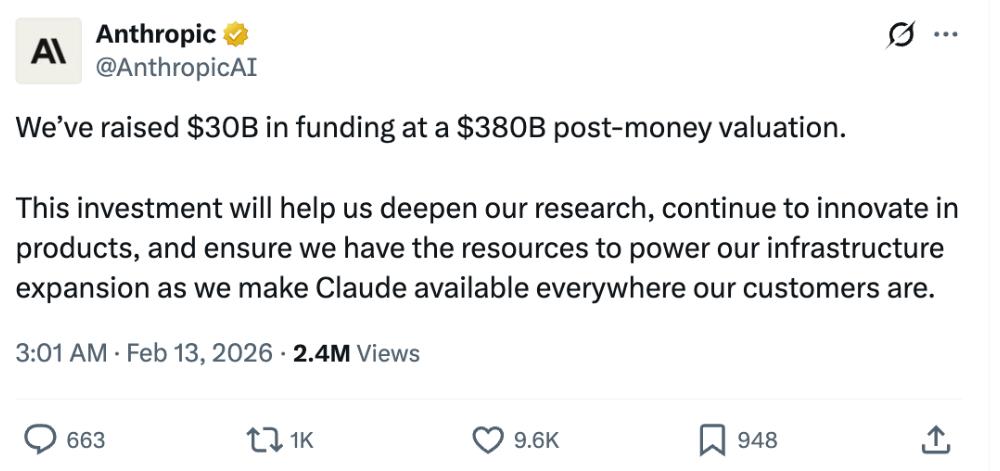
Core Insights - Anthropic has successfully raised $30 billion in Series G funding, achieving a post-money valuation of $380 billion, setting a record for single-round equity financing in the AI sector [7][21] - The funding round was led by Singapore's sovereign wealth fund GIC and Coatue, with participation from several prominent investors including Microsoft and NVIDIA, which contributed a portion of their previously announced $15 billion investment commitment [21][9] - Anthropic reported an annualized revenue of $14 billion, with over 10x growth each year for the past three years, attributed to strong demand from B2B users [13][21][22] Funding Details - The Series G funding round included significant investors such as Accel, Addition, Alpha Wave Global, and many others, reflecting high demand and interest in the company [9][10] - The investment will be utilized to deepen research, continue product innovation, and expand infrastructure to make Claude accessible to users globally [14][21] Market Position - Anthropic's growth trajectory positions it competitively against other AI companies, with its revenue growth driven primarily by enterprise API and coding solutions, contrasting with ChatGPT's consumer-driven growth [22][21] - The funding round was reportedly oversubscribed, indicating strong market confidence in Anthropic's future prospects [23]
AI“超级代理”大战打响!四大赛道全面铺开,OpenAI、Anthropic正挑战微软们的软件帝国
Hua Er Jie Jian Wen· 2026-02-13 02:01
Core Insights - Major AI companies like OpenAI and Anthropic are launching enterprise-level AI products that challenge existing enterprise software markets, prompting traditional software vendors like Microsoft and Salesforce to accelerate their own AI tools and management platforms [1][2] Group 1: Competitive Landscape - The competition involves four main product categories: browser-based agents, computer-operable agents, agent-building tools, and agent management consoles [1][2] - OpenAI and Google provide browser-based agents capable of executing multi-step tasks, while Anthropic's Cowork and Google's Gemini Computer Use are examples of computer-operable agents [2] - Agent-building tools such as Salesforce's Agentforce and Google's Gemini Enterprise allow clients to create agents that can access various enterprise applications [2] - The agent management console market features competitors like Microsoft's Agent 365 and OpenAI's Frontier, raising questions about the necessity of multiple consoles for clients [2] Group 2: Adoption Challenges - Despite the promising outlook, new agent technologies face significant challenges before widespread adoption, including security concerns and usability issues [3] - Companies like OpenAI and Anthropic indicate that their computer-operable agents are still in research preview, suggesting they are not yet ready for large-scale enterprise deployment [3] - Hilton's CTO Onkar Birk expressed caution in adopting new subscriptions, highlighting the complexity and investment required for developing customer support agents [4] Group 3: Traditional Software Companies' Response - OpenAI's strategy involves positioning its agent command technology above traditional enterprise "record systems," which are critical for storing business data [5] - Traditional enterprise application companies like Salesforce and Microsoft have not yet taken steps to block AI agents from accessing or modifying data within their systems [5] - There is a recognition that traditional companies are utilizing technologies from OpenAI and Anthropic to support their own agents, even as these AI firms promote their competitive tools [5] Group 4: Market Dynamics - Snowflake, a database company, has released a product supported by AI models from OpenAI and Anthropic, enabling clients to develop agents for searching and retrieving business metrics [6] - The competitive landscape is characterized by high stakes, with industry leaders feeling pressure to either achieve a $1 trillion valuation or face potential failure [6]


从xAI联创“转身”看行业局势,全球头部AI公司人才创业观察
3 6 Ke· 2026-02-13 01:53
Core Insights - The recent departures of xAI co-founders Yuhuai Tony Wu and Jimmy Ba have sparked significant industry discussion, signaling a potential shift towards smaller, AI-driven teams redefining innovation in the sector [1][2] - The trend of key personnel leaving established AI companies like OpenAI to pursue entrepreneurial ventures is becoming a notable pattern in the industry, indicating a movement from large organizations to startups [3][4] Group 1: xAI Developments - xAI's founding team has halved since its inception in 2023, with several core technical figures departing, which may impact the company's future capabilities and direction [3] - Wu's and Ba's statements reflect a broader trend in the AI industry, emphasizing the potential of small teams leveraging AI technology to create impactful solutions [2][3] Group 2: OpenAI Talent Exodus - A significant number of key personnel from OpenAI have left to establish their own startups, focusing on various aspects of AI, including safety, general intelligence systems, and AI search [4][5] - Notable startups emerging from this talent exodus include Safe Superintelligence, Thinking Machines Lab, and Perplexity AI, each targeting different niches within the AI landscape [7][8][10] Group 3: Investment and Valuation Trends - Safe Superintelligence has raised approximately $10 billion in funding, achieving a valuation of around $50 billion, with further funding rounds increasing its valuation to about $320 billion [7] - Thinking Machines Lab has also attracted significant investment, securing $20 billion in seed funding and reaching a valuation of approximately $120 billion [9] - Perplexity AI has gained traction as an early AI search tool, supported by investments from notable figures and firms, including Jeff Bezos and Nvidia [11] Group 4: Competitive Landscape - Anthropic, founded by former OpenAI employees, is focusing on large model development and has achieved a valuation of $615 billion following its E-round funding [14] - Character.AI, co-founded by former Google Brain researchers, has become a leader in AI virtual character interactions, boasting over 20 million monthly active users and a valuation of around $10 billion [26][27] Group 5: Future Outlook - The AI industry is evolving from a focus on foundational model breakthroughs to practical applications and long-term strategic planning, with a clear trend towards safety and system architecture [28] - The emergence of open-source ecosystems is enabling smaller teams and individual developers to redefine the execution capabilities of AI, suggesting a dynamic future for the industry [29]


2月13日国际晨讯 | 日韩股市低开,美股、金银遭大规模抛售,特兰普宣称希望与伊朗在“一个月左右”达成协议
Sou Hu Cai Jing· 2026-02-13 01:43
Market Review - Gold and silver continued their downward trend, with London spot silver dropping below $74 per ounce and gold reaching a low of approximately $4886 per ounce. The previous trading day saw a significant sell-off, with silver falling over 10% and gold declining more than 3% [1] - Asian stock markets opened lower on February 13, with the Nikkei 225 index down 0.77% and the Korean Composite Index down 0.16% [1] - The US stock market experienced a large sell-off, with the Dow Jones Industrial Average falling by 669.42 points (1.34%) to close at 49451.98 points, the Nasdaq down 469.32 points (2.03%) to 22597.15 points, and the S&P 500 down 108.71 points (1.57%) to 6832.76 points. The fear index (VIX) surged over 20% during trading [1] Company News - OpenAI released its first AI model, GPT-5.3-Codex-Spark, based on chips from semiconductor startup Cerebras Systems [1] - AI startup Anthropic announced it raised $30 billion in its latest funding round, achieving a valuation of $380 billion. This round included "some" of the previously announced investments from Microsoft and Nvidia, which had planned to invest up to $5 billion and $10 billion, respectively [1][2] International Macro - According to CME's FedWatch, the probability of the Federal Reserve cutting rates by 25 basis points by March is 7.8%, while the probability of maintaining rates is 92.2%. By April, the cumulative probability of a 25 basis point cut rises to 25.3%, with a 73.1% chance of no change, and a 1.6% chance of a 50 basis point cut. By June, the probability of a 25 basis point cut is 49.9% [3]