
工商银行

Search documents
信用卡账单分期业务纳入贴息支持范围
Sou Hu Cai Jing· 2026-01-22 22:48
Group 1 - The core viewpoint of the article is the comprehensive upgrade of the consumer loan "national subsidy" policy, which includes extending the policy deadline to the end of this year and incorporating credit card bill installment services into the support scope [1] - The annual subsidy rate for credit card bill installments is set at 1%, which is a significant highlight of the policy upgrade that consumers are concerned about [1] - Major financial institutions, including China Construction Bank and Agricultural Bank of China, have clarified the application process for the subsidy, indicating that consumers can benefit from automatic subsidy calculations during repayment [1][2] Group 2 - The policy aims to enhance consumer willingness and ability to spend by making it easier for credit card holders to access consumer credit support without needing to apply for personal loans [2] - The policy has expanded the list of eligible institutions to include city commercial banks, rural cooperative financial institutions, foreign banks, consumer finance companies, and auto finance companies, which will help boost local consumption [2] - The focus on third and fourth-tier cities and county-level consumption is highlighted as a significant growth point for China's consumer market, with local banks and non-bank institutions expected to play a crucial role in promoting consumption and expanding domestic demand [2]
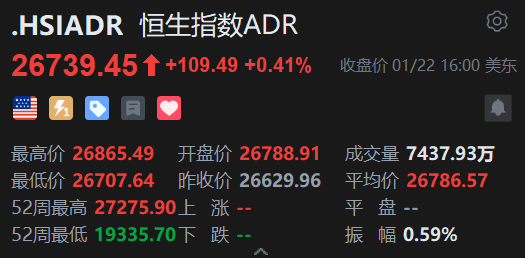
智通ADR统计 | 1月23日
智通财经网· 2026-01-22 22:19
Market Overview - The Hang Seng Index (HSI) closed at 26,739.45, up by 109.49 points or 0.41% as of January 22, 16:00 Eastern Time [1] - The index reached a high of 26,865.49 and a low of 26,707.64 during the trading session, with a trading volume of 74.379 million shares [1] Stock Performance - HSBC Holdings closed at HKD 130.600, an increase of 0.69% compared to the previous close [2] - Tencent Holdings closed at HKD 594.990, a decrease of 0.42% compared to the previous close [2] - Alibaba Group (ADR) saw a price increase of 4.78%, closing at HKD 164.800, while its ADR price was USD 172.684 [3] - Other notable stock movements include: - China Ping An: down 2.34% to HKD 66.900 [3] - Baidu Group: up 4.10% to HKD 160.000 [3] - BYD Company: up 0.71% to HKD 99.750 [3] - New World Development: up 3.63% to HKD 114.200 [3]






信用卡账单分期业务纳入贴息支持范围 年贴息比例为一个百分点
Ren Min Ri Bao· 2026-01-22 22:01
Group 1 - The core viewpoint of the news is the comprehensive upgrade of the consumer loan "national subsidy" policy, which includes extending the policy deadline to the end of this year and incorporating credit card bill installment services into the support scope [1] - The annual subsidy rate for credit card bill installments is set at 1%, which is a significant highlight of the policy upgrade that consumers are concerned about [1] - Financial institutions such as China Construction Bank and Agricultural Bank of China have clarified the application process for credit card bill installment subsidies, emphasizing that the process remains generally the same but requires signing specific agreements [1] Group 2 - Credit card holders can enjoy consumer credit support through bill installments without needing to apply for personal consumer loans, making it more convenient and often at lower rates than credit card overdrafts, which can effectively enhance consumer willingness and capacity [2] - Major banks like Industrial and Commercial Bank of China and Bank of China have stated that loans with completed subsidy applications do not need to re-sign subsidy agreements, and transactions from January 1, 2026, will automatically apply the latest subsidy policy [2] - The policy has expanded the range of institutions eligible for subsidies, including city commercial banks, rural cooperative financial institutions, foreign banks, consumer finance companies, and auto finance companies, which will help boost consumption in lower-tier cities and rural areas [2]



深耕普惠金融促发展惠民生
Jing Ji Ri Bao· 2026-01-22 21:58
Core Viewpoint - The development of inclusive finance is a concrete manifestation of the people-centered development philosophy, emphasizing the importance of providing affordable and effective financial services to all social strata and groups, particularly small and micro enterprises and low-income populations [2][3]. Group 1: Importance and Achievements of Inclusive Finance - Inclusive finance promotes social equity and inclusive growth by focusing on equal opportunities and commercial sustainability [2]. - Since the concept was proposed by the United Nations in 2005, China has made significant progress in developing inclusive finance, with policies established since 2013 to support its growth [2][3]. - The 2023 State Council's implementation opinions emphasize high-quality development of inclusive finance to promote common prosperity for all [2]. Group 2: Current State of Inclusive Finance in China - China has established a comprehensive policy and service system for inclusive finance, significantly improving service coverage, accessibility, and satisfaction [4]. - By the end of 2024, there will be an average of 1.62 bank outlets per 10,000 people, with nearly 98% coverage in town banks [4]. - Mobile payment transactions in rural areas reached 33.93 billion, a year-on-year increase of 33.03% [4]. Group 3: Innovations and Technological Integration - Financial institutions are innovating products and services tailored to the characteristics of small and micro enterprises, such as flexible loan repayment options and supply chain finance [5][6]. - The integration of technologies like big data and artificial intelligence is enhancing the efficiency and effectiveness of inclusive finance, exemplified by digital banks offering rapid loan approval processes [6]. Group 4: Pilot Programs and Regional Experiences - Various pilot zones for inclusive finance have been established to explore differentiated approaches and accumulate experiences, with notable examples in regions like Henan and Zhejiang [8][9]. - Innovations in credit information sharing and risk-sharing mechanisms have been implemented to support rural revitalization and enhance credit access for agricultural entities [9][10]. Group 5: Focus on Key Demographics - Inclusive finance primarily targets five groups: small micro enterprises, agricultural workers, new urban residents, the elderly, and flexible employment individuals, addressing their unique financial needs [13]. - The quality of financial services in the livelihood sector has improved significantly, with efforts to integrate services into the daily lives of these key demographics [13][14]. Group 6: Future Directions and Challenges - Continuous efforts are needed to enhance the accessibility of financial services in key areas, with a focus on structural reforms and risk prevention [7][12]. - Challenges remain in balancing profitability with inclusivity, improving the precision and adaptability of financial products, and enhancing consumer financial literacy [16][17].
银行探路“航天+”: 一本成本账 一盘生态棋
Zhong Guo Zheng Quan Bao· 2026-01-22 21:51
Core Insights - The article discusses the increasing involvement of commercial banks in the "finance + aerospace" integration, highlighting the significant financial investments required for satellite development, launch, and operation [1] Group 1: Satellite Launches and Applications - Several banks, including China Merchants Bank and Pudong Development Bank, successfully launched satellites, namely "Zhaoyin Jinkui" and "Puyin Shuzhi," which are part of China's first low-orbit satellite IoT constellation, "Tianqi Constellation" [1] - Pudong Development Bank aims to leverage its communication service expertise to innovate applications in financial asset lifecycle management and cross-border asset and trade supervision using the satellite data capabilities [1] Group 2: Technological Integration in Banking - China Merchants Bank has integrated remote sensing satellite technology into its financial risk control system, enhancing efficiency in post-loan monitoring of real estate projects across the country [3] - The bank has initiated the application verification of low-orbit satellite communication technology in its financial disaster recovery systems, establishing a technical foundation for a comprehensive financial emergency communication network [3] Group 3: Value Proposition and Investment Returns - The technology is expected to address three core pain points in traditional banking risk control: remote monitoring of collateral and project progress, application in agricultural finance to reduce data collection costs and loan default risks, and obtaining independent data from space to mitigate information asymmetry [4] - Investment returns from satellite systems are characterized by low initial returns, stable mid-term returns, and increasing long-term value as applications expand into green finance, cross-border finance, and disaster recovery [4] - Differentiated strategies are emerging, with large banks building their satellite systems to control data and create technological barriers, while smaller banks are opting for data service procurement or third-party platform integration for practical participation [4]


银行探路“航天+”:一本成本账 一盘生态棋
Zhong Guo Zheng Quan Bao· 2026-01-22 20:56
Core Insights - The banking sector is actively exploring the integration of finance and aerospace, particularly in the context of commercial space ventures, while facing challenges related to the significant funding required for satellite development, launch, and operation [1] Group 1: Satellite Launches and Applications - Several banks, including China Merchants Bank and Shanghai Pudong Development Bank, successfully launched satellites, namely "Zhaoyin Jinkui" and "Puyin Shuzhi," which are part of China's first low-orbit satellite IoT constellation, "Tianqi Constellation" [1] - Shanghai Pudong Development Bank aims to leverage its communication service capabilities to innovate applications in financial asset lifecycle management and cross-border asset and trade supervision, supporting the large-scale development of the satellite IoT industry [1] Group 2: Technological Integration and Risk Management - China Merchants Bank has integrated remote sensing satellite technology into its financial risk control system, enhancing the efficiency of post-loan inspections through high-precision monitoring of construction progress across the country [2] - The bank has initiated the application verification of low-orbit satellite communication technology in its financial disaster recovery systems, establishing a technical foundation for a comprehensive financial emergency communication network [2] Group 3: Strategic Importance and Value Realization - Banks have been pursuing satellite-related strategies for years, driven by needs for risk control and business upgrades, with technologies like big data and satellite remote sensing becoming crucial for rural revitalization efforts [3] - The investment return from satellite systems is characterized by low initial returns, stable mid-term returns, and increasing long-term value as applications expand into green finance, cross-border finance, and disaster recovery systems [3] Group 4: Implementation Strategies - There is a consensus in the industry regarding differentiated implementation strategies, where large banks build their satellite systems to control data and create technological barriers, while smaller banks opt for purchasing data services or accessing third-party platforms to participate effectively [4]
落实个人消费贷款最新财政贴息政策
Xin Lang Cai Jing· 2026-01-22 19:12
Core Viewpoint - Major banks in China have collectively announced the implementation of the latest fiscal interest subsidy policy for personal consumption loans, aiming to enhance consumer spending and support economic recovery [1] Group 1: Policy Implementation - The implementation period for the personal consumption loan fiscal interest subsidy policy has been extended to December 31, 2026 [1] - The scope of support has been expanded to include credit card bill installment services [1] - The subsidy field has been broadened by removing the restriction on single transactions of 50,000 yuan and above [1] Group 2: Subsidy Standards - The subsidy standard has been improved by eliminating the upper limit of 500 yuan for single transaction subsidies [1] - The previous cumulative subsidy limit of 1,000 yuan for each borrower at a single institution for transactions below 50,000 yuan has been removed [1] Group 3: Existing Agreements - For loans that have already signed the "Personal Consumption Loan Fiscal Interest Subsidy Service Agreement," any consumption occurring after January 1, 2026, will automatically apply the latest fiscal interest subsidy policy without the need to re-sign the agreement [1]



广发消费领航股票型发起式证券投资基金基金份额发售公告
Xin Lang Cai Jing· 2026-01-22 19:11
基金管理人:广发基金管理有限公司 基金托管人:华夏银行股份有限公司 发售日期:2026年1月28日至2026年2月3日 重要提示 1.广发消费领航股票型发起式证券投资基金(以下简称"本基金")于2025年11月17日经中国证监会证监 许可〔2025〕2542号文准予募集注册。 2.本基金为契约型开放式证券投资基金。 3.本基金的管理人和注册登记机构为广发基金管理有限公司(以下简称"本公司"或"基金管理人"),基 金托管人为华夏银行股份有限公司。 4.本基金募集对象为符合法律法规规定的可投资于证券投资基金的个人投资者、机构投资者、合格境外 投资者以及法律法规或中国证监会允许购买证券投资基金的其他投资人。 5.本基金首次募集规模上限为80亿元人民币(不包括募集期利息,下同)。 在募集期内任何一天(含第一天)当日募集截止时间后累计有效认购申请金额超过80亿元人民币,基金 管理人将采取末日比例确认的方式实现规模的有效控制。当发生末日比例确认时,基金管理人将及时公 告比例确认情况与结果。未确认部分的认购款项将在募集期结束后退还给投资者,由此产生的损失由投 资人自行承担。其中,本基金对发起资金认购申请全额确认。 末日认购 ...

金价可能大跌开始了,26年1月22日黄金跌价
Sou Hu Cai Jing· 2026-01-22 18:26
1月22日,上海金价走弱:9999现货1084元/克、期金1090元/克、基础价1093元/克;多家金店足金下调后,饰品挂牌多落在1247—1506元/克区间,金店、银 行与水贝报价,并解释金饰溢价与回收价差,给出选择建议。 一、金价与换算基准 上海黄金交易所现货参考价约为1055.99元/克,折算为100元可买约0.0947克,可作为银行柜台买卖投资金的对照基准,按当日汇率换算,1盎司(约31.10 克)约4691.2美元,约合150.83美元/克,100美元约可买0.66302克。 不同渠道可能以"交易所报价、银行产品价或实时成交价"作为口径,短时点差异会导致数字不完全一致;商场金饰因设计、加工与渠道成本叠加,通常明显 高于交易所"原料价"。 二、主要品牌金店挂牌价 周大福、六福、周生生、老凤祥等品牌当日均调低足金饰品报价,足金"金脚环/饰品"多数集中在1493—1498元/克:周大福、六福、谢瑞麟、金至尊、潮宏 基多报1498元/克;周生生1495元/克;老庙1493元/克;周六福1483元/克。 相对较低的有菜百与中国黄金,足金多为1435元/克,铂金首饰方面,多数品牌报993元/克,菜百与中国黄金约 ...

Visa Enables Apple Pay Support for Chinese Visa Cardholders
Yahoo Finance· 2026-01-22 18:08
Group 1 - Visa Inc. has enabled Apple Pay support for Chinese Visa cardholders, allowing eligible customers to add their Visa cards to Apple Pay for various payment methods [1][2] - The banks participating in this initiative include major institutions such as Industrial and Commercial Bank of China, Bank of China, and Agricultural Bank of China, with plans to expand the network further [2] - Visa is increasing investments in data and payment security, launching tokenization services, and focusing on cross-border payment scenarios to enhance its digital payment strategy in China [3][4] Group 2 - Visa operates VisaNet, a transaction-processing network that facilitates the authorization, clearing, and settlement of payment transactions globally [4]
