浦发银行

Search documents
涉贷款、票据等业务违规 5家银行领2.15亿元罚单
Mei Ri Jing Ji Xin Wen· 2025-10-31 15:02
Summary of Key Points Core Viewpoint - Five major Chinese banks, including Bank of China, Agricultural Bank of China, Minsheng Bank, Ping An Bank, and Shanghai Pudong Development Bank, received fines totaling over 215 million yuan due to imprudent business management practices across various sectors such as loans, interbank transactions, bills, and sales [1][2]. Group 1: Penalties and Amounts - Bank of China was fined 97.9 million yuan for issues related to corporate governance, loans, interbank transactions, bills, asset quality, and non-performing asset disposal [1]. - Agricultural Bank of China faced a penalty of 27.2 million yuan for non-compliance in product sales, service charges, and imprudent management of credit fund flows [1]. - Minsheng Bank was fined 58.65 million yuan for multiple violations including imprudent management of loans, bills, interbank transactions, and non-compliance in regulatory data reporting [1]. - Ping An Bank received a fine of 18.8 million yuan for imprudent management in internet loans and agency sales [2]. - Shanghai Pudong Development Bank was fined 12.7 million yuan for similar issues in internet loan management [2]. Group 2: Responsible Personnel - In total, five responsible personnel from Bank of China were warned and fined a combined 300,000 yuan [1]. - One responsible personnel from Agricultural Bank of China was warned and fined 100,000 yuan [1]. - Six personnel from Minsheng Bank received warnings and were fined a total of 360,000 yuan [1]. - Three personnel from Ping An Bank were warned, with two receiving fines totaling 100,000 yuan [2]. - One personnel from Shanghai Pudong Development Bank was warned and fined 70,000 yuan [2].
【31日资金路线图】医药生物板块净流入155亿元居首 龙虎榜机构抢筹多股
Zheng Quan Shi Bao· 2025-10-31 11:53
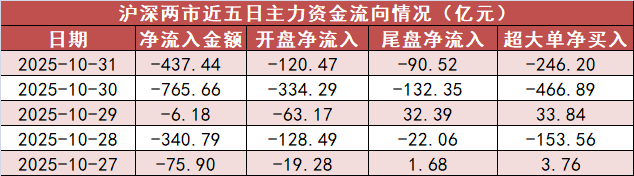
Market Overview - The A-share market experienced an overall decline on October 31, with the Shanghai Composite Index closing at 3954.79 points, down 0.81%, the Shenzhen Component Index at 13378.21 points, down 1.14%, and the ChiNext Index at 3187.53 points, down 2.31%. The North Star 50 Index increased by 1.89% [1] - Total trading volume in the A-share market was 23501.16 billion, a decrease of 1144.6 billion compared to the previous trading day [1] Capital Flow - The main capital outflow from the A-share market was 437.44 billion, with an opening net outflow of 120.47 billion and a closing net outflow of 90.52 billion [2] - The CSI 300 index saw a net outflow of 255.4 billion, while the ChiNext and STAR Market experienced net outflows of 162.56 billion and 57.19 billion, respectively [4] Sector Performance - The pharmaceutical and biotechnology sector led with a net inflow of 155.42 billion, marking a 2.72% increase [6][7] - Other sectors with significant inflows included media (96.02 billion, up 2.98%), computer (92.13 billion, up 1.81%), food and beverage (38.11 billion, up 1.49%), and retail (25.35 billion, up 1.55%) [7] - Conversely, the electronics sector faced the largest outflow at 278.68 billion, down 0.73%, followed by non-ferrous metals at 128.48 billion, down 1.03% [7] Institutional Activity - Oriental Precision Engineering saw the highest net inflow of 12.45 billion [8] - Institutions were active in several stocks, with notable net purchases in Zejing Pharmaceutical (206.78 million) and Shutai Shen (198.10 million) [10][11] Stock Recommendations - Recent institutional focus includes China Life Insurance with a target price of 10.40, indicating a potential upside of 23.22% from the latest closing price [12] - Other stocks with buy ratings include Shanghai Bank (target price 12.02, upside 26.66%) and Yuyue Medical (target price 45.47, upside 26.20%) [12]

上市银行三季度财富管理大盘点,中收最高增两成达206.7亿,呈现私行、代销驱动等四大特征
Xin Lang Cai Jing· 2025-10-31 11:09
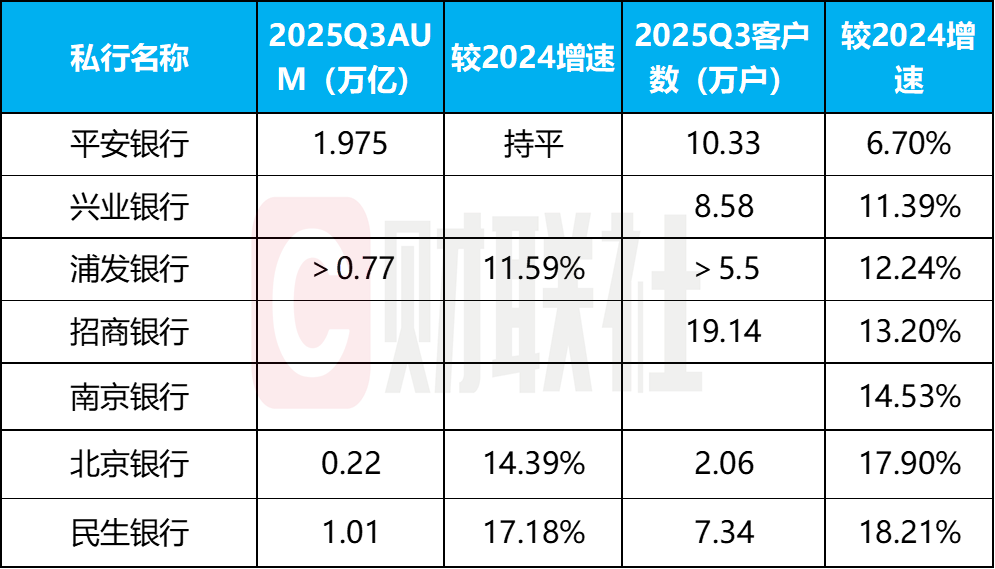
Core Insights - The wealth management business of banks has shown significant growth in Q3 2025, characterized by "private banking leadership, agency sales driving, digital empowerment, and cross-border expansion" [1][2][4] - Most banks are building retail financial service systems driven by wealth management, with rapid increases in business scale, customer numbers, and fee income [2][3] Group 1: Wealth Management Performance - Wealth management client numbers have steadily increased, with Nanjing Bank's wealth clients growing by 16.31% compared to the end of the previous year [2] - Citic Bank achieved its highest annual growth in Assets Under Management (AUM) in nearly three years [1] - China Merchants Bank's wealth management fee and commission income reached 20.67 billion yuan, a year-on-year increase of 18.76% [3] Group 2: Private Banking as a Growth Engine - Private banking clients have become a core growth engine, with most banks reporting over 10% growth in private banking client numbers since the beginning of the year [4][5] - Specific banks like Shanghai Pudong Development Bank and Beijing Bank have also seen over 10% growth in private banking AUM [5][6] Group 3: Agency Sales Driving Growth - Agency sales, including insurance, funds, and wealth management products, are the main growth drivers for banks [8] - Ping An Bank's agency insurance income grew by 48.7%, while China Merchants Bank's agency fund income increased by 38.76% [8] Group 4: Digital and Professional Services Integration - Banks are enhancing customer engagement through digital and professional services, with Shanghai Pudong Development Bank focusing on wealth management needs and launching a global wealth management platform [9] - Beijing Bank is leveraging its "Retail Crystal Ball System" to drive value creation through data-driven insights [9] Group 5: Cross-Border Wealth Management Demand - There is a growing demand for cross-border wealth management, with Standard Chartered Bank reporting a 30% increase in wealth management business due to strong market performance and cross-border demand [10][11] - The bank's affluent client base and AUM have seen significant growth, indicating a robust long-term outlook for wealth management revenue [11]
公积金服务“提速增效” 浦发银行北京分行赋能首都民生
Zheng Quan Ri Bao Zhi Sheng· 2025-10-31 10:41
Core Points - The article discusses the initiatives taken by Shanghai Pudong Development Bank's Beijing branch to enhance the accessibility and effectiveness of housing provident fund policies for contributors [1][2] - The bank aims to ensure that the benefits of these policies reach both employers and individual contributors efficiently [1] Group 1: Policy Communication and Support - The bank has implemented a series of diverse promotional activities to communicate housing provident fund policies clearly to contributors [1] - A specialized service team conducts "one-on-one" phone communications with key contributing units to ensure accurate information delivery [1] - The bank focuses on small and micro enterprises by providing face-to-face services, answering questions, and guiding online operations [1] Group 2: Tailored Financial Services - Shanghai Pudong Development Bank has customized housing provident fund service plans to offer comprehensive support for both businesses and individuals [1] - The bank promotes a "zero-run" contribution model, simplifying the contribution process through online operations to reduce the administrative burden on enterprises [1] - For individual contributors, the bank provides convenient online services for card binding and inquiries, along with optimized loan processing to enhance the efficiency and experience of urban residents [1] Group 3: Future Commitment - The bank plans to continue fulfilling its social responsibility by exploring innovative service paths for the housing provident fund [2] - There is a commitment to further optimize service processes and enrich service scenarios to support the high-quality development of the capital's real economy [2]

中行农行收巨额罚单
Bei Jing Ri Bao Ke Hu Duan· 2025-10-31 10:12
Group 1 - The National Financial Supervision Administration has imposed significant fines on several major banks in China for various regulatory violations [1] - China Bank was fined 97.9 million yuan for issues related to corporate governance, loan management, and asset quality [1] - Agricultural Bank of China received a fine of 27.2 million yuan for non-compliance in product sales and credit fund management [1] Group 2 - China Minsheng Bank was fined 58.65 million yuan for imprudent management of loans and regulatory data reporting [1] - Ping An Bank faced a fine of 18.8 million yuan due to issues in internet loans and related business management [1] - Shanghai Pudong Development Bank was fined 12.7 million yuan for similar violations in internet loan management [1]
浦发银行三季度净利润增超10%,AUM同比增长近20%
2 1 Shi Ji Jing Ji Bao Dao· 2025-10-31 10:05
Core Insights - Shanghai Pudong Development Bank (SPDB) reported a net profit increase of over 10% in Q3 2025, with total revenue reaching 41.721 billion yuan, a year-on-year growth of 0.31% [1] - The bank's total assets reached 9.89 trillion yuan, reflecting a 4.55% increase from the end of the previous year, while the non-performing loan (NPL) ratio decreased to 1.29% [2] Financial Performance - For the first three quarters, SPDB achieved a total revenue of 132.28 billion yuan, up 1.88% year-on-year, and a net profit of 39.171 billion yuan, an increase of 10.21% [1] - Net interest income for the first three quarters was 89.606 billion yuan, growing by 3.93%, primarily due to optimized funding costs [2] - The bank's net interest margin improved by 6 basis points to 1.44% as the deposit interest rate decreased by 38 basis points year-on-year [2] Asset Quality and Risk Management - The NPL balance decreased to 72.889 billion yuan, with the NPL ratio showing a decline, and the provision coverage ratio increased to 198.04% [4] - The bank's focus on technology finance, supply chain finance, inclusive finance, cross-border finance, and treasury finance has led to an optimized loan structure [2] Customer and Wealth Management - SPDB's retail assets under management (AUM) reached 4.62 trillion yuan, a year-on-year increase of 19.07%, driven by deeper customer engagement [3] - Retail loans (excluding personal business loans) amounted to 1.504721 trillion yuan, with a growth of 2.84% from the end of the previous year [3] - The bank's wealth management business saw a significant increase, with asset management scale reaching 3.19 trillion yuan, a net increase of 503.062 billion yuan [3]
大摩:内银第三季盈利呈反弹趋势 农业银行(01288)表现优于同业
智通财经网· 2025-10-31 09:37
Core Insights - Morgan Stanley reports that despite a decline in investment income, most mainland banks have shown improvement in net interest income and healthy growth in fee income for Q3 2025 [1][2] - State-owned banks are experiencing ongoing net interest margin pressure, but many banks expect this pressure to ease further [2][3] - The asset quality of banks remains stable, with a majority reporting a steady non-performing loan ratio [3] Group 1: Financial Performance - Most state-owned banks reported higher profit growth in Q3 2025 compared to the first half of the year, supported by stable asset quality [1] - Net interest margin for many banks has rebounded due to lower funding costs and more prudent loan growth and pricing [1][2] - Ningbo Bank reported the highest net interest income growth among covered banks, benefiting from increased market share and lower margin pressure [1] Group 2: Fee Income Growth - Average fee income growth for covered banks rebounded from 1.4% in Q2 2025 to 11.1% in Q3 2025, driven by a recovery in capital market activities and strong insurance sales [2] - Ningbo Bank led with a 94% year-on-year growth in fee income, while Agricultural Bank maintained a 23.6% growth [2] Group 3: Asset Quality and Credit Costs - The average non-performing loan ratio for covered banks remained stable at 1.15%, with credit costs declining for most banks [3] - State-owned banks slightly reduced credit costs to support profit growth, while the non-performing loan coverage ratio remained high at 263% [3] - Overall, banks continue to show a trend of profit rebound, with state-owned banks accelerating profit growth in Q3 2025 due to further declines in credit costs [3]


浦发银行2025年三季报:数智赋能筑韧性 战略深耕显担当
第一财经网· 2025-10-31 09:32
Core Insights - The core viewpoint of the article emphasizes that Shanghai Pudong Development Bank (SPDB) has demonstrated strong resilience and responsibility in serving the real economy while achieving steady growth in operating performance, with both revenue and net profit increasing year-on-year in the first three quarters of 2025 [1][2]. Financial Performance - For the first three quarters of 2025, SPDB reported operating income of 132.28 billion yuan, a year-on-year increase of 1.88%, and a net profit attributable to shareholders of 38.82 billion yuan, up 10.21% year-on-year, with profit growth accelerating compared to the first half of the year [2]. - The cost-to-income ratio was maintained at 27.53%, and the decline in net interest margin has significantly narrowed, indicating a stable foundation for profit growth [2]. - As of the end of Q3, the total assets of the group reached 9.89 trillion yuan, a 4.55% increase from the end of the previous year, with total loans (including discounted bills) amounting to 5.67 trillion yuan, up 5.20% [2]. Risk Management and Asset Quality - SPDB's improvement in profitability is driven by both the enhancement of interest margin structure and the optimization of income structure. The bank has effectively managed its liabilities, resulting in a year-on-year decrease of 38 basis points in the deposit interest rate [3]. - As of the end of Q3, the non-performing loan balance was 72.89 billion yuan, a decrease of 0.265 billion yuan from the end of the previous year, with the non-performing loan ratio dropping to 1.29% [3]. - The provision coverage ratio improved to 198.04%, marking the best level in nearly a decade, reinforcing the bank's sustainable development foundation [3]. Strategic Focus and Development - SPDB is focusing on key strategic areas such as technology finance, supply chain finance, and green finance, with over 70% of new loans allocated to these sectors [5]. - The bank has established a comprehensive technology finance ecosystem, serving over 250,000 technology enterprises, with technology finance loans exceeding 1 trillion yuan [5][6]. - The supply chain finance sector has seen rapid growth, with online supply chain business volume reaching 574.86 billion yuan, a year-on-year increase of 267.65% [6]. Service Enhancement and Social Responsibility - SPDB is committed to enhancing service capabilities and fulfilling its social responsibilities, integrating its development into the national development framework [8]. - The bank's regional strategy has shown effectiveness, with loans in the Yangtze River Delta region exceeding 2 trillion yuan, accounting for about 58% of the company's loan growth [8]. - SPDB aims to deepen financial supply-side structural reforms and enhance service capabilities, aligning with national planning and contributing to the construction of a financial power [9].
浦发银行:前三季度净利润增长10.21%,数智化战略纵深推进
Zhong Guo Jin Rong Xin Xi Wang· 2025-10-31 09:23
Core Insights - Shanghai Pudong Development Bank (SPDB) reported a revenue of 132.28 billion yuan and a net profit of 38.82 billion yuan for the first three quarters of 2025, reflecting a year-on-year growth of 1.88% and 10.21% respectively [1] - The bank is focusing on a "digital intelligence" strategy, emphasizing strong sectors, optimized structure, risk control, and efficiency improvement to support the real economy [1][2] Financial Performance - SPDB's total assets reached 9.89 trillion yuan, a 4.55% increase from the end of the previous year, with total loans (including discounted bills) amounting to 5.67 trillion yuan, up by 5.20% [2] - The bank's total liabilities grew by 3.83% to 90.51 trillion yuan, with deposits increasing by 9.19% to 56.19 trillion yuan [2] - Non-performing loans decreased to 72.89 billion yuan, with a non-performing loan ratio of 1.29%, down by 0.07 percentage points [2] Strategic Focus - SPDB is implementing a "shaped arrow" regional strategy, concentrating on the Yangtze River Delta, Beijing-Tianjin-Hebei, and the Greater Bay Area, with over 60% of loans allocated to these key regions [3] - The bank's focus on technology finance, supply chain finance, and green finance has led to these sectors accounting for over 70% of new loan increments [6] Capital and Investment - The recent completion of a 50 billion yuan convertible bond with a conversion rate of 99.7% will enhance the bank's core tier-one capital and improve its capacity to serve the real economy [8] - SPDB aims to strengthen its market competitiveness in key sectors and regions while enhancing its integrated development layout [5] Innovation and Services - The bank's personal financial assets reached 4.62 trillion yuan, a 19.07% increase, with significant growth in its pension service system [7] - Cross-border financial services have expanded, with a 47% increase in RMB settlement volume for cross-border transactions, reaching 3.29 trillion yuan [6]
股份制银行板块10月31日跌0.73%,光大银行领跌,主力资金净流出3.81亿元
Zheng Xing Xing Ye Ri Bao· 2025-10-31 08:42
Market Overview - On October 31, the share price of the banking sector fell by 0.73% compared to the previous trading day, with Everbright Bank leading the decline [1] - The Shanghai Composite Index closed at 3954.79, down 0.81%, while the Shenzhen Component Index closed at 13378.21, down 1.14% [1] Individual Bank Performance - Industrial Bank (601166) saw a closing price of 20.23, with an increase of 1.00% and a trading volume of 887,900 shares, totaling 1.793 billion yuan [1] - Huaxia Bank (600015) remained unchanged at 6.81, with a trading volume of 670,600 shares, totaling 45.6 million yuan [1] - Ping An Bank (000001) closed at 11.32, down 0.53%, with a trading volume of 970,200 shares, totaling 1.099 billion yuan [1] - China Merchants Bank (600036) closed at 40.89, down 0.75%, with a trading volume of 702,600 shares, totaling 2.882 billion yuan [1] - Zheshang Bank (601916) closed at 2.99, down 0.99%, with a trading volume of 1.6683 million shares, totaling 501 million yuan [1] - Minsheng Bank (600016) closed at 3.91, down 1.01%, with a trading volume of 4.6781 million shares, totaling 1.834 billion yuan [1] - CITIC Bank (601998) closed at 7.74, down 1.28%, with a trading volume of 915,000 shares, totaling 705 million yuan [1] - Shanghai Pudong Development Bank (600000) closed at 11.49, down 1.29%, with a trading volume of 1.4353 million shares, totaling 1.658 billion yuan [1] - Everbright Bank (601818) closed at 3.34, down 3.19%, with a trading volume of 5.9154 million shares, totaling 1.987 billion yuan [1] Capital Flow Analysis - The banking sector experienced a net outflow of 381 million yuan from main funds, while speculative funds saw a net inflow of 433 million yuan, and retail investors had a net outflow of 51.53 million yuan [1] - Specific capital flows for individual banks indicate varying trends, with Shanghai Pudong Development Bank experiencing a main fund net inflow of 241 million yuan but a net outflow from retail investors of 181 million yuan [2] - Industrial Bank had a main fund net inflow of 56.7 million yuan, while retail investors saw a net outflow of 48.09 million yuan [2] - CITIC Bank recorded a main fund net inflow of 30.28 million yuan, with a net outflow from retail investors of 47.03 million yuan [2] - Everbright Bank faced a significant main fund net outflow of 65.63 million yuan, despite a net inflow from speculative funds of 111 million yuan [2] - China Merchants Bank had a substantial main fund net outflow of 2.71 billion yuan, while speculative funds saw a net inflow of 3.15 billion yuan [2] - Minsheng Bank experienced a main fund net outflow of 3.17 billion yuan, with a net inflow from retail investors of 2.37 billion yuan [2]