
京新药业

Search documents
30家药企涌入一条赛道!非奈利酮仿制热潮背后的医药内卷与破局机遇
Ge Long Hui· 2025-10-29 19:03
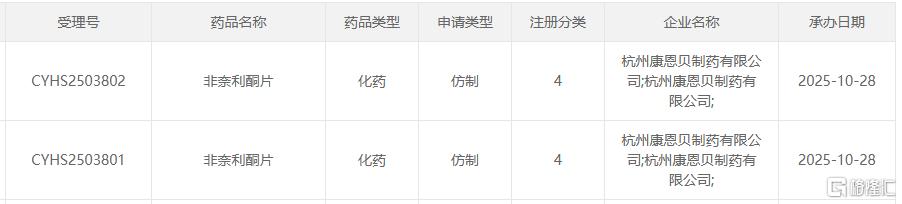
Core Insights - Hangzhou Kang En Bei Pharmaceutical's application for the generic version of Finerenone has been accepted, with 30 companies currently competing for the first generic approval [1][7][10] - Finerenone, originally developed by Bayer, is used for treating type 2 diabetes-related chronic kidney disease (CKD) and heart failure, showing strong market performance with sales exceeding 410 million yuan in the first half of 2025, a 135.98% year-on-year increase [4][10] - The original patent for Finerenone is set to expire in February 2028, with 23 companies currently filing for a type 3 patent declaration, indicating they cannot market the product until the patent expires [10][13] Company Developments - Kang En Bei Pharmaceutical has successfully obtained approvals for over 50 products, with several being the first to pass consistency evaluations, including Sulfamethoxazole and Amisulpride solutions [16] - The competition for Finerenone has intensified, with 37 companies having completed bioequivalence (BE) trials and over 20 more currently conducting BE trials [13][16] Market Dynamics - The strong sales performance of Finerenone has attracted numerous domestic pharmaceutical companies to enter the market, leading to a competitive landscape [4][7] - The ongoing patent challenges and the competitive nature of the generic drug market suggest a dynamic environment for both original and generic manufacturers [10][13]


京新药业:2025年前三季度净利润约5.76亿元
Mei Ri Jing Ji Xin Wen· 2025-10-29 10:26
Group 1 - The core viewpoint of the article highlights the financial performance of Jingxin Pharmaceutical in Q3 2025, showing a revenue decline but a slight increase in net profit [1] - The company's revenue for the first three quarters of 2025 is approximately 3.048 billion yuan, representing a year-on-year decrease of 5% [1] - The net profit attributable to shareholders is about 576 million yuan, reflecting a year-on-year increase of 0.1% [1] - Basic earnings per share are reported at 0.7 yuan, which is a year-on-year increase of 4.48% [1] Group 2 - As of the report, Jingxin Pharmaceutical has a market capitalization of 15.6 billion yuan [2]

京新药业(002020) - 2025 Q3 - 季度财报
2025-10-29 10:05
Financial Performance - Q3 2025 revenue was CNY 1,031,649,329.24, a decrease of 2.57% year-over-year, while year-to-date revenue reached CNY 3,048,192,079.46, down 5.00% compared to the same period last year[5] - Net profit attributable to shareholders for Q3 2025 was CNY 187,732,848.96, an increase of 8.59% year-over-year, with year-to-date net profit at CNY 575,611,846.06, showing a slight increase of 0.10%[5] - Basic and diluted earnings per share for Q3 2025 were both CNY 0.23, reflecting a 15.00% increase compared to the same period last year[5] - Total operating revenue for the current period was ¥3,048,192,079.46, a decrease of 5.01% from ¥3,208,743,897.71 in the previous period[19] - Operating profit for the current period was ¥664,258,601.66, slightly down from ¥671,815,265.63, reflecting a decrease of 1.04%[19] - Net profit before tax was ¥664,916,102.75, compared to ¥676,464,298.28 in the previous period, indicating a decline of 1.61%[19] - The net profit attributable to the parent company shareholders was CNY 575,611,846.06, a slight increase from CNY 575,012,790.33 in the previous period, reflecting a growth of 0.10%[20] - The total comprehensive income attributable to the parent company owners was CNY 575,497,372.10, compared to CNY 575,219,327.84 in the previous period, indicating a growth of 0.05%[20] - The basic and diluted earnings per share increased to CNY 0.70 from CNY 0.67, representing a growth of approximately 4.48%[20] Assets and Liabilities - Total assets at the end of Q3 2025 were CNY 7,978,648,630.10, a decrease of 5.90% from the end of the previous year[5] - Total assets decreased to ¥7,978,648,630.10 from ¥8,479,313,218.60, a reduction of 5.91%[18] - Total liabilities decreased to ¥2,293,129,014.28, down from ¥2,477,769,425.69, a decline of 7.43%[17] - Current assets increased to ¥3,142,880,026.72, up from ¥2,904,776,219.94, an increase of 8.19%[16] - Cash and cash equivalents rose to ¥452,279,163.55, compared to ¥316,266,734.17, reflecting a significant increase of 42.94%[16] - Inventory decreased slightly to ¥783,702,441.62 from ¥792,719,340.04, a decrease of 1.28%[16] - Unappropriated profits increased to ¥3,188,139,806.91 from ¥2,897,381,706.60, an increase of 10.03%[17] Cash Flow - Cash flow from operating activities for the year-to-date period was CNY 615,483,813.37, showing a slight increase of 0.46%[5] - The net cash flow from operating activities was CNY 615,483,813.37, slightly up from CNY 612,693,212.93 in the previous period, showing an increase of 0.46%[23] - Cash inflow from investment activities was CNY 2,038,840,858.84, down from CNY 3,277,371,692.31, a decrease of 37.87%[23] - The net cash flow from investing activities was CNY 514,465,812.65, reflecting a 133.66% increase due to reduced external investments[10] - The net cash flow from financing activities was CNY -981,378,371.85, a significant decrease of 529.57% primarily due to share repurchases[10] - The net cash flow from financing activities was negative CNY 981,378,371.85, worsening from negative CNY 155,879,600.17 in the previous period[23] - The total cash and cash equivalents at the end of the period amounted to CNY 433,628,680.58, an increase from CNY 204,186,009.58 in the previous period[23] - The company received CNY 2,846,292,493.75 in cash from sales of goods and services, a slight increase from CNY 2,838,651,137.39 in the previous period[22] - The company paid CNY 1,020,986,605.26 for goods and services, down from CNY 1,100,794,598.42, indicating a decrease of 7.25%[23] Shareholder Information - The total number of common shareholders at the end of the reporting period is 22,318[11] - The top 10 shareholders hold a total of 60.77% of the shares, with the largest shareholder, Lü Gang, holding 20.77%[11] - The company has repurchased 47,271,295 shares, accounting for 5.49% of the total share capital, with a total transaction amount of 608.72 million RMB[13] - The maximum purchase price for repurchased shares was 14.41 RMB per share, while the minimum was 11.86 RMB per share[13] - The company plans to raise up to 150 million RMB through the fourth employee stock ownership plan, with a purchase price of 12.50 RMB per share[14] - The total number of shares involved in the employee stock ownership plan is 12 million shares[14] - The company has no preferred shareholders or significant changes in the top 10 shareholders due to margin trading[12] - The company’s major shareholder, Lü Gang, and his spouse hold 100% of the shares in Jingxin Holdings Group[11] - The company has not identified any other relationships among the top shareholders that would classify them as acting in concert[12] - The company’s repurchase account does not count towards the top 10 shareholders list[11] Income and Expenses - The company reported a significant increase of 1987.85% in current assets due to an increase in short-term deposits[9] - Investment income for the year-to-date period was CNY 16,687,385.45, a substantial increase of 179.54% year-over-year, attributed to higher dividend income[9] - The company experienced a 53.86% decrease in other income, primarily due to a reduction in government subsidies[9] - Total operating costs decreased to ¥2,417,770,049.29, down 7.33% from ¥2,608,110,283.39[19] - The company reported a decrease in other comprehensive income attributable to the parent company owners, with a net amount of CNY -114,473.96 compared to CNY 206,537.51 in the previous period[20]
10月28日生物经济(970038)指数跌0.16%,成份股美亚光电(002690)领跌
Sou Hu Cai Jing· 2025-10-28 12:22
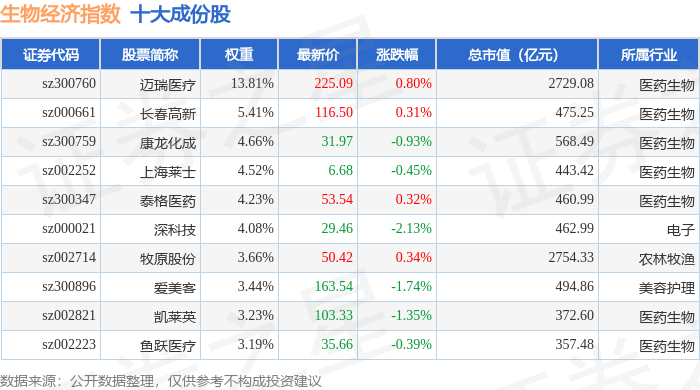
Core Points - The Bioeconomy Index (970038) closed at 2277.51 points, down 0.16%, with a trading volume of 18.883 billion yuan and a turnover rate of 1.2% [1] - Among the index constituents, 23 stocks rose while 27 fell, with Iwubio leading the gainers at 6.71% and Meiya Optoelectronics leading the decliners at 3.02% [1] Index Constituents Summary - The top ten constituents of the Bioeconomy Index include: - Mindray Medical (sz300760) with a weight of 13.81%, latest price at 225.09 yuan, and a market cap of 272.908 billion yuan [1] - Changchun High-tech (sz000661) with a weight of 5.41%, latest price at 116.50 yuan, and a market cap of 47.525 billion yuan [1] - Kanglong Chemical (sz300759) with a weight of 4.66%, latest price at 31.97 yuan, and a market cap of 56.849 billion yuan [1] - Other notable constituents include Shishihistory (sz002252), Table Pharmaceutical (sz300347), and Muyuan Foods (sz002714) [1] Capital Flow Analysis - The Bioeconomy Index constituents experienced a net outflow of 871 million yuan from institutional investors, while retail investors saw a net inflow of 544 million yuan [3] - Key capital flows include: - Iwubio (300357) with a net inflow of 52.9277 million yuan from institutional investors [3] - Dabo Medical (002901) with a net inflow of 31.8434 million yuan from institutional investors [3] - Changchun High-tech (000661) with a net inflow of 27.6452 million yuan from institutional investors [3]




2025年睡眠健康品牌推荐:从智能监测到个性化干预的全周期管理
Tou Bao Yan Jiu Yuan· 2025-10-27 14:24
Investment Rating - The report does not explicitly provide an investment rating for the sleep health industry Core Insights - The sleep health industry is focused on improving and maintaining individual sleep quality, driven by increasing consumer demand for quality sleep and technological advancements [5][11] - The market size is projected to grow from 344.68 billion RMB in 2019 to 532.11 billion RMB in 2024, with a compound annual growth rate (CAGR) of 9.07%, and further to 754.12 billion RMB by 2029, with a CAGR of 7.19% [11][13] - The industry is experiencing a shift from single product manufacturing to intelligent solutions, with a focus on personalized and technology-driven products [12][13] Market Background - The sleep health industry encompasses a range of activities and services aimed at improving sleep quality and addressing sleep disorders [6] - The evolution of sleep medicine has progressed significantly since the 19th century, with notable advancements in sleep monitoring technologies [7][8] Market Status - The market is characterized by a growing awareness of sleep health among consumers, with various methods being adopted to improve sleep quality [12] - The demand for sleep health products is driven by a high prevalence of sleep issues, with 48.5% of the population experiencing sleep disturbances [16] Market Competition - The competitive landscape includes major players such as 喜临门, 鱼跃医疗, and 慕思, each with unique strengths in product development and market positioning [21][22] - The evaluation of companies in the industry is based on market capitalization, revenue, and patent counts, indicating their competitive strength and innovation capabilities [17][20] Development Trends - Technological innovation is driving product upgrades, with advancements in sensor technology and AI enhancing sleep monitoring and personalized solutions [35] - A diversified product and service ecosystem is emerging, catering to various consumer needs, including sleep monitoring devices and nutritional supplements [36] - The integration of online and offline sales channels is becoming prevalent, enhancing consumer experience and accessibility to sleep health products [37]
重磅BD落地,持续推荐创新药械产业链
Haitong Securities International· 2025-10-27 06:16
Investment Rating - The report maintains an "Overweight" rating for several pharmaceutical companies including Jiangsu Heng Rui Medicine, Hansoh Pharmaceutical Group, 3SBio, and Jiangsu Nhwa Pharmaceutical, with related targets such as CSPC Innovation Pharmaceutical [6][28]. Core Insights - The innovative drug sector is experiencing high prosperity, and the report continues to recommend innovative drugs and their industry chain. It highlights the recent global strategic collaboration between Innovent Biologics and Takeda, which is expected to catalyze the innovative drug market [6][29]. - The report notes that the A-Shares pharmaceutical sector underperformed the market in the fourth week of October 2025, with the SW Pharmaceutical and Biological index rising only 0.6% compared to a 2.9% increase in the SHCOMP [8][30]. - In the same period, the Hong Kong pharmaceutical sector also underperformed, while the U.S. pharmaceutical sector performed in line with the market [31][19]. Summary by Sections Continuous Recommendation of Innovative Drugs and Industry Chain - The report emphasizes the ongoing recommendation of innovative drugs and the industry chain, maintaining "Overweight" ratings for various companies including Heng Rui Medicine, Hansoh Pharmaceutical, 3SBio, and Nhwa Pharmaceutical. It also recommends Biopharma/Biotech companies with innovative pipelines and increasing performance, maintaining "Overweight" ratings for Innovent Biologics, Xiamen Amoytop Biotech, and others [6][28]. Performance of A-Shares Pharmaceutical Sector - In the fourth week of October 2025, the A-Shares pharmaceutical sector's performance was weaker than the overall market, with a 0.6% increase compared to the SHCOMP's 2.9% rise. The medical service, pharmaceutical commerce, and medical equipment sub-sectors showed relatively better performance [8][30]. Performance of Hong Kong and U.S. Pharmaceutical Sectors - The Hong Kong pharmaceutical sector underperformed the market with a decline of 0.8%, while the U.S. pharmaceutical sector matched the market performance with a 1.9% increase. Notable stock movements included significant gains for companies like WuXi AppTec and declines for Alphamab Oncology in Hong Kong [31][19].



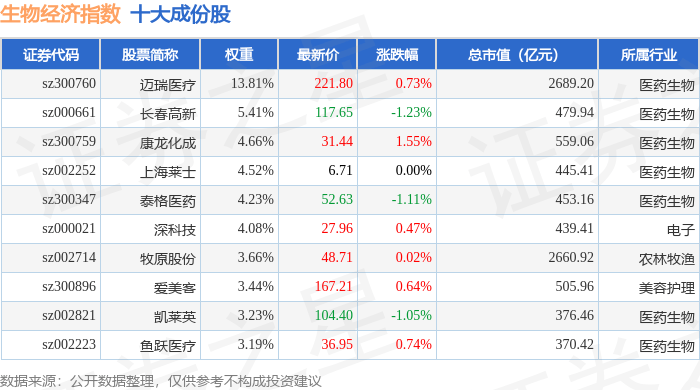
10月23日生物经济(970038)指数跌0.06%,成份股京新药业(002020)领跌
Sou Hu Cai Jing· 2025-10-23 09:56
Core Viewpoint - The Biotech Index (970038) closed at 2259.94 points, down 0.06%, with a trading volume of 17.182 billion yuan and a turnover rate of 1.24% on October 23 [1] Group 1: Index Performance - The Biotech Index had 26 stocks rising and 22 stocks falling on the day, with Huace Testing leading the gainers at a 3.03% increase, while Jingxin Pharmaceutical led the decliners with a 4.17% drop [1] - The top ten constituent stocks of the Biotech Index include: - Mindray Medical (13.81% weight, latest price 221.80, market cap 268.92 billion yuan) [1] - Changchun High-tech (5.41% weight, latest price 117.65, market cap 47.994 billion yuan) [1] - Kanglong Chemical (4.66% weight, latest price 31.44, market cap 55.906 billion yuan) [1] - Others include Shishi Yushang, Biao Ge Pharmaceutical, and more, all within the biotech and related sectors [1] Group 2: Capital Flow - The Biotech Index constituents experienced a net outflow of 502 million yuan from main funds, while retail investors saw a net inflow of 354 million yuan [3] - Detailed capital flow for key stocks includes: - Deep Technology: Main fund net inflow of 82.5949 million yuan, retail net inflow of 21.4 million yuan [3] - Mindray Medical: Main fund net inflow of 66.9479 million yuan, retail net outflow of 3.6088 million yuan [3] - Other stocks like Muyuan Foods and Kanglong Chemical also showed varying levels of net inflow and outflow from different investor categories [3]


京新药业股价跌5.02%,红土创新基金旗下1只基金重仓,持有39.57万股浮亏损失37.59万元
Xin Lang Cai Jing· 2025-10-23 03:14
Group 1 - The core point of the news is that Jingxin Pharmaceutical experienced a 5.02% decline in stock price, reaching 17.99 yuan per share, with a trading volume of 168 million yuan and a turnover rate of 1.27%, resulting in a total market capitalization of 15.49 billion yuan [1] - Jingxin Pharmaceutical, established on February 13, 1999, and listed on July 15, 2004, is located in Zhejiang Province and specializes in the research, production, and sales of chemical preparations, traditional Chinese medicine, biological preparations, chemical raw materials, and medical devices [1] - The company's main business revenue composition is 82.46% from pharmaceutical manufacturing and 17.54% from medical devices [1] Group 2 - According to data from the top ten holdings of funds, Hongtu Innovation Fund has a significant position in Jingxin Pharmaceutical, with its Hongtu Innovation Steady Mixed A Fund (006700) increasing its holdings by 68,000 shares in the second quarter, totaling 395,700 shares, which accounts for 2.95% of the fund's net value, ranking as the fifth-largest holding [2] - The Hongtu Innovation Steady Mixed A Fund was established on March 13, 2019, with a current scale of 748.024 million yuan, yielding 1.95% this year, ranking 7530 out of 8159 in its category, and a one-year return of 2.6%, ranking 7326 out of 8030 [2] - The estimated floating loss for the fund today is approximately 375,900 yuan [2]
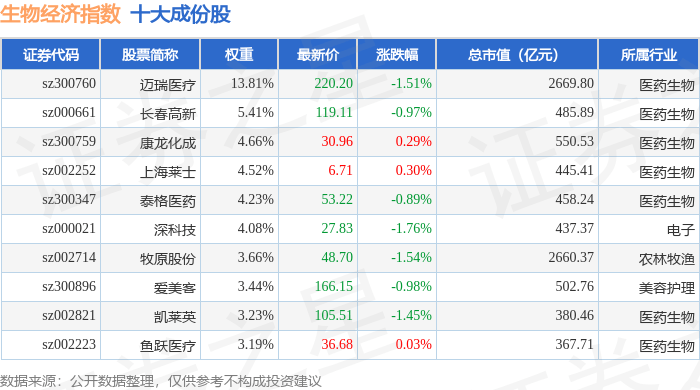
10月22日生物经济(970038)指数跌0.81%,成份股普洛药业(000739)领跌
Sou Hu Cai Jing· 2025-10-22 10:24
Core Insights - The Biotech Economy Index (970038) closed at 2261.4 points, down 0.81%, with a trading volume of 16.635 billion yuan and a turnover rate of 1.19% [1] - Among the index constituents, 19 stocks rose while 30 stocks fell, with Meihao Medical leading the gainers at 6.53% and Prolo Pharma leading the decliners at 5.41% [1] Index Performance - The Biotech Economy Index experienced a decline of 0.81% on the reporting day [1] - The total market capitalization of the index constituents was significant, with major players like Mindray Medical valued at 266.98 billion yuan [1] Top Constituents - The top ten constituents of the Biotech Economy Index include: - Mindray Medical (13.81% weight, 220.20 yuan, -1.51% change, 2669.80 billion yuan market cap) [1] - Changchun High-tech (5.41% weight, 119.11 yuan, -0.97% change, 485.89 billion yuan market cap) [1] - Kanglong Chemical (4.66% weight, 30.96 yuan, +0.29% change, 550.53 billion yuan market cap) [1] - Other notable constituents include Taige Pharmaceutical, Muyuans, and Aimeike, all within the biotech and healthcare sectors [1] Capital Flow - The net outflow of main funds from the Biotech Economy Index constituents totaled 0.893 billion yuan, while retail investors saw a net inflow of 0.75 billion yuan [1] - Specific stocks like Kanglong Chemical and Meihao Medical experienced varying levels of net inflow and outflow from different investor categories [2]


BD密集落地,持续关注创新药械产业链
Haitong Securities International· 2025-10-21 12:34
Investment Rating - The report maintains a positive outlook on the innovative drug and medical device industry, highlighting key targets for investment [5][24]. Core Insights - The innovative drug sector is experiencing high growth, with a focus on companies such as Jiangsu Heng Rui Medicine, Hansoh Pharmaceutical Group, and others. The report emphasizes the potential for value re-evaluation in these firms [5][24]. - Recent business development (BD) deals in the innovative drug sector are expected to catalyze market activity, with notable transactions including Jiangsu Heng Rui Medicine's agreement with Kite for a $1.20 billion upfront payment, potentially reaching $15.20 billion in total [5][24]. - The A-share pharmaceutical sector underperformed the broader market in the third week of October 2025, with the Shanghai Composite Index falling by 1.5% and the SW Biopharma index declining by 2.5% [7][18]. Summary by Sections 1. Continuous Focus on Innovative Drugs and Medical Devices - The report emphasizes the high growth potential in innovative drugs, with key investment targets including Jiangsu Heng Rui Medicine, Hansoh Pharmaceutical Group, and others. Related targets include CSPC Innovation Pharmaceutical [5][24]. 2. A-Share Pharmaceutical Sector Performance - In the third week of October 2025, the A-share pharmaceutical sector saw a decline of 2.5%, underperforming the Shanghai Composite Index, which fell by 1.5%. The report notes that the sector's premium relative to all A-shares is currently at a normal level, with a relative premium rate of 74.5% [7][14][21]. 3. Hong Kong and U.S. Pharmaceutical Sector Performance - The report indicates that the Hong Kong and U.S. pharmaceutical sectors also underperformed, with the Hang Seng Healthcare index dropping by 5.8% and the S&P 500 Healthcare index increasing by only 0.7% during the same period [18][24].
