潍柴动力

Search documents
AIDC燃机-柴发-液冷观点汇报
2026-02-10 03:24
Summary of AIDC Gas Turbine, Diesel Power, and Liquid Cooling Insights Industry Overview - The report focuses on the gas turbine market, diesel power generation, and liquid cooling technology within the data center industry, highlighting the current trends and future opportunities in these sectors [1][3]. Key Insights and Arguments Gas Turbine Market - Gas turbines are identified as the preferred solution for power deployment in data centers due to their short deployment cycle, high reliability, and flexible start-stop capabilities, especially in underdeveloped grid areas [1][3]. - The global gas turbine market is highly concentrated, with GE, Siemens, and Mitsubishi Heavy Industries holding over 80% market share, leading to extended delivery times until 2029 or even 2030 due to limited production capacity [1][4]. - A significant supply-demand gap exists, with global orders exceeding 80 GW by 2025, while current capacity is only about 50 GW, driving expectations for price increases across the industry [4]. Domestic Opportunities - Domestic companies have opportunities in the gas turbine component sector, particularly in hot-end components (like blades and rotors) and cold-end components (like large castings), despite a gap in complete machine manufacturing capabilities [5]. - Companies like Yingliu have entered Siemens' supply chain, marking a breakthrough, while Haomai Technology is a key supplier for the Jiayi gas turbine cylinder [5]. Diesel Power Generation - The diesel power generation market is dominated by international giants such as Caterpillar, MTU, and Cummins, but their willingness to expand production is limited, creating opportunities for domestic firms like Weichai Power and Yuchai Machinery [6]. Liquid Cooling Technology - Liquid cooling technology is gaining traction in data centers, with major investments from companies like Meta and Google, which are significantly increasing their capital expenditures for infrastructure development [7]. - The Nvidia Rubin solution exemplifies advancements in liquid cooling, with single-chip power exceeding 2000 watts and cabinet power exceeding 220 kW, utilizing a fully liquid-cooled design to optimize heat dissipation [2][7]. Competitive Landscape in Liquid Cooling - Companies such as Yingwei have secured high supply permissions and are involved in core component production, while new microchannel cover structures enhance cooling efficiency [8]. - The maturation of self-developed chips by Meta and Google is expected to drive market growth, benefiting companies like Hongchang, Feilong, and Feirongda [8]. - As Nvidia's chip ban is gradually lifted, domestic demand is surging, making companies like Shenling Environment and Gaolan noteworthy solution providers [8]. Additional Important Points - The report emphasizes the long-term potential of renewable energy sources like nuclear, hydro, wind, and solar, but notes their longer construction timelines compared to gas turbines, which can be deployed more rapidly [3]. - The report also highlights the importance of component technology control by upstream suppliers like ABB and Bosch, which affects the supply-demand balance in the diesel power generation market [6].
自由现金流ETF(159201)连续5日合计“吸金”9.89亿元,最新规模达132.06亿元
Xin Lang Cai Jing· 2026-02-10 02:33
Group 1 - The core index, the National Certificate Free Cash Flow Index (980092), experienced a decline of 0.12% as of February 10, 2026, with mixed performance among constituent stocks [1] - Leading stocks included Fenghuo Communication, Qianjin Pharmaceutical, and Anfu Technology, while stocks such as Silver Nonferrous, ShouLü Hotel, and Jiashitang lagged [1] - The Free Cash Flow ETF (159201) also saw a decrease of 0.15%, with the latest price at 1.31 yuan [1] Group 2 - The Free Cash Flow ETF recorded a net inflow of 9.89 billion yuan over the past five days, reaching a total share count of 10.063 billion and a total scale of 13.206 billion yuan, both marking new highs since inception [1] - The ETF's financing net purchase on the previous trading day was 4.6439 million yuan, with the latest financing balance at 172 million yuan [1] - The ETF has shown strong performance, with a maximum monthly return of 9.25% since inception and a historical holding period profit probability of 100% over six months [1] Group 3 - The National Certificate Free Cash Flow Index reflects the price changes of listed companies with high and stable free cash flow levels in the Shanghai and Shenzhen stock exchanges [2] - The top ten weighted stocks in the index as of January 30, 2026, include China National Offshore Oil Corporation, Gree Electric Appliances, and SAIC Motor, collectively accounting for 50.3% of the index [2] - The management fee for the Free Cash Flow ETF is 0.15%, and the custody fee is 0.05%, which are among the lowest in comparable funds [2]
未知机构:长江汽车高伊楠团队燃气发电机短期具备爆发力中长期具备持续性产业链被严重低估-20260210
未知机构· 2026-02-10 02:10
Summary of Conference Call Notes Industry Overview - The focus is on the gas generator industry, particularly in North America, where there is a clear demand for gas-powered generators due to electricity shortages [1][2]. Key Insights - **Short-term Demand**: North America is experiencing a power shortage, and the long delivery times for gas turbines make it difficult to alleviate this situation quickly. It is estimated that by 2026, the electricity gap for data centers in North America will be approximately 12-15 GW, with around 80% expected to be covered by gas generators, translating to about 10-12 GW or approximately 3,000 units of gas generators [1]. - **Long-term Growth**: The demand for small to medium-sized data centers, such as edge computing centers, is expected to grow over 30% annually. Gas engines are favored due to their ability to reduce operational costs through lower parallel unit requirements and modular characteristics that decrease redundancy costs [2]. Competitive Advantages - Gas engines may become a superior alternative to gas turbines due to their two main advantages: reduced operational costs and modular design [3]. - Major overseas manufacturers have secured large orders, with individual units valued at up to 10 million yuan, significantly higher than traditional diesel generators. For instance, Caterpillar has received a 2 GW order for gas generator sets, with potential future orders reaching 8 GW, scheduled for delivery between September 2026 and August 2027 [3]. Company Recommendations - **Weichai Power**: Has established a presence in the gas generator market, with hundreds of non-data center orders expected by 2026. They plan to launch 2-3 MW products by 2027 [3]. - **Yinlun**: Acts as a core supplier for Caterpillar's gas generator thermal management systems, with a cost component of approximately 10-20 thousand dollars per unit based on a 2.5 MW generator [4]. - **Tianrun Industrial**: Supplies connecting rods for Caterpillar, with plans to expand into crankshafts, starting mass production in May 2026 [4]. Additional Companies to Watch - Other notable companies include Weifu High-Technology (after-treatment and fuel nozzles) and Changyuan Donggu (cylinder blocks and heads) [5].


未知机构:AIDC发电专题报告北美缺电逻辑持续演绎相关投资线索再梳理东吴机-20260210
未知机构· 2026-02-10 02:00
Summary of Conference Call Notes Industry Overview - The report focuses on the North American electricity shortage, driven by the non-linear growth of AI power demand and aging power grid infrastructure [1] - The demand side sees a surge in AIDC projects in the U.S., leading to a significant increase in electricity demand [1] - On the supply side, while total supply is expected to meet short-term demand by 2025, long-term challenges include a decline in stable supply and regional electricity shortages [1] Key Points Supply Challenges - **Decline in Stable Supply**: The aging power grid leads to frequent outages, failing to meet AIDC's requirement for 100% reliable power. The upcoming retirement peak of coal power plants and the instability of wind and solar energy further exacerbate the situation. Only natural gas can currently fill the gap [1][2] - **Regional Electricity Shortages**: By 2024, over 50% of data centers are expected to be located in Texas, California, and Virginia, putting significant pressure on regional power supplies. The fragmented nature of the U.S. power grid and poor interconnections have led to emergency controls due to power imbalances [1] Future Projections - NERC forecasts an average peak gap of over 20 GW in the U.S. from 2027 to 2030, with Texas, the Mid-Atlantic, the Midwest, and California facing significant risks. The DOE predicts an average peak gap of 20-40 GW by 2030 [1] Technology Solutions - **Gas Turbines**: Considered the optimal solution for AIDC self-built power, with efficiency exceeding 60% and the lowest cost per kWh. The global installation of gas turbines is accelerating, with major manufacturers like GE, Siemens, and Mitsubishi Heavy Industries having orders scheduled until 2029 [2] - **Gas Internal Combustion Engines**: Slightly lower efficiency than gas turbines but offer rapid deployment. Leading company Wärtsilä saw a 111% year-on-year increase in new orders for Q1-Q3 2025, with deliveries extending to 2028 [2] - **Solid Oxide Fuel Cells (SOFC)**: High efficiency but currently in early commercialization stages, making it less viable in the short term due to cost and capacity constraints [2] - **Diesel Generators**: Optimal for backup power due to quick start-up capabilities, with Cummins reporting a revenue growth of approximately 20% year-on-year for related products in Q1-Q3 2025 [2] Investment Recommendations - Investment opportunities are expanding from gas turbines to gas internal combustion engines and SOFCs, as the current electricity shortage in North America exceeds the total production capacity of various technologies [3] - **Gas Turbines**: Recommended companies include Jerry Holdings, Yingliu Co., Dongfang Electric, Linde Co., and Haomai Technology [3] - **Gas Internal Combustion Engines**: Focus on Linde Co., with additional attention to Weichai Power and Eagle Precision [3] - **SOFC**: Suggested to monitor Weichai Power [3] - **Diesel Generators**: Recommended companies include Linde Co., with additional focus on KOTAI Power, Weichai Power, and Eagle Precision [3] Risk Factors - Potential risks include lower-than-expected investment in AI data centers, international trade tensions, and slower-than-anticipated capacity ramp-up [4]


北美缺电逻辑持续演绎,相关投资线索再梳理
Zhong Guo Neng Yuan Wang· 2026-02-10 01:48
Core Viewpoint - The report from Dongwu Securities highlights significant regional power supply pressures in the U.S. due to the increasing establishment of data centers, particularly in Texas, California, and Virginia, with projections indicating a substantial power gap by 2030 [1][2]. Group 1: Supply and Demand Dynamics - Over 50% of data centers are projected to be built in Texas, California, and Virginia by 2024, leading to considerable regional power supply stress [1][2]. - The North American Electric Reliability Corporation (NERC) anticipates an average peak power gap of over 20 GW from 2027 to 2030, with Texas, the Mid-Atlantic, the Midwest, and California facing significant risks [1][2]. - The U.S. Department of Energy (DOE) forecasts an average peak power gap of 20-40 GW by 2030 [1][2]. Group 2: Supply Challenges - The U.S. power supply is facing long-term challenges, including a decline in stable supply due to aging infrastructure and frequent outages, which cannot meet the 100% reliability demands of AI data centers [2]. - The upcoming retirement of coal power plants and the instability of wind and solar energy further exacerbate the supply issues, necessitating reliance on natural gas for current gaps [2]. Group 3: Technology Solutions - Gas turbines are identified as the optimal solution for self-built power generation in AIDC, with combined cycle gas turbines achieving over 60% efficiency and the lowest cost per kilowatt-hour [3]. - Gas internal combustion engines, while slightly less efficient, offer rapid deployment capabilities, with a significant increase in orders reported by leading companies [3]. - Solid Oxide Fuel Cells (SOFC) have high efficiency but are still in early commercialization stages, making them less viable in the short term [3]. - Diesel generators are noted for their quick start-up advantages, serving as optimal backup power solutions [3]. Group 4: Investment Recommendations - Investment opportunities are shifting from gas turbines to gas internal combustion engines and SOFCs, as the current power deficit in North America exceeds the total production capacity of various technologies [4]. - Recommended companies for gas turbines include Jerry Holdings, Yingliu Co., Dongfang Electric, Linde Co., and Haomai Technology [4]. - For gas internal combustion engines, Linde Co. is recommended, with additional attention to Weichai Power and Weichai Heavy Machinery [4]. - SOFC investments should focus on Weichai Power, while diesel generator investments recommend Linde Co. and other related companies [4].



山西证券研究早观点-20260210
Shanxi Securities· 2026-02-10 01:41
Market Trends - The domestic market indices showed positive performance with the Shanghai Composite Index closing at 4,123.09, up 1.41%, indicating broad growth potential [4] - The Shenzhen Component Index increased by 2.17%, while the ChiNext Index rose by 2.98%, reflecting a strong market sentiment [4] Company Insights - Under Armour reported a 4% decline in revenue for FY2026, with Q3 revenue dropping 5% to $1.3 billion and a net loss of $431 million [8] - In North America, Under Armour's revenue fell by 10% to $757 million, while international markets saw a 3% increase, with EMEA growing by 6% and Latin America by 20% [8] - The company's gross margin decreased by 3.10 percentage points to 44.4%, primarily due to higher tariffs and pricing pressures [8] - For FY2026, Under Armour anticipates an 8% revenue decline in North America and a 6% decline in the Asia-Pacific region, with an expected operating loss of $154 million [8] Industry Dynamics - In 2025, China's gold consumption is projected to decline by 3.57% to 950.096 tons, with jewelry consumption dropping by 31.61% [8] - The demand for gold is diversifying, with a notable increase in gold bars and coins consumption, which is expected to surpass jewelry consumption for the first time [8] - The textile and apparel sector saw a 1.32% increase, outperforming the broader market, with specific segments like textile manufacturing and apparel showing significant gains [9] Investment Recommendations - The report suggests focusing on brands like Bosideng, which is expected to meet its sales targets due to product innovation and extended sales periods [9] - Companies like Geely and Jiangnan Buyi are highlighted for their stable performance and high dividend yields, with Jiangnan Buyi maintaining an average payout ratio of 84% from 2021 to 2025 [9] - In the home textile sector, companies like Luolai Life and Mercury Home Textile are recommended due to their strong product performance and market positioning [9] - The report emphasizes the potential of companies involved in gold investment, such as Caibai Co., which is expected to see significant profit growth due to rising gold prices [10]
整车主线周报:404批工信部新车公告发布,蔚来25Q4业绩超预期
Soochow Securities· 2026-02-10 00:25
Investment Rating - The industry investment rating is "Overweight," indicating an expected outperformance of the industry index relative to the benchmark by more than 5% over the next six months [35]. Core Insights - The report highlights a recovery in the passenger vehicle sector, driven by the implementation of subsidy policies and a shift in consumer demand. It emphasizes the importance of focusing on high-end electric vehicle manufacturers that are less sensitive to policy fluctuations, such as Jianghuai Automobile and Geely [25][26]. - In the heavy truck segment, the report anticipates a positive outlook for 2026, projecting domestic sales to reach 800,000 to 850,000 units, a year-on-year increase of 3% [30][28]. - The bus market is expected to see growth in 2026, with a conservative estimate of 40,000 units sold, reflecting a 40% year-on-year increase, supported by the continuation of subsidy policies [30][29]. - The motorcycle sector is projected to achieve total sales of 19.38 million units in 2026, a 14% increase year-on-year, with a significant focus on the large-displacement motorcycle market [26]. Summary by Sections Passenger Vehicles - Short-term recovery is anticipated in the passenger vehicle sector due to established subsidy policies, with a focus on high-end electric vehicles and companies less affected by policy changes [25][26]. - Key companies to watch include Jianghuai Automobile, Geely, Great Wall Motors, and BYD, among others [25]. Heavy Trucks - In 2025, wholesale heavy truck sales reached 1.144 million units, a 26.8% increase year-on-year, with domestic sales of 799,000 units, up 32.8% [30]. - The report recommends leading heavy truck manufacturers such as China National Heavy Duty Truck Group, Weichai Power, and FAW Jiefang [30][28]. Buses - The bus market saw a slight decline in 2025, with sales of 29,000 units, down 6% year-on-year. However, a rebound is expected in 2026, with a projected 40% increase in sales [30][29]. - Recommended companies include Yutong Bus and King Long [30]. Motorcycles - The motorcycle industry is forecasted to grow, with total sales expected to reach 19.38 million units in 2026, a 14% increase year-on-year, driven by large-displacement models [26]. - Recommended companies include Chunfeng Power and Longxin General [26].




东吴证券晨会纪要2026-02-10-20260210
Soochow Securities· 2026-02-09 23:30
证券研究报告 东吴证券晨会纪要 东吴证券晨会纪要 2026-02-10 宏观策略 [Table_MacroStrategy] 海外周报 20260208:1 月美国非农和 CPI 前瞻:关注上行风险——海外 宏观与交易复盘 核心观点:本周(2 月 2-8 日)在美股 AI 软件泡沫担忧引发的科技股大 跌、及随后的动量抛售等交易因素造成的流动性冲击下,海外权益、大宗 商品和比特币等资产经历剧烈波动。我们认为,近期资本市场的流动性冲 击更多来自交易层面,而海外宏观基本面和广义流动性环境并未有显著 变化,这意味着部分资产存在被流动性冲击"错杀"的可能。关注下周公 布的 1 月美国非农就业和 CPI 数据,我们预期二者均存在上行风险,令 本周略有升温的美联储降息预期再度面临回调。 宏观量化经济指数周报 20260208:预计 2026 年 1 月贷款温和增长、社 融小幅同比多增 晨会编辑 袁理 执业证书:S0600511080001 021-60199782 yuanl@dwzq.com.cn 请务必阅读正文之后的免责声明部分 东吴证券研究所 1 / 37 [Table_Tag] 节前经济供需两端基本符合季节性特征 ...
年内已有713只个股获券商“买入”评级
Zheng Quan Ri Bao· 2026-02-09 15:52
Group 1 - The core viewpoint of the articles highlights the active adjustment of stock ratings by brokerages in response to the performance forecasts and reports of A-share companies for 2025, indicating a positive market sentiment and potential investment opportunities [1][2] - As of February 9, 2023, brokerages have upgraded ratings for 25 stocks, with 3 receiving a "strongly recommended" rating, including Huai Bei Mining and China Duty Free Group [1] - A total of 713 stocks have been given a "buy" rating by brokerages, with notable sectors being electronics, power equipment, machinery, and automotive [1][2] Group 2 - The performance of listed companies is a significant reference for brokerage ratings, with analysts noting substantial growth in revenue for companies like DiKe Co. and Baiwei Storage, leading to "strongly recommended" ratings [3] - Brokerages are focusing on sectors with strong growth potential, such as technology (including domestic chips and semiconductor equipment), high-demand industries (like energy storage and lithium battery supply chains), and sectors benefiting from policy support (like commercial aerospace and nuclear power) [3] - The distribution of the 713 stocks with "buy" ratings includes 163 in the electronics sector, 124 in power equipment, and 112 each in machinery and automotive sectors, indicating a diverse interest across industries [2]



崔东树:1月的新车推出伴随新价格 部分车型的价格下探力度较大
智通财经网· 2026-02-09 10:58
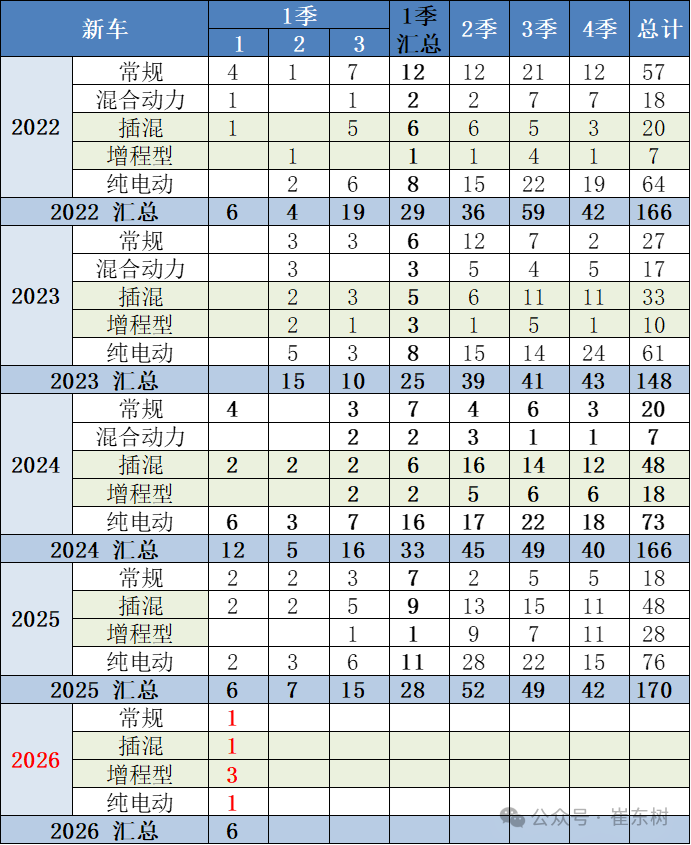
Core Viewpoint - The passenger car market is experiencing a slowdown in new traditional vehicle launches while there is a significant increase in new energy vehicle (NEV) introductions, indicating a shift in market dynamics and consumer preferences [1][2]. New Vehicle Launches - In January, the number of new vehicles launched was consistent with the previous year, with 6 new models introduced, including 1 pure electric, 1 plug-in hybrid, and 3 range-extended models. Only 1 new fuel vehicle was launched, highlighting a significant concern for the industry [1][3]. - The trend shows a shift from high-end to smaller vehicles, with many new models being compact cars, reflecting changing consumer preferences and the impact of trade-in policies [1][10]. Market Competition - The automotive industry is facing intense price competition, particularly among traditional and new energy vehicles, as manufacturers strive to capture market share in a rapidly evolving landscape [1][2]. - The classification of new models is crucial, with various manufacturers adopting different grading systems, although the industry commonly references the German Volkswagen classification system [1][7]. Future Market Potential - The domestic car market has significant potential for growth, particularly in the small car segment, which is essential for increasing private car ownership and facilitating the export of NEVs [2][3]. - The introduction of new tariffs and international trade dynamics will impact the export strategies of NEVs, particularly in targeting less developed markets before approaching developed ones [2]. Pricing Trends - The minimum prices for new models are gradually returning to market levels, with some new energy vehicle brands successfully expanding their product lines into lower price segments, which is expected to drive incremental sales [6][10]. - The pricing strategy for new models indicates a downward trend, with several models breaking previous price barriers for the years 2023-2025 [6]. Vehicle Classification and Standards - The classification of new energy vehicles is complex and requires careful consideration of various factors, including vehicle length and wheelbase, to establish industry standards [7][9]. - The current classification system is still under discussion, with industry experts encouraged to provide feedback to refine the grading of new models [16].