Samsung

Search documents
TSMC: Why This Semiconductor Giant Looks Like a Massive Bargain Right Now
The Motley Fool· 2025-04-16 22:00
Core Viewpoint - TSMC is positioned to benefit from the significant growth of the global semiconductor market, which is projected to reach $2 trillion in annual revenue by 2032, more than triple the $656 billion generated last year [2][3]. Company Position and Market Share - TSMC holds a dominant position in the foundry market with an estimated share of 67%, which has increased by six percentage points in 2024, while Samsung's share has decreased to 11% [4]. - The company's technological advantage, particularly its advanced 3-nanometer process node, allows it to manufacture powerful and efficient chips, attracting major clients like AMD, Apple, and Nvidia [5][6]. Future Growth and Investments - TSMC plans to start mass production of its 2-nanometer processors in the second half of this year, potentially outpacing competitors like Samsung and Intel [7]. - The company has committed to investing $165 billion in the U.S. to establish advanced chip manufacturing facilities aimed at supporting AI applications [7][8]. - TSMC's strategy to diversify its manufacturing presence globally is expected to mitigate risks from trade-related conflicts [8]. Financial Performance - TSMC reported $90 billion in revenue for 2024, a 30% increase from the previous year, and a 42% revenue jump in Q1 2025 to $25.6 billion, exceeding market expectations [10]. - The company anticipates maintaining an annual revenue growth rate of 20% over the next five years, supported by a total addressable market of nearly $250 billion in foundry and packaging services [11][12]. - TSMC's current trading multiples of 22 times trailing earnings and 17 times forward earnings present a favorable valuation compared to the Nasdaq-100 index's forward earnings multiple of 27 [12].



Zacks Industry Outlook Kulicke and Soffa, Axcelis and Veeco
ZACKS· 2025-04-16 09:55
Core Viewpoint - The Zacks Electronics - Manufacturing Machinery industry is currently facing challenging macroeconomic conditions and high inventory levels, but companies like Kulicke and Soffa Industries, Axcelis Technologies, and Veeco Instruments are benefiting from increased capital spending in high-performance computing, AI, and other advanced technologies [1][2]. Industry Overview - The industry comprises companies providing solutions for wafer processing, device packaging, and semiconductor manufacturing, including thin-film processing systems and advanced packaging lithography [3]. - There is a growing emphasis on contamination-free transportation and storage of materials, highlighting the importance of micro-contamination control products [4]. Trends Influencing the Industry - Miniaturization in semiconductor manufacturing is driving demand for advanced packaging and new device architectures, which enhances prospects for industry participants [5]. - The complexity of semiconductor manufacturing processes is increasing due to the demand for faster and more energy-efficient semiconductors, driven by cloud computing, IoT, and AI [7][8]. - Strong demand for NAND and DRAM, particularly in data centers and cloud segments, is a positive indicator for the industry [9]. Industry Performance and Valuation - The Zacks Electronics - Manufacturing Machinery industry ranks 234, placing it in the bottom 5% of over 250 Zacks industries, indicating bearish near-term prospects [10][11]. - The industry has underperformed the broader Zacks Computer and Technology sector and the S&P 500, declining 47.2% over the past year compared to the S&P 500's growth of 6.7% [14]. - The current trailing 12-month EV/EBITDA ratio for the industry is 9.59X, significantly lower than the S&P 500's 15.82X and the sector's 14.68X [15]. Company Highlights - **Kulicke and Soffa Industries (KLIC)**: This company designs and manufactures capital equipment for semiconductor assembly. Its new Fluxless Thermo-Compression system is expected to enhance throughput and capture advanced logic customers. The consensus estimate for fiscal 2025 earnings is $1.49 per share, with shares down 35.4% year to date [16][17]. - **Axcelis Technologies (ACLS)**: Specializes in ion implantation and processing equipment, benefiting from strong demand in the silicon carbide market, particularly for EV applications. The consensus estimate for 2025 earnings is $2.55 per share, with shares down 32% year to date [18][19]. - **Veeco Instruments (VECO)**: Expected to benefit from improving demand for its laser annealing and wet processing systems. The consensus estimate for 2025 earnings is $1.35 per share, with shares down 28.2% year to date [19].




Google receives cease and desist order from Japan's antimonopoly watchdog over unfair practices
CNBC· 2025-04-16 03:11
However, JFTC said Google also used licenses to require manufacturers to preinstall and prominently feature Google Search and Chrome on devices, with at least six such agreements in effect with Android makers as of December 2024. The Commission added that the company required manufacturers to exclude rival search services as a condition of its advertising revenue-sharing model. An attendee takes a photograph using a Google Pixel 9 smartphone during the CP+ trade show in Yokohama, Japan on February 27, 2025. ...


1 Artificial Intelligence Stock I'm Buying Hand Over First While It's Down 30%
The Motley Fool· 2025-04-12 12:30
Company Overview - ASML is a global leader in lithography systems essential for semiconductor production, particularly in the manufacturing of AI chips [3][4] - The company holds a technological monopoly in extreme ultraviolet (EUV) lithography systems, which are crucial for producing advanced semiconductor chips [4][10] Market Position and Financial Performance - ASML's share price has decreased by over 30% in the past year, but its competitive advantages position it as a top long-term investment in the tech sector [2] - In 2024, ASML generated 21.8 billion euros in net system sales, with 44 EUV systems sold, accounting for 38% of total sales [5] - The company reported total revenue of 28.3 billion euros in 2024, reflecting a modest increase of 2.6% from 2023 [8] Growth Potential - The global semiconductor market is projected to grow significantly, with sales expected to reach $1 trillion by 2030, driven by the increasing demand for AI technology [7] - ASML anticipates revenue projections of 7.5 billion to 8 billion euros for Q1 2025, representing a year-over-year increase of 42% to 51% [9] - Long-term sales projections for ASML suggest potential revenues of 44 billion to 60 billion euros by 2030 [9] Competitive Landscape - ASML faces competition primarily from China's investment of approximately $40 billion in its chip industry, but the complexity of EUV systems makes it challenging for competitors to match ASML's offerings [6] - Despite potential competition, ASML's dominant market position and technological edge provide a strong foundation for future growth [12]


信息图表:2024年第四季度 | 智能手机 | 移动市场监测
Counterpoint Research· 2025-04-09 13:01
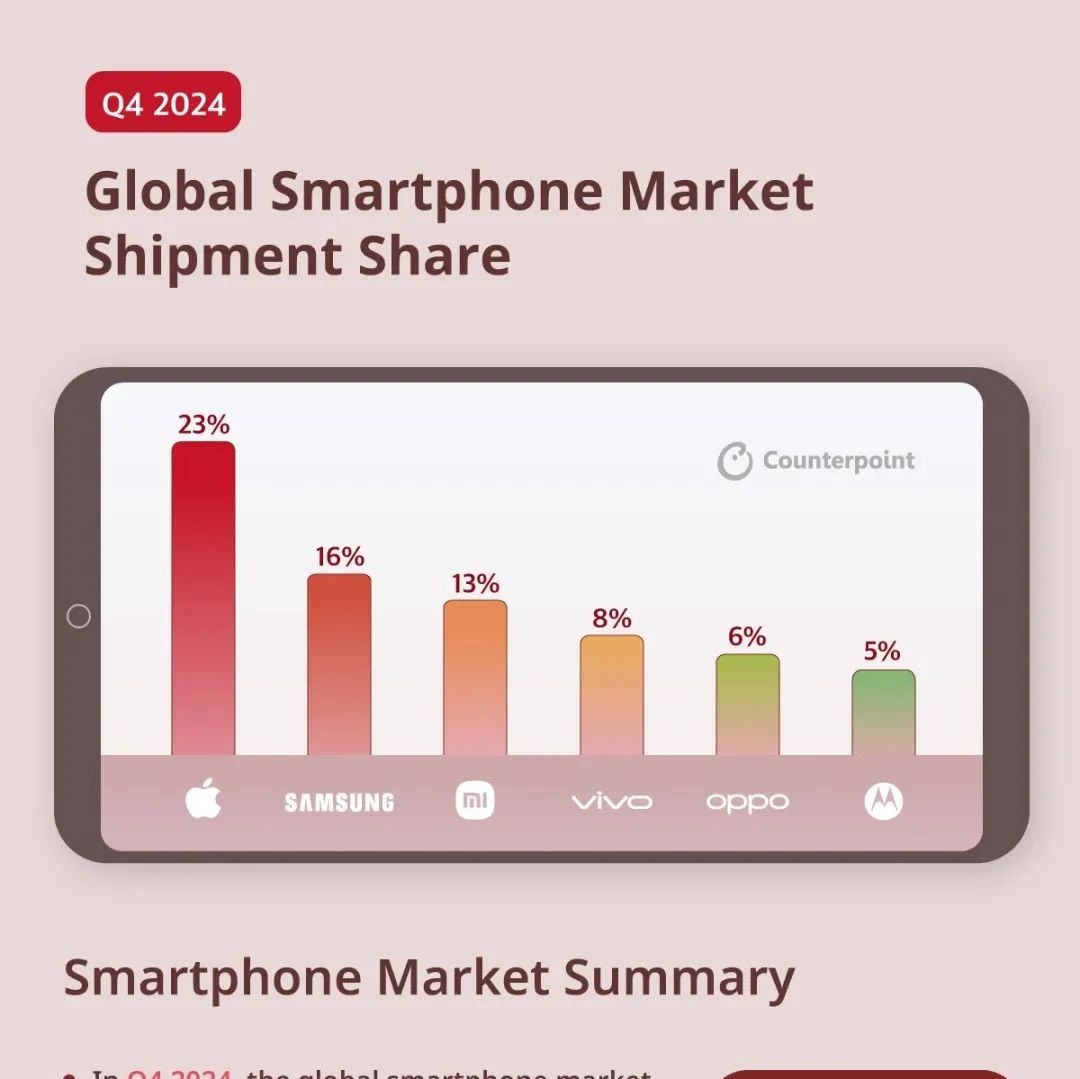
Core Insights - The global smartphone market remained stable in Q4 2024, with shipments reaching 323 million units [3][8] - Global smartphone revenues increased by 5% year-over-year, driven by a trend towards premiumization as consumers preferred higher-end models [3][8] - The average selling price (ASP) of smartphones rose by 2% year-over-year, supported by stable demand for premium devices [3][8] Market Share and Performance - Apple led the global smartphone market in Q4 2024 with a 23% market share, followed by Samsung with a 16% share [3][8] - Apple achieved its highest-ever ASP for the quarter and captured 54% of global smartphone revenues [3][8] - Vivo and Xiaomi were the only two among the top five manufacturers to show significant revenue growth, with year-over-year increases of 20% and 11%, respectively [3][8]

信息图表:2024年第四季度 | 智能手机 | 移动市场监测
Counterpoint Research· 2025-04-09 13:01
Asia Pacific North America 65% 18% 16% 12% 8% 18% 10% 3% Europe LATAM 2106 我们已发布 《2024年第四季度市场监测报告》 。我们每季度会以单页信息图形式总结智能手机市场 动态。以下是2024年第四季度智能手机市场的关键观察: 2024年第四季度全球智能手机市场表现平稳,出货量达3.23亿台; 受益于高端化趋势(消费者更倾向高端机型),全球智能手机营收同比增长5%; 在稳定高端需求支撑下,当季全球智能手机平均售价(ASP)同比上涨2%; Apple 以23%的市场份额领跑2024年第四季度全球智能手机市场,Samsung 以16%份额位居第 二; Apple 当季ASP创历史新高,斩获全球智能手机总营收的54%; vivo和小米营收分别实现20%和11%的同比增长,是前五大厂商中仅有的两家呈现显著增长的 企业。 Smartphone Market Summary 5% Growth YoY 1% Growth QoQ Regional Smartphone Shipment Market Share · In Q4 2024, the ...
Have $8,000? These 3 Stocks Could Be Bargain Buys for 2025 and Beyond.
The Motley Fool· 2025-04-08 08:10
Core Viewpoint - The current market downturn presents buying opportunities for investors in tech stocks, particularly ASML, TSMC, and Supermicro, despite the challenges posed by tariffs and geopolitical tensions [1][2]. Group 1: ASML - ASML is the leading producer of lithography systems essential for chip manufacturing, particularly the only supplier of extreme ultraviolet (EUV) systems [3][4]. - The stock has declined nearly 40% over the past year due to export curbs and tariffs, but the exclusion of semiconductors from tariffs and growth in the AI market are expected to support its EUV business [4][5]. - Analysts project ASML's revenue and earnings per share (EPS) to grow at a compound annual growth rate (CAGR) of 12% and 22% from 2024 to 2027, respectively, making its stock appear historically cheap at 20 times next year's earnings [5][6]. Group 2: Taiwan Semiconductor Manufacturing (TSMC) - TSMC is the largest contract chipmaker globally, producing chips for major companies like Apple and Nvidia, with operations in multiple countries [7]. - The stock has seen a 3% increase over the past year but has dropped 27% year to date due to tariffs and geopolitical tensions, although a $165 billion investment in U.S. fabs over the next four years may mitigate these impacts [8][9]. - Analysts expect TSMC's revenue and EPS to grow at a CAGR of 22% and 24% from 2024 to 2027, driven largely by the AI market expansion, with the stock trading at 13 times next year's earnings [9]. Group 3: Supermicro - Supermicro specializes in building servers for data centers, focusing on dedicated AI servers, and has a strong partnership with Nvidia for GPU access [10][11]. - The stock has plummeted nearly 70% over the past year due to various setbacks, including allegations of inflated revenue and regulatory scrutiny, but has recently made improvements by hiring a new auditor and submitting its 10-K filing [11][12]. - Analysts forecast Supermicro's revenue and EPS to grow at a CAGR of 38% and 22% from 2024 to 2027, respectively, with the stock trading at 9 times next year's earnings, indicating potential for a higher valuation if the company stabilizes and expands its U.S. manufacturing [12].


2025年全球自动驾驶行业洞察报告
亚瑟·D·利特尔咨询公司· 2025-04-08 01:50
Investment Rating - The report does not explicitly provide an investment rating for the autonomous mobility industry Core Insights - The autonomous mobility sector is experiencing a paradigm shift with increasing integration of autonomous vehicles (AVs) into daily life, driven by advancements in technology and changing consumer preferences [8][10] - Despite a challenging venture-funding environment, real-world testing and deployment of AVs are expanding globally, particularly in the US and China, with notable developments in the Gulf Cooperation Council (GCC) region [13][14][16] - The successful commercialization of AVs requires an ecosystem approach, emphasizing collaboration among public and private sectors, technology providers, and transport agents [17][24] Industry Dynamics - The autonomous driving sector is pursuing commercialization despite a sluggish venture-funding environment, with trends including the exploration of robobuses and robotaxis as part of mobility-as-a-service (MaaS) offerings [13][14] - AV companies are scaling up testing and commercial pilot efforts globally, with significant activity in the US and China, while the GCC is emerging as a hotspot for AV pilots [14][16] - Financial struggles persist in the AV industry, with a shift in investor focus towards targeted applications like trucking and last-mile delivery, as companies seek profitability through specific use cases [18][20] Use Case of the Semester - Autonomous buses, or robobuses, are being integrated into urban transportation systems, offering efficiency and safety improvements while addressing driver shortages [44][45] - Successful integration of robobuses faces challenges such as safety, connectivity, and consumer acceptance, necessitating a thorough piloting process [46][48] - The deployment of robobuses requires careful planning and execution, including regulatory approvals, infrastructure modifications, and operational testing [52][55] City of the Semester: Beijing - Beijing is recognized for its rapid advancement in AV deployment, with over 300 autonomous delivery vehicles fulfilling over 4 million orders by January 2024 [70][71] - The city has established a supportive regulatory environment, advanced testing infrastructure, and public awareness initiatives to facilitate AV integration [71][89] - Beijing's digital infrastructure, including high-speed 5G networks and smart traffic management systems, supports the growth of autonomous mobility [87][90] Interview of the Semester - The interview with Dr. Tony Han, CEO of WeRide, highlights the industry's transition from testing to commercialization, emphasizing technological advancements and regulatory developments [91][92]

中国高科技基金的影响(英)2025
PitchBook· 2025-04-07 07:50
Investment Rating - The report does not explicitly provide an investment rating for the industry Core Insights - China's venture capital (VC) activity has significantly weakened amid economic uncertainty and escalating tech rivalry with the US, leading to a decline in private investment across key deep-tech sectors. In response, a state-backed high-tech fund was introduced in March 2025, aiming to inject 1 trillion yuan (approximately $138 billion) over 20 years to revitalize innovation and strengthen the high-tech VC ecosystem in China [3][4][5] - The fund will allocate capital across various sectors, with expected positive impacts in AI & ML and semiconductors, although there are concerns about potential crowding out of private capital. In contrast, sectors like quantum computing and hydrogen energy remain heavily state-driven, limiting VC participation [3][4][5] - The success of the high-tech fund hinges on its ability to integrate private capital effectively. If structured well, it could stabilize the deep-tech VC ecosystem; however, if dominated by state-backed firms, private investors may remain cautious, limiting the fund's long-term impact on innovation and market growth [3][5][58] Summary by Sections Key Takeaways - China's VC activity has weakened, prompting the introduction of a high-tech fund to inject 1 trillion yuan over 20 years to counteract declining private capital flows [3] - The fund's impact will vary across sectors, with potential revitalization in AI & ML but risks of crowding out in semiconductors [3][4] - Past state investment programs indicate that government-linked firms may be favored, posing risks of capital misallocation and restricted private market participation [3][5] China's Strategic Push for High-Tech Leadership - The high-tech fund aims to accelerate innovation in critical industries, including AI, quantum computing, semiconductors, and clean energy, amidst geopolitical tensions and economic challenges [4][7] - The fund's introduction reflects China's urgency to achieve technological self-sufficiency and maintain strategic autonomy in high-tech sectors [4][8] More About the Fund and Its Impact on Private Markets - The high-tech fund will deploy capital across multiple strategic sectors, unlike previous state investment programs that focused on single industries [10] - The fund's structure and execution will determine whether it creates new opportunities for VC and PE investors or follows past patterns of government-driven capital misallocation [5][10] Comparing the High-Tech Fund with the Big Fund - The high-tech fund is designed to support a broader range of industries compared to the Big Fund, which primarily focused on semiconductors [50][52] - The Big Fund's experience highlights risks such as crowding out of private investment and capital misallocation, which could also emerge with the high-tech fund if it favors SOEs [50][58] Concluding Thoughts - The high-tech fund's success will depend on effective capital allocation and the ability to attract private investment, as the current VC landscape in China faces significant challenges [61][64] - Without clear governance and market-based incentives, there is a risk that the fund may replicate past state-led initiatives, limiting private investor participation [64]
Should You Buy the 44% Dip on Arm Holdings?
The Motley Fool· 2025-04-05 09:20
Core Viewpoint - Arm Holdings experienced a significant stock price decline of 44% since reaching a high on January 22, 2025, despite delivering stronger-than-expected results, primarily due to high valuation and economic uncertainties [1][2]. Company Overview - Arm does not manufacture semiconductor chips but develops technology and maintains intellectual property (IP) that is licensed to various companies for chip design and manufacturing [3]. - Major customers include Apple, Qualcomm, Nvidia, Microsoft, Amazon, Alphabet, Samsung, and Taiwan Semiconductor Manufacturing, with Arm holding over 99% market share in mobile application processors [4]. Market Position and Growth Potential - Arm aims to capture a 50% share of the data center CPU market in 2025, a significant increase from 15% in 2024, driven by adoption from major tech companies [5]. - The lower power consumption of Arm's designs has attracted chipmakers like Nvidia and Amazon, who are utilizing Arm's architecture for their custom AI processors [6]. Strategic Initiatives - Arm is involved in the Stargate Project, which anticipates $500 billion investment in AI infrastructure over the next four years, potentially boosting its cloud revenue [8]. - The cloud CPU market was valued at $21 billion at the end of fiscal 2024, with expectations for growth in the current fiscal year [9]. Financial Performance and Valuation - Analysts expect Arm's earnings growth to accelerate following a 26% increase in fiscal 2025, with a significant jump in data center CPU revenue anticipated due to increased licensing deals [9]. - The stock's pullback has made it relatively cheaper, trading at 132 times trailing earnings, down from 205 times at the end of 2024, with a forward earnings multiple of 50 [10]. - The median price target for Arm stock is $177.50, suggesting potential gains of 77% over the next 12 months [11].