
Unity Software Inc.

Search documents
‘Frothy and Risky’ Rally in Profitless Tech Grows as Fed Eases
Yahoo Finance· 2025-09-24 13:52
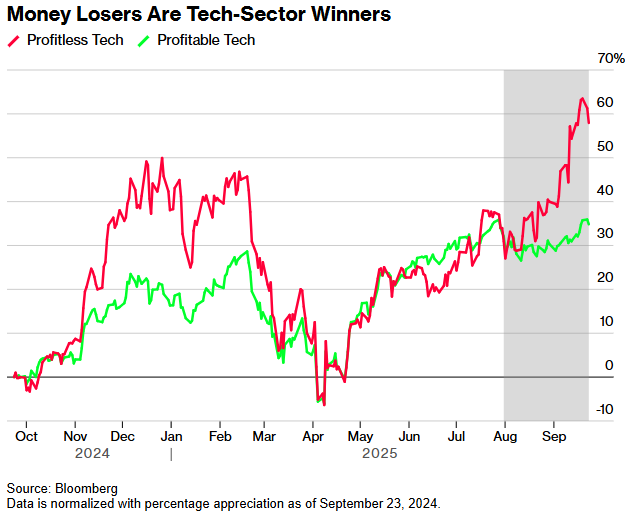
Bets that the Federal Reserve will continue cutting interest rates have fueled a rally in one of the riskiest corners of the technology sector, raising concerns about a potential reversal in the stocks. A basket of unprofitable tech companies tracked by UBS Group AG has jumped 22% since the end of July, compared with a 2.5% advance for its profitable counterpart and the Nasdaq 100 Index’s 5.9% advance. The run-up has sent the group, which includes lesser-known companies like SoundHound AI Inc. and Unity S ...
美联储降息预期催生投机泡沫 高风险反弹席卷未盈利科技股
智通财经网· 2025-09-24 12:50
Group 1 - The core viewpoint of the articles highlights a significant rise in high-risk tech stocks due to market expectations of continued interest rate cuts by the Federal Reserve, raising concerns about potential rapid declines if these expectations change [1][4][8] - A basket of unprofitable tech stocks tracked by UBS has surged 21% since the end of July, while profitable tech stocks only increased by 2.1%, and the Nasdaq 100 index rose by 5.9% during the same period [1] - The recent rally in unprofitable tech stocks is characterized as a "junk rebound," driven by speculative excess and the revival of "animal spirits," with warnings about the high risks involved [4][8] Group 2 - Goldman Sachs reports that a similar unprofitable investment portfolio has nearly doubled since its low in April, reaching its highest level since February 2022, with notable stock price increases for companies like OpenDoor Technologies Inc. and IonQ Inc. [5] - Despite the recent rebound, the current performance of unprofitable tech stocks remains about 50% lower than their peak in 2021, indicating a significant decline from previous highs [5] - Some investors view the recent surge as justified, citing higher earnings transparency in the tech sector and favorable macroeconomic conditions, although they caution that unprofitable tech stocks are vulnerable to reversals in the event of a broader economic downturn [8]



Gaming and Leisure Properties (GLPI) Fell Due to Investor Concerns
Yahoo Finance· 2025-09-24 12:20
Core Viewpoint - Baron Growth Fund underperformed in Q2 2025, gaining only 0.86% compared to the Russell 2000 Growth Index's 11.97% and the Russell 3000 Index's 10.99% [1] Group 1: Fund Performance - The fund's strategy of maintaining a high-conviction portfolio of advantaged businesses was less favored as investors preferred riskier stocks during the quarter [1] - The fund's top five holdings are highlighted as key picks for 2025 [1] Group 2: Gaming and Leisure Properties, Inc. (NASDAQ:GLPI) - Gaming and Leisure Properties, Inc. (NASDAQ:GLPI) experienced a one-month return of -3.30% and an 8.25% decline over the last 52 weeks, closing at $46.37 with a market capitalization of $13.123 billion on September 23, 2025 [2] - The company is a triple net REIT that owns and leases casino properties, facing investor concerns over sustained high interest rates affecting its 6% dividend yield [3] - Despite the decline, the company is collecting 100% of its rent, increasing rental rates by 2% annually, and growing its dividend at a low- to mid-single-digit rate, indicating a strong financial position for future acquisitions and shareholder returns [3] Group 3: Hedge Fund Interest - Gaming and Leisure Properties, Inc. (NASDAQ:GLPI) was held by 33 hedge fund portfolios at the end of Q2 2025, an increase from 26 in the previous quarter [4] - While the company shows potential, certain AI stocks are viewed as having greater upside potential and lower downside risk [4]

GenAI系列报告之64暨AI应用深度之三:AI应用:Token经济萌芽
Shenwan Hongyuan Securities· 2025-09-24 12:04
Investment Rating - The report does not explicitly provide an investment rating for the industry Core Insights - The report focuses on the commercialization progress of AI applications, highlighting significant advancements in various sectors, including large models, AI video, AI programming, and enterprise-level AI software [4][28] - The report emphasizes the rapid growth in token consumption for AI applications, indicating accelerated commercialization and the emergence of new revenue streams [4][15] - Key companies in the AI space are experiencing substantial valuation increases, with several achieving over $1 billion in annual recurring revenue (ARR) [16][21] Summary by Sections 1. AI Application Overview: Acceleration of Commercialization - AI applications are witnessing a significant increase in token consumption, reflecting faster commercialization progress [4] - Major models like OpenAI have achieved an ARR of $12 billion, while AI video tools are approaching the $100 million ARR milestone [4][15] 2. Internet Giants: Recommendation System Upgrades + Chatbot - Companies like Google, OpenAI, and Meta are enhancing their recommendation systems and developing independent AI applications [4][26] - The integration of AI chatbots into traditional applications is becoming a core area for computational consumption [14] 3. AI Programming: One of the Hottest Application Directions - AI programming tools are gaining traction, with companies like Anysphere achieving an ARR of $500 million [17] - The commercialization of AI programming is accelerating, with several startups reaching significant revenue milestones [17][18] 4. Enterprise-Level AI: Still Awaiting Large-Scale Implementation - The report notes that while enterprise AI has a large potential market, its commercialization has been slower compared to other sectors [4][25] - Companies are expected to see significant acceleration in AI implementation by 2026 [17] 5. AI Creative Tools: Initial Commercialization of AI Video - AI video tools are beginning to show revenue potential, with companies like Synthesia reaching an ARR of $100 million [15][21] - The report highlights the impact of AI on content creation in education and gaming [4][28] 6. Domestic AI Application Progress - By mid-2025, China's public cloud service market for large models is projected to reach 537 trillion tokens, indicating robust growth in AI applications domestically [4] 7. Key Company Valuation Table - The report provides a detailed valuation table for key companies in the AI sector, showcasing significant increases in their market valuations and ARR figures [16][22]




What Are the 2 Best Bargain Artificial Intelligence (AI) Stocks to Buy Right Now?
The Motley Fool· 2025-09-23 08:33
Core Insights - The article highlights investment opportunities in the AI sector, focusing on companies that are positioned for significant growth and value in the market [2]. Group 1: Taiwan Semiconductor Manufacturing Company (TSMC) - TSMC is identified as a crucial player in the AI space, experiencing rapid growth while trading at a relatively low price, indicating strong value [4][8]. - The company operates as a chip foundry, manufacturing chips for major designers like Nvidia and AMD, which diversifies its revenue sources [6]. - TSMC has a well-established business across various sectors, including smartphones, automotive, and gaming, with AI contributing significantly to its current and future growth [7]. - In Q2, TSMC reported a 44% year-over-year revenue increase, with gross margin rising from 53.2% to 58.6%, operating margin improving from 42.9% to 49.6%, and net profit margin expanding from 36.8% to 42.7% [8]. Group 2: Unity Software - Unity Software is recognized as a key player in the AI market, particularly in the gaming sector, and is transitioning towards cloud data center processors [10]. - The company provides game engine services and has a digital marketing business that enhances creators' reach [11]. - Despite facing challenges, including a 77% decline from its peak share price, Unity has seen a 120% increase over the past year [12]. - The appointment of a new CEO and the launch of an AI-powered advertising business have contributed to a resurgence in its digital marketing segment, with a 15% sequential quarterly sales increase in Q2 [13]. - Unity has potential opportunities in licensing data for AI model training, leveraging its strengths in gaming to achieve significant growth in the AI sector [14].


Gaming ETF ESPO Nears $500 Million — Thematics on the Rise?
Etftrends· 2025-09-22 20:55
Core Insights - Thematic ETFs have gained traction, particularly the VanEck Video Gaming and eSports ETF (ESPO), which has seen significant growth in assets under management (AUM) this year [1][3][5] Group 1: ETF Overview - The VanEck Video Gaming and eSports ETF (ESPO) launched prior to the 2021 ETF rule and charges 56 basis points, tracking the MVIS Global Video Gaming & eSports index [2] - The index consists of fewer than 30 companies, focusing on subsectors like gaming hardware and software, providing concentrated exposure [2] Group 2: Performance Metrics - ESPO's AUM has increased from approximately $279 million to $496 million year-to-date, with about $70 million in net inflows, driven by price appreciation [3] - The ETF has delivered a year-to-date return of 45.5%, outperforming its category and segment averages [4] Group 3: Notable Holdings - AppLovin Corp (APP), the largest holding in ESPO, has achieved a 100% return year-to-date, with a return on equity of 259% and a year-over-year quarterly revenue growth of 77% [4] - Other significant holdings include Nintendo and Unity Software, enhancing the ETF's focus on gaming software and development [4]

Unity Software Inc. (U): A Bull Case Theory
Yahoo Finance· 2025-09-16 16:37
Core Thesis - Unity Software Inc. is undergoing a significant transformation under new leadership, with a focus on operational efficiency and sustainable returns, marking Q2 2025 as a pivotal inflection point in its recovery journey [2][5][6] Financial Performance - Unity reported a net loss of $921 million in 2022, but has since reduced GAAP net losses to $107 million, while achieving a free cash flow increase of 59% to $127 million [2][5] - The company holds a cash position of $1.7 billion, providing financial stability as it navigates its turnaround strategy [5] Business Segments - Unity operates through two main segments: Create Solutions, which is its game engine platform, and Grow Solutions, a monetization network enhanced by the $4.4 billion acquisition of ironSource [3] - The integration of these segments has faced challenges in the past, but the new strategy aims to leverage AI for optimizing both development and monetization [3] Strategic Initiatives - The company has undergone a necessary reset, including layoffs and the exit from non-core business units, which has allowed it to focus on its profitable core [4] - Unity's subscription-based model positions it favorably in mobile and indie game development, providing predictable recurring revenue [4] Market Position - Unity holds over 70% market share in mobile gaming, and its strategic refocus under new leadership aims to expand into industries such as automotive and architecture [6] - The launch of Unity Vector in early 2025 is expected to increase ad network revenue by 15% sequentially, serving as a catalyst for monetization growth [3][6]
预见2025:《2025年中国游戏产业全景图谱》(附市场规模、细分市场发展现状、产业竞争格局等)
Qian Zhan Wang· 2025-09-16 02:18
Industry Overview - The gaming industry is defined as an ecosystem economy centered around "content + technology + users," encompassing activities such as development, marketing, sales, and after-sales of video games [1] - Key participants include game developers, operators, distributors, and players, operating across various platforms like PC, mobile devices, and consoles [1] Industry Chain Analysis - The upstream of the gaming industry includes IP owners and game developers, while the midstream consists of comprehensive game publishers, and the downstream involves terminal distribution and marketing channels [2] Industry Development History - The development of China's gaming industry can be divided into several key stages: 1. **Emergence and Initial Phase (1980s-2000s)**: Introduction of arcade games and home consoles [5] 2. **Exploration and Growth Phase (2003-2015)**: Rise of domestic online games supported by national policies [5] 3. **Full Explosion and Mobile Transformation (2015-2020)**: Transition to mobile gaming with the growth of 4G users [6] 4. **High-Quality Development and Adjustment Phase (2021-Present)**: Shift towards regulated growth and overseas markets [6][7] Current Industry Status - The gaming market in China is rebounding, with a projected market size of 325.78 billion yuan in 2024, reflecting a year-on-year growth of 7.53% [9] - After a brief decline from 2020 to 2022, the market is expected to grow at over 7% annually, reaching 168 billion yuan by mid-2025 [9] - Overseas revenue for Chinese gaming is projected to reach 18.557 billion USD in 2024, marking a historical high with a year-on-year increase of 13.39% [10] Market Segmentation - **Mobile Gaming**: Expected revenue of 238.217 billion yuan in 2024, with a growth rate of 5.01% [14] - **Web Games**: Revenue is declining, with a projected 2.203 billion yuan in 2025, down 5.87% [19] - **Client Games**: Stable growth with a projected revenue of 35.403 billion yuan in 2025, up 4.86% [20] - **Console Games**: Rapid growth with a projected revenue of 1.034 billion yuan in 2025, up 29.78% [23] Competitive Landscape - The majority of listed gaming companies are concentrated in developed regions like Guangdong and Beijing, with Guangdong having the highest number at 27 [24] - The market is fragmented, but major players like Tencent and NetEase dominate, accounting for 60% of the market capitalization of listed gaming companies [27] Future Development Trends - The gaming industry in China is expected to continue growing, with a market size projected to exceed 360 billion yuan by 2025 and potentially reach 500 billion yuan by 2030 [33] - There is a trend towards deeper integration of traditional culture into gaming products, supported by favorable policies [34]


RBLX Leans on AI-Powered Tools: Catalyst for Long-Term Growth?
ZACKS· 2025-09-11 14:25
Core Insights - Roblox Corporation is heavily investing in artificial intelligence to drive sustained growth, reporting 111.8 million daily active users, a 41% increase year-over-year, and 27.4 billion hours of engagement in Q2 2025 [1][10] - The company's generative AI model, Cube 3D, has generated over 1 million models, facilitating easier content creation and lowering entry barriers for new developers [2][10] - AI enhancements are improving search, discovery, and personalization, which is crucial for connecting players with relevant content and ensuring broad-based creator monetization [3][10] - Roblox is also implementing safety innovations like RoGuard 1.0 to address trust and safety concerns, reinforcing its leadership in the user-generated gaming economy [4] - With a 51% increase in bookings and raised fiscal 2025 guidance, AI tools are becoming structural catalysts for Roblox's growth strategy [5] Competitive Landscape - Unity Software Inc. is a direct competitor, offering AI-assisted creation tools that enhance development cycles across various gaming platforms [6] - Electronic Arts Inc. is also exploring AI for game design and personalization, potentially enhancing player experiences in its major franchises [7] Financial Performance - Roblox's stock has increased by 39.7% over the past three months, outperforming the industry average rise of 18.3% [8] - The Zacks Consensus Estimate for Roblox's 2025 loss per share has widened from $1.38 to $1.71, indicating increased caution among analysts regarding the company's near-term earnings [11] - Currently, Roblox is trading at a forward price-to-sales multiple of 12.59X, significantly above the industry average of 3.29X [12]

Magnite (MGNI) 2025 Conference Transcript
2025-09-03 20:42
Summary of Magnite (MGNI) 2025 Conference Call Company Overview - **Company**: Magnite (MGNI) - **Industry**: Advertising Technology (AdTech) Key Points and Arguments DOJ Case and Implications - The results of the DOJ case were somewhat favorable to Google, but there is no clear read-through to the AdTech antitrust case involving Magnite [3][6] - The behavioral remedies related to Magnite's case are expected to begin on September 22, 2025, with potential rulings that could be beneficial for Magnite [4][5][7] - If behavioral remedies are implemented, they may impact Magnite positively in 2026 [8] Market Dynamics and Share Gains - Magnite has seen share gains in the DBplus segment, attributed to winning large accounts like Pinterest, which encourages more ad spend through Magnite [11][12] - The industry is consolidating, with Magnite taking share primarily from the long tail of publishers rather than from Google, which maintains a 60% market share [13] Connected TV (CTV) Growth - CTV ad spend is growing, but the gap between CTV revenue growth and ad spend is narrowing [14] - Future growth in CTV revenue is expected to be driven by upselling higher take-rate services [15][16] - The evolution of programmatic advertising is leading to more advertisers entering the TV space, particularly small and medium-sized businesses (SMBs) [29] Sales Strategy and Infrastructure - Magnite is not planning to significantly increase its sales force but is focusing on enhancing infrastructure to support growth [30][32] - The company aims to facilitate demand for its publishers by ensuring access to a wide range of advertisers [35][37] Innovation and Competitive Position - Magnite has rebranded its ad server, SpringServ, to enhance clarity and competitive advantage in the market [38][41] - Investments in artificial intelligence are making Magnite's products more attractive and sticky for customers [44][45] - The addition of 50 curators is aimed at enhancing audience segmentation and improving monetization for publishers [46][51] Pricing Power and Market Strategy - Magnite's DBplus business has stable take rates, while CTV is focused on gradually increasing service levels and take rates through programmatic sales [63][65] - The company is monitoring take rates based on market conditions, with flexibility to adjust based on auction liquidity [68][69] Partnership with Netflix - Magnite is onboarding more supply and demand partners with Netflix, which is transitioning to programmatic advertising [70][72] - Netflix is expected to become one of Magnite's largest clients by the end of the year [72][73] Additional Important Insights - The shift towards programmatic advertising is creating opportunities for new advertisers who previously could not afford traditional TV advertising [29] - The competitive landscape is evolving, with Magnite positioning itself as a strategic partner rather than just another SSP [66][67] This summary encapsulates the key insights and developments discussed during the Magnite conference call, highlighting the company's strategic direction, market dynamics, and growth opportunities.
