OPPO

Search documents
折叠屏手机市场加速多元化
Zheng Quan Ri Bao· 2025-09-04 16:25
Core Viewpoint - Huawei has officially launched its second-generation tri-fold screen flagship smartphone, the Mate XTs, which is expected to drive innovation and upgrades across the supply chain in the folding screen smartphone industry [1][2]. Group 1: Product Features and Innovations - The new tri-fold smartphone is equipped with the Kirin 9020 chip and the latest Harmony operating system, resulting in a 36% performance improvement [1]. - Huawei's continuous innovation in hinge structure, screen layering, and system adaptation has made tri-fold screens practical, enhancing their lightweight, durability, and multi-tasking capabilities [1][4]. Group 2: Market Dynamics and Competitors - The global foldable smartphone shipment increased by 45% year-on-year in Q2, driven by strong demand in the Chinese market, where Huawei is a key player [2]. - By 2025, it is projected that 4.98 million foldable smartphones will be shipped in China, with Huawei holding a 75% market share [2]. Group 3: Industry Trends and Future Outlook - The introduction of tri-fold smartphones is expected to shift the market from "novelty" to "mainstream," with a variety of form factors coexisting [2]. - By 2026, global shipments of foldable smartphones are anticipated to reach 61 million units, indicating a significant growth trajectory for the segment [2]. - The complexity of tri-fold structures is driving upgrades in core components like hinges and screens, with domestic suppliers entering Huawei's supply chain [4].
流量之后,数码行业的增长密码或许在「心智」
36氪· 2025-09-04 13:10
Core Viewpoint - The digital industry is shifting from a focus on visibility to a focus on memorability, emphasizing the importance of establishing a strong mental anchor in consumers' minds to drive long-term growth [3][6][28]. Group 1: Industry Dynamics - The digital industry is characterized by rapid performance improvements, aesthetic iterations, and algorithm updates, leading to a highly competitive and saturated market [3][6]. - As hardware differences diminish, the competition is increasingly centered on cognitive shortcuts that consumers use to make decisions, such as memorable product labels [7][29]. - The traditional correlation between brand exposure and sales is weakening; now, the position a brand occupies in consumers' minds is crucial for sustained growth [6][28]. Group 2: Mental Framework - The mental framework for brand positioning consists of three layers: product cognition (functional recognition), scenario cognition (usage context), and brand cognition (emotional and identity recognition) [11][13]. - Successful brands leverage this three-layer mental framework to create memorable associations, which can lead to higher price premiums and stronger repurchase intentions [14][16]. Group 3: AI's Role in Marketing - AI is transforming the marketing landscape by enabling more precise targeting and understanding of consumer motivations, thus facilitating effective communication [20][21]. - Brands that engage in mental construction on platforms like Douyin (TikTok) experience faster asset accumulation and greater business growth compared to those that do not [16][27]. - AI-driven marketing strategies allow brands to measure and track their mental positioning, providing insights into the relationship between mental construction and actual sales [25][26]. Group 4: Case Studies and Results - Xiaomi's use of the three-layer mental strategy resulted in a 233% increase in orders and a 155% rise in search popularity, demonstrating the effectiveness of mental positioning [14]. - The collaboration between brands and platforms like Douyin has led to significant increases in brand awareness and sales, as seen in the case of LiberLive and Xiaomi [21][23]. Group 5: Future Implications - The digital industry's marketing logic is undergoing an irreversible shift, where long-term cognitive accumulation is more valuable than short-term traffic spikes [28][29]. - The competitive edge will increasingly depend on how well brands can establish and maintain mental associations in consumers' minds, rather than just leading in technical specifications [30].

流量之后,数码行业的增长密码或许在「心智」
3 6 Ke· 2025-09-04 13:03
Core Insights - The digital industry is experiencing a shift from performance competition to cognitive competition, where brand recognition and mental positioning are becoming crucial for long-term growth [3][4][18] - Brands must establish a strong mental anchor in consumers' minds to differentiate themselves in a crowded market, as traditional metrics like exposure are no longer sufficient [3][10] - The integration of AI in marketing strategies is enabling brands to accelerate the process of building mental recognition and improving engagement with consumers [11][12][17] Group 1: Industry Dynamics - The digital industry is characterized by rapid product iterations and high-frequency consumption, leading to a saturated market where differentiation is challenging [3][4] - As hardware differences diminish, cognitive shortcuts in consumer decision-making are becoming more significant, with memorable product tags like "photography expert" being more impactful than technical specifications [4][8] - The relationship between brands and consumers has evolved, where mere exposure is not enough; brands must occupy a specific position in the consumer's mind for sustained growth [3][6] Group 2: Mental Framework - The mental framework for brand recognition consists of three layers: product cognition (functional understanding), scenario cognition (context of use), and brand cognition (emotional and identity alignment) [6][8] - Successful brands are leveraging this three-layer framework to create memorable associations, as demonstrated by Xiaomi's marketing strategies that resulted in significant sales growth [8][10] Group 3: AI's Role - AI is transforming the marketing landscape by enabling precise targeting and understanding of consumer behavior, thus facilitating more effective communication and engagement [11][12][17] - Brands utilizing AI can quickly generate relevant content that resonates with specific consumer segments, enhancing the efficiency of their marketing efforts [12][15] - The ability to measure and track mental positioning through AI-driven insights allows brands to optimize their strategies and predict sales outcomes based on cognitive engagement [10][17] Group 4: Conclusion - The marketing logic in the digital industry is shifting towards a focus on mental recognition rather than just traffic generation, emphasizing the importance of long-term cognitive assets [18] - As the industry evolves, the competitive edge will increasingly depend on how well brands can establish and maintain a strong mental presence in consumers' minds [18]

华为新款三折叠屏手机来了
财联社· 2025-09-04 11:35
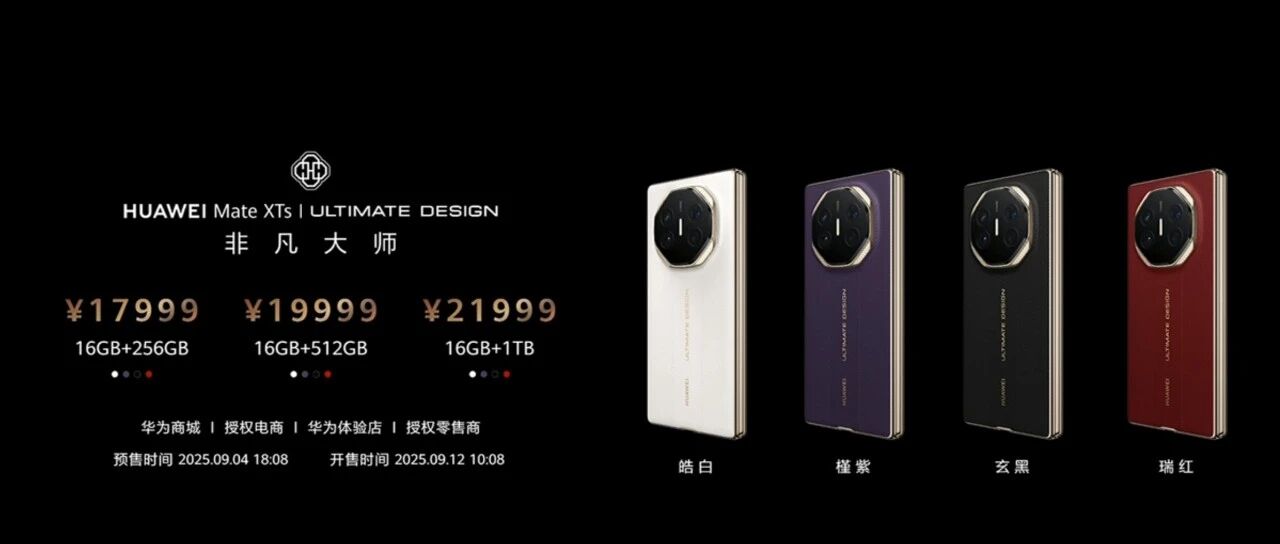
Core Viewpoint - Huawei has launched its new foldable smartphone Mate XTs Master Edition at a starting price of 17,999 yuan, which is a reduction of 2,000 yuan compared to the previous generation [2]. Group 1: Product Launch and Features - The Mate XTs is equipped with the Kirin 9020 chip, marking the first public display of Kirin chips in four years [2]. - The camera system has been upgraded with RYYB sensors, a 40-megapixel ultra-wide-angle lens, and a new red maple color camera [2]. - The new model emphasizes software ecosystem expansion, featuring applications like WPS Office and Wind Financial Terminal, and supports PC-level multi-window operations [2]. Group 2: Market Performance - According to IDC, China's foldable smartphone shipments are expected to reach 4.98 million units in the first half of 2025, with a year-on-year growth of 12.6% [3]. - Huawei leads the market with a shipment of 3.74 million units, capturing 75% of the market share [3]. - The previous generation Mate XT has nearly 500,000 units shipped as of mid-2023, making Huawei the first Chinese brand to exceed 10 million cumulative shipments since the launch of its first foldable phone in 2019 [4]. Group 3: Competitive Landscape - Apple is preparing to enter the foldable smartphone market, with plans to launch its first foldable iPhone in 2026 and a foldable iPad in 2028 [6]. - Analysts believe Apple's entry could accelerate the growth of the foldable smartphone market and drive innovation in the supply chain [6]. Group 4: Supply Chain Insights - Lens Technology is a key supplier of precision structural components for Huawei's foldable smartphones [7]. - Dongguan Huajing Powder Company has been a major supplier of MIM precision structural components for Huawei's flexible screen smartphones since 2018 [7]. - Dafu Technology's subsidiary is a primary supplier of core components for Huawei's foldable smartphone hinges [8]. - Huawei's screen suppliers include BOE and Visionox [9].
央视曝光,防蓝光贴膜效果不如保鲜膜,妥妥智商税产品?
3 6 Ke· 2025-09-04 07:07
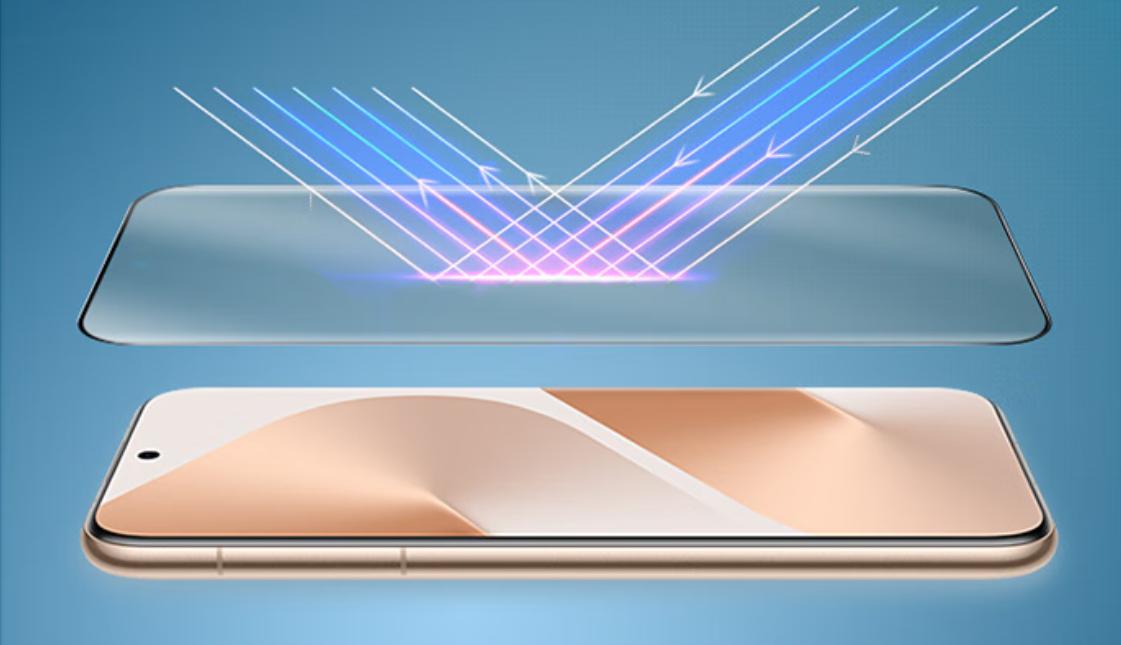
给手机贴膜这事儿,就应该不用我多啰嗦了吧。 总之,自从智能手机普及的那一刻起,贴膜基本上就是我国广大人民群众最喜闻乐见的事情。 从软膜到硬膜,经典的超清膜和蓝光膜,再到之后细分的AR膜、抗摔膜、磨砂膜、水凝膜、雾面膜等等,为了保护我们的手机屏幕,大伙绝对可以说是煞 费苦心,折腾得那叫一个起劲。 (图源:雷科技) 当然,大家对于贴膜的执念也养活了一大批做手机膜的商家。 这也导致目前市面上的贴膜产品,那叫一个鱼龙混杂,标着同一种卖点、甚至用着同一张图片的商品,价格差距可能达到10倍甚至以上,特别是最常见的蓝 光膜,价格更是从5块到150块不等。 有意思的是,对这类产品来说,产品价格的鱼龙混杂可能只是最小的问题。 很多商家标出的所谓防蓝光手机贴膜,都宣称能"过滤有害蓝光"、"保护眼睛"。于是乎,消费者潜意识里就会觉得这样的贴膜可以防止手机屏幕里的蓝光, 可以对我们的眼睛起到保护效果,让我们在深夜刷短视频、熬夜偷玩游戏的时候,多了一份心安理得。 但这张小小的贴膜,真的有那么神奇吗?这事儿的引爆点,还得从央视最近的一个调查说起。 防蓝光贴膜,效果不如保鲜膜? 近日,央视新闻频道的一期节目将镜头对准了市面上热销的蓝光膜。 ...
OPPO周意保:Find X9比上代电池增加1000mAh以上
Feng Huang Wang· 2025-09-04 04:28
Core Insights - OPPO Find X9 will feature a battery capacity increase of over 1000mAh compared to its predecessor while maintaining the same thickness of 7.9mm [1] - The previous models, Find X8 and Find X8S+, had battery capacities of 5630mAh and 6000mAh respectively, indicating that Find X9's battery capacity is expected to exceed 6630mAh, potentially surpassing 7000mAh [1] - The OPPO Find X9 series and ColorOS 16 system are confirmed to launch in October [1] - The new Find X9 model will include features such as the narrowest physical four edges, ultrasonic fingerprint recognition, and wireless fast charging [1]
Counterpoint:Q2印尼智能手机出货量同比下滑7%
Zhi Tong Cai Jing· 2025-09-04 01:31
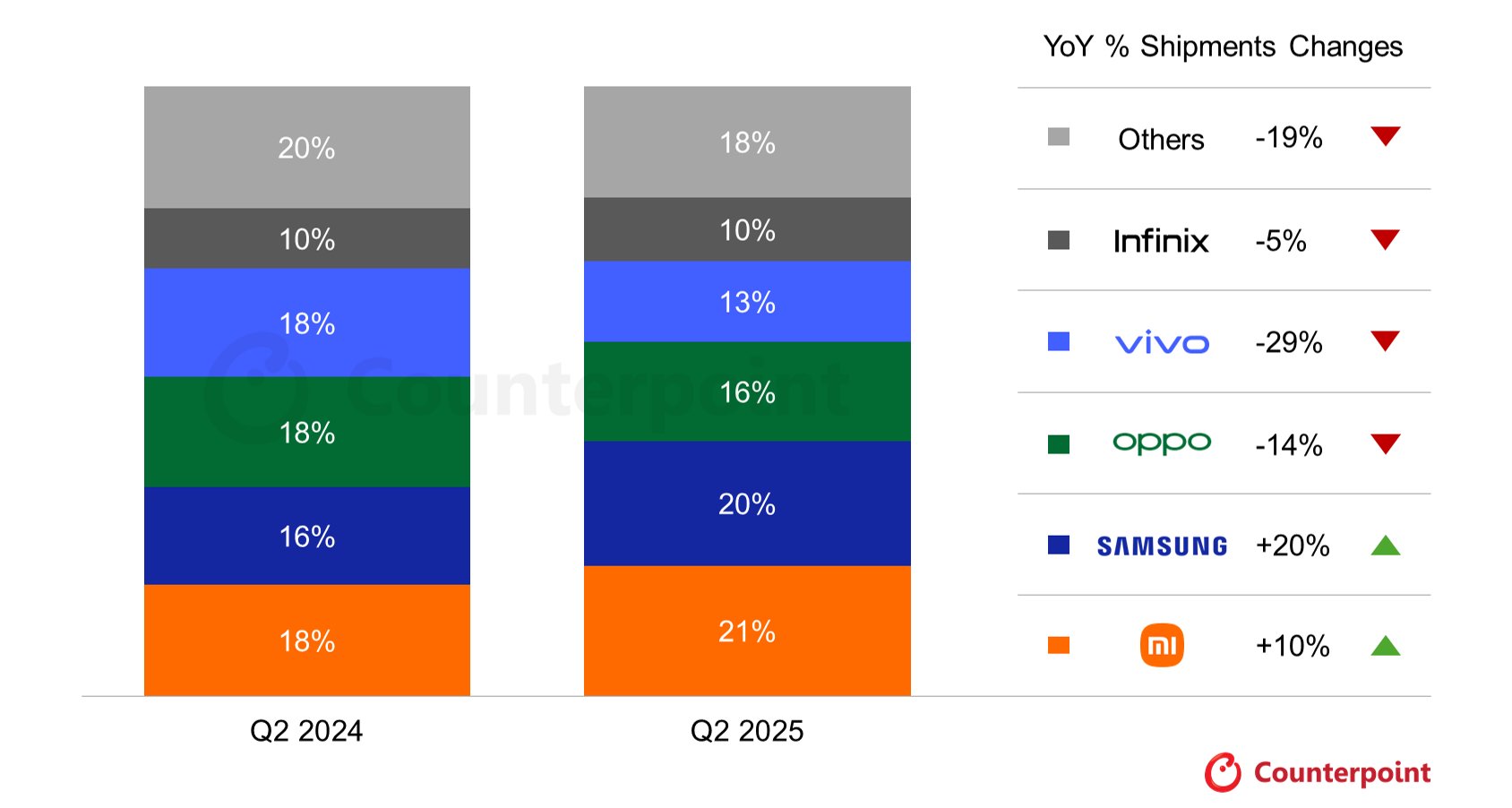
Core Insights - Indonesia's smartphone shipments are projected to decline by 7% year-on-year in Q2 2025 due to weak demand and macroeconomic uncertainties [1] - Samsung and Xiaomi are the only major brands to experience growth, with Samsung's shipments increasing by 20% and Xiaomi's by 10% [1][3] - The entry-level smartphone segment (priced under $150) saw a 3% increase in shipments, while the mid-to-high-end market experienced a significant decline [1][4] Market Dynamics - Samsung's growth is attributed to its comprehensive 5G A-series lineup, strong marketing, trade-in promotions, and attractive installment plans, positioning it as the second-largest player in the market [3] - Xiaomi maintains the largest market share at 21%, bolstered by its offline channel expansion and product diversification, with recent launches in the 15 series and Pocophone F7 series contributing to its growth [3] - OPPO and vivo faced declines in shipments, down 14% and 29% respectively, due to a strategic shift towards higher price segments without new entry-level products [3] 5G and Future Outlook - The share of 5G smartphones in Indonesia reached a record high of 35%, with entry-level models under $150 accounting for 13% of the overall market [4] - Government initiatives, including the construction of 8,500 new 5G base stations, are expected to enhance market conditions [4] - Analysts predict an improvement in macroeconomic confidence and consumer spending in the latter half of 2025, suggesting potential growth for the smartphone market [4]

2025年Q2印度EMS市场格局:迪克森登顶最大智能手机厂商,巴格瓦蒂增速最快
Counterpoint Research· 2025-09-04 01:04
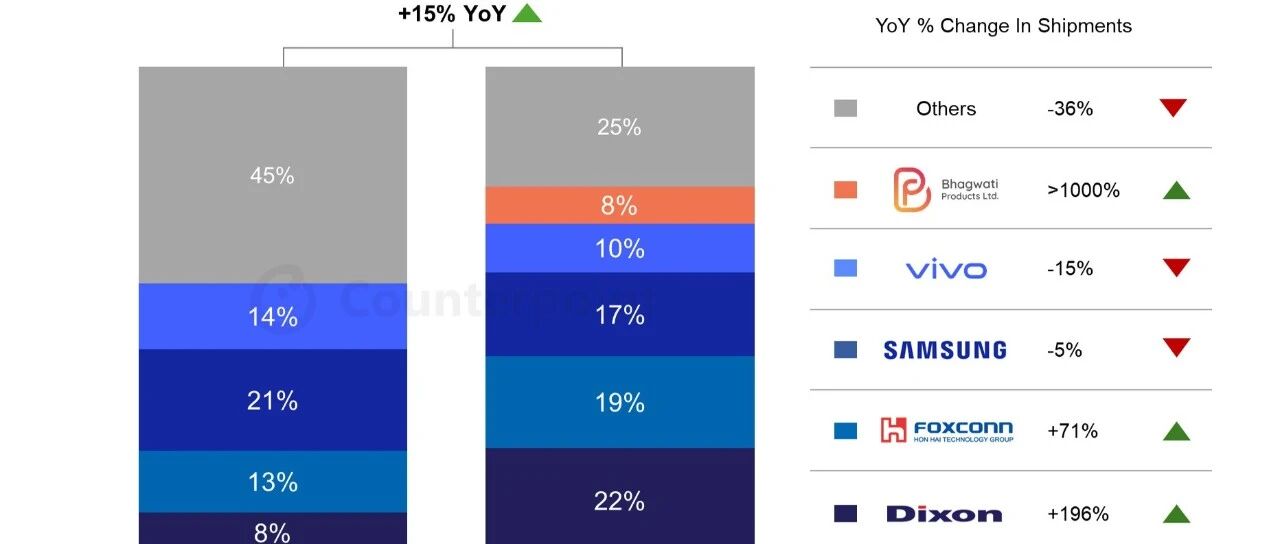
Core Insights - The article highlights the significant growth of smartphone manufacturing in India, driven by a 15% year-on-year increase in shipments in Q2 2025, primarily due to a 32% surge in exports and an 8% rise in domestic shipments [4][8]. - Dixon Technologies has emerged as the largest smartphone manufacturer in India, with a remarkable 196% increase in shipments, fueled by orders from Motorola, Transsion brands, Xiaomi, and Realme [4][8]. - The article emphasizes the critical role of Indian manufacturers as major Chinese OEMs outsource production to India, with expectations for further expansion of India's EMS landscape [6][9]. Export Growth - Apple has become the largest exporter in Q2, benefiting from geopolitical shifts and increased demand, particularly for iPhones, which has positively impacted Foxconn and Tata Electronics [9]. - The combined market share of Apple and Samsung in India's smartphone export market remains stable at over 93%, indicating a strong reliance on these brands for export growth [9]. - Future sustainability of India's EMS sector depends on building a robust local supply chain and increasing investment in domestic smartphone component manufacturing [9]. Market Dynamics - Bhagwati Products Limited (BPL) has entered the top five smartphone manufacturers in India, achieving the fastest growth in the market, supported by increased orders from Vivo and OPPO [4][8]. - The article notes that several manufacturers are forming joint ventures to invest in local component production, which will enhance India's domestic value addition [9]. - The Indian government's initiatives, such as the Electronics Components Manufacturing Plan, are expected to play a pivotal role in expanding the electronic manufacturing supply chain in India [6].
2025年Q2印尼智能手机出货量同比下滑7%,三星、小米助力缓解跌势
Counterpoint Research· 2025-09-04 01:04
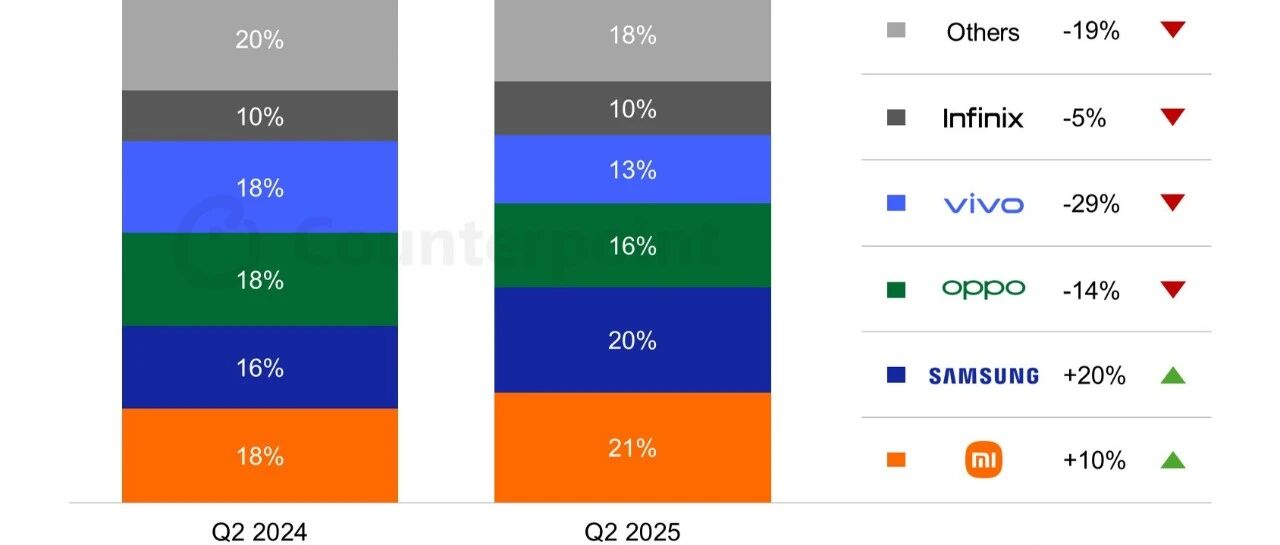
Core Viewpoint - The smartphone shipment volume in Indonesia decreased by 7% year-on-year in Q2 2025 due to cautious consumer spending and macroeconomic uncertainties [3][4]. Group 1: Market Dynamics - Most smartphone brands in Indonesia experienced a decline in shipment volume in Q2 2025, except for Samsung and Xiaomi, which saw year-on-year growth of 20% and 10% respectively [4][9]. - The demand during the holiday season was notably weaker compared to previous years, with consumer purchases focusing on entry-level models priced under $150, which saw a 3% increase in shipment volume [6][10]. - The government’s consumption stimulus policies primarily targeted basic livelihood areas, providing limited support to the smartphone market [6]. Group 2: Brand Performance - Samsung achieved the highest shipment growth among major manufacturers, with a 20% increase, positioning it as the second-largest brand in market share, following Xiaomi [6][9]. - Xiaomi maintained its market leadership with a 21% share, supported by offline channel expansion and a diversified product portfolio, including the newly launched 15 series and Pocophone F7 series [6][9]. - OPPO and Vivo experienced significant declines in shipment volume, with decreases of 14% and 29% respectively, due to a strategic shift towards higher price segments and a lack of new entry-level products [7]. Group 3: Future Outlook - The share of 5G smartphones in Indonesia reached a record high of 35% in Q2 2025, driven by the demand for entry-level models [10]. - The Indonesian government is enhancing 5G infrastructure by constructing 8,500 new base stations, which is expected to improve market conditions [10]. - As macroeconomic confidence improves in the second half of 2025, the smartphone market in Indonesia is anticipated to experience growth [12].
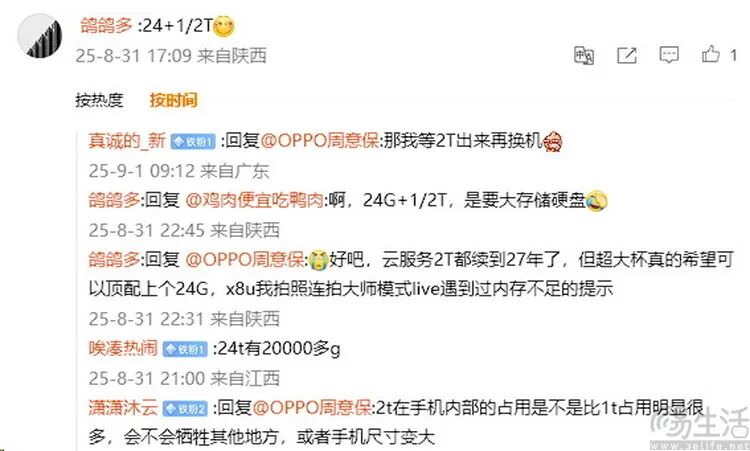
2TB存储容量的手机,到底是“做不出”还是“不肯做”
3 6 Ke· 2025-09-03 12:15
最近随着各大品牌新机发布时间的不断临近,各家也开始积极与用户进行关于新机配置、功能方面的预热 沟通。 比如,OPPO Find系列产品负责人周意保近日就在社交平台发文,宣传Find X9系列新机"续航提升非常显 著"。但更引人注意的,是他与网友随后针对新机存储容量所进行的讨论。 周意保表示,OPPO目前还无意推出配备2TB存储空间的机型,原因是"2TB的硬件目前还不成熟"。那么问 题就来了,这个"不成熟"到底是出现在哪个环节,又是什么原因导致了目前各厂商还不能推出2TB存储容 量的手机呢? 首先,2TB的手机存储芯片目前还"不存在" 众所周知,目前绝大多数智能手机使用的内置闪存,无非就是UFS和eMMC这两种单芯片解决方案。 闪迪 | Part Number . | Interface ▼ | Package Size ▼ | Capacity - | Voltage ▼ | Temperature ▼ | Product Status ▼ | | --- | --- | --- | --- | --- | --- | --- | | KLUGGARHUF-FOHP | G5 2Lane | 11.5 x 1 ...