德方纳米

Search documents
12.19犀牛财经早报:多家银行调降美元存款利率
Xi Niu Cai Jing· 2025-12-19 01:36
Group 1 - As of November 2025, the total scale of private equity funds in China reached 22.09 trillion yuan, with 19,314 fund managers managing 138,055 funds [1] - The private equity market is experiencing a divergence in strategies as firms prepare for the upcoming year, with some optimistic about a potential valuation recovery in the tech sector [1] - Deloitte forecasts a 94% increase in A-share IPO financing in 2025, with 114 companies expected to go public, raising a total of 1,296 billion yuan [3] Group 2 - Multiple banks have lowered their USD deposit rates following the Federal Reserve's recent rate cuts, with rates for 3-month, 6-month, and 1-year deposits dropping by 0.05 percentage points [2] - Public funds have actively participated in the A-share private placement market this year, with 39 institutions involved in 85 stocks, raising a total of 34.088 billion yuan, a 14.24% increase from the previous year [2] - The price of electrolytic manganese has risen for 13 consecutive days, reaching a new high of 17,820 yuan per ton, with a cumulative increase of nearly 15% in December [5] Group 3 - The Hong Kong Securities and Futures Commission has expressed concerns over the declining quality of IPO applications, highlighting issues such as unclear business model descriptions and exaggerated market positions [3] - The average price of multi-link products in the photovoltaic industry has rebounded, indicating a recovery trend in the sector [4] - The price of white feather broiler chickens has approached its annual high due to reduced supply, with prices reaching 3.65 yuan per pound, indicating potential for further increases [5]
太“锰”了!电解锰价格连涨13天,创出三年多新高(附股)
Zheng Quan Shi Bao Wang· 2025-12-18 23:49
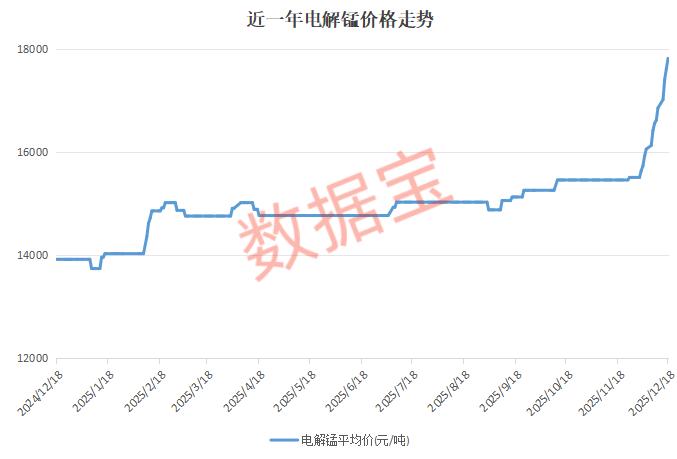
Core Viewpoint - The price of electrolytic manganese has risen continuously for 13 days since December, reaching a new high of 17,820 yuan/ton, with a cumulative increase of over 2,300 yuan/ton, marking a nearly 15% rise since the beginning of the month [1][3]. Price Drivers - The recent price increase of electrolytic manganese is driven by multiple factors including supply contraction, cost support, and improved demand [3]. - Environmental regulations in major production areas like Guangxi and Guizhou have led to reduced production from smaller facilities, contributing to supply tightness [3]. - Rising water and electricity costs due to the dry season have increased production costs, prompting some small smelting enterprises to cut back on output [3]. - The ongoing construction of a 600,000-ton electrolytic manganese project by Ningxia Tianyuan Manganese Industry is expected to further tighten supply until its completion in the second half of 2026 [3]. Demand Analysis - The steel industry shows stable demand, with many steel mills maintaining production rates and year-end inventory replenishment needs becoming apparent [4]. - Specific downstream sectors, such as the 200 series stainless steel, exhibit strong demand resilience for electrolytic manganese [4]. - Recent bidding prices for spherical electrolytic manganese have surged to 16,600 yuan/ton, reflecting a significant increase of 2,102 to 2,420 yuan/ton from the previous round, boosting market sentiment [4]. Growth in New Energy Sector - The manganese industry is transitioning from being primarily associated with steel to becoming a critical component in the new energy sector, particularly in battery production [5]. - The commercial application of new battery technologies, such as lithium iron phosphate manganese, is driving explosive growth in demand for high-purity electrolytic manganese [5]. - Projects like Yunnan Youneng's second phase, expected to be fully operational by the end of 2025, will add significant production capacity for lithium iron phosphate manganese [5]. Manganese Industry Stocks - Key manganese industry stocks include Sanxia Water, Hongxing Development, Xiangtan Electric, Western Gold, and Zhonggang Tianyuan, among others [6]. - Hongxing Development holds manganese mining assets with a total capacity of approximately 250,000 tons/year [6]. - Xiangtan Electric has a total capacity of 122,000 tons for electrolytic manganese dioxide and plans to expand its lithium manganese oxide capacity [7]. - Zhonggang Tianyuan is the largest producer of battery-grade manganese tetroxide, with a production capacity of 85,000 tons [7]. - Western Gold's subsidiary, Kebang Manganese, is the only electrolytic manganese producer in Xinjiang, benefiting from a complete industry chain [8].



电解锰价格13连涨 最新价创三年多新高
Zheng Quan Shi Bao Wang· 2025-12-18 23:41
转自:证券时报 据证券时报·数据宝统计,锰产业相关上市公司主要包括三峡水利、红星发展、湘潭电化、西部黄金、 中钢天源等。此外,磷酸锰铁锂相关上市公司有德方纳米、湖南裕能、当升科技、容百科技、五矿新能 等。 人民财讯12月19日电,进入12月,电解锰价格一路走高,最新价格创出三年多新高。Wind数据显示, 12月18日,电解锰平均价为17820元/吨,环比上涨200元/吨。12月以来,电解锰价格已连续13日上涨, 累计涨幅近15%,创出2022年5月以来新高。 ...
德方纳米跌2.03%,成交额3.05亿元,主力资金净流出1534.66万元
Xin Lang Zheng Quan· 2025-12-18 02:57
12月18日,德方纳米盘中下跌2.03%,截至10:49,报42.86元/股,成交3.05亿元,换手率2.79%,总市值 120.09亿元。 资金流向方面,主力资金净流出1534.66万元,特大单买入1266.88万元,占比4.15%,卖出2024.77万 元,占比6.64%;大单买入6260.43万元,占比20.53%,卖出7037.20万元,占比23.07%。 德方纳米今年以来股价涨16.21%,近5个交易日跌2.68%,近20日跌18.75%,近60日涨5.64%。 资料显示,深圳市德方纳米科技股份有限公司位于广东省深圳市南山区留仙大道3370号南山智园崇文园 区1号楼10层,成立日期2007年1月25日,上市日期2019年4月15日,公司主营业务涉及锂离子电池材料 的研发、生产和销售。主营业务收入构成为:磷酸盐系正极材料95.17%,其他(补充)4.83%。 德方纳米所属申万行业为:电力设备-电池-电池化学品。所属概念板块包括:固态电池、磷酸铁锂、锂 电池、储能、比亚迪概念等。 截至9月30日,德方纳米股东户数5.28万,较上期增加9.29%;人均流通股4767股,较上期减少8.50%。 2025年1 ...
磷酸铁锂迎来涨价潮!有头部企业已提前锁单并扩产 业内预估涨势将持续到明年四季度
Mei Ri Jing Ji Xin Wen· 2025-12-15 11:20
磷酸铁锂一波涨价行情正悄悄到来。 自12月上旬开始,新能源产业链迎来价格波动,其中磷酸铁锂正极材料生产厂商掀起集体提价潮。 近日,《每日经济新闻》记者(以下简称"每经记者")从部分磷酸铁锂头部企业、中国化学与物理电源行业协会、行业分析师等多个渠道了解到,在即将迎 来2026年之际,多家磷酸铁锂企业开始和客户商谈价格,一些头部企业提出了提价诉求,涨幅集中在2000~3000元/吨之间。部分企业甚至表示,涨价趋势预 计将持续至明年第四季度。 每经记者发现,本轮磷酸铁锂提价除了储能等需求拉动外,还有碳酸锂等原材料成本上涨的驱动。有分析师表示,碳酸锂作为磷酸铁锂正极材料的关键原 料,其价格每上涨1万元/吨,就会直接推高正极材料成本约2300~2500元/吨。 一家头部磷酸铁锂企业负责市场的有关人士告诉每经记者,公司目前正在和下游客户商谈价格,"涨幅在2000元/吨,3000元目前还触不到。"他向记者强 调,这一波涨势估计会持续到明年四季度。 龙蟠科技有关人士也表示,正在和客户谈,明年需求不错。 卓创资讯富宝锂电分析师苗敏向每经记者表示,当前行业价格回升具备了坚实基础:一方面,行业协会已发布成本指数,引导企业摆脱低价倾 ...
多家上市公司拟提价 磷酸铁锂行业寻求以标准提升准入门槛
Di Yi Cai Jing· 2025-12-14 00:03
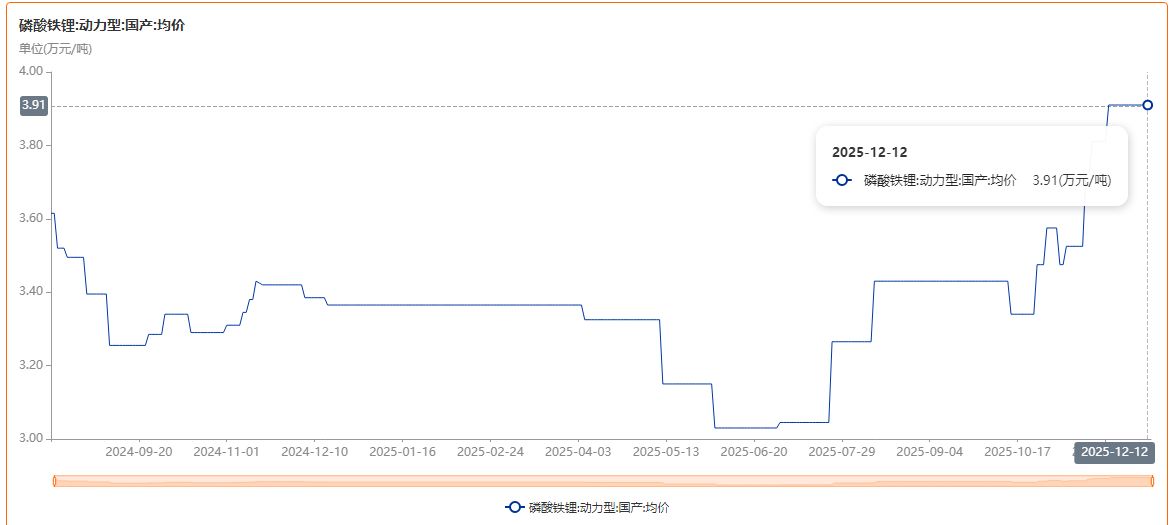
Core Insights - The lithium iron phosphate (LFP) materials industry is experiencing strong market demand but is simultaneously facing widespread losses across the sector [1][3][5] - Major companies are adjusting product prices in response to rising raw material costs and prolonged industry losses [1][3][6] - The industry is exploring sustainable development paths through standardization and cautious capacity expansion [2][7][8] Industry Overview - The LFP materials sector has been in a state of loss for three consecutive years, prompting companies to seek price adjustments to recover profitability [1][3][5] - Key raw materials, including sulfur and sulfuric acid, have seen significant price increases, contributing to the overall cost pressures faced by LFP manufacturers [3][4][6] - Despite high demand in the energy storage and electric vehicle markets, the industry is grappling with structural overcapacity and high debt levels among leading firms [4][6][7] Price Adjustments - A wave of price increases is occurring, with major manufacturers notifying clients of upcoming price hikes, including a unified processing fee increase starting in 2026 [3][4] - As of December 1, the average spot price for power-type LFP reached 39,950 yuan per ton, while energy storage-type LFP was at 36,950 yuan per ton [3][4] Demand Dynamics - The energy storage market has exceeded expectations in the second half of the year, driving demand alongside a steady increase in electric vehicle sales [4][6] - China's lithium-ion battery exports reached $55.38 billion from January to September 2025, marking a 26.75% year-on-year increase, with domestic new energy vehicle penetration surpassing 45% [4][6] Industry Standards and Regulations - The China Chemical and Physical Power Industry Association plans to establish a comprehensive standard system by 2026 to set technical barriers and guide industry development [1][7][8] - The association aims to create a technical roadmap and conduct surveys to assess actual production capacity and technological status [1][8] Capacity Expansion and Market Order - Companies are adopting a cautious approach to capacity expansion, emphasizing the need to maintain market order and avoid destructive low-price contracts [9] - The industry is calling for a unified technical standard to regulate market competition and guide investment towards advanced products rather than exacerbating overcapacity in existing technologies [8][9]
独家丨多家上市公司拟对磷酸铁锂产品提价
第一财经· 2025-12-13 11:04
Core Viewpoint - The lithium iron phosphate (LFP) materials industry is experiencing a paradox of strong market demand but widespread losses among companies, prompting price adjustments and a search for sustainable development paths [3][4][5]. Group 1: Industry Challenges - The LFP industry has faced three consecutive years of losses, leading major companies to adjust product prices in an effort to recover profitability [4][6]. - Key raw materials for LFP production are in short supply and experiencing rapid price increases, causing companies to slow down expansion efforts [4][8]. - The industry is characterized by structural overcapacity, with many companies suffering from high debt levels and low profit margins, making the current situation unsustainable [9][11]. Group 2: Price Adjustments and Market Dynamics - A wave of price increases is occurring, with major manufacturers notifying clients of price hikes for LFP products starting in 2026 [7][8]. - As of December 1, the average spot price for power-type LFP reached 39,950 yuan/ton, while energy storage-type LFP reached 36,950 yuan/ton, driven by rising upstream raw material costs [7][8]. - The demand for energy storage and electric vehicles has surged, with significant growth in lithium-ion battery exports and a domestic new energy vehicle penetration rate exceeding 45% [8][9]. Group 3: Regulatory and Standardization Efforts - The Ministry of Industry and Information Technology (MIIT) has signaled the need for regulatory measures to address irrational competition in the battery industry [13][14]. - The China Chemical and Physical Power Industry Association plans to establish a comprehensive standard system for the LFP industry by 2026, focusing on production capacity, technology, and environmental standards [12][15]. - There is a consensus among industry representatives on the importance of establishing unified technical standards to guide investment and production towards advanced products, thereby avoiding exacerbation of overcapacity in lower-tier products [15][16].



独家|多家上市公司拟提价,磷酸铁锂行业寻求以标准提升准入门槛
Di Yi Cai Jing· 2025-12-13 10:43
Core Insights - The lithium iron phosphate (LFP) materials industry is experiencing strong market demand but is simultaneously facing widespread losses across the sector [1][6][7] Group 1: Industry Dynamics - Major companies in the LFP sector are adjusting product prices in response to three consecutive years of losses, with firms like Hunan Youneng and Wanrun New Energy indicating a cautious approach to capacity expansion [2][4] - The industry is currently facing a shortage of upstream chemical raw materials, leading to a slowdown in production expansion [2][4] - The China Chemical and Physical Power Industry Association plans to establish a complete standard system by 2026 to set technical barriers for the industry [2][9] Group 2: Pricing Trends - A wave of price increases is occurring in the LFP industry, with the average price of power-type LFP reaching 39,950 yuan/ton and energy storage-type LFP at 36,950 yuan/ton as of December 1 [4][5] - The price hikes are driven by rising costs of key raw materials such as sulfur and sulfuric acid, with expectations that this trend will continue into the next year [4][5] Group 3: Market Demand - The demand for energy storage has unexpectedly surged in the second half of the year, contributing to the overall growth in the electric vehicle market [5] - Data shows that from January to September 2025, China's lithium-ion battery exports reached $55.38 billion, a year-on-year increase of 26.75%, with domestic new energy vehicle penetration exceeding 45% [5] Group 4: Financial Performance - Most companies in the LFP sector have reported losses in recent years, with average debt-to-asset ratios reaching 67.81% across six listed companies [8][7] - Specific companies like Wanrun New Energy and Defang Nano reported net losses of 15.04 billion yuan and 16.36 billion yuan respectively for 2023 [8] Group 5: Regulatory and Standardization Efforts - The Ministry of Industry and Information Technology has emphasized the need to regulate competition in the battery industry and to promote high-quality development [9][10] - The industry association is working on a comprehensive report to guide government policy and encourage rational investment in the sector [10][11]
安达科技20251211
2025-12-12 02:19
Summary of the Conference Call for Anda Technology Company Overview - **Company**: Anda Technology - **Industry**: Lithium Iron Phosphate (LFP) Battery Materials - **Market Position**: Major producer of lithium iron phosphate cathode materials, with a market capitalization of 4.2 billion yuan, and a component of the North Exchange 50 index [6][30] Key Points and Arguments Industry Dynamics - The North Exchange's specialized index and related ETFs are expected to attract more investors and enhance market ecology [2] - The overall lithium iron phosphate industry is recovering, driven by increased energy storage demand, with Anda Technology's capacity utilization exceeding 95% [6][14] Financial Performance - In the first three quarters of 2025, Anda Technology reported revenue of 2.273 billion yuan, a year-on-year increase of 109% [4][14] - Projected net profits for 2025 to 2027 are -304 million yuan, 46 million yuan, and 303 million yuan, respectively, with corresponding EPS of -0.51 yuan, 0.08 yuan, and 0.51 yuan [4][28] - Current stock price corresponds to a PE ratio of 14.3 times for 2027 [4][28] Product Development and Market Strategy - Anda Technology focuses on high-end products, including the fourth-generation high-pressure dense lithium iron phosphate products B9P and B9, which have begun mass shipments [2][8][10] - The company is expanding its production capacity, with a project under construction that will add 240,000 tons per year, increasing total capacity to 390,000 tons per year [2][8][15] Competitive Advantages - Anda Technology benefits from its location in Guizhou, which provides access to phosphate resources and low energy costs [2][12] - The company is extending its upstream operations with a precursor project of 300,000 tons per year, expected to start production in Q3 2026 [2][12] Strategic Partnerships - Strategic partnership with BYD, which is also a significant shareholder, enhances R&D capabilities and product development [4][12][18] Risks and Challenges - Risks include structural overcapacity in the industry, fluctuations in raw material prices, and high customer concentration [16][29] - The company is actively seeking to diversify its customer base and expand into overseas markets to mitigate these risks [16][29] Future Outlook - Short-term catalysts for profit recovery include strong price increase expectations for lithium iron phosphate materials and robust demand from the energy storage and electric vehicle markets [7][8] - Long-term growth is supported by technology iteration, market share expansion through capacity growth, and integrated supply chain advantages [9][30] Conclusion - Anda Technology is positioned for significant growth in the lithium iron phosphate market, with a focus on high-end products and strategic partnerships. Despite facing risks, the company's proactive strategies and market dynamics suggest a positive outlook for future performance [30][31]
一“芯”难求 + 全球抢单 中国锂电产业链开启新一轮“价值跃迁”
Shang Hai Zheng Quan Bao· 2025-12-10 17:57
Core Viewpoint - The lithium battery industry is experiencing significant price increases and supply chain adjustments due to rising raw material costs and strong demand, particularly in the energy storage and electric vehicle sectors [3][4][5]. Industry Trends - Dejia Energy announced a 15% price increase for its battery products starting December 16 due to rising production costs from upstream raw materials [3]. - Contemporary Amperex Technology Co., Ltd. (CATL) and other leading companies are securing long-term agreements to lock in upstream capacity and supply chains, emphasizing the importance of capacity acquisition for future growth [3][4]. - The lithium battery supply chain is currently characterized by a "full production and sales" state, with companies like Penghui Energy and Tianji Co. reporting strong demand and rising prices for their products [4]. Market Demand - Global power battery installation reached 811.7 GWh in the first three quarters of this year, a 34.7% increase from the previous year, while the energy storage market saw a 90.7% year-on-year growth [5]. - The rapid growth in renewable energy installations and the expansion of AI data centers are driving increased demand for energy storage solutions [5]. Long-term Contracts - The industry is witnessing a surge in long-term contracts, with significant agreements such as a 10-year strategic partnership between Haibosi and CATL for a minimum of 200 GWh of procurement [6]. - Other notable contracts include a collaboration between Hicharge Energy and CRRC Zhuzhou Electric Locomotive Research Institute for at least 120 GWh of energy storage products [6]. Price Dynamics - The price of battery-grade lithium carbonate has surged to 92,750 RMB per ton, a 23% increase from the previous month, while the price of lithium hexafluorophosphate has exceeded 180,000 RMB per ton [4]. - The tight supply and high demand have led to longer delivery times, with some companies reporting that delivery schedules extend into the first half of next year [4]. Technological Advancements - The industry is undergoing a "quality upgrade" driven by technological advancements, with companies like CATL launching fifth-generation lithium iron phosphate batteries that improve energy density and cycle life [9][10]. - High-density lithium iron phosphate products are becoming a focus, with expectations that their market share will increase significantly by 2026 [9]. Capacity Expansion - Companies are accelerating capacity expansion to meet growing demand, with Fulin Precision Engineering planning to invest 4 billion RMB to build a new production line for lithium iron phosphate [8]. - Dragon Power Technology is also raising funds to expand production capacity in response to customer needs [8]. Globalization Efforts - Leading companies are pursuing global expansion strategies, with firms like Hunan YN planning production capacity in Spain and Dragon Power Technology nearing full production at its Indonesian facility [10]. - The industry is shifting from scale competition to value competition, aiming for high-quality development as new products are launched and recycling systems are improved [10].