
邮储银行

Search documents
邮储银行(601658) - 中国邮政储蓄银行股份有限公司关于召开2025年第三次临时股东大会的通知
2025-12-02 09:30
一、 召开会议的基本情况 中国邮政储蓄银行股份有限公司(以下简称中国邮政储蓄银行或本行) 董事会 (三) 投票方式 本次股东大会所采用的表决方式是现场投票和网络投票相结合的方式 证券代码:601658 证券简称:邮储银行 公告编号:临 2025-061 中国邮政储蓄银行股份有限公司 关于召开2025年第三次临时股东大会的通知 中国邮政储蓄银行股份有限公司董事会及全体董事保证本公告内容不存在 任何虚假记载、误导性陈述或者重大遗漏,并对其内容的真实性、准确性和完整 性承担法律责任。 重要内容提示: 1 股东大会召开日期:2025年12月19日 本次股东大会采用的网络投票系统:上海证券交易所股东大会网络投票 系统 (一) 股东大会类型和届次 2025年第三次临时股东大会 (二) 股东大会召集人 (四) 现场会议召开的日期、时间和地点 召开的日期时间:2025 年 12 月 19 日 10 点 00 分 召开地点:北京市西城区金融大街 3 号金鼎大厦 A 座 (五) 网络投票的系统、起止日期和投票时间 网络投票系统:上海证券交易所股东大会网络投票系统 网络投票起止时间:自2025 年 12 月 19 日 至2025 ...
杠杆资金,清算时刻来临?
Ge Long Hui· 2025-12-02 09:27
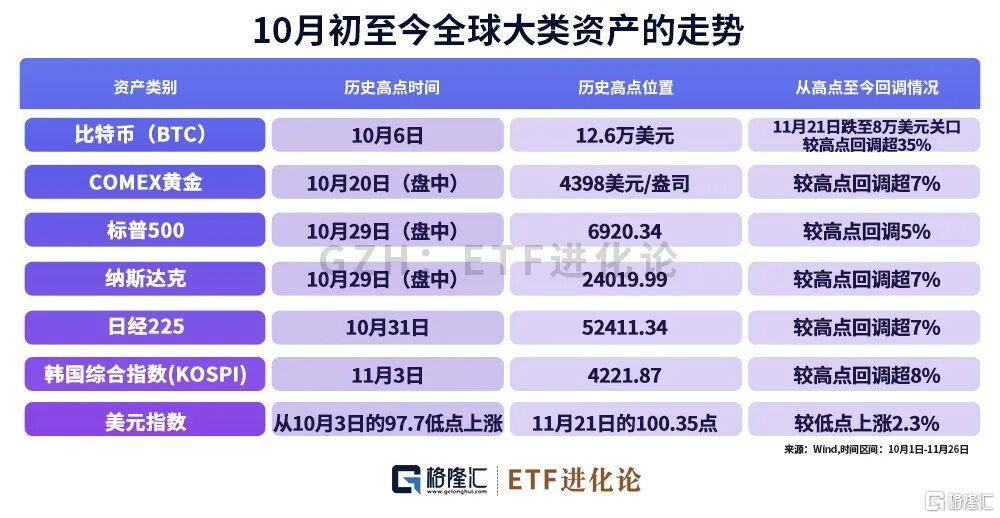
Core Viewpoint - The global asset market is experiencing a significant downturn, driven by actions from the US and Japanese central banks, leading to a renewed wave of selling in various asset classes, including stocks and cryptocurrencies [1][4]. Group 1: Market Performance - Hong Kong and A-shares are all in the red, with the Shenzhen Composite Index and ChiNext Index dropping over 1% in the afternoon session, and trading volume shrinking to 1.61 trillion yuan [1]. - The US stock market saw all three major indices decline, while the cryptocurrency market experienced a drop of over 6%, marking the largest single-day decline since March, with Bitcoin falling over 30% from its peak of over $126,000 on October 6 [1][2]. Group 2: Central Bank Actions - The recent market pullback is attributed to the Federal Reserve's strategy of "expectation management," where it aims to prevent the market from pricing in a December rate cut too early, thus allowing for a more substantial correction before potentially announcing a rate cut [1][4]. - The Bank of Japan's Governor has indicated a thorough discussion on the possibility of interest rate hikes in the upcoming December meeting, leading to a significant sell-off in Japanese stocks and bonds [4][5]. Group 3: Interest Rate and Yield Changes - Japanese two-year government bond yields have surged above 1% for the first time since 2008, while the 30-year yield reached 3.41%, the highest since 1999 [4]. - The US 10-year Treasury yield rose by 7.7 basis points to 4.096%, marking the largest single-day increase since mid-July [4]. Group 4: Market Sentiment and Investment Strategies - The reversal of the "yen carry trade" strategy, where investors borrow low-interest yen to invest in higher-yielding assets, is causing market panic, reminiscent of the significant market crash on August 5, 2024 [5][7]. - The current environment suggests a shift towards a low-interest-rate era, prompting a need for diversified asset allocation strategies to adapt to changing market conditions [11][12]. Group 5: Banking Sector Developments - Major Chinese banks have ceased offering five-year large-denomination certificates of deposit, indicating pressure on net interest margins and a scarcity of assets [11]. - The average interest rates for remaining three-year products have dropped to between 1.5% and 1.75%, reflecting the ongoing adjustments in the banking sector [11][12].

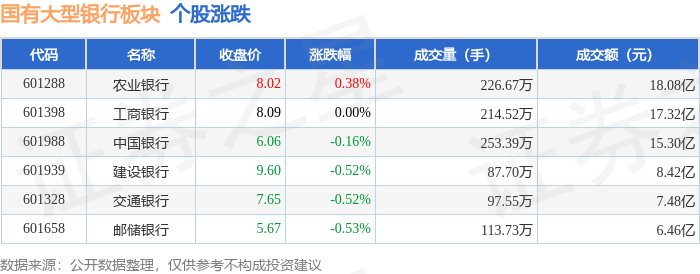
国有大型银行板块12月2日涨0.06%,农业银行领涨,主力资金净流出4.49亿元
Zheng Xing Xing Ye Ri Bao· 2025-12-02 09:05
Group 1 - The core viewpoint of the news is that the state-owned large banks sector experienced a slight increase of 0.06% on December 2, with Agricultural Bank leading the gains, while the overall stock market indices showed declines [1] - The Shanghai Composite Index closed at 3897.71, down 0.42%, and the Shenzhen Component Index closed at 13056.7, down 0.68% [1] - The trading performance of individual state-owned banks showed mixed results, with Agricultural Bank's stock price at 8.02, up 0.38%, while other banks like China Bank and Construction Bank saw declines [1] Group 2 - The net capital flow for the state-owned large banks sector showed a net outflow of 449 million yuan from institutional investors, while retail investors contributed a net inflow of 327 million yuan [1] - Detailed capital flow data indicated that Agricultural Bank had a significant retail net inflow of 930.61 million yuan, despite a net outflow of 819.22 million yuan from institutional investors [2] - The data also revealed that Industrial and Commercial Bank experienced a net outflow of 136 million yuan from institutional investors, with a smaller net inflow from retail investors of 11.5 million yuan [2]




股市高位震荡 银行上调近100只基金风险等级
2 1 Shi Ji Jing Ji Bao Dao· 2025-12-02 08:45
Core Viewpoint - Recent fluctuations in the stock market have led several banks to raise the risk levels of their distributed public funds, indicating a response to market volatility and regulatory requirements [1][2][3]. Group 1: Bank Actions - Multiple banks, including China Construction Bank and Minsheng Bank, have raised the risk levels of various public fund products, with some banks adjusting risk levels up to seven times this year [1][3]. - China Construction Bank announced an adjustment of 87 public fund products, with 32 moving from medium-low risk (R2) to medium risk (R3) and 55 from medium risk (R3) to medium-high risk (R4) [3]. - Minsheng Bank also raised the risk levels of eight funds from low to medium risk, marking its fourth adjustment in October alone [4]. Group 2: Market and Regulatory Context - Analysts suggest that the banks' actions are a result of a combination of product, market, and regulatory factors, particularly after a significant market rally that saw the Shanghai Composite Index exceed 4000 points [2][4]. - The adjustments are seen as a precautionary measure to protect investors from potential losses due to market volatility [2][4]. - Regulatory frameworks, such as the "Commercial Banks' Agency Sales Business Management Measures," emphasize the need for banks to independently assess and adjust risk ratings for the products they sell [5]. Group 3: Compliance and Regulatory Actions - Several banks have faced regulatory penalties for inadequate risk assessment and compliance failures in their fund sales operations, highlighting the importance of proper risk management practices [6][7]. - Regulatory bodies have issued corrective measures against banks like Zhejiang Chouzhou Bank and Huaxia Bank for failing to meet compliance standards in fund sales [6][7]. - The ongoing regulatory scrutiny is expected to lead to more frequent adjustments in risk ratings as banks strive to align with compliance requirements and protect investor interests [4][6].

邮储银行(01658) - 截至2025年11月30日股份发行人的证券变动月报表
2025-12-02 08:30
FF301 | 1. 股份分類 | 普通股 | 股份類別 | H | | 於香港聯交所上市 (註1) | | 是 | | | --- | --- | --- | --- | --- | --- | --- | --- | --- | | 證券代號 (如上市) | 01658 | 說明 | H股 | | | | | | | | | 法定/註冊股份數目 | | | 面值 | | 法定/註冊股本 | | | 上月底結存 | | | 19,856,167,000 | RMB | | 1 RMB | | 19,856,167,000 | | 增加 / 減少 (-) | | | | | | RMB | | | | 本月底結存 | | | 19,856,167,000 | RMB | | 1 RMB | | 19,856,167,000 | | 2. 股份分類 | 普通股 | 股份類別 | A | | 於香港聯交所上市 (註1) | | 否 | | | --- | --- | --- | --- | --- | --- | --- | --- | --- | | 證券代號 (如上市) | 601658 | 說明 | | A ...
六大行,全面停售5年期大额存单
财联社· 2025-12-02 08:25
"我跑了两家大行网点,5年期大额存单都停售了,就连3年期的都得靠'抢',额度一出来很快就没了,关键利率还比去年降了不少。"家住北京市的王 女士告诉记者,她手中的50万元闲置资金本想配置长期大额存单以求稳健收益,如今却陷入了"无处可放"的困境。 王女士的遭遇并非个例。记者近期调研发现,工商银行、农业银行、中国银行、建设银行、交通银行、邮储银行六家国有大行已全面停售5年期大额 存单产品,部分股份制银行及城商行也紧随其后收缩长期存款业务。 六大行全面停售5年期大额存单 记者登录六大行官方APP及手机银行查询时发现,目前各银行大额存单期限结构已明显"短期化"。工商银行"大额存单"栏目下仅剩余1个月、3个月、 6个月、1年、2年、3年六个期限产品。其中,3年期大额存单产品利率为1.55%,1年期、2年期产品利率均为1.20%。 此外,中国银行、建设银行、交通银行及邮储银行的产品矩阵呈现相似特征,5年期产品均已从在售列表中移除。在农业银行2018年至2025年的人民 币个人大额存单产品目录中,也并未出现5年期大额存单产品的"踪影"。 回溯来看,5年期大额存单的退出并非突然之举。以中国银行为例,今年5月20日,中国银行曾在 ...

银行5年期存款全面停售?
清华金融评论· 2025-12-02 08:23
Core Viewpoint - The article highlights a significant shift in the structure of bank deposit products in China, with a notable decline in long-term large-denomination certificates of deposit (CDs) due to multiple operational pressures and policy directions faced by banks [2]. Group 1: Changes in Deposit Products - Major banks in China have removed 5-year large-denomination CDs from their offerings, indicating a trend towards shorter-term deposit products [2]. - The current available terms for large-denomination CDs at Industrial and Commercial Bank of China are limited to 1 month, 3 months, 6 months, 1 year, 2 years, and 3 years [2]. - Several banks, including joint-stock banks and city commercial banks, have discontinued their 3-5 year large-denomination CD products this year [2]. Group 2: Reasons for the Shift - The primary reason for this shift is the continuous narrowing of net interest margins, which has created survival pressure for banks [2]. - As of Q3 2025, the net interest margin for commercial banks remains low at 1.42%, with private banks experiencing a further decline [2]. - The reduction in loan rates has led to shrinking asset-side returns for banks, making long-term large-denomination CDs, which are high-cost liabilities, less viable as the interest expense approaches the breakeven point [2]. Group 3: Future Outlook - The trend of pressure on net interest margins is expected to persist, leading to further adjustments in long-term deposit products by more banks [2]. - The deposit market is likely to normalize with characteristics of short-term, low-interest rates, and strict controls [2].


六大行全面停售5年期大额存单 储户该如何调整资产配置?
Jin Rong Shi Bao· 2025-12-02 08:23
Core Viewpoint - The major state-owned banks in China have completely stopped offering 5-year large denomination certificates of deposit (CDs), with a trend towards shorter-term products, reflecting a shift in the banking sector's approach to long-term deposits amid declining interest rates and changing depositor behavior [1][2][10]. Group 1: Bank Actions - Six major state-owned banks, including ICBC, ABC, BOC, CCB, BOCOM, and PSBC, have ceased offering 5-year large denomination CDs, with some also reducing the availability of 3-year products [1][2][6]. - The current offerings from these banks now primarily include shorter-term products, with the longest available being 3 years at a rate of 1.55% [2][6]. - The trend of discontinuing long-term deposit products is not limited to national banks; local commercial banks and private banks are also following suit, as seen with the announcements from banks in Inner Mongolia [10][11]. Group 2: Market Dynamics - The reduction in long-term deposit products is attributed to the downward trend in interest rates, leading banks to avoid higher costs associated with long-term deposits [10][11]. - There is a notable increase in deposit enthusiasm among residents, resulting in rapid growth in bank deposit scales, while credit demand remains weak, reducing banks' motivation to attract long-term deposits [10][11]. - Many banks are also lowering deposit rates, with some reductions reaching up to 65 basis points, indicating a broader strategy to optimize their liability structure under pressure from interest margins [10][11]. Group 3: Depositor Behavior - The withdrawal of long-term deposit products has created a dilemma for depositors, as many are uncertain about where to allocate their idle funds, with a significant portion of savers expressing a desire for more savings [11]. - A survey indicates that the proportion of depositors inclined towards saving more has decreased by 1.5 percentage points, suggesting a shift in asset allocation strategies among investors in a low-interest-rate environment [11]. - Financial experts recommend that investors adjust their expectations for returns and consider diversifying their asset allocation to include cash management products, money market funds, and government bonds [11].
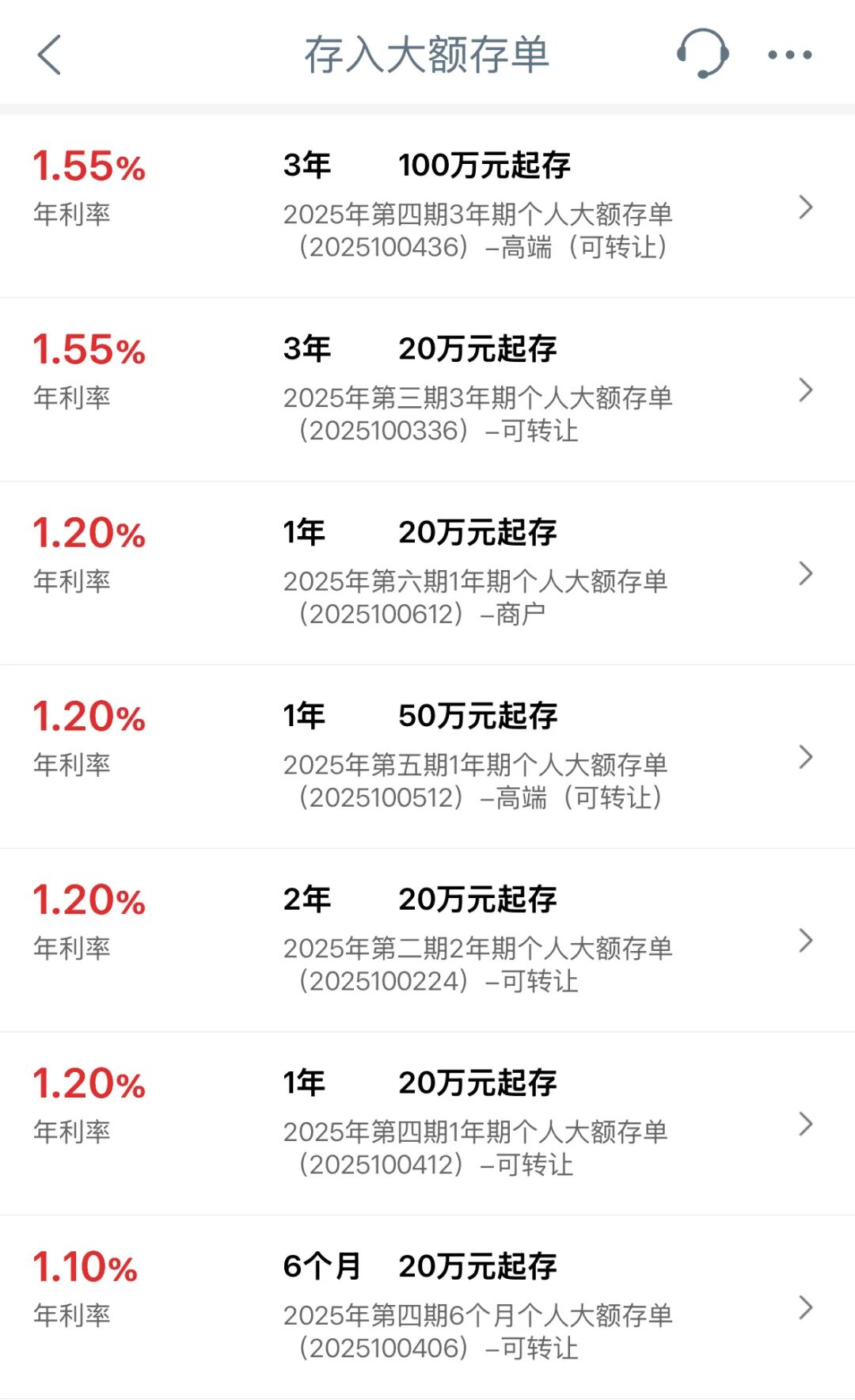
六大行全面停售5年期大额存单,工商银行大额存单仅剩余1个月、3个月、6个月、1年、2年、3年六个期限产品
Ge Long Hui· 2025-12-02 07:37
Core Viewpoint - The large-denomination time deposit products offered by major banks in China have shifted towards shorter maturities, with longer-term options being removed from availability [1] Summary by Category Product Offerings - The Industrial and Commercial Bank of China (ICBC) currently offers large-denomination time deposits with maturities of 1 month, 3 months, 6 months, 1 year, 2 years, and 3 years [1] - The interest rate for the 3-year large-denomination time deposit is 1.55%, while the rates for the 1-year and 2-year products are both 1.20% [1] - Other banks such as Bank of China, China Construction Bank, Bank of Communications, and Postal Savings Bank exhibit similar trends, having removed 5-year products from their offerings [1] Market Trends - Agricultural Bank of China has not included any 5-year large-denomination time deposit products in its catalog from 2018 to 2025 [1]
六大行全面停售5年期大额存单产品
Zheng Quan Shi Bao Wang· 2025-12-02 07:35
Core Viewpoint - Six major state-owned banks in China have collectively stopped offering 5-year large denomination time deposit products, indicating a trend towards shorter-term deposit offerings in the banking sector [1] Group 1: Bank Actions - The six major state-owned banks include Industrial and Commercial Bank of China, Agricultural Bank of China, Bank of China, China Construction Bank, Bank of Communications, and Postal Savings Bank of China [1] - Several joint-stock banks and city commercial banks are also following suit by reducing their long-term deposit products [1] Group 2: Product Offerings - The current offerings of large denomination time deposits have shifted to shorter terms, with Industrial and Commercial Bank of China now only providing products with terms of 1 month, 3 months, 6 months, 1 year, 2 years, and 3 years [1] - The 3-year large denomination time deposit product has an interest rate of 1.55%, while the 1-year and 2-year products both have rates of 1.20% [1] - Other banks such as Bank of China, China Construction Bank, Bank of Communications, and Postal Savings Bank of China exhibit similar trends, having removed 5-year products from their offerings [1] - Agricultural Bank of China does not list any 5-year large denomination time deposit products in its catalog for the period from 2018 to 2025 [1]