
浦发银行

Search documents
中国移动转股增持!浦发转债即将到期兑付,“白衣骑士”为何接踵而至?
Xin Lang Cai Jing· 2025-10-14 14:00
Core Viewpoint - The recent conversion of convertible bonds by China Mobile into shares of Shanghai Pudong Development Bank (SPDB) signifies a strategic move to enhance capital strength and market confidence, while also benefiting from the bank's long-term value [1][3][4]. Group 1: China Mobile's Investment - China Mobile converted 56.31454 million SPDB convertible bonds into 450 million ordinary shares, increasing its stake from 17% to 18.18% [1][3]. - This conversion does not trigger a mandatory takeover bid and maintains the existing equity structure of SPDB [3]. - The move is seen as a win-win situation, providing China Mobile with shares at a comparable market price while aiding SPDB in bolstering its core tier one capital [3][4]. Group 2: SPDB's Financial Position - As of June 30, SPDB's core tier one capital adequacy ratio stood at 8.91%, with total assets nearing 9.65 trillion yuan [7]. - The bank reported a revenue of 90.56 billion yuan and a net profit of 29.74 billion yuan for the first half of 2025, reflecting year-on-year growth of 2.6% and 10.2% respectively [7]. - The upcoming maturity of SPDB's convertible bonds on October 28, with a redemption price of 110 yuan per bond, poses a challenge as the bank's stock price has remained below the strong redemption threshold [4][5]. Group 3: Market Reactions and Future Implications - The market is closely monitoring whether other strategic investors will follow China Mobile's lead in converting bonds to shares, which could help SPDB navigate its capital challenges [5][6]. - Previous conversions by China Cinda and Dongfang Asset Management have resulted in significant paper profits, indicating a trend among asset management companies to leverage convertible bonds for strategic equity stakes [8][9]. - The new accounting standards have allowed these asset management companies to recognize substantial gains from their investments in SPDB, further encouraging similar actions from other investors [12][17].



这家银行系信托,迎来新董事长!
Zhong Guo Ji Jin Bao· 2025-10-14 13:59
Core Viewpoint - The approval of Cui Bingwen as the chairman of Shanghai International Trust marks a significant leadership change after over two years, aiming to enhance the company's operational capabilities and contribute to the development of Shanghai as an international financial center [1][5]. Group 1: Leadership Change - Cui Bingwen has been approved as the chairman of Shanghai International Trust, previously serving as the vice president of Shanghai Pudong Development Bank [1][5]. - This leadership transition follows the departure of former chairman Pan Weidong, who held the position since June 2008 and stepped down in December 2022 [5]. Group 2: Background of New Chairman - Cui Bingwen, born in 1969, holds a doctoral degree and is a senior economist with extensive experience in the banking sector [5]. - His previous roles include various leadership positions at Industrial and Commercial Bank of China and Shanghai Pudong Development Bank, showcasing a strong background in financial management [5]. Group 3: Strategic Goals - At a recent meeting, Cui outlined three main objectives for Shanghai Trust: to support high-quality development, integrate with its parent bank, and enhance profitability and operational standards [5]. - The company aims to develop unique trust services and contribute to the construction of Shanghai as an international financial hub [5]. Group 4: Company Overview - Shanghai Trust, established in 1981, is one of the earliest trust companies in China, with a registered capital of 5 billion yuan [6]. - The company specializes in asset management and wealth management services, catering to high-net-worth clients with a comprehensive range of financial products [6]. Group 5: Financial Performance - In the first half of this year, Shanghai Trust reported revenues of 1.115 billion yuan, reflecting a year-on-year growth of 39.77% [7]. - The net profit for the same period was 488 million yuan, showing a year-on-year increase of 27.64% [7].
这家银行系信托,迎来新董事长!
中国基金报· 2025-10-14 13:57
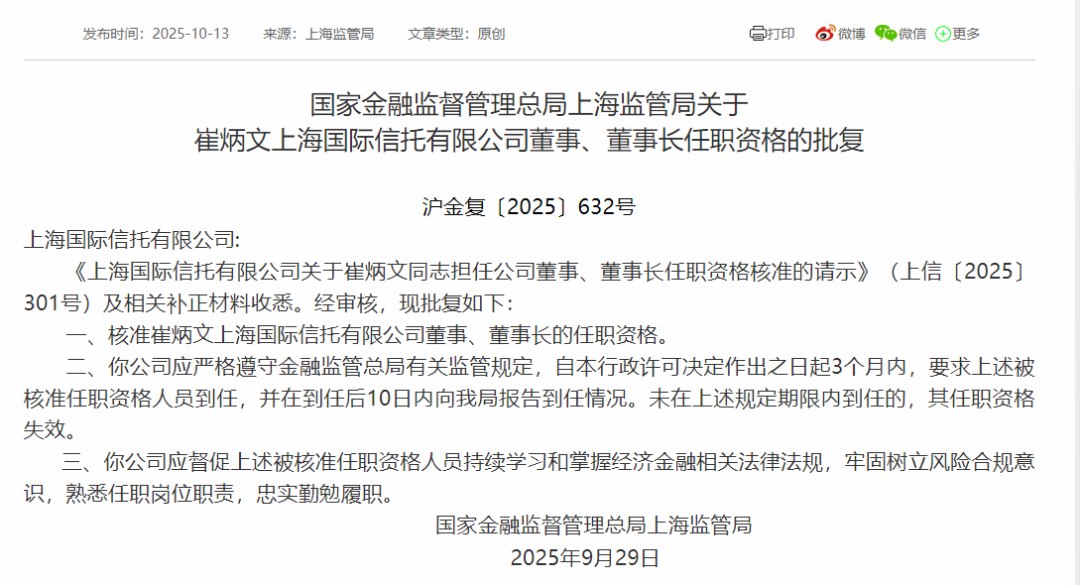
【 导读 】上海信托董事长崔炳文任职资格获批,此前系浦发银行副行长 中国基金报记者 马嘉昕 10 月 13 日,国家金融监督管理总局上海监管局批复公告称,核准崔炳文上海国际信托有限 公司(以下简称上海信托)董事、董事长的任职资格。这意味着上海信托董事长正式落定。 今年 7 月,在上海信托召开的 2025 年中工作会议暨党建工作会议上,崔炳文作为浦发银行 副行长出席会议。会上,他明确提出未来上海信托的三大目标,提出上海信托要助力高质量 发展、与母行融合发展,同时,进一步提升自身盈利能力和经营水平,打造独具信托特色的 业务和服务,为上海国际金融中心建设添砖加瓦。 据官网资料,上海信托成立于 1981 年,是国内最早成立的信托公司之一,注册资本为 50 亿元,主要从事资产管理、家族及财富管理业务,为高净值客户提供专业的理财方案与服 务,业务领域主要涵盖股权债权融资、证券投资、另类投资、工商受托、公益信托、投行服 务、家族传承等,是目前国内信托行业业务品种齐全、产品服务体系完备的专业投资机构之 一。 从股权结构来看,浦发银行是上海信托最大股东,持股比例为 97.3333% ,此外,上海汽车 集团股权投资有限公司持股比 ...
上海国际信托董事长落定 系控股股东浦发银行副行长
2 1 Shi Ji Jing Ji Bao Dao· 2025-10-14 13:49
Core Viewpoint - The approval of Cui Bingwen as the chairman of Shanghai International Trust Company marks a significant leadership change in the company, which is undergoing a transformation to adapt to the evolving financial landscape and regulatory environment [1][2]. Company Overview - Shanghai International Trust, established in 1981, is one of the earliest trust companies in China with a registered capital of RMB 5 billion. The company is primarily owned by Shanghai Pudong Development Bank, holding 97.3333% of the shares [1]. - The company specializes in asset management and wealth management services for high-net-worth clients, offering a comprehensive range of products including equity and debt financing, securities investment, alternative investments, and family legacy services [1]. Leadership Changes - Cui Bingwen, currently a member of the Party Committee and Vice President of Shanghai Pudong Development Bank, has been approved to take on the role of chairman at Shanghai Trust. His previous roles include various leadership positions within the bank [1][2]. - The company had previously indicated a potential leadership change, with Zhang Baoquan being considered for the chairman position, but the recent approval confirms Cui's appointment [2]. Financial Performance - In the latest financial report, Shanghai Trust reported a significant decline in revenue, with operating income of RMB 1.852 billion, down 77.25% year-on-year, and a net profit of RMB 669 million, down 86.49% year-on-year [2]. - The trust asset management scale reached RMB 956.823 billion by the end of 2024, reflecting an 82.9% increase from the beginning of the year. The company reported non-performing assets of RMB 55.5 million, with a non-performing asset ratio of 2.48%, a decrease of 1.15 percentage points from the start of the year [2]. Industry Context - The trust industry is currently experiencing significant personnel changes and a restructuring of development paths, with many companies focusing on retail transformation, risk management, and collaboration with securities firms [3][5]. - The new "Trust Company Management Measures" introduced by the regulatory authority emphasizes the core role of trust companies in asset management and risk control, aiming to return to the fundamental principle of "trustee responsibility" [4][5].
菏泽信贷诚信管理评价揭晓浦发银行菏泽分行居股份制与城商行首位
Qi Lu Wan Bao Wang· 2025-10-14 13:26
Group 1 - The core viewpoint of the article is the implementation of credit integrity management measures in Heze City to enhance the financial credit environment and address challenges in credit issuance [1][2] - In June 2025, Heze City government issued the "Heze City Enterprise Credit Integrity Management Measures (Trial)" and "Heze City Banking Institutions Credit Integrity Management Measures (Trial)" to improve credit integrity awareness [1] - A special working group was established in July-August 2025 by the Heze City Financial Bureau and other institutions to evaluate the credit integrity behaviors of banks and enterprises [1] Group 2 - The evaluation results indicated that the Shanghai Pudong Development Bank Heze Branch ranked first among joint-stock banks and city commercial banks, with no negative evaluations from the 24 participating enterprises [2] - This achievement reflects the bank's commitment to integrity in credit operations and serves as a positive example for the healthy development of the financial credit environment in Heze City [2]
A股突发!这一板块全线飘红
Zhong Guo Jing Ying Bao· 2025-10-14 12:06
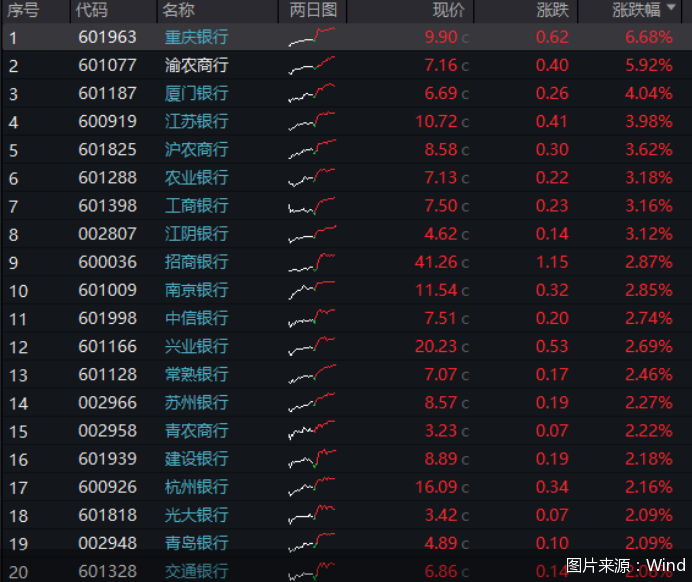
Core Viewpoint - The banking sector is experiencing a strong rebound due to its defensive characteristics amid increased market volatility, with a notable rise in stock prices for various banks as of October 14 [2][3]. Group 1: Market Performance - As of October 14, Chongqing Bank saw a price increase of 6.68%, with 42 listed banks showing positive performance and the banking index rising by 2.54% [2]. - Following the National Day and Mid-Autumn Festival holidays, the banking sector has shown an upward trend, with the China Securities Banking Index increasing by 0.75% on October 13, led by Shanghai Pudong Development Bank with a 5.66% rise [3]. Group 2: Reasons for Bank Stock Increase - The current market environment has created a demand for defensive asset allocation, providing opportunities for investment in bank stocks [3]. - Positive policy signals from the government are expected to improve the asset quality outlook for banks [3][4]. - The ongoing urban renewal and the establishment of a new real estate development model are anticipated to enhance credit and asset quality for banks [4]. Group 3: Investment Opportunities - The banking sector has been in a correction phase since July 11, presenting a potential for a rebound as the market adjusts [5]. - The banking index has seen a cumulative decline of 14% since July 10, underperforming compared to the CSI 300 index, which has risen by 15% [5]. - The upcoming dividend distribution period and stable earnings expectations for banks may lead to a catch-up rally in the banking sector [5][6]. Group 4: Future Outlook - Analysts suggest that the banking sector's low valuation and high dividend yield make it attractive for risk-averse investors [6]. - The sustainability of the upward trend in bank stocks will depend on the strength of economic recovery and improvements in corporate credit demand [6].


全线飘红,银行股又“香”了?
Bei Jing Shang Bao· 2025-10-14 12:06
Core Viewpoint - The banking sector has become a focal point in the A-share market, with all 42 listed banks experiencing gains on October 14, driven by a combination of defensive capital inflow, valuation advantages after corrections, and strong fundamentals [1][2][4]. Group 1: Market Performance - On October 14, all 42 bank stocks rose, with Chongqing Bank and Chongqing Rural Commercial Bank leading the gains at 6.68% and 5.92%, respectively [1][2]. - Year-to-date, 19 bank stocks have increased by over 10%, with Agricultural Bank of China leading at 39.52% [2]. - The banking sector had previously experienced a correction, with 41 banks seeing declines after reaching their yearly highs in early July [2][3]. Group 2: Reasons for Recent Performance - The recent rally in bank stocks is attributed to a "defensive switch" by investors amid increased market volatility and a decline in risk appetite due to renewed trade tensions between China and the U.S. [4][6]. - The sector's recovery follows a period of deep correction, making bank stocks attractive for risk-averse investors [4][6]. Group 3: Insider Buying Trends - There has been a notable trend of insider buying among banks, with major shareholders and management teams increasing their stakes, indicating confidence in the long-term value of bank stocks [5][6]. - For instance, Suzhou Bank reported significant insider purchases totaling approximately 2.98 billion yuan [5]. Group 4: Future Outlook - The banking sector is expected to see continued growth, supported by improved asset quality and profitability, as well as favorable government policies encouraging diversified operations [6][7]. - Investment strategies vary, with conservative investors advised to focus on state-owned banks for stable dividends, while more aggressive investors may consider high-performing regional banks for potential higher returns [7].



莫开伟:银行贷款业务缘何会成违规“重灾区”?
Xin Lang Cai Jing· 2025-10-14 11:52
Core Viewpoint - The banking sector in China continues to face significant issues with loan-related violations, with a total of 997 penalties issued from January to September this year, amounting to 9.81 billion yuan, primarily due to non-compliance in credit operations [1][2]. Summary by Sections Regulatory Actions - The National Financial Supervision Administration has issued a total of 997 fines to various banking institutions, including state-owned banks and foreign banks, with a cumulative penalty amount of 9.81 billion yuan from January to September this year [1]. - Historical data shows a consistent trend of penalties over the years, with fines issued from 2020 to 2024 totaling 2894, 4027, 1235, 998, and 1533 respectively, indicating a persistent issue in the banking sector [2]. Reasons for Violations - Credit operations are central to banking performance and profitability, leading to increased pressure on banks to meet loan growth targets, which often results in lax internal controls and management practices [3]. - The scarcity of loan resources creates a competitive environment where banks may lower their lending standards, leading to increased instances of non-compliance [4]. - The presence of moral hazards among bank management, including corruption and collusion, exacerbates the issue, resulting in significant financial losses for banks [5]. Internal Control Failures - Weak internal controls and inadequate penalties for violations contribute to the persistence of loan-related misconduct, as banks prioritize business expansion over compliance [6][7]. - The lack of effective oversight and the tendency to overlook post-loan management have led to frequent violations and substantial fines [6]. Market Competition - Intense competition among banks, characterized by product homogeneity, has led to a focus on volume over compliance, resulting in frequent violations [9]. - Smaller banks, in particular, exhibit a tendency to prioritize scale over risk management, leading to a higher incidence of non-compliance [9]. External Influences - Local government pressures and the need to maintain relationships with authorities often compel banks to issue loans that may not meet compliance standards, further complicating the regulatory landscape [10]. Recommendations for Improvement - To address these issues, banks need to overhaul their internal control mechanisms, enhance the training and ethical standards of credit management personnel, and implement advanced monitoring technologies to track loan usage effectively [11][12][13].
力合科技使用2000万元闲置募集资金进行现金管理,年化收益率0.70%-1.85%
Xin Lang Cai Jing· 2025-10-14 11:52
Core Viewpoint - Lihe Technology (Hunan) Co., Ltd. announced the progress of using part of its idle raised funds for cash management, allowing up to 90 million yuan of idle raised funds and up to 900 million yuan of self-owned funds for cash management within a twelve-month period after board approval [1] Cash Management Details - The company signed a structured deposit agreement with Shanghai Pudong Development Bank, with an investment amount of 20 million yuan and an annualized return rate of 0.70% or 1.65% or 1.85% for a one-month term [2] Impact on the Company - The use of idle raised funds for cash management is conducted without affecting the progress of investment projects and normal operations, aiming to improve fund utilization efficiency and generate returns for shareholders [4]

银行系信托,迎新董事长!
Zheng Quan Shi Bao Wang· 2025-10-14 11:32
Core Viewpoint - The approval of Cui Bingwen as the new chairman of Shanghai International Trust marks a significant leadership change for the company, which is one of the earliest established trust companies in China and is known for its comprehensive range of financial services [1][5]. Company Overview - Shanghai International Trust was established in 1981 with a registered capital of 5 billion yuan. The company is primarily engaged in asset management and wealth management services for high-net-worth clients, covering various areas including equity and debt financing, securities investment, alternative investments, and family legacy services [2]. - The company is controlled by Shanghai Pudong Development Bank, which holds a 97.3333% stake [2]. Leadership Changes - The recent appointment of Cui Bingwen as chairman follows the departure of former chairman Pan Weidong, who had served since June 2008. Pan stepped down from his roles in December 2022 but remains the legal representative of the company [3][5]. - Cui Bingwen, born in 1969 and holding a doctoral degree, has extensive experience in the financial sector, previously serving in various leadership roles at Shanghai Pudong Development Bank and other institutions [5]. Financial Performance - In 2024, Shanghai International Trust reported a significant decline in financial performance, with a net profit of 669 million yuan, down 86.49% year-on-year. The company’s operating revenue also fell by 77.25% to 1.852 billion yuan [6]. - The drastic changes in net profit are attributed to high investment income in the previous year, particularly from the sale of a 51% stake in a fund management company, which inflated the 2023 profits [6]. Asset Management - As of the end of 2024, Shanghai International Trust managed trust assets totaling 956.823 billion yuan, reflecting an 82.9% increase from the beginning of the year. The company reported a non-performing asset total of 55.5 million yuan, with a non-performing rate of 2.48%, down 1.15 percentage points from the start of the year [7]. - The company is actively pursuing a transformation strategy in response to the evolving economic landscape, focusing on enhancing wealth management and asset management capabilities while cautiously managing financing-related business scales [7].