
中信银行

Search documents
银行股全线上涨
第一财经· 2025-11-04 02:16
Core Viewpoint - The banking sector continues to show positive momentum, with several banks experiencing significant stock price increases on November 4th, indicating a bullish trend in the market [1]. Group 1: Stock Performance - Shanghai Bank, CITIC Bank, Industrial Bank, China Merchants Bank, Xiamen Bank, and Postal Savings Bank all saw stock price increases of over 2% [1]. - Specific stock performance data includes: - CITIC Bank: +2.29%, current price 8.04 [2] - Industrial Bank: +2.24%, current price 21.02 [2] - Shanghai Bank: +2.27%, current price 9.90 [2] - China Merchants Bank: +2.23%, current price 42.72 [2] - Xiamen Bank: +2.11%, current price 7.25 [2] - Postal Savings Bank: +2.08%, current price 5.90 [2] - Other banks also showed positive performance, with Agricultural Bank up by 1.87% and Industrial and Commercial Bank up by 1.65% [2].






银行板块震荡走强 上海银行等涨超2%
Zheng Quan Shi Bao Wang· 2025-11-04 02:07
Core Viewpoint - The banking sector has shown a strong upward trend, with several banks experiencing significant stock price increases [1] Group 1: Stock Performance - Shanghai Bank, China Merchants Bank, and CITIC Bank have all risen by over 2% [1] - Xiamen Bank, Postal Savings Bank, and Agricultural Bank have also seen increases of over 1% [1]



中信银行涨2.04%,成交额1.07亿元,主力资金净流入1397.79万元
Xin Lang Zheng Quan· 2025-11-04 01:58
Core Points - CITIC Bank's stock price increased by 2.04% on November 4, reaching 8.02 CNY per share, with a total market capitalization of 446.27 billion CNY [1] - The bank's stock has risen 17.80% year-to-date, with a 2.82% increase over the last five trading days and a 9.86% increase over the last 20 days [1] - As of September 30, 2025, CITIC Bank reported a net profit of 53.39 billion CNY, a year-on-year increase of 3.02% [2] Financial Performance - CITIC Bank's main business revenue composition includes corporate banking (46.40%), retail banking (38.28%), and financial market business (14.37%) [1] - The bank has distributed a total of 173.84 billion CNY in dividends since its A-share listing, with 52.99 billion CNY distributed in the last three years [3] Shareholder Information - As of September 30, 2025, the number of CITIC Bank shareholders increased by 6.11% to 125,800, while the average number of circulating shares per person decreased by 7.52% to 403,402 shares [2] - The top ten circulating shareholders include China Securities Finance Corporation, holding 1.02 billion shares, and Hong Kong Central Clearing Limited, holding 340 million shares, which decreased by 32.21 million shares from the previous period [3]
零售贷款增速显著跑输对公,民生兴业平安个贷增速为负!哪家对公强?
Xin Lang Cai Jing· 2025-11-04 01:00
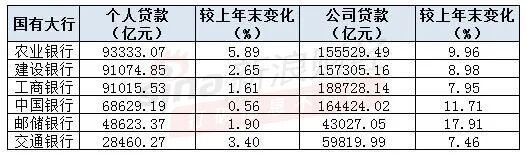
Core Viewpoint - The report highlights that corporate loans continue to drive the growth of bank credit, significantly outpacing retail loans in the first three quarters of 2025, with state-owned banks showing a notable increase in corporate lending compared to retail lending [1][5][11]. Group 1: State-Owned Banks Performance - Among state-owned banks, Agricultural Bank of China leads in personal loan size at 93,333.07 million yuan, with a growth of 5.89% compared to the end of the previous year [3][5]. - Postal Savings Bank shows a remarkable increase in corporate loans, with a growth rate of 17.91%, while its personal loans grew by only 1.90% [5][7]. - The overall trend indicates that personal loan growth is lagging behind corporate loan growth, with only Agricultural Bank exceeding a 5% increase in personal loans among the major banks [5][11]. Group 2: Joint-Stock Banks Performance - Several joint-stock banks, including Minsheng Bank, Industrial Bank, and Ping An Bank, reported negative growth in retail loans, while their corporate loans continued to grow positively [1][11]. - For instance, Ping An Bank's personal loans decreased by 2.10% to 17,291.92 million yuan, while its corporate loans saw a decline in bad debt rates [11][12]. - In contrast, China Merchants Bank reported a retail loan balance of 36,966.19 million yuan, with a modest growth of 1.43%, but its corporate loans grew significantly [9][13]. Group 3: Retail Asset Under Management (AUM) - Despite the challenges in retail loan growth, several banks reported strong growth in retail AUM. For example, China Merchants Bank's retail AUM reached 16.6 trillion yuan, growing by 11.19% [1][15]. - Shanghai Pudong Development Bank also reported a significant increase in personal financial assets, with a growth of 19.07% to 4.62 trillion yuan [15]. - Management teams from various banks emphasized their commitment to enhancing retail market share, indicating a long-term strategic focus on retail banking despite current market conditions [15][16].





加强品牌建设 助推高质量发展
Ren Min Ri Bao· 2025-11-03 21:51
Group 1: Financial Institutions and Technology Innovation - The National Financial Supervisory Administration is promoting financial institutions to increase support for technological innovation, establishing a multi-level technology financial service system [1] - A comprehensive policy framework for technology finance has been initiated, with a focus on enhancing credit services for high-tech enterprises and small and medium-sized technology companies [1] - By the end of Q3 2025, the loan balance for high-tech enterprises in both domestic and foreign currencies reached 18.84 trillion yuan, a year-on-year increase of 6.9% [1] Group 2: Agricultural Financial Services - The Agricultural Development Bank of China is focusing on creating four major professional brands to support agricultural development [5] - The bank aims to enhance food security and promote digital finance across the entire agricultural value chain [6] - It is also committed to supporting high-standard farmland construction and ecological protection through financial services [6] Group 3: Inclusive Finance Development - The China Banking Association emphasizes the importance of inclusive finance, aiming to meet the financial needs of small and micro enterprises, rural areas, and low-income groups [3][4] - By June 2025, the balance of inclusive loans for small and micro enterprises from large commercial banks reached 16.23 trillion yuan, which is 3.36 times that of the end of the 13th Five-Year Plan [3] - The banking sector is innovating products tailored to the operational characteristics of small and micro enterprises, increasing the proportion of first-time loans and credit loans [3] Group 4: Digital and Intelligent Financial Services - The Industrial and Commercial Bank of China is implementing digital reforms and has established a digital inclusive finance center to enhance service efficiency [7] - The bank has developed a financial big model and an intelligent decision-making engine to improve risk identification accuracy [7] - By focusing on inclusive finance, the bank aims to create a new service model that is precise, smooth, and intelligent [7] Group 5: Insurance Sector Innovations - The People's Insurance Company of China is enhancing insurance coverage for major national strategies and key areas, with an insurance liability amount of 2988 trillion yuan for 2024 [15] - The company is innovating in technology insurance and has launched various products to provide comprehensive risk protection for technological research and development [15] - It is also expanding green insurance offerings to support environmental sustainability initiatives [15] Group 6: Comprehensive Financial Ecosystem - Citic Bank is focusing on building a standardized system for inclusive finance, enhancing its product offerings and risk control mechanisms [11][12] - The bank aims to create a diversified service ecosystem by collaborating with various stakeholders to support small and micro enterprises [12] - It is committed to developing a more mature and rich product service system for inclusive finance [12]
“存款活化”遇上“到期窗口” 重定价助银行负债卸包袱
Zhong Guo Zheng Quan Bao· 2025-11-03 20:11
Core Insights - The attractiveness of wealth management products has increased as deposit rates decline, leading to a shift in asset allocation from traditional savings to diversified financial products [1][3][6] - A significant amount of high-interest deposits are maturing, prompting customers to invest in wealth management products, which is contributing to the growth of the wealth management market [2][3] - The trend of increasing demand for liquid deposits is changing the liability structure of banks, with a notable rise in the proportion of demand deposits [4][5] Wealth Management Market Growth - As of the end of Q3 2025, the total number of wealth management products in the market reached 43,900, a year-on-year increase of 10.01%, with a total scale of 32.13 trillion yuan, up 9.42% year-on-year [3] - The decline in deposit rates has led to a noticeable shift in customer behavior, with many opting for wealth management products that offer higher returns compared to traditional savings [2][3] Changes in Deposit Structure - The marginal improvement in demand deposits is evident, with a reported balance of 12.69 trillion yuan in demand deposits by the end of September 2025, reflecting a year-to-date increase of 502.3 billion yuan, or 4.12% [4][5] - The proportion of demand deposits has decreased by 1.21 percentage points compared to the beginning of the year, but the rate of decline has slowed, indicating a stabilization trend [5] Impact on Bank Profitability - The re-pricing of maturing high-interest deposits is expected to alleviate the pressure on net interest margins for banks, with potential downward adjustments in deposit interest rates by approximately 30 basis points per year [6][7] - The ongoing decline in deposit rates is anticipated to create new opportunities for monetary policy and capital markets, as banks can lower their funding costs [6][7]
“存款活化”遇上“到期窗口”重定价助银行负债卸包袱
Zhong Guo Zheng Quan Bao· 2025-11-03 20:11
Core Insights - The attractiveness of wealth management products has increased as deposit rates decline, leading to a shift in asset allocation from traditional savings to diversified financial products [1][2][4] Wealth Management Product Growth - The number of wealth management products in the market reached 43,900 by the end of Q3 2025, marking a year-on-year growth of 10.01% [2] - The total scale of these products was 32.13 trillion yuan, reflecting a year-on-year increase of 9.42% [2] Changes in Deposit Structure - There has been a marginal improvement in demand for demand deposits, with a notable increase in their growth rate [3] - As of the end of September, the balance of demand deposits in one bank was 12.69 trillion yuan, with a year-to-date increase of 502.3 billion yuan, representing a growth rate of 4.12% [3] Impact of Market Conditions - The capital market's recovery has led to a shift in residents' asset allocation, with stocks and funds becoming primary alternatives to traditional savings [2][3] - The A-share market has seen a 20% increase since June 23, 2025, contributing to the growing appeal of capital market investments [2] Interest Rate Dynamics - The repricing of high-interest deposits is expected to alleviate the pressure on banks' net interest margins, with potential downward adjustments of 30 basis points per year anticipated for deposit rates [4][5] - The decline in deposit rates is projected to continue, benefiting banks by reducing their funding costs [4][5] Asset Allocation Trends - There is a noticeable shift in residents' asset allocation from "single savings" to "diversified financial management," driven by the decreasing attractiveness of low-interest deposits [4][5] - The preference for fixed-term deposits has been influenced by the need for capital preservation and risk aversion in the current financial environment [5]
易方达科技先锋混合型证券投资基金基金份额发售公告
Shang Hai Zheng Quan Bao· 2025-11-03 19:51
Fund Overview - The fund is named "E Fund Technology Pioneer Mixed Securities Investment Fund" with A class fund share code 025918 and C class fund share code 025919 [17] - It is a contract-based open-end mixed securities investment fund with an indefinite duration [18] - The fund aims to pursue investment returns that exceed the performance benchmark while controlling risks [19] Fund Raising Details - The initial fundraising cap for the fund is set at 2 billion RMB (approximately 20 billion) [3] - The fundraising period is from November 12, 2025, to November 18, 2025, with the possibility of adjustments based on subscription conditions [21] - The fund will be available for subscription to individual investors, institutional investors, qualified foreign investors, and other investors permitted by laws and regulations [20] Fund Share Classes - The fund offers two classes of shares: A class shares, which charge subscription fees, and C class shares, which do not charge subscription fees but incur sales service fees during the holding period [2][23] - Each class of shares will have separate codes and will calculate and publish net asset values independently [2] Subscription and Investment Limits - The minimum subscription amount for individual investors through non-direct sales institutions is set at 1 RMB, while for direct sales, it is 50,000 RMB [6] - There is no upper limit on the total subscription amount for individual investors, but measures will be taken to control situations where a single investor's holdings exceed 50% of the fund [6] Subscription Confirmation and Processing - Investors can make multiple subscriptions during the fundraising period, but once confirmed, the subscription cannot be revoked [9] - The fund will process subscription applications on a first-come, first-served basis, and any excess applications beyond the fundraising cap will be proportionally confirmed [4] Fund Management and Custody - The fund is managed by E Fund Management Co., Ltd., and the custodian is CITIC Bank [1][60] - The fund management company is committed to managing and utilizing fund assets with integrity and diligence but does not guarantee profits or minimum returns [66]
中信银行股份有限公司关于召开2025年第三季度业绩说明会的公告
Shang Hai Zheng Quan Bao· 2025-11-03 18:12
Core Points - The company will hold a performance briefing for the third quarter of 2025 on November 11, 2025, from 15:00 to 16:00 [2][4] - The meeting will be conducted via an online interactive format, allowing investors to engage through the Shanghai Stock Exchange's platform [2][4] - Investors can submit questions via email to the company's investor relations before November 7, 2025, for discussion during the meeting [2][6] Meeting Details - Meeting Type: The briefing will focus on the company's third quarter performance and operational status, addressing common investor concerns [3] - Meeting Time and Format: Scheduled for November 11, 2025, from 15:00 to 16:00, conducted online [4] - Participants: Senior management, independent directors, and relevant department heads will be present [5] Investor Participation - Investors can log in to the Shanghai Stock Exchange's platform to interact during the meeting [6] - Questions can be sent via email to the investor relations address before the specified deadline [6] Contact Information - Contact Person: Liu Qingsong from the company's board office [7] - Contact Email: ir@citicbank.com [8]
机遇“金闪闪” 银行贵金属业务规模大增
Shang Hai Zheng Quan Bao· 2025-11-03 18:11
Core Viewpoint - The strong international gold prices and rising global risk aversion are driving the growth of banks' precious metals businesses, with significant year-on-year increases reported in the third-quarter financial results of listed banks. However, the recent fluctuations in gold prices present new challenges for these banking operations [1]. Group 1: Growth in Precious Metals Business - The precious metals business of banks has rapidly expanded due to the sustained rise in gold prices, with smaller banks showing particularly impressive growth. As of the end of September, Nanjing Bank's precious metals business reached 7.201 billion yuan, a staggering increase of 11,914.36% compared to the end of 2024. Hangzhou Bank's precious metals business grew to 1.217 billion yuan, up 1,523.57% from the end of 2024 [2]. - Joint-stock banks also experienced significant growth in their precious metals business. By the end of September, compared to the end of 2024, the precious metals business of Shanghai Pudong Development Bank increased by over 350%, while China CITIC Bank saw an increase of over 200%. Other banks like Zhejiang Commercial Bank, Industrial Bank, China Merchants Bank, and Minsheng Bank all reported growth exceeding 100% [2]. - Major banks maintained steady growth from a high base, with the precious metals business of Bank of China, China Construction Bank, and Agricultural Bank of China all increasing by over 10% compared to the end of 2024 [2]. Group 2: Strategic Focus on Precious Metals - The precious metals business combines wealth management and increased intermediary income, potentially becoming a significant factor in banks' intermediary income. Precious metals, especially gold, are seen as irreplaceable in banks' wealth management offerings and are crucial for customer asset allocation [3]. - Analysts note that the demand for gold as a hedge and a store of value is rising among residents. Banks, as key channels for gold bar sales and coin distribution, are well-positioned to meet this demand through the continued popularity of online investment products like account gold and gold accumulation [3]. - The decline in gold jewelry consumption may lead banks to reduce reliance on traditional jewelry sales and instead focus on innovation and promotion of their precious metals business [3]. Group 3: Risk Management Amid Price Volatility - Despite the growth, the high volatility of precious metals, particularly gold and silver, poses challenges for banks. Since October, these metals have entered a period of high volatility, prompting banks to enhance their risk management strategies [4]. - In response to market fluctuations, banks have adjusted trading rules and increased the minimum purchase thresholds for gold accumulation products to a range of 950 to 1,200 yuan, compared to around 500 yuan last year. Additionally, some banks have modified their precious metals wallet services to align with real-time gold price fluctuations [4]. - Looking ahead, institutions expect gold to retain its upward potential, maintaining its importance in asset allocation. The profitability of banks' precious metals business will increasingly depend on their internal capabilities, including the establishment of robust risk management systems to mitigate price volatility risks and the optimization of asset allocation for stable returns [4].


