Centrus Energy

Search documents
美股核电概念股走强
Ge Long Hui A P P· 2025-12-04 16:19
Group 1 - Oklo and NuScale Power both saw stock increases of over 10% [1] - Centrus Energy experienced a stock rise of over 5% [1] - Constellation Energy's stock increased by over 3% [1]
新工业双周报(11/17-11/30):IMM 要求 FERC 裁定:大型数据中心仅在电网能可靠供电时才可接入,美国居民用电价格 9 月同比上涨 7.4%-20251204
Haitong Securities International· 2025-12-04 14:13
Investment Rating - The report suggests a positive outlook for the new industrial sector, particularly focusing on data centers and energy infrastructure, driven by the increasing demand for AI and cloud services. Core Insights - The report highlights a significant increase in data center capacity in Europe, expected to double due to rising demand from new cloud services. In the U.S., residential electricity prices rose by 7.4% year-on-year in September, indicating a tightening energy market [1][3]. - The report emphasizes the need for regulatory clarity from FERC regarding the connection of large data centers to the grid, stressing that they should only connect when grid reliability is assured [1][3]. - The U.S. energy market is experiencing a shift, with a notable increase in electricity demand driven by industrial returns, AI data center construction, and decarbonization efforts [5][9]. Summary by Sections Global Infrastructure and Construction Equipment - Data center vacancy rates in North America have reached a historic low of 1.6%, with significant price increases for data center cabinets due to high demand and limited power supply [8]. - The U.S. Department of Energy is pushing for the construction of data centers on federal land as part of its AI strategy, which includes significant investments in energy infrastructure [9][10]. Global Electrical and Intelligent Equipment - The gas turbine price index in the U.S. increased by 5.49% year-on-year and 2.1% month-on-month as of September 2025, reflecting strong demand in the energy sector [15][17]. - The report notes that the U.S. electricity demand is expected to grow significantly, with projections indicating an increase of 15.8% by 2029 [23][27]. Global Energy Industry - The wholesale electricity prices in the U.S. have shown significant fluctuations, with the average retail electricity price reaching 14.23 cents/kWh, a 7% increase year-on-year [3][29]. - The report indicates that the U.S. is investing heavily in transmission infrastructure, with over $50 billion approved for new transmission expansions [27][28]. Global New Materials - The report tracks the uranium spot price at $75.80 per pound, with a slight decrease of 5% month-on-month, while the long-term price remains at $86.00 per pound [4]. Key Company Insights and Comments - The report recommends focusing on companies involved in AI power operations and energy equipment, such as Entergy, Talen Energy, and Oklo, as they are well-positioned to benefit from the ongoing energy transition [5][42]. - Companies like GE Vernova and Siemens Energy are expanding their manufacturing capabilities to meet the growing demand for energy infrastructure [44][45].


The Nuclear Stock Everyone's Talking About (and Why You Should Care)
The Motley Fool· 2025-11-27 09:05
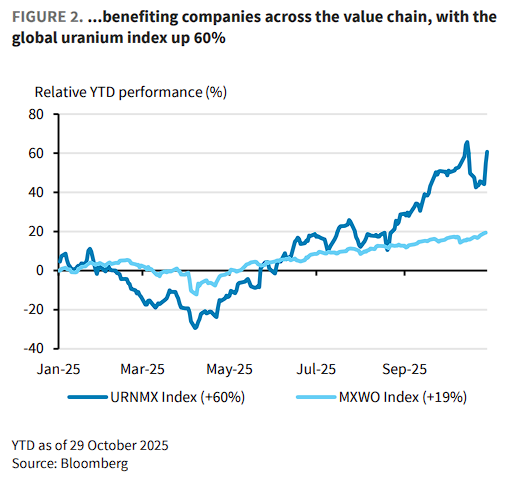
Core Insights - Nuclear energy stocks have experienced significant growth in 2025, with the Global X Uranium ETF up over 62% year-to-date [1] - Nano Nuclear Energy is gaining attention for its innovative small nuclear reactor design that can be transported by truck, potentially revolutionizing energy supply [2] - Despite its potential, Nano is currently pre-revenue and facing regulatory approval challenges, with its stock price down nearly 50% from October highs [3] Company Overview - Nano Nuclear Energy is positioned at the intersection of three major trends: the resurgence of nuclear energy, the shift towards clean energy, and advancements in artificial intelligence [4] - The company's strategy involves creating small reactors to provide power to areas with unreliable electricity, including data centers, mining sites, military camps, off-grid communities, and even space [4] Financial Position - As of June, Nano had approximately $210 million in cash and raised $400 million from private investors, indicating a strong balance sheet [6] - The company's trailing twelve-month cash burn is around $30 million, providing a sufficient runway for operations [6] Regulatory Challenges - The primary concern for Nano is the timeline for passing regulatory processes, which currently leaves the company with no revenue [8] - Due to this uncertainty, the stock is expected to be volatile, making it potentially less suitable for conservative investors [8]


解决电力短缺,美国拟新增多达10座核反应堆,可能日本“买单”
美股IPO· 2025-11-20 16:07
Core Viewpoint - The U.S. government is planning to procure and own up to 10 new large nuclear reactors to address the surging electricity demand driven by data centers and artificial intelligence, declaring a "national emergency" to justify this intervention in the private market [3][5][6]. Group 1: Government Intervention and Funding - The plan may utilize Japan's commitment of $550 billion in investments, with approximately $332 billion earmarked for U.S. energy projects, including investments in Westinghouse's new AP1000 reactors and small modular reactors [4][6]. - The U.S. Department of Energy has not disclosed specific site details for the reactors but expresses confidence in the project's implementation [6]. Group 2: Industry Beneficiaries - Key players in the nuclear energy sector, such as Westinghouse, BWX Technologies, and Mirion Technologies, are expected to benefit significantly from this government initiative [4][7][8]. - Westinghouse, which holds the only large reactor design currently under discussion, is coordinating with the U.S. government for potential contracts [7]. - BWX Technologies, as a primary nuclear contractor, and Flowserve, a major supplier of nuclear pumps and valves, are also positioned to receive substantial orders, with Flowserve estimating potential nuclear contract revenues of up to $10 billion [8]. Group 3: Market Context and Historical Background - The initiative aims to revive the U.S. nuclear power construction sector, which has been stagnant for over a decade, primarily due to the financial struggles of previous projects like Southern's Vogtle [9][10]. - The current energy crisis and the rise of AI are reshaping industry dynamics, potentially making large nuclear projects more viable again [10][12].
解决电力短缺,美国拟新增多达10座核反应堆,可能日本“买单”
Hua Er Jie Jian Wen· 2025-11-20 03:52
Core Insights - The U.S. government plans to procure and own up to 10 new large nuclear reactors to address the surging electricity demand driven by data centers and artificial intelligence [1][2] - This initiative is seen as a response to a "national emergency," indicating a significant shift in government intervention in the private market [2][3] - The plan may leverage Japan's previously committed $550 billion investment, with $332 billion earmarked for U.S. energy projects, including investments in Westinghouse's new AP1000 reactors [1][3] Government Intervention - The U.S. power system is under immense pressure due to explosive growth in electricity demand from AI data centers and potential manufacturing recovery [2] - The Energy Department has not disclosed specific site details for the reactors but expresses confidence in the project's implementation [2][3] - The government is also expected to provide "hundreds of billions" in loans to the nuclear sector, including a $1 billion loan for the restart of the Three Mile Island nuclear plant [2] Industry Beneficiaries - Key players in the nuclear energy sector are anticipated to benefit from the federal government's procurement plan [3][4] - Westinghouse, the sole large reactor design currently under discussion, is jointly owned by Cameco and Brookfield Asset Management, and is coordinating with the U.S. government [3] - BWX Technologies, Mirion Technologies, and Flowserve are positioned to gain significant contracts in heavy manufacturing and safety monitoring [3][4] Uranium Mining Sector - Domestic uranium mining companies (e.g., UEC, EU, URG, UUUU) are expected to benefit from the federal government's efforts to expand domestic uranium mining for both commercial and defense needs [4] Nuclear Power Resurgence - If the plan is realized, it could break a decade-long stagnation in U.S. nuclear power construction, with the last major project starting over ten years ago [5][6] - The previous setbacks in the industry, such as the Vogtle project exceeding its budget by $16 billion and facing a seven-year delay, have led to skepticism about large nuclear projects [5][6] - The current AI boom is changing the industry's dynamics, potentially reviving interest in large nuclear projects [6][7] Government's Role - The direct intervention of the U.S. government may be the critical impetus needed for the nuclear industry to restart amid electricity shortages [8]
全球最大镰刀也盯上能源了
Hu Xiu· 2025-11-13 14:39
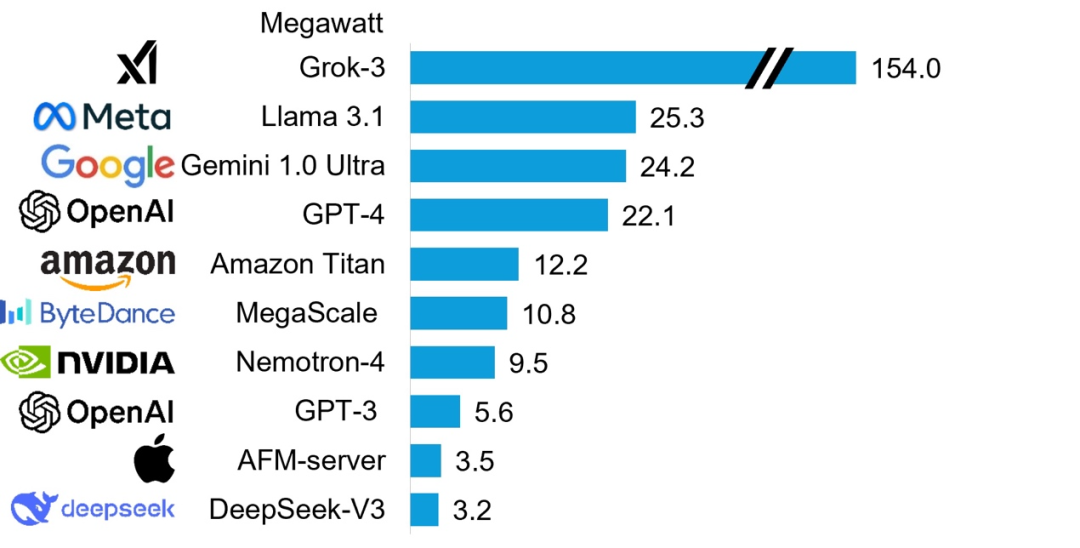
Core Insights - The increasing demand for AI computing power is leading to a significant electricity shortage, with major tech companies like Microsoft and OpenAI highlighting the risks to their operations due to insufficient power supply [2][3][8] - The investment landscape is shifting towards energy solutions, particularly in the context of AI's growing electricity needs, with companies exploring advanced nuclear technologies [4][40] Group 1: Electricity Demand and Supply Dynamics - AI server clusters are consuming electricity at a rate that outpaces the expansion of the power grid, potentially creating a bottleneck for the AI era [3] - The power consumption of AI training has escalated dramatically, with data centers projected to consume 945 TWh by 2030, which would account for approximately 63.42% of China's residential electricity consumption in 2024 [4][7] - The U.S. is currently the largest consumer of data center electricity, accounting for 45% of global consumption, with significant growth expected in both the U.S. and China by 2030 [7][8] Group 2: U.S. Electricity Challenges - The U.S. electricity system is unprepared for the surge in demand driven by AI, with a disconnect between economic growth and electricity demand [8][11] - The aging infrastructure and the retirement of coal-fired power plants have exacerbated the electricity supply issues, leading to a projected shortfall of approximately 100 GW over the next five years [12][14] - Major data centers in the U.S. are already facing delays in new projects due to transmission capacity limitations [14][15] Group 3: China's Energy Landscape - China has a robust energy supply, with total electricity generation exceeding consumption, and is expected to see significant growth in renewable energy sources [20][22] - The country is focusing on integrating computing power with renewable energy, with policies aimed at achieving a synergy between energy supply and demand [26][30] - By 2030, China's data center electricity demand is projected to reach between 3000-7000 billion kWh, while renewable energy generation is expected to exceed this demand [34][35] Group 4: Nuclear Energy as a Solution - Both the U.S. and China are increasingly looking towards nuclear energy, particularly small modular reactors (SMRs) and controlled nuclear fusion, to meet future energy demands [49][50] - The commercial viability of SMRs is still in its early stages, with significant investments being made but no substantial revenue expected until the late 2020s [51][52] - Controlled nuclear fusion is gaining traction as a long-term solution, with various countries setting ambitious timelines for its commercialization and significant funding being directed towards this technology [54][55]
Centrus Energy (LEU) - 2025 Q3 - Earnings Call Transcript
2025-11-06 14:30
Financial Data and Key Metrics Changes - In Q3 2025, the company achieved revenue of $74.9 million, a 30% increase from the same quarter last year, which was $57.7 million [13] - The company reported a gross loss of $4.3 million compared to a gross profit of $8.9 million in Q3 2024 [14] - Net income for Q3 2025 was $3.9 million, a significant improvement from a net loss of $5 million in the same period last year [15] - Year-to-date net income for 2025 reached $60 million, compared to $19.5 million during the same period last year [15] - The total company backlog stood at $3.9 billion as of September 30, 2025, extending to 2040 [16] Business Line Data and Key Metrics Changes - The LEU segment generated $44.8 million in Q3 2025, an increase of 29% or $10 million compared to Q3 2024, driven by increased uranium sales volume [13] - The technical solutions segment delivered revenue of $30.1 million in Q3 2025, a 31% increase over Q3 2024, attributed to LEU sales to the DOE [13] Market Data and Key Metrics Changes - The published spot price for LEU SWU soared to $220, near historic levels, indicating strong demand for U.S.-owned enrichment capacity [19] - The Nuclear Energy Institute identified over 8 gigawatts of expected additional generation from the existing fleet, indicating a growing market for nuclear power [18] Company Strategy and Development Direction - The company is focused on strengthening its operational preparations and capitalizing on growth opportunities, including a $1 billion at-the-market program to raise funds ahead of planned expansion [10][11] - The company aims to secure funding through public-private partnerships, leveraging potential task order awards under its LEU enrichment contract [6][8] - The company is actively pursuing readiness initiatives to prepare for large-scale deployment of its technology [8] Management's Comments on Operating Environment and Future Outlook - Management expressed confidence in the growing demand for nuclear power, driven by investments from technology giants and government initiatives [18] - The company anticipates a tight market for enrichment in the late 2020s and early 2030s, reinforcing its business model [36] - Management highlighted the importance of securing commitments from customers to support future expansion plans [65] Other Important Information - The company closed an oversubscribed convertible senior note transaction, increasing its unrestricted cash balance to over $1.6 billion [8] - The company has signed agreements with KHNP and POSCO International for potential investment in its enrichment capacity [9] Q&A Session Summary Question: National security opportunity and NNSA's Notice of Intent - Management acknowledged the NNSA's intent to sole source award and expressed readiness to support national security missions [23][24] Question: Readiness efforts at Piketon - Management confirmed that readiness efforts for planned build-out are progressing rapidly, including hiring and operational studies [28][29] Question: Impact of waivers for 2026 and 2027 on political commentary - Management indicated no official updates on the January 1, 2028 deadline for Russian imports but emphasized the growing demand for enrichment [34][36] Question: Dynamics of SWU prices - Management noted that SWU prices are expected to rise due to increasing demand and limited new capacity [46][47] Question: Korean investment and third-party capital - Management confirmed ongoing discussions with private sector investors and emphasized the importance of maximizing public-private partnerships [58][59] Question: Expansion signals and SWU pricing - Management stated that further expansion will depend on market commitments and highlighted the current favorable SWU pricing environment [62][65]

1 Incredible Reason to Buy Nano Nuclear Energy Stock Before Dec. 2
Yahoo Finance· 2025-11-05 19:58
Group 1: Nuclear Energy Resurgence - Nuclear energy experienced a significant resurgence in 2025, driven by novel reactor designs and new enrichment capacity, leading to substantial stock price gains for companies like Oklo (480% YTD) and Centrus Energy (360% YTD) [1] Group 2: Nano Nuclear Energy Overview - Nano Nuclear Energy is designing portable microreactors, with its stock price increasing approximately 90% this year, making it a company to watch ahead of its earnings report in December [2][4] - The company's microreactors are compact and portable, offering a lower-cost alternative to traditional nuclear plants, which can take years and billions to construct [4][8] Group 3: Market Potential and Challenges - The demand for electricity is rising, particularly from large data centers that require significant power, and Nano Nuclear's reactors could provide a mini-grid solution in remote areas lacking reliable power [5] - Despite its innovative concepts, Nano Nuclear is still in the R&D phase, lacking regulatory approval from the Nuclear Regulatory Commission (NRC) and having not made any sales yet [6][8] Group 4: Investment Considerations - If Nano Nuclear can successfully commercialize its mini-reactors, the potential financial rewards could be substantial, suggesting a small investment position may be warranted if progress towards licensing is made [7]
巴克莱:供应集中+核能超级周期=一个多年的“铀牛市”
美股IPO· 2025-11-04 07:24
Core Viewpoint - The uranium market is entering a structural bull market driven by a significant supply-demand imbalance, geopolitical risks, and a nuclear energy supercycle, with global uranium demand expected to increase by 124% to 391 million pounds by 2040 [3][9]. Supply Concentration and Geopolitical Risks - The uranium supply chain is highly concentrated, with Kazakhstan accounting for nearly 40% of global production and Russia controlling about 40% of processing capacity, creating significant geopolitical risks [1][5]. - The top five companies, including Kazakhstan's Kazatomprom, Canada's Cameco, and France's Orano, control 70% of global uranium production, exacerbating supply risks [5]. Demand Surge Driven by Nuclear Energy - The demand for uranium is expected to surge due to the nuclear energy supercycle, with the World Nuclear Association predicting an increase from 175 million pounds in 2024 to 391 million pounds by 2040, a growth of 124% [9][12]. - Key drivers of this demand include the expansion of nuclear power in China, the restart of nuclear plants in the U.S., and the rise of small modular reactors (SMRs) [12]. Supply Response Challenges - Uranium supply is inelastic due to long exploration cycles, high capital investment, and regulatory hurdles, with new mines taking over ten years to develop [13]. - A supply deficit is projected to occur as early as 2032, even considering existing inventories, establishing a solid foundation for a prolonged uranium bull market [13]. Policy Support and Supply Chain Restructuring - Governments are actively working to localize the uranium value chain in response to supply security challenges, creating unprecedented opportunities for related companies [15]. - The U.S. government has taken significant steps, including an executive order to accelerate domestic mineral production and a commitment to quadruple nuclear power capacity by 2050 [16][17]. - The EU is also moving towards supporting policies that aim to reduce dependence on Russian uranium imports, with significant investments needed for nuclear power projects [20][21].
供应集中+核能超级周期=一个多年的“铀牛市”
Hua Er Jie Jian Wen· 2025-11-04 06:27
Core Viewpoint - The uranium market is entering a structural bull market driven by geopolitical risks and a nuclear energy supercycle, characterized by a highly concentrated supply and surging demand [1] Supply Concentration and Geopolitical Risks - Kazakhstan accounts for nearly 40% of global uranium production, while Russia controls about 40% of uranium processing and enrichment capacity, creating significant geopolitical risks [3] - The top five companies, including Kazakhstan's Kazatomprom and Canada's Cameco, control 70% of global uranium mining, exacerbating supply risks [3] Vulnerabilities in Processing - Approximately 40% of uranium conversion and enrichment capacity is located in Russia, making Western countries heavily reliant on geopolitical adversaries for critical nuclear fuel processing [6] - The U.S. is particularly vulnerable, consuming over 25% of global uranium while producing less than 1% domestically [6][7] Structural Supply-Demand Imbalance - The World Nuclear Association predicts global uranium demand will surge from 175 million pounds in 2024 to 391 million pounds by 2040, a 124% increase [8] - Demand is driven by the expansion of nuclear power in China, the restart of U.S. nuclear plants, and the rise of small modular reactors (SMRs) [8] - Uranium supply is inelastic due to long exploration cycles and high capital requirements, with new mines taking over ten years to develop [8] - A supply deficit in the global uranium market could occur as early as 2032, establishing a solid foundation for a prolonged bull market [8] Policy Support and Supply Chain Restructuring - Governments are actively promoting the localization of the uranium value chain to address supply security challenges, creating unprecedented opportunities for related companies [10] - The U.S. government has taken significant steps, including an executive order to accelerate domestic mineral production and a commitment to quadruple nuclear power capacity by 2050 [10] - Following policy announcements, U.S. uranium companies have seen substantial stock price increases, with Cameco rising 108% and Centrus Energy soaring 487% [10] EU Policy Environment - The European Commission's roadmap aims to eliminate reliance on Russian energy, including uranium imports, requiring an estimated €241 billion investment for nuclear power projects [13] - Sweden has proposed lifting the ban on uranium exploration and mining, indicating a shift in policy among some EU member states [13]