Manulife Investment Management

Search documents
Capital Power Extends Midland Cogen Contract With Consumers Energy to 2040
Yahoo Finance· 2025-09-19 01:55
Core Insights - Capital Power Corp. has secured a long-term power purchase agreement (PPA) with Consumers Energy for the Midland Cogeneration Venture (MCV), extending operations through 2040 and increasing annual earnings by an estimated US$100 million [1][2][8] - The agreement covers 1,240 megawatts, approximately 75% of MCV's capacity, starting in June 2030, with expected adjusted EBITDA at MCV increasing by roughly 85% compared to current contract pricing [2][3] - MCV is the largest natural gas-fired combined heat and power facility in the U.S., playing a vital role in the Midcontinent Independent System Operator (MISO) region, and is crucial for balancing renewable energy sources [3][5] Company Strategy - The contract is a significant milestone for Capital Power, reinforcing the importance of efficient natural gas assets in maintaining grid reliability amid growing energy demand [4][5] - Capital Power is actively pursuing contract extensions to ensure revenue stability and strengthen its portfolio in a changing energy landscape [8] - The agreement positions Capital Power as a key partner in Michigan's energy transition, securing long-term cash flow [8] Industry Context - The deal highlights the importance of natural gas-fired plants like MCV in addressing grid reliability concerns as renewable energy penetration increases and coal plants retire [5][6] - Consumers Energy emphasizes the reliability benefits of MCV for its customers, ensuring dependable generation during the transition to a sustainable energy future [7]
Capital Power executes new contract for Midland Cogeneration Venture with Consumers Energy
Globenewswire· 2025-09-18 13:00
Core Viewpoint - Capital Power has successfully executed a long-term contract with Consumers Energy for the Midland Cogeneration Venture, extending to 2040 and providing 10 years of incremental contracted revenue [1][2]. Group 1: Contract Details - The new Power Purchase Agreement (PPA) will cover 1,240 MW, approximately 75% of MCV's capacity, starting in June 2030, ensuring long-term revenue stability [2]. - The contract is projected to generate an annual gross increase in adjusted EBITDA of approximately US$100 million, representing an 85% increase over current contract pricing [2]. Group 2: Strategic Importance - MCV is recognized as the largest natural gas-fired combined electric and steam generation facility in the U.S. and is crucial for reliable power generation in Michigan [2]. - The contract reinforces the role of efficient natural gas assets like MCV in maintaining grid reliability as energy demand increases [3]. Group 3: Company Positioning - Capital Power is positioned as North America's fifth-largest natural gas Independent Power Producer (IPP) and is focused on strategic partnerships to shape the future of energy [3]. - The company emphasizes the importance of investing in assets that provide stable cash flows and long-term contract extensions with creditworthy counterparties [3].


风暴再起!全球国债抛售潮,发生了什么?
美股研究社· 2025-09-04 11:11
Core Viewpoint - A global government bond sell-off is occurring, pushing the 30-year U.S. Treasury yield towards the critical psychological level of 5% [2][10] Group 1: Bond Market Dynamics - The sell-off has affected bond markets across the Atlantic, with yields rising in the U.S., U.K., Italy, and France [2] - The U.S. 30-year Treasury yield reached 5% for the first time since July, while the 10-year yield climbed to 4.291% [2] - The U.K. 30-year bond yield hit 5.72%, the highest since 1998, while Germany and France's yields reached 3.41% and 4.51%, the highest since 2011 and 2009, respectively [5][10] Group 2: Supply and Demand Factors - A significant influx of corporate bond supply is impacting the market, with predictions of $150 billion to $180 billion in U.S. investment-grade corporate bond issuance this month [10][12] - This issuance is expected to exceed last year's $172.5 billion, marking a near-decade high [12] - The market is experiencing a "never-ending primary market" for various spread products, necessitating investor adjustments to absorb new supply [12] Group 3: Fiscal Concerns - The sell-off reflects deep concerns about the fiscal health of developed economies, exacerbated by pandemic-related spending [14] - Governments are increasingly reliant on bond issuance to finance their deficits, raising investor skepticism [14] Group 4: Seasonal and Technical Factors - September is traditionally a challenging month for long-duration bondholders, with historical data showing a median decline of 2% for bonds over 10 years in this month [16] - Technical liquidity issues are expected, with predictions of nearly $200 billion being withdrawn from the banking system on September 15 due to various fiscal activities [16] Group 5: Market Focus on Employment Data - The market is closely watching the upcoming U.S. employment report, which will influence the Federal Reserve's interest rate decisions [18] - Strong employment data could heighten concerns over prolonged high rates, while weak data may reinforce expectations for rate cuts [18]

风暴再起!全球国债抛售潮,发生了什么?
Sou Hu Cai Jing· 2025-09-03 15:39
Group 1 - A global government bond sell-off is occurring, pushing the 30-year U.S. Treasury yield towards the psychological 5% mark [2] - The sell-off has affected bond markets across the Atlantic, with yields rising in the U.S., U.K., Italy, and France, reaching new highs since the financial crisis [2][4] - The U.S. 30-year Treasury yield has risen to 5%, marking the first time since July, while the 10-year yield has climbed to 4.291% [2] Group 2 - The U.K. 30-year Treasury yield has reached 5.72%, the highest since 1998, while Germany and France's yields have also hit their highest levels since 2011 and 2009, respectively [4] - Japan's 30-year Treasury yield has surged to 3.28%, the highest on record, with the 20-year yield reaching 2.69%, a new high since 1999 [7] Group 3 - The sell-off is attributed to a combination of massive corporate bond supply, concerns over government fiscal conditions, and seasonal liquidity tightening [8] - September is traditionally unfavorable for long bond holders, with significant corporate bond issuance expected, estimated at $150 billion to $180 billion in the U.S. alone this month [10][11] - The market is currently focused on the upcoming U.S. employment report, which will influence the Federal Reserve's interest rate decisions [8][14] Group 4 - The bond market's turmoil reflects deep concerns about the fiscal health of developed economies, exacerbated by pandemic-related spending [12] - Historical trends indicate that September is typically a poor month for long-duration bonds, with a median decline of 2% over the past decade [13] - Technical liquidity factors are also contributing to the market's challenges, with significant cash withdrawals expected in September [13]

风暴再起,全球国债抛售潮,发生了什么?
3 6 Ke· 2025-09-03 11:17
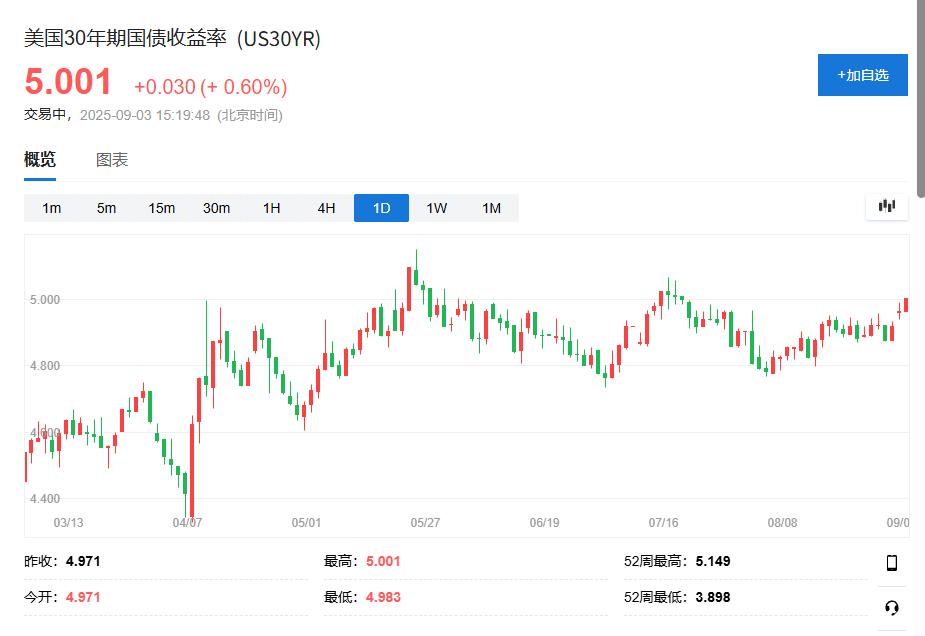
Group 1 - A global government bond sell-off is occurring, pushing the 30-year U.S. Treasury yield towards the psychological 5% mark [1][9] - The sell-off has affected bond markets across the Atlantic, with yields rising in the U.S., U.K., Italy, and France, reaching new highs since the financial crisis [1][3] - The U.S. 30-year Treasury yield has risen to 5%, and the 10-year yield has climbed to 4.291%, leading to a 0.7% drop in the S&P 500 index, marking its worst single-day performance since August 1 [1] Group 2 - The U.K. 30-year Treasury yield has reached 5.72%, the highest since 1998, while Germany and France's yields have also hit their highest levels since 2011 and 2009, at 3.41% and 4.51% respectively [3] - Japan's 30-year Treasury yield has surged to 3.28%, the highest on record, with the 20-year yield also reaching 2.69%, a new high since 1999 [6] Group 3 - The sell-off is driven by a massive supply of corporate bonds, concerns over government fiscal conditions, and seasonal liquidity tightening [9][10] - September is traditionally unfavorable for long bond holders, with Wall Street predicting a corporate bond issuance of $150 billion to $180 billion this month, potentially exceeding last year's $172.5 billion [9][10] Group 4 - The global sell-off reflects deep concerns about the fiscal health of developed economies, exacerbated by pandemic-related spending [11] - There is a shift in market sentiment, with investors needing reassurance from governments to regain confidence in their bonds [11] Group 5 - Technical liquidity factors and historical trends also contribute to the current market turmoil, with September historically being a poor month for long-duration bonds [12][13] - Predictions indicate a significant liquidity drain in the U.S. market, potentially withdrawing nearly $200 billion from the banking system on September 15 due to various fiscal factors [13] Group 6 - Market focus is shifting to the upcoming U.S. employment report, which will influence the Federal Reserve's interest rate decisions [14] - Strong employment data could heighten concerns over prolonged high rates, while weak data may reinforce expectations for rate cuts, impacting the bond market's recovery [14]
风暴再起!全球国债抛售潮,发生了什么?
华尔街见闻· 2025-09-03 09:59
Core Viewpoint - A global bond sell-off is occurring, pushing the 30-year U.S. Treasury yield towards the psychological threshold of 5% [2][9]. Group 1: Market Dynamics - The sell-off has affected government bond markets across the U.S., U.K., Italy, and France, with yields rising significantly, including the U.K. and France reaching their highest levels since the financial crisis [1][13]. - The U.S. 30-year Treasury yield rose to 5%, marking the first time since July, while the 10-year yield climbed to 4.291% [1]. - The S&P 500 index fell by 0.7%, its worst single-day performance since August 1, due to the negative sentiment in the bond market [1]. Group 2: Supply and Demand Factors - A surge in corporate bond issuance is contributing to the sell-off, with predictions of $150 billion to $180 billion in investment-grade corporate bonds being issued in September, which is expected to exceed last year's figures [7][10]. - The influx of corporate bonds is providing investors with higher-yield alternatives, diverting funds away from government bonds [7][10]. - September is traditionally a challenging month for long-term bondholders, exacerbated by the return of traders from summer vacations and the influx of new corporate bond supply [7][10]. Group 3: Economic Indicators and Federal Reserve Focus - The market is closely watching the upcoming U.S. employment report, which will influence the Federal Reserve's interest rate decisions [7][20]. - Current expectations suggest a 92% chance of a rate cut by the Federal Reserve this month, with the employment report being a critical variable for market direction [20]. - Strong employment data could heighten concerns over prolonged high rates, while weak data may reinforce rate cut expectations, providing relief to the struggling bond market [20].