幻方量化

Search documents
量化私募业绩“吊打”主观私募?1000指增、选股策略集体爆发,有产品年内狂赚46%
Mei Ri Jing Ji Xin Wen· 2025-07-24 08:21
Core Viewpoint - The A-share market is experiencing a volatile upward trend, with small-cap growth style indices performing strongly, highlighting a structural market characteristic [1][2] Group 1: Performance of Quantitative and Subjective Strategies - Quantitative private equity funds have shown remarkable performance, with many strategies yielding over 30% returns year-to-date as of July 11 [1][2] - In contrast, subjective private equity funds, particularly those with over 100 billion in assets, have lagged behind due to strategy limitations, with an average return of 11.38% for their long-only equity products [3] Group 2: Quantitative Strategy Performance - The 1000 index growth strategy has outperformed, with top performers like Lingjun's 1000 index growth strategy achieving a return of 36.79% and an excess return of 17.4% [3] - The 500 index growth strategies also performed well, with top returns of 33.13% from Xinhong Tianhe and 30.63% from Abama [2][3] - The 300 index growth strategies have underperformed, with the highest return being 19.13% from Lingjun [2] Group 3: Quantitative Stock Selection Strategies - Quantitative stock selection strategies have emerged as the biggest winners, with the highest return reaching 46.26% from Xiaoyong's strategy [4] - Many quantitative private equity firms are promoting "full market stock selection" products, aiming to maximize absolute returns without additional risk [4][5] Group 4: Market Research and Trends - A total of 135 quantitative private equity firms have participated in A-share company research activities this year, covering 395 stocks across 29 industries [6] - The electronics, pharmaceuticals, and machinery sectors have been the most frequently researched, indicating a focus on these industries by quantitative firms [6]
北上广深杭私募半年榜出炉!上海数量领衔,广州收益第1!幻方、阿巴马、信弘天禾进入十强
私募排排网· 2025-07-16 03:37
Core Viewpoint - The article highlights the performance of private equity firms in major Chinese cities, emphasizing the concentration of firms in Beijing, Shanghai, Guangzhou, Shenzhen, Hangzhou, and the significant differences in average returns among these regions [2][3]. Summary by Sections Private Equity Landscape - As of June 30, 2023, there are 415 private equity firms in the top five cities, accounting for 75.05% of the total number of private equity firms in China [2]. - Shanghai has the highest number of private equity firms at 173, representing over 45% of the leading firms [2]. Performance Metrics - Guangzhou leads with the highest average return of 16.15%, followed by Hangzhou at 12.67% [3]. - The average returns for other cities are as follows: Shenzhen at 12.22%, Beijing at 10.08%, and Shanghai at 9.57% [4]. Top Performing Firms - In Shanghai, the top firms include Tongben Investment, Weifang Fund, and Chenyao Private Equity, with a performance threshold for the top 20 set at ***% [5][6]. - In Beijing, the leading firms are Luyuan Private Equity, Beiheng Fund, and Yunlian Zhirong, with a similar performance threshold [11][13]. - Shenzhen's top firm is Fuyuan Capital, followed by Rongshu Investment and Liangchuang Investment, with all firms being small to mid-sized [16][18]. - In Guangzhou, the top firms include Qinxing Fund and Zeyuan Investment, with only one firm exceeding 100 billion in assets [20][21]. - Hangzhou's top firms are Yunqi Quantitative, Jianji Investment, and Fuying Investment, with a focus on quantitative strategies [25][26]. Investment Strategies - The article notes a variety of investment strategies among the top firms, including subjective, quantitative, and mixed approaches, with subjective strategies being the most common [4][11][16]. - Notable firms like Tongben Investment have shifted their focus to new consumption trends, predicting a "golden three years" for investment in this sector [10]. Conclusion - The article provides a comprehensive overview of the private equity landscape in China, highlighting the performance and strategies of leading firms across major cities, indicating a competitive and evolving market environment [2][3][4].

美国科技圈再迎中国AI冲击波,科学家:该醒来了
Nan Fang Du Shi Bao· 2025-07-15 15:15
Core Insights - The Kimi K2 model, developed by the Chinese AI startup "月之暗面," has made a significant impact in the global tech community, showcasing China's ability to innovate under resource constraints [1][2][3] - The model has been praised for its programming capabilities and cost-effective API pricing, leading to widespread adoption by various tech companies and tools [1][4] - Kimi K2's release has prompted discussions about the competitive landscape of AI models, particularly highlighting the gap between Chinese and Western advancements in open-source models [2][8] Model Performance - Kimi K2 features a total parameter count of 1 trillion, with 32 billion active parameters, surpassing many existing open-source models and approaching the performance of leading closed-source models from OpenAI and Google [3][4] - The model has achieved a training peak of zero, indicating high efficiency and stability, which has impressed industry experts [6] Industry Reactions - The CEO of Perplexity, an AI search company, has expressed intentions to conduct further training on the Kimi K2 model, marking a notable endorsement from the U.S. tech sector [4] - HuggingFace's co-founder remarked on the impressive capabilities of K2, emphasizing its challenge to existing closed-source models at a fraction of the cost [4] Technological Advancements - Kimi K2 is designed to excel in coding and general agent tasks, representing a shift in the focus of foundational models towards these capabilities [10] - The model can analyze complex datasets and generate professional reports, showcasing its advanced analytical skills [10][11] Future Prospects - While Kimi K2 lays a solid foundation for general agent capabilities, further advancements in reasoning and visual understanding are anticipated in future iterations [11] - The competitive landscape is tightening, with major players like OpenAI, Google, and others vying for dominance, necessitating Kimi to prove its value and navigate commercialization challenges [14]
老中新量化私募谁更赚钱?新锐量化上半年收益更胜一筹!幻方、海南盛丰、量创进入前十
私募排排网· 2025-07-15 06:39
Core Viewpoint - The article discusses the evolution and current landscape of China's quantitative private equity industry, highlighting the performance and characteristics of different generations of quantitative private equity firms as of mid-2025 [2][17]. Group 1: Established Quantitative Private Equity - There are 111 established quantitative private equity firms with management scales over 500 million, with 36 firms (32.43%) managing over 5 billion [2]. - The top-performing established quantitative private equity firms include Stable Investment, Long Flag, and Zhi Xin Rong Ke [2][7]. - The average return for the top 20 established quantitative private equity firms is noted, with specific firms like Jin Wang Investment and Stable Investment leading the performance [4][7]. Group 2: Mid-generation Quantitative Private Equity - There are 108 mid-generation quantitative private equity firms, with 26 classified as top firms managing between 500 million and 5 billion [8]. - The majority of these firms are located in Shanghai, with significant numbers also in Beijing and Shenzhen [8]. - The top-performing mid-generation firms include Liang Chuang Investment and Guangzhou Tian Zhan Han, with their average returns highlighted [8][11]. Group 3: Emerging Quantitative Private Equity - There are 39 emerging quantitative private equity firms, with 5 classified as top firms managing between 500 million and 5 billion [12]. - The average return for the top 10 emerging quantitative private equity firms is higher than that of established and mid-generation firms [12]. - Leading firms in this category include Yun Qi Quantitative and Quan Cheng Fund, with their innovative strategies and performance metrics discussed [14][15].

幻方、龙旗、进化论连登三榜!孝庸等量化黑马崛起!2025年上半年私募排排网量化人气榜出炉!
私募排排网· 2025-07-09 07:04
Core Viewpoint - In the first half of 2025, the private equity industry is experiencing a surge in interest in "quantitative" strategies, driven by advancements in AI technology and strong performance from small-cap stocks. The implementation of new regulations for quantitative trading is expected to lead to significant changes in the industry, including a shift towards fundamental factors, increased use of machine learning and alternative data, and enhanced risk control measures [2]. Group 1: Popular Quantitative Companies - The top 20 popular quantitative companies include 17 from leading private equity firms, with the top five being all billion-dollar firms. Shanghai is home to 12 of these firms, and three firms have over 100 employees [3]. - Ningbo Huansheng Quantitative ranks first in popularity, with its 11 products achieving a notable performance in the first half of the year. The firm has been utilizing machine learning for automated quantitative trading since 2008, accumulating over 10PB of data [7]. - Blackwing Asset ranks fourth in popularity, with 20 products and a significant number of registered products. The firm has integrated AI technology into its operations since 2017, enhancing model prediction accuracy [8]. - Hainan Shengfeng Private Equity, a newer firm established in 2022, has also made a mark with its strict programmatic strategies and impressive performance [9]. Group 2: Popular Quantitative Fund Managers - The top five popular quantitative fund managers include Xu Jin, Wang Yiping, Lin Ziyang, Zhu Xiaokang, and Sun Lin, with over half of the top 20 managers coming from billion-dollar firms [10]. - Wang Yiping from Evolutionary Asset leads with the highest performance among fund managers, emphasizing the importance of eliminating outdated capacities for economic growth [13]. - Li Xiang from Mengxi Investment, with extensive experience in low-latency trading strategies, ranks eighth among fund managers [13][14]. Group 3: Popular Quantitative Products - Among the top 20 quantitative products, 16 are long-only strategies, with Hainan Shengfeng Private Equity and Longqi Technology having multiple products listed [15]. - Longqi Technology's "Longqi Zhongzheng 2000 Index Growth No. 1" achieved high returns in the first half of the year, managed by Zhu Xiaokang, who has a strong background in international quantitative investment [19]. - Shenzhen Zeyuan's "Zeyuan Zhicheng Beta Quantitative No. 1 A-Class" also performed well, showcasing the firm's expertise in multi-asset trading strategies [19].
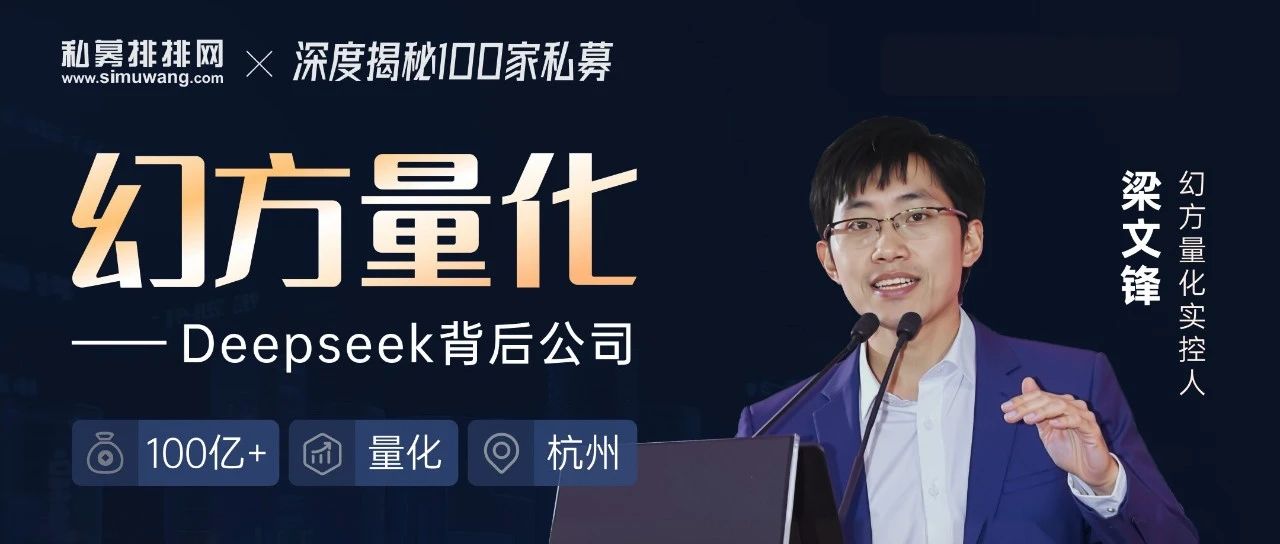
深度揭秘量化巨头幻方量化!DeepSeek创始人梁文锋实控的两家百亿量化私募业绩如何?
私募排排网· 2025-07-08 03:15
Core Viewpoint - The article emphasizes the growing interest of high-net-worth investors in private equity funds, particularly in the context of wealth management, highlighting the need for transparency and insight into the operations and performance of these funds [2]. Company Overview - Founded in 2015, the company has rapidly grown to become one of the leading quantitative investment firms in China, managing approximately 600 billion yuan after previously exceeding 1 trillion yuan [6][11]. - The company has consistently ranked among the top five in terms of returns over the past six months, one year, and three years in the latest private equity rankings [6][11]. Core Investment Philosophy - The company relies on artificial intelligence technology for quantitative investment, believing that technology is the best way to explore the world [12]. - It focuses on long-term vision and continuous investment in both team and hardware/software to create sustained value for clients [12]. Core Research Team - The team comprises experts, including Olympic medalists in mathematics and computer science, as well as leaders in AI and various academic fields [30]. - The team has a strong background in machine learning and quantitative strategies, contributing to the firm's innovative approaches [30][39]. Investment Strategies and Product Lines - The company employs a flexible asset allocation strategy based on market conditions, utilizing fundamental and technical analysis to optimize investment portfolios [36]. - It offers a range of index-enhanced products aimed at achieving returns that exceed market indices while managing risk effectively [32][34]. Core Advantages - The company has developed a proprietary deep learning training platform, "Firefly II," which enhances its AI capabilities for quantitative trading [40]. - It integrates AI with multi-strategy and multi-cycle investment approaches to maximize returns [42]. Other Information - The company has received numerous awards, including multiple "Golden Bull Awards" for its performance in the private equity sector [44]. - It is committed to social responsibility, having donated over 221.38 million yuan to charitable causes, including significant contributions from its employees [45].
量化交易新规落地,高频交易戴上“紧箍咒”
2 1 Shi Ji Jing Ji Bao Dao· 2025-07-07 14:31
Core Viewpoint - The new regulations on algorithmic trading, effective from July 7, 2023, aim to impose precise supervision on high-frequency trading and strict constraints on abnormal trading, reshaping the market ecology and promoting the standardized development of the quantitative industry [1][4][19]. Summary by Relevant Sections High-Frequency Trading Regulation - The new regulations define high-frequency trading as any account making 300 or more orders per second or exceeding 20,000 orders per day, which will be subject to differentiated fees and additional reporting requirements [3][5][14]. - The regulations aim to suppress short-term speculation by limiting behaviors such as frequent order cancellations and manipulative trading, thereby reducing false liquidity and irrational market fluctuations [5][6]. Cost Implications - High-frequency trading strategies may see a decline in profitability by 30% to 50%, with smaller private equity firms facing elimination due to increased compliance costs [6][11]. - The introduction of a 1 yuan order fee and a 5 yuan cancellation fee will raise the breakeven point for high-frequency strategies by 30% to 50% [6][19]. Market Structure Changes - The regulations are expected to consolidate the advantages of leading quantitative firms that primarily use medium to low-frequency strategies, while smaller firms relying on high-frequency strategies may need to transition or exit the market [6][11]. - The overall market concentration is likely to increase, as smaller firms with insufficient technical reserves face pressure to adapt or exit [6][19]. Market Ecology Optimization - The regulations are anticipated to improve liquidity quality by reducing deceptive trading practices, allowing genuine supply and demand to be more accurately reflected in prices [6][11]. - The fairness of the market is expected to enhance as the technical advantages of high-frequency trading diminish, thereby protecting the interests of smaller investors [6][11]. Impact on Trading Volume - On the first day of the new regulations, the trading volume in the two markets decreased by over 200 billion yuan, indicating a potential impact on quantitative trading activities [8][9]. - Despite the drop, some market participants believe that the trading volume remained high, suggesting that the market's response to the new regulations may be within normal parameters [10][11]. Long-Term Industry Outlook - The new regulations are seen as a step towards a more transparent and fair market, promoting the sustainable development of the quantitative industry [16][19]. - The focus of competition in the quantitative sector is shifting from speed to the effectiveness of strategies, with an increasing emphasis on fundamental factors [19].
上半年私募都在忙啥?百亿量化疯狂卷AI,靖奇投资“内斗大戏”令人炸舌
Mei Ri Jing Ji Xin Wen· 2025-07-07 01:34
Core Insights - The application of AI in quantitative private equity has become a significant focus, with firms like DeepSeek leading the charge in this area [1][2] - Major quantitative private equity firms are heavily investing in AI research and development, indicating a competitive landscape [2][3] Group 1: AI Investment Trends - In the first half of 2025, the integration of AI in quantitative private equity is highlighted as a key direction, with firms like Ming Shi Fund increasing investments in supercomputing and AI strategy development [1] - DeepSeek, established by Huanfang Quantitative, has gained attention, with its founder Liang Wenfeng being a prominent figure in the industry [2] - Leading firms such as Kuande and Jiukun have publicly announced their commitment to enhancing AI research and development [3] Group 2: Performance Metrics - Huanfang Quantitative's product, Jiuzhang Huanfang CSI 500 Quantitative Multi-Strategy No. 1, reported a year-to-date return of 18.08% and a cumulative return of 394.05% since inception [2] - The average return for quantitative private equity firms this year is reported at 6.85%, with some individual products performing above this average [4] Group 3: Internal Conflicts - Jingqi Investment faced internal turmoil with the resignation of its controlling person, Fan Siqi, who cited management and coordination challenges as reasons for his departure [4] - Following his resignation, Fan Siqi accused the company of orchestrating a planned removal, claiming he lost access to critical operational tools and communication channels [5] - Despite the turmoil, Jingqi Investment clarified that the funds managed by Fan Siqi represent a small portion of the company's total assets under management, indicating limited impact on overall operations [4][5]
论坛| 未可知 x 杭州欧美同学会: AI投资下半场的技术,赛道与商业化
未可知人工智能研究院· 2025-07-03 13:00
Core Viewpoint - The global AI industry is experiencing rapid growth, particularly in generative AI, which is projected to reach a market size of $40 billion by 2024, despite challenges faced by the Chinese AI sector [3][6]. Global AI Industry: Opportunities and Challenges - Generative AI is growing at an annual rate of 83%, becoming a new engine for economic growth, with a projected market size of $40 billion by 2024 [3]. - China's AI industry faces dual challenges: a shrinking financing scale, expected to account for only 5% of the global total by 2024, and restrictions on high-end computing power due to U.S. chip export controls [3]. - Despite these challenges, China holds a 20% share of the global market for large language models, showcasing strong competitive differentiation [3]. DeepSeek: Innovation Breakthrough in Chinese AI - DeepSeek, an AI company backed by Huansheng Quantitative, trained a model comparable to GPT-4 for only $6 million, which is 1/6th of the cost of GPT-4 [6]. - The company achieved over 100 million users within 7 days after integrating into the WeChat ecosystem, with daily active users exceeding 20 million [6]. - This "technology + ecosystem" integration model is expected to reshape user demand expression and transform the search advertising business model [6]. Four High-Potential AI Investment Tracks by 2025 - General Intelligence Agents: Autonomous task execution systems like Manus represent a leap from "dialogue" to "action," with significant potential in office automation and creative production [9]. - Embodied Intelligence and Humanoid Robots: The global humanoid robot market is expected to reach a million units by 2035, focusing on spatial intelligence technology and core component innovation [9]. - Small AI Hardware: Including home entertainment (e.g., FOLO smart toys), wearable devices (e.g., Thunderbird AI glasses), and in-vehicle systems, with a market size exceeding $180 billion by 2024 [9]. - AI for Science: AI is expected to enhance research efficiency by over 70% in fields like materials development and drug discovery, triggering a new scientific revolution [9]. Investment Strategy: Focus on Technology Monetization and Ecosystem Building - Investors are advised to focus on three types of companies: those with core technological barriers in computing chips, data-closed-loop enterprises in vertical scenarios, and platform partners with ecosystem integration capabilities [12]. - The competition in the second half of AI has shifted from pure technological competition to the construction of commercial ecosystems, with companies that can connect "technology - scenario - business model" gaining long-term advantages [12].

神秘高净值客户十五年间投资私募胜率100%!
私募排排网· 2025-07-02 03:00
Core Viewpoint - The article highlights the exceptional investment performance of a private investor, referred to as "Mr. Wang," who has achieved consistent positive returns over a decade, with some funds yielding up to 284.97% [2][4]. Group 1: Investment Performance - Mr. Wang's private fund portfolio has consistently generated positive returns, with the highest single product achieving a floating profit of 284.97% and multiple products yielding between 20% to 50% [2][4]. - The article emphasizes the rarity of such performance in the private fund sector, where over 80,000 products exist, surpassing the total number of A-share listed companies [2]. Group 2: Investment Philosophy - Mr. Wang's investment strategy is based on a methodology of "three parts selection, seven parts management," indicating a strong focus on both choosing the right funds and ongoing management [8]. - He believes in the importance of understanding a fund manager's "circle of competence," which helps in assessing when a manager can generate profits and when they may incur losses [9]. Group 3: Avoiding Pitfalls - The article discusses the "star fund manager paradox," where increased popularity can lead to rapid fund growth, potentially disrupting investment strategies and performance [12]. - Mr. Wang advises against following popular fund managers blindly, as this can lead to poor investment outcomes due to the risks associated with rapid scale expansion [11][17]. Group 4: Communication and Research - Frequent professional communication is highlighted as a key to Mr. Wang's success, allowing him to gain insights and clarity during uncertain times [8]. - The use of rankings and lists from platforms like "Private Equity排排网" aids in identifying potential fund managers and avoiding the pitfalls of chasing after "star" funds [11]. Group 5: Long-term Investment Approach - Mr. Wang emphasizes a long-term investment perspective, suggesting that investors should be patient and allow fund managers the necessary time to navigate market cycles [14]. - He closely monitors fund performance, market conditions, and the fund manager's adherence to their investment style, making adjustments as necessary [14][15].