
沪农商行

Search documents
19家上市银行加码财富管理赛道,2026年战略布局将提速
Di Yi Cai Jing· 2026-01-05 12:50
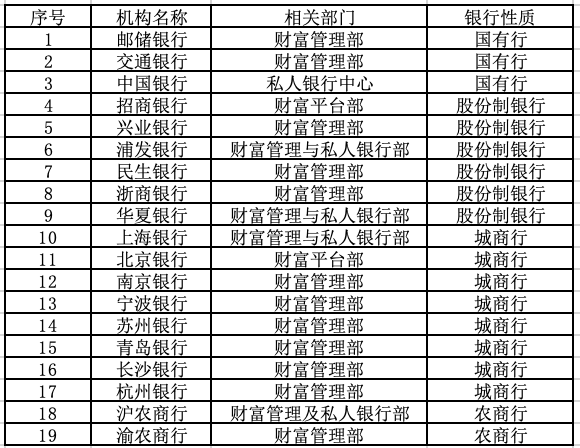
Core Insights - The rapid expansion of high-net-worth client groups is prompting domestic listed banks to accelerate the establishment of dedicated wealth management departments, shifting their retail banking strategy from "product sales" to "full lifecycle asset allocation" [1][2] - By the end of 2025, 19 listed banks are expected to have established or adjusted their wealth management-related departments, including 3 state-owned banks, 6 joint-stock banks, 8 city commercial banks, and 2 rural commercial banks [2][3] Group 1: Wealth Management Department Establishment - State-owned banks like Postal Savings Bank, Bank of China, and Bank of Communications are completing wealth management business integration at the head office level by 2025 [1][4] - Joint-stock banks and city commercial banks are adopting a model that integrates wealth management with private banking, with several banks like Shanghai Bank and Hangzhou Bank establishing new wealth management departments [5][6] Group 2: Strategic Shifts and Market Positioning - The establishment of wealth management departments reflects a strategic shift towards enhancing professional capabilities and resource integration, aiming to upgrade wealth management as a core strategy for banks [7][8] - Compared to state-owned banks, joint-stock banks and city commercial banks focus on precise market positioning, with banks like China Merchants Bank prioritizing wealth management as a core capability [7][8] Group 3: Growth and Performance Metrics - As of Q3 2025, the wealth management AUM of listed banks continues to expand, with Postal Savings Bank reaching 17.89 trillion yuan and significant growth rates reported by other banks [9] - The future of wealth management business is expected to accelerate due to the continuous accumulation of resident wealth and the diversification of high-net-worth client needs, with strategic investments and organizational adjustments being crucial for competitive positioning [9]

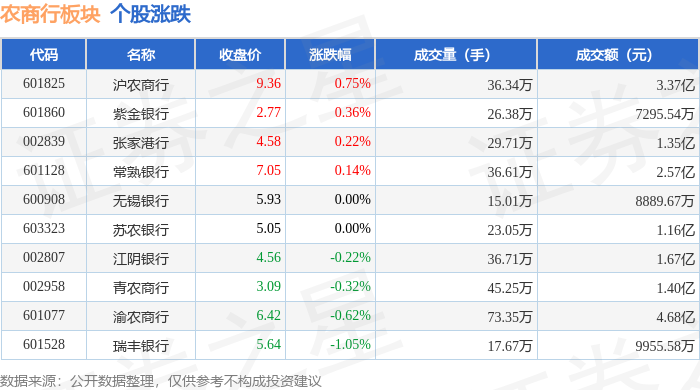
农商行板块1月5日涨0.09%,沪农商行领涨,主力资金净流入7699.1万元
Zheng Xing Xing Ye Ri Bao· 2026-01-05 09:09
Core Insights - The agricultural commercial bank sector experienced a slight increase of 0.09% on January 5, with Shanghai Agricultural Commercial Bank leading the gains [1] - The Shanghai Composite Index closed at 4023.42, up by 1.38%, while the Shenzhen Component Index closed at 13828.63, up by 2.24% [1] Stock Performance - Shanghai Agricultural Commercial Bank (601825) closed at 9.36, with a rise of 0.75% and a trading volume of 363,400 shares, totaling a transaction value of 337 million yuan [1] - Other notable banks include: - Zijin Bank (601860) at 2.77, up 0.36% with a transaction value of 72.96 million yuan [1] - Zhangjiagang Bank (002839) at 4.58, up 0.22% with a transaction value of 135 million yuan [1] - Changshu Bank (601128) at 7.05, up 0.14% with a transaction value of 257 million yuan [1] - Wuxi Bank (600908) remained unchanged at 5.93 with a transaction value of 88.9 million yuan [1] Capital Flow - The agricultural commercial bank sector saw a net inflow of 76.99 million yuan from institutional investors and 84.57 million yuan from retail investors, while individual investors had a net outflow of 162 million yuan [1] - Specific capital flows for key banks include: - Shanghai Agricultural Commercial Bank had a net inflow of 47.24 million yuan from institutional investors, but a net outflow of 54.86 million yuan from individual investors [2] - Changshu Bank saw a net inflow of 32.72 million yuan from institutional investors, with a net outflow of 33.53 million yuan from individual investors [2] - Suzhou Agricultural Bank had a net inflow of 13.51 million yuan from institutional investors, with a net outflow of 12.27 million yuan from individual investors [2]
点“质”成金,沪农商行“质量贷”助力实体经济创新升级
Jin Rong Jie· 2026-01-05 08:43
Core Insights - Shanghai Rural Commercial Bank is promoting a unique financial product called "Quality Loan" to support the high-quality development of Shanghai's economy by converting companies' quality achievements into tangible credit assets [1][3] - The "Quality Loan" initiative aims to create a financing system that enhances companies' quality through financial means, fostering a cycle where quality creates value and value reinforces quality [1][3] Group 1: Product and Implementation - Since its launch in 2023, the "Quality Loan" has been tailored to regional characteristics, resulting in various localized sub-products such as "Jinzhidai" in Jinshan District and "Huangpu Zhihui Loan" in Huangpu District [2] - In Yangpu District, the bank collaborates with local authorities to focus on financing services for technology innovation, benefiting over 50 companies, with around 80% being technology-oriented [2] Group 2: Case Study and Impact - Shanghai NLW Technology Co., a leader in the field of nano-modified plastics, received a specialized loan of 40 million yuan to support its R&D efforts in overcoming key technological challenges [3] - As of the end of 2025, the "Quality Loan" program is expected to have disbursed over 3.5 billion yuan, covering more than 2,000 companies recognized for their quality achievements, reflecting strong support for the real economy and alignment with the "Quality Power" strategy [3]
前瞻预测:2026年,谁将会成为上市银行的十大牛股?
Sou Hu Cai Jing· 2026-01-05 04:16
Core Viewpoint - The A-share banking sector concluded 2025 with a structural rise, with 35 out of 42 listed banks experiencing gains, and the banking index rising by 12.04%, indicating strong defensive and allocation value [2][3]. Group 1: 2025 Banking Sector Performance - The banking sector exhibited significant structural differentiation, with the top ten stocks including Agricultural Bank (52.66%), Xiamen Bank (35.78%), and others showing gains over 20% [3][4]. - The market's focus shifted towards "certainty of returns" and "growth cost-effectiveness" amid an "asset shortage" backdrop, leading to a preference for certain banks [3][4]. Group 2: Core Drivers of 2025 Bull Stocks - Three main factors drove the performance of bull stocks: high dividends and low valuations supporting state-owned banks, regional economic vitality empowering small and medium banks, and asset structure optimization promoting value reassessment [4][5]. - Agricultural Bank led with a dividend yield above 5% and a price-to-book ratio exceeding 1, breaking the long-standing trend of state-owned banks trading below book value [4][5]. Group 3: 2026 Bull Stock Predictions - The banking sector is expected to maintain a "steady progress" operational trend in 2026, with key dimensions for identifying bull stocks including net interest margin improvement, business transformation growth, and stable asset quality [5][6]. - The predicted top ten bull stocks for 2026 include Agricultural Bank, China Merchants Bank, and Ningbo Bank, among others, with each having specific growth drivers [7][8]. Group 4: Key Factors for 2026 Predictions - Agricultural Bank is expected to continue its strong performance due to its county-level business advantages and low liability costs [7]. - China Merchants Bank is anticipated to see dual growth in performance and valuation, driven by its wealth management transformation and strong asset quality [8]. - Ningbo Bank is positioned to benefit from regional economic vitality and diversified non-interest income growth [8][9]. Group 5: Structural Trends and Risks - The banking sector is likely to experience a dual rise in performance and valuation, supported by improved net interest margins and robust asset quality [12][13]. - However, structural differentiation risks may intensify, with some smaller banks facing challenges due to high regional economic dependency and single customer structures [12][13].







成都农商银行晋级万亿元:农商行头部阵营扩容至五家 金融资源“极化”趋势凸显
Mei Ri Jing Ji Xin Wen· 2026-01-04 15:24
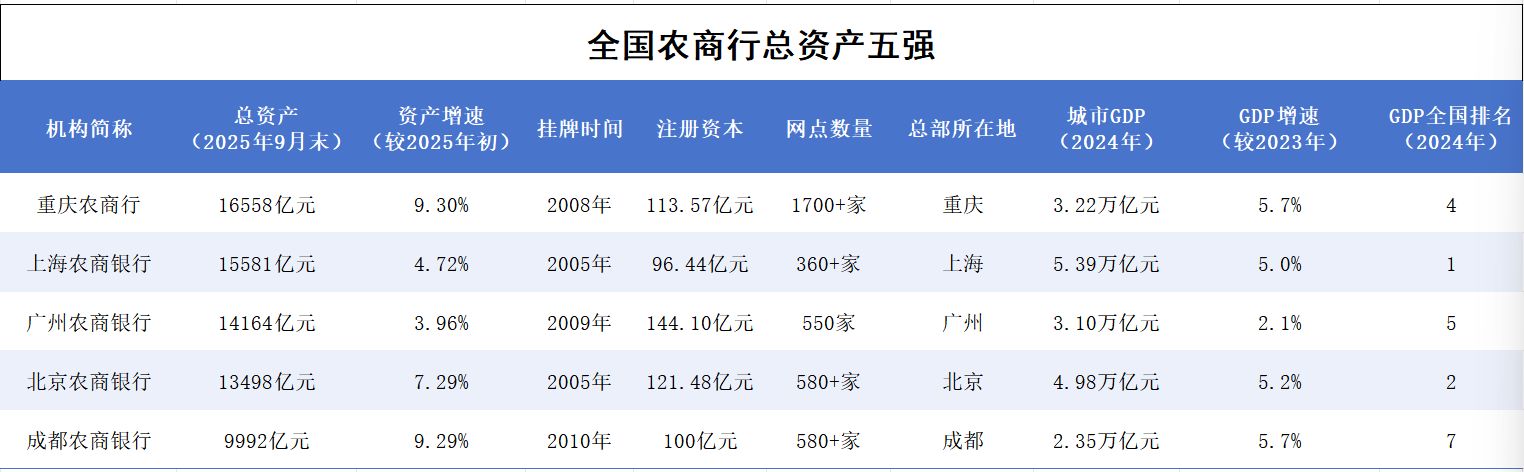
Core Insights - Chengdu Rural Commercial Bank has officially announced that its asset scale has surpassed 1 trillion yuan as of December 31, 2025, joining the "trillion yuan club" alongside four other major rural commercial banks in China [1][3] - The emergence of these banks reflects a trend of financial resource concentration in economically vibrant regions, indicating a shift in China's regional economic development landscape [1][8] Group 1: Overview of the Trillion Yuan Club - The "trillion yuan era" for rural commercial banks began six years ago, with Chongqing Rural Commercial Bank being the first to exceed this threshold in June 2019 [2] - As of September 2025, the total assets of the five major rural commercial banks exceeded 11% of the total assets of all rural financial institutions in China, showcasing significant concentration effects [4] - The five banks—Chongqing, Shanghai, Guangzhou, Beijing, and Chengdu—are primarily located in major cities with strong economic performance, collectively accounting for over 14% of the national GDP [4] Group 2: Individual Bank Performance - As of September 2025, the asset scales of the five banks are as follows: Chongqing Rural Commercial Bank at 1.66 trillion yuan, Shanghai Rural Commercial Bank at 1.56 trillion yuan, Guangzhou Rural Commercial Bank at 1.42 trillion yuan, Beijing Rural Commercial Bank at 1.35 trillion yuan, and Chengdu Rural Commercial Bank at 999.2 billion yuan [6] - Each bank has developed unique strategies based on their regional characteristics, such as Beijing's focus on serving agriculture and small enterprises, and Shanghai's emphasis on wealth management and technology [10][11] Group 3: Strategic Implications - The formation of the "trillion yuan club" among these banks enhances their ability to support local infrastructure projects, providing greater financial autonomy for regional development [15] - The collective strength of these banks facilitates the integration of financial services across administrative boundaries, potentially lowering financing costs for businesses operating in multiple regions [15] - The emergence of this banking cluster is expected to contribute to the establishment of a Western financial center, attracting more financial resources and fostering innovation in financial products tailored to local industries [15]

成都农商银行资产规模突破1万亿元
Jin Rong Jie· 2026-01-04 14:13
公开信息显示,成都农商银行是在原成都市农村信用社基础上改制成立的股份制商业银行,于2010年1 月15日挂牌开业。2011年完成增资扩股,注册资本达到100亿元。2020年6月,完成股权结构调整,回归 国有,市区两级国资合计持股比例77.67%,是成都市国资持股比例最大的银行,系市属国资一级企 业。 银行频道更多独家策划、专家专栏,免费查阅>> 2026年1月1日,成都农商银行在其官方平台宣布,该行资产规模正式突破 1 万亿元,成为全国第五家迈 入 "万亿农商行俱乐部" 的农商行,其余四家分别为重庆农商行、北京农商行、广州农商行和上海农商 行。 责任编辑:小讯 ...
银行资产质量持续巩固
Xiangcai Securities· 2026-01-04 11:25
Investment Rating - The industry rating is maintained at "Overweight" [9][39]. Core Insights - The financial stability report indicates that the asset quality of banks continues to consolidate, with significant progress in resolving debt risks associated with financing platforms and managing risks in small and medium-sized financial institutions [8][36]. - As of the end of 2024, approximately 40% of financing platforms have exited the platform sequence through market-oriented transformations, with the scale of operational financial debt for these platforms around 14.8 trillion yuan, a decrease of about 25% from early 2023 [9][36]. - The average interest rate for newly issued bonds by financing platforms dropped to 2.67% in Q4 2024, a reduction of over 2 percentage points compared to Q1 2023, indicating a significant decrease in financing risk premiums [9][36]. - The overall risk status of national banks is stable, with 71% of the asset scale concentrated in 21 national banks, and the majority of ratings falling within levels 1-5 [9][36]. - The report highlights that there are no "red zone" banks in nine provinces, and the number of "red zone" banks in 13 provinces remains in single digits, indicating a significant reduction in existing risks across most regions [10][36]. Summary by Sections Market Performance - Over the past 12 months, the industry has shown a relative return of -10.7% and an absolute return of 7.0% [6]. Investment Recommendations - The banking sector's profitability is stabilizing at the bottom, with ongoing risk management in key areas such as urban investment and real estate, creating conditions for valuation recovery [12][39]. - In a low-interest-rate environment, the high dividend advantage of bank stocks is expected to continue, highlighting their investment value [12][39]. - Recommended banks include Industrial and Commercial Bank of China, Bank of China, CITIC Bank, Jiangsu Bank, Shanghai Rural Commercial Bank, Chongqing Rural Commercial Bank, and Suzhou Bank [12][39].
首个“非直辖”万亿农商行
Xin Lang Cai Jing· 2026-01-04 11:24
来源:看懂经济 2026年初,成都农商行宣布,其资产规模已突破万亿元大关。 它成为全国第五家、中西部非直辖市城市中第一个破万亿的农商行。 至此,万亿农商行"五强格局"正式落定—— 重庆农商行、北京农商行、上海农商行、广州农商行,以及新晋成员成都农商行。 其中,前面跻身万亿阵营的四家农商行,皆坐落于直辖市或传统一线城市;而成都农商行,是新一线、 非直辖的首个破万亿的农商行。 它的入局,不仅刷新了西部地方法人银行的历史纪录,也标志着西部金融力量的实质性崛起。 五年重塑一条路 成都农商行的万亿之路,始于五年前一次至关重要的"复位"。 2020年6月,该行完成股权结构调整,成都市、区两级国资合计持股近80%,成为实际控制人。 这次"回归国有",终结了此前股权相对分散的阶段,为其后续发展奠定了稳固的治理基础。五年间,成 都农商行的资产规模从5000亿级跨越至万亿级。 图:企业预警通,成都 农商行近五年归母净利润情况 其归母净利润在2020年时为38.29亿元,同比下降19.08%;而后一年,转为正增长,并且在接下来的四 年中,均保持双位数增长。 增长不仅是"量"的扩张,更是"质"的优化。 截至2025年6月末,不良贷款 ...

2025银行股业绩梳理
2 1 Shi Ji Jing Ji Bao Dao· 2025-12-31 23:42
Core Viewpoint - The A-share banking sector experienced a year of volatility in 2025, with an overall increase of 7%, which is significantly lower than the 34.39% gain in 2024, yet many individual bank stocks reached historical highs [1][3]. Group 1: Market Performance - By the end of 2025, 35 out of 42 bank stocks in the sector recorded gains, with 20 banks hitting historical highs and 21 banks increasing by over 10%, while 6 banks saw gains exceeding 20% [1][6]. - Agricultural Bank of China saw a remarkable stock price increase of over 52% during the year, briefly surpassing Industrial and Commercial Bank of China (ICBC) in market capitalization [1][3]. - ICBC maintained its position as the "king of stocks" with a market capitalization of 2.63 trillion yuan and a stock price increase of 21.54% [1][3]. Group 2: IPO Market - The A-share IPO market for banks remained stagnant in 2025, with no new listings, as several banks, including Guangzhou Bank, withdrew their applications [2][11]. - The only banks still in the IPO queue are Dongguan Bank, Huzhou Bank, Hubei Bank, Jiangsu Kunshan Rural Commercial Bank, and Guangdong Nanhai Rural Commercial Bank [11]. Group 3: Investment Trends - Long-term funds, particularly insurance capital, have been actively purchasing bank stocks, with insurance companies holding 382.5 million shares valued at 37.976 billion yuan by the end of Q3 2025 [8]. - The "stock accumulation for dividends" strategy has gained popularity among investors, with 28 out of 42 listed banks offering dividend yields above 4% [7][8]. Group 4: Capital Support - In 2025, state-owned banks received significant capital injections, with a total of approximately 520 billion yuan raised through targeted placements to enhance their capital structure [10]. - Meanwhile, smaller banks attracted investments from foreign and local state-owned enterprises, although the IPO process remains challenging for most [10][11].
“每天要加十几个,完不成扣钱或加班”!银行员工为企业微信考核伤脑筋,有人去电商买量,还有同行发帖求“互加”
Mei Ri Jing Ji Xin Wen· 2025-12-31 13:40
Core Viewpoint - Banks are increasingly implementing performance assessments based on the addition of clients on enterprise WeChat, reflecting the pressure on retail banking amid declining revenues and profits in the sector [1][17]. Group 1: Performance Assessment and Pressure - Many banks have set specific targets for adding clients on enterprise WeChat, with some requiring customer managers to add up to 100 clients per month, leading to significant pressure on employees [4][6]. - Employees are sharing their enterprise WeChat QR codes on social media to meet these targets, often incentivized by monetary rewards or penalties for failing to meet the requirements [2][5]. - The assessment mechanisms include strict monitoring and penalties, such as deductions from salaries for not meeting the required number of added clients [6][9]. Group 2: Rationale Behind Enterprise WeChat Adoption - The push for enterprise WeChat is partly to prevent "client privatization," ensuring that client relationships remain with the bank rather than individual employees [9][10]. - Banks view enterprise WeChat as a tool for unified client management, allowing for better data collection and analysis of customer behavior and preferences [9][10]. - The financial industry is facing rising customer acquisition costs, making effective client engagement through platforms like enterprise WeChat increasingly important [10][17]. Group 3: Challenges and Misconceptions - There are significant challenges in the implementation of enterprise WeChat, including the perception that the current assessment system is flawed and does not effectively utilize the platform's potential [13][16]. - Many employees express concerns about the quality of interactions with clients, often resorting to generic content that fails to engage customers meaningfully [15][16]. - The focus on quantitative metrics, such as the number of added clients, often overshadows the need for qualitative interactions that drive actual business results [16][17]. Group 4: Retail Banking Performance - Retail banking is experiencing a downturn, with many banks reporting declines in retail revenue and profits compared to the previous year [17][18]. - Specific banks, such as Ping An Bank and Zhejiang Commercial Bank, have seen significant drops in retail revenue, with some experiencing double-digit declines [18]. - Despite some banks reporting growth in retail profits, this is often due to low comparative bases from the previous year, indicating underlying challenges in the retail banking sector [19][20]. Group 5: Success Stories and Future Outlook - Some banks have successfully leveraged enterprise WeChat to enhance customer engagement, with notable increases in client activity and retention rates [20][21]. - For instance, the Industrial and Commercial Bank of China reported significant growth in the number of clients added through enterprise WeChat, leading to improved customer engagement metrics [20][22]. - The ongoing digital transformation in banking emphasizes the need for effective use of platforms like enterprise WeChat to drive profitability and customer satisfaction [10][17].
