
微创医疗

Search documents
强生近百亿美元资产拆分背后 骨科行业迎来新巨头
Sou Hu Cai Jing· 2025-10-20 17:22
Core Insights - Major global medical giants are announcing business spin-offs to focus on core operations and enhance competitiveness, leading to a reshaping of the orthopedic industry and the potential emergence of a new "giant" [1][2] - Johnson & Johnson plans to spin off its orthopedic business into an independent company named DePuy Synthes within 18 to 24 months, aiming to improve profitability by shedding lower-margin markets [2][6] Industry Trends - The global orthopedic robotics market is projected to exceed $3.5 billion by 2030, with a compound annual growth rate (CAGR) of over 10% [1][10] - The orthopedic sector is experiencing a significant transformation, with major players like Medtronic and Stryker also engaging in business separations to concentrate on high-growth areas [3][5] Company Developments - Johnson & Johnson's orthopedic business generates nearly $10 billion in annual revenue, accounting for about 10% of the company's total revenue [2] - The new DePuy Synthes is expected to become the largest company focused solely on orthopedics, leading in key product categories such as hip, knee, and shoulder implants [2][6] Competitive Landscape - Stryker, Johnson & Johnson, and Medtronic dominate the orthopedic market, with Stryker holding over 50% market share in trauma care [7] - Johnson & Johnson's orthopedic revenue is approximately $10 billion, while Stryker's exceeds $20 billion, indicating a competitive gap [7] Market Performance - Both Medtronic and Johnson & Johnson have seen significant stock price increases this year, with Medtronic up nearly 20% and Johnson & Johnson's stock rising by about one-third [6] - The market is responding positively to these strategic business adjustments, as evidenced by Johnson & Johnson's stock reaching an all-time high following the announcement of the spin-off [6] Future Outlook - The orthopedic robotics segment is identified as a key battleground for major companies, with Johnson & Johnson's VELYS platform already in the market [8][10] - The rise of domestic Chinese companies in the orthopedic robotics space is notable, with local firms capturing over 70% of the market share in robot-assisted surgeries [11][12]

强生拆分业务 骨科行业迎来新巨头
Bei Jing Shang Bao· 2025-10-19 15:40
Core Viewpoint - Johnson & Johnson announced plans to spin off its orthopedic business into a new independent company named DePuy Synthes within the next 18 to 24 months, aiming to enhance competitiveness and focus on core operations in response to market changes [1][2] Group 1: Company Strategy - The spin-off is part of a broader trend among major medical companies to restructure and focus on high-growth, high-margin areas such as oncology, immunology, neuroscience, surgical care, vision care, and cardiovascular sectors [2] - Johnson & Johnson has been exploring the restructuring of its orthopedic business for two years, with the reorganization expected to be completed by the end of 2025 [1][2] Group 2: Market Position and Financials - The orthopedic business generates nearly $10 billion in annual revenue, accounting for about 10% of Johnson & Johnson's total revenue [1] - Medtronic and Johnson & Johnson Medical Technology both reported annual revenues exceeding $30 billion, while Chinese companies Mindray and MicroPort had revenues of $5 billion and $1 billion, respectively [3] - Johnson & Johnson's orthopedic segment is currently the largest in the market, with a significant share in trauma care, but it lags behind competitors like Stryker in joint replacement surgeries [4] Group 3: Competitive Landscape - The orthopedic market is dominated by four major companies: Stryker, Johnson & Johnson, Zimmer Biomet, and Smith & Nephew, with Stryker leading in knee and hip replacement markets [4] - Analysts estimate that Johnson & Johnson holds approximately 17% of the global knee surgery market and about 25% of the hip surgery market, while Stryker's annual revenue exceeds $20 billion [4][3] - The establishment of DePuy Synthes is expected to create a formidable competitor in the orthopedic sector, potentially becoming the largest and most comprehensive orthopedic company globally [3][5]
医药生物:十五五规划和ESMO即将召开,创新主线或迎催化
Huafu Securities· 2025-10-19 10:35
Investment Rating - The industry rating is "Outperform the Market" [8][85] Core Views - The report highlights that the innovative drug sector is expected to benefit from upcoming events such as the ESMO conference and the 14th Five-Year Plan, indicating a potential catalyst for investment [3][5] - The report suggests that the innovative drug sector has undergone sufficient adjustment since August, and October is seen as an important time for positioning [5][6] - The report emphasizes a focus on three main themes: innovation, recovery, and policy support in the medium to long term [6][17] Market Review and Short-term Investment Thoughts - The report notes that the CITIC Pharmaceutical Index fell by 2.6% during the week of October 13-17, 2025, underperforming the CSI 300 Index by 0.4 percentage points [4][40] - The report identifies that the innovative drug sector and CXO are expected to perform well due to favorable interest rate trends and the overall industry outlook [4][5] - The report lists top-performing stocks for the week, including Asia-Pacific Pharmaceutical (+36.7%) and Duorui Pharmaceutical (+28.8%) [4][56] Sector Insights and Outlook - **Innovative Drugs**: The report anticipates strong revenue growth for companies with robust pipelines and commercial capabilities, particularly in the BioPharma and Pharma sectors [17][29] - **Medical Devices**: The report indicates that the medical device sector is at a turning point, with expected improvements in fundamentals and valuation [33][34] - **Traditional Chinese Medicine**: The report suggests that the sector may see a turning point in performance due to low base effects and potential recovery in consumption [31][32] - **Vaccines**: The report highlights the need for new product launches to stimulate demand in the vaccine sector [22][23] - **CXO and Upstream**: The report notes that the CXO sector is experiencing strong external demand, with expectations for continued growth [26][29] Recommended Stocks - The report recommends focusing on stocks such as Kangfang Biotech, Baiao Pharmaceutical, and MicroPort Medical for the upcoming month [6][14]
强生近百亿美元资产拆分背后,骨科行业迎来新巨头
Di Yi Cai Jing Zi Xun· 2025-10-18 15:45
Core Viewpoint - Johnson & Johnson announced plans to spin off its orthopedic business into a separate company named DePuy Synthes within the next 18 to 24 months, aiming to enhance competitiveness and focus on core areas [2][3]. Group 1: Company Strategy - The orthopedic business generates nearly $10 billion in annual revenue, accounting for about 10% of Johnson & Johnson's total revenue [3]. - The spin-off is part of a broader trend among major medical companies to restructure and focus on high-growth, high-margin areas such as oncology, immunology, and cardiovascular sectors [3][5]. - Other companies like Medtronic and Thermo Fisher have also announced business separations to concentrate on more promising sectors [4]. Group 2: Market Dynamics - The orthopedic industry is undergoing significant changes, with the potential emergence of a new "giant" in the market, intensifying competition with key players like Stryker and Zimmer Biomet [2][6]. - The market is currently dominated by four major companies: Stryker, Johnson & Johnson, Zimmer Biomet, and Smith & Nephew, with Johnson & Johnson holding over 50% market share in trauma care [7]. Group 3: Financial Performance - Johnson & Johnson's stock price reached a historical high following the announcement of the spin-off, reflecting positive market sentiment towards the restructuring [6]. - Medtronic's stock has increased by nearly 20% this year, while Johnson & Johnson's stock has risen by about one-third [6]. Group 4: Future Innovations - The orthopedic sector is expected to focus on robotic technologies, with DePuy Synthes likely to accelerate innovation and product launches in this area [9]. - The global orthopedic robotics market is projected to exceed $1.9 billion in 2024 and grow to over $3.5 billion by 2030, with a compound annual growth rate of over 10% [9]. Group 5: Competitive Landscape in China - Chinese companies are rapidly advancing in the orthopedic robotics market, with domestic manufacturers capturing over 70% of the market share in 2024 [11]. - The domestic orthopedic robot market is expected to grow significantly, with projections indicating a market size of $3.84 billion by 2026, reflecting a growth rate of 44.3% [11][12].


强生近百亿美元资产拆分背后,骨科行业迎来新巨头
第一财经· 2025-10-18 15:33
Core Viewpoint - Johnson & Johnson announced plans to spin off its orthopedic business into a separate company named DePuy Synthes within the next 18 to 24 months, aiming to enhance competitiveness and focus on core business areas in response to market changes [3][5]. Group 1: Business Split and Market Impact - The orthopedic business of Johnson & Johnson generates nearly $10 billion in annual revenue, accounting for about 10% of the company's total revenue [5]. - This is the second major split for Johnson & Johnson in 2023, with the goal of allowing the orthopedic division to focus on higher-margin markets and improve profitability [5][6]. - Other major medical companies, such as Medtronic and Thermo Fisher, have also announced business splits to concentrate on core growth areas [6][7]. Group 2: Competitive Landscape - The orthopedic market is undergoing significant changes, with potential for new "giants" to emerge, intensifying competition with current leaders like Stryker and Zimmer Biomet [3][9]. - Analysts predict that DePuy Synthes could become the largest dedicated orthopedic company globally, with a strong market position in key product categories [5][11]. - The orthopedic market is currently dominated by four major players: Stryker, Johnson & Johnson, Zimmer Biomet, and Smith & Nephew, with Johnson & Johnson holding over 50% market share in trauma care [11][12]. Group 3: Robotics and Innovation - The orthopedic robotics market is seen as the next battleground for industry giants, with DePuy Synthes expected to focus on innovation and accelerate product launches, including robotic technologies [13][14]. - Johnson & Johnson has already developed the VELYS robotic platform, which is currently not available in the Chinese market, but partnerships with local companies are underway [15][17]. - The global orthopedic robotics market is projected to exceed $1.9 billion in 2024 and grow to over $3.5 billion by 2030, with a compound annual growth rate of over 10% [15][16]. Group 4: Chinese Market Dynamics - Chinese companies are rapidly advancing in the orthopedic robotics sector, with domestic manufacturers capturing over 70% of the market share in 2024 [17][18]. - The domestic market is expected to grow significantly, with projections indicating a market size of $3.84 billion by 2026, reflecting a growth rate of 44.3% [18]. - However, the competitive landscape in China is becoming increasingly saturated, with over 50 companies vying for market share, leading to potential market overcapacity [19].

深度|强生近百亿美元资产拆分背后 骨科行业迎来新巨头
Di Yi Cai Jing· 2025-10-18 10:10
Core Viewpoint - Johnson & Johnson announced plans to spin off its orthopedic business into a separate company named DePuy Synthes within the next 18 to 24 months, aiming to enhance competitiveness and focus on core areas [1][2]. Summary by Sections Company Strategy - The orthopedic business generates nearly $10 billion in annual revenue, accounting for about 10% of Johnson & Johnson's total revenue [2]. - The spin-off is part of a broader trend among major medical companies to restructure and focus on high-growth, high-margin areas such as oncology, immunology, and cardiovascular sectors [2][3]. - Johnson & Johnson has been exploring the restructuring of its orthopedic business for two years, with the spin-off expected to be completed by the end of 2025 [2]. Market Dynamics - The orthopedic industry is undergoing significant changes, with major players like Medtronic and Stryker also announcing business splits to enhance focus and investment in core areas [3]. - The market is expected to see the emergence of a new "giant" in the orthopedic sector, intensifying competition with existing leaders like Stryker and J&J [1][6]. Financial Performance - Both Medtronic and Johnson & Johnson have seen positive stock performance this year, with Medtronic's stock up nearly 20% and Johnson & Johnson's stock increasing by about one-third [5]. - The spin-off announcement has led to a historical high in Johnson & Johnson's stock price, indicating market approval of the restructuring strategy [6]. Competitive Landscape - Stryker currently leads in knee and hip replacement markets, while Johnson & Johnson holds a significant share in trauma care, with over 50% in the trauma market [6][7]. - The orthopedic market is dominated by four major companies: Stryker, Johnson & Johnson, J&J's DePuy Synthes, and Zimmer Biomet, with Stryker generating over $20 billion in annual revenue compared to J&J's nearly $10 billion [7]. Future Trends - The orthopedic sector is expected to focus on robotic technologies, with DePuy Synthes likely to accelerate innovation and product launches in this area [8]. - The global orthopedic robotics market is projected to exceed $1.9 billion in 2024, with a compound annual growth rate of over 10% expected through 2030 [8]. Emerging Competitors - Chinese companies are rapidly advancing in the orthopedic robotics field, with domestic sales of surgical robots expected to grow significantly [11][12]. - The competitive landscape in China is becoming increasingly crowded, with over 50 companies participating in the orthopedic robotics market, leading to potential market oversaturation [12].
深度|强生近百亿美元资产拆分背后,骨科行业迎来新巨头
Di Yi Cai Jing Zi Xun· 2025-10-18 10:08
Core Insights - Johnson & Johnson announced plans to spin off its orthopedic business into a new independent company named DePuy Synthes within the next 18 to 24 months, marking its second major split in 2023 [1][3] - The orthopedic segment generates nearly $10 billion in annual revenue, accounting for about 10% of Johnson & Johnson's total revenue [3] - The spin-off is part of a broader trend among major medical companies to focus on core businesses and enhance competitiveness in response to market changes [1][3] Company Developments - Johnson & Johnson aims to improve the profitability of its orthopedic division by separating it from lower-margin markets and product lines, focusing instead on high-growth areas such as oncology, immunology, and cardiovascular health [3][4] - The new DePuy Synthes is expected to become the largest company dedicated to orthopedics globally, leading in key product categories like hip, knee, and shoulder implants [3][6] - The company appointed Namal Nawana as the global president of DePuy Synthes, who has prior experience as CEO of Stryker and has led Johnson & Johnson's spine business [8] Market Trends - The orthopedic industry is undergoing significant restructuring, with major players like Medtronic and Thermo Fisher also announcing business splits to focus on more promising growth areas [4][5] - The orthopedic robotics market is identified as the next competitive battleground, with Johnson & Johnson's VELYS robotic platform already in development [9][10] - The global orthopedic robotics market is projected to exceed $1.9 billion in 2024 and grow to over $3.5 billion by 2030, with a compound annual growth rate of over 10% [10][12] Competitive Landscape - Major competitors in the orthopedic market include Stryker, Johnson & Johnson, Zimmer Biomet, and Smith & Nephew, with Stryker currently leading in revenue [7][11] - Stryker has successfully integrated robotic systems into its offerings, significantly contributing to its sales growth [11] - The Chinese market for orthopedic robotics is rapidly expanding, with domestic companies capturing over 70% of the market share and achieving significant sales growth [12][13]

11月29日开学!瞄准医疗科技商业新机,就在上海交大医健未来!
思宇MedTech· 2025-10-18 01:11
Core Insights - The article emphasizes the importance of integrating clinical, capital, channel, and regulatory aspects to drive high-quality development in the medical technology sector, showcasing China's innovation in this field [1]. Group 1: Medical Ecosystem and Innovation - The establishment of a comprehensive medical ecosystem is highlighted, which includes research institutions, hospitals, and investment funds, aimed at fostering innovation and collaboration [9][27]. - The article introduces the "Value Engine Methodology," which focuses on collaborative efforts between academia and industry to cultivate strategic thinking, innovation capabilities, and leadership skills among entrepreneurs [10][16]. Group 2: Educational Programs and Curriculum - A specialized curriculum is designed to address trends, challenges, and innovations in the medical industry, helping participants understand the development trajectory and strategic positioning of the sector [13][14]. - The program includes modules on strategic diagnosis, growth strategies, and commercial model design, aimed at equipping participants with the necessary skills to navigate the complexities of the medical industry [19][21]. Group 3: Networking and Alumni Development - The establishment of the "Medical and Health Future Alumni Association" is mentioned, which aims to connect alumni and facilitate collaboration within the medical technology ecosystem [25]. - The association organizes various events, including annual conferences and visits to leading medical institutions, to foster knowledge exchange and networking opportunities [32][33].

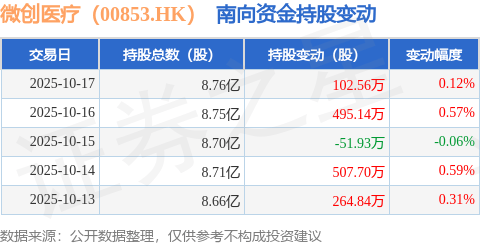
微创医疗(00853.HK):10月17日南向资金增持102.56万股
Sou Hu Cai Jing· 2025-10-17 19:24
Group 1 - The core point of the news is that southbound funds have significantly increased their holdings in MicroPort Scientific Corporation (00853.HK), with a total net increase of 13.18 million shares over the last five trading days and 47.15 million shares over the last twenty trading days [1][2] - As of October 17, 2025, southbound funds hold 876 million shares of MicroPort, accounting for 45.8% of the company's total issued ordinary shares [1][2] - The daily changes in shareholding show fluctuations, with a notable increase of 4.95 million shares on October 16, 2025, and a decrease of 519,300 shares on October 15, 2025 [2] Group 2 - MicroPort Scientific Corporation specializes in the manufacturing and sales of medical devices, with divisions focused on orthopedic, cardiovascular, neuro-interventional, surgical, robotic, cardiac rhythm management, and heart valve products [2]
ESMO会议+三季度业绩期,创新药板块冲击两连阳,恒生医药ETF涨2%,四连“吸金”
Ge Long Hui A P P· 2025-10-16 02:55
Group 1 - The Hong Kong innovative drug sector has rebounded strongly for the second consecutive day, with notable stock increases for companies such as 3SBio (+7.76%), InnoCare Pharma (+6.88%), and CanSino Biologics (+6.72%) [1] - The upcoming European Society for Medical Oncology (ESMO) annual meeting from October 17 to 21 in Berlin is expected to be a catalyst for domestic innovative drug companies, including CanSino Biologics, Kelun-Biotech, and others [1] - The market is also focused on the third-quarter earnings reports, with a significant trend of new product launches and accelerating revenue for traditional pharmaceutical companies like Hengrui Medicine and BeiGene [1] Group 2 - The Hang Seng Medical ETF (159892) has seen a net inflow of 420 million yuan over the past four days, indicating strong investor interest [1] - The innovative drug industry is expected to maintain its core direction of "innovation + internationalization," with ongoing policy support and enhanced global competitiveness [1] - The Hong Kong Medical ETF (520510) has a leading concentration of CXO stocks, including WuXi AppTec, MicroPort Medical, and JD Health, reflecting a strong focus on AI in healthcare [2]