
髋关节

Search documents
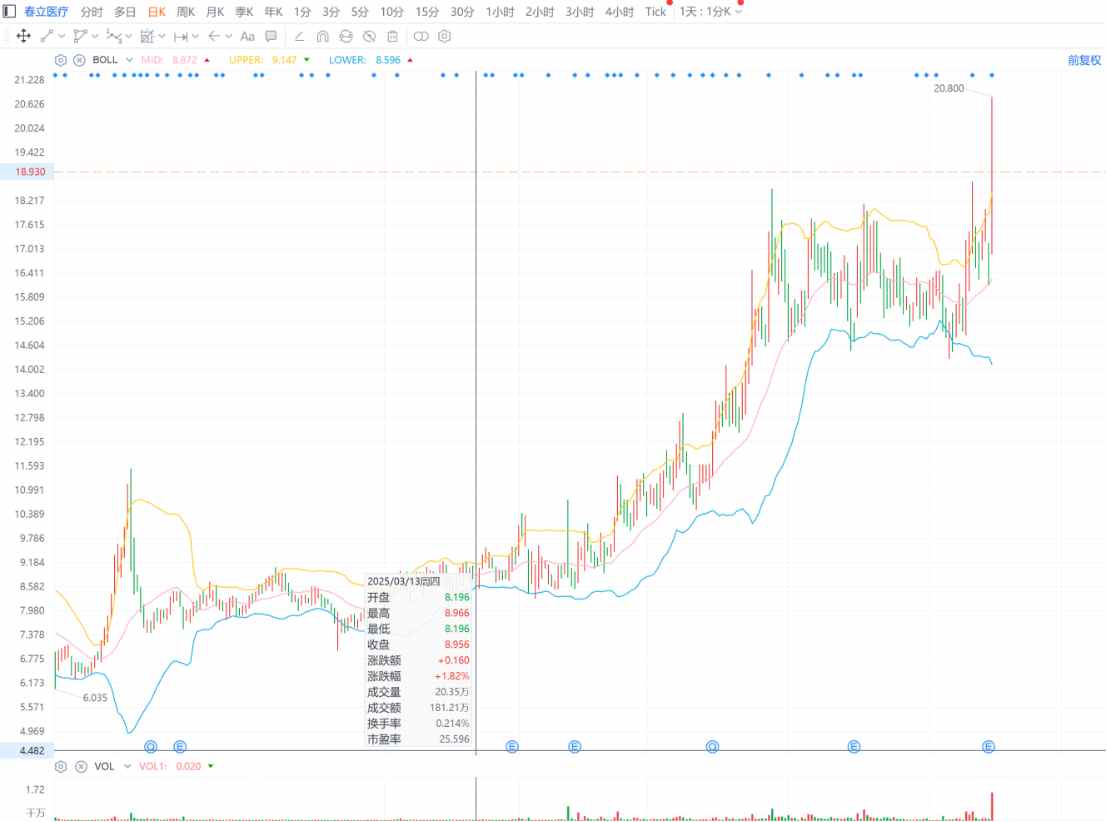
集采影响消散年内股价涨超120%,横盘三个月的春立医疗将走向何方?
Zhi Tong Cai Jing· 2025-11-02 11:16
Core Viewpoint - The performance of Spring Medical has shown significant recovery after the impact of centralized procurement, with notable increases in revenue and net profit in recent quarters [2][3][12]. Financial Performance - In Q3 2024, Spring Medical reported revenue of 756 million yuan, a year-on-year increase of 48.75%, and a net profit of 192 million yuan, up 213.21% year-on-year [2]. - The company's Q3 revenue reached 268 million yuan, marking a 109.51% increase year-on-year, and the net profit turned positive at 77.06 million yuan [2][3]. - In Q1 2023, Spring Medical achieved a revenue of 230 million yuan, a slight increase of 3.6%, and a net profit of 58 million yuan, up 5.2% [3]. Market Trends - The orthopedic consumables industry is experiencing a recovery, with Spring Medical's revenue growth in Q2 2025 reaching 62.85%, outperforming peers [6]. - The global orthopedic medical device market is projected to grow to $62.22 billion in 2024 and exceed $94 billion by 2032, with a stable annual growth rate of 5.3% [12]. Stock Performance - Spring Medical's stock price has increased by 122.13% year-to-date as of October 31, 2024, reflecting renewed market confidence [2]. - The stock experienced a significant rise in May, June, and July 2024, with respective increases of 17.69%, 12.18%, and 29.85% [9]. Strategic Developments - Spring Medical has been actively expanding its international market presence, with overseas revenue accounting for 40% of total revenue in the first half of 2025 [14]. - The company has received multiple regulatory approvals for its products, including the FDA 510(K) approval for its knee prosthesis system, enhancing its competitive edge in international markets [15]. Product Development - Spring Medical has made significant advancements in product development, with 35 new registrations obtained in the first nine months of the year, and R&D investment accounting for 11.44% of revenue [13]. - The company is the first in China to have a chemical vapor deposition manufacturing process for porous tantalum metal implants, breaking foreign monopolies [13].


强生近百亿美元资产拆分背后,骨科行业迎来新巨头
第一财经· 2025-10-18 15:33
Core Viewpoint - Johnson & Johnson announced plans to spin off its orthopedic business into a separate company named DePuy Synthes within the next 18 to 24 months, aiming to enhance competitiveness and focus on core business areas in response to market changes [3][5]. Group 1: Business Split and Market Impact - The orthopedic business of Johnson & Johnson generates nearly $10 billion in annual revenue, accounting for about 10% of the company's total revenue [5]. - This is the second major split for Johnson & Johnson in 2023, with the goal of allowing the orthopedic division to focus on higher-margin markets and improve profitability [5][6]. - Other major medical companies, such as Medtronic and Thermo Fisher, have also announced business splits to concentrate on core growth areas [6][7]. Group 2: Competitive Landscape - The orthopedic market is undergoing significant changes, with potential for new "giants" to emerge, intensifying competition with current leaders like Stryker and Zimmer Biomet [3][9]. - Analysts predict that DePuy Synthes could become the largest dedicated orthopedic company globally, with a strong market position in key product categories [5][11]. - The orthopedic market is currently dominated by four major players: Stryker, Johnson & Johnson, Zimmer Biomet, and Smith & Nephew, with Johnson & Johnson holding over 50% market share in trauma care [11][12]. Group 3: Robotics and Innovation - The orthopedic robotics market is seen as the next battleground for industry giants, with DePuy Synthes expected to focus on innovation and accelerate product launches, including robotic technologies [13][14]. - Johnson & Johnson has already developed the VELYS robotic platform, which is currently not available in the Chinese market, but partnerships with local companies are underway [15][17]. - The global orthopedic robotics market is projected to exceed $1.9 billion in 2024 and grow to over $3.5 billion by 2030, with a compound annual growth rate of over 10% [15][16]. Group 4: Chinese Market Dynamics - Chinese companies are rapidly advancing in the orthopedic robotics sector, with domestic manufacturers capturing over 70% of the market share in 2024 [17][18]. - The domestic market is expected to grow significantly, with projections indicating a market size of $3.84 billion by 2026, reflecting a growth rate of 44.3% [18]. - However, the competitive landscape in China is becoming increasingly saturated, with over 50 companies vying for market share, leading to potential market overcapacity [19].


爱康医疗(1789.HK):中报业绩符合预期 止血纱及脑膜胶新产品快速放量
Ge Long Hui· 2025-10-14 04:05
Core Viewpoint - The company's revenue growth in H1 2025 is under short-term pressure, while profit growth meets expectations. Looking ahead to H2 2025, the nationwide implementation of the artificial joint procurement renewal policy is expected to stabilize the industry pricing system. The company has seen price increases in hip and knee joint bids during this renewal, indicating a potential for both volume and price growth. The orthopedic surgery volume is expected to recover, and with a low revenue base from the previous year, the company is projected to experience a trend of lower performance in the first half and higher performance in the second half of the year. In the medium to long term, the company's forward-looking layout in 3D printing, surgical robots, and digital orthopedic ecosystems will create solid technological barriers and open new growth spaces. Additionally, the overseas market is expected to become a strong growth engine as the "JRI + Aikang" dual-brand strategy deepens and product registrations continue to progress [1][2][3]. Financial Performance - In H1 2025, the company achieved a revenue of 694 million yuan, a year-on-year increase of 5.6%, and a net profit of 161 million yuan, a year-on-year increase of 15.3%. The earnings per share (EPS) was 0.14 yuan. The revenue growth was driven by accelerated import substitution due to volume-based procurement policies, leading to increased sales of products within the procurement scope. The company made breakthroughs in clinical applications at high-end medical institutions, particularly in key provinces such as Shanghai, Guangdong, and Zhejiang [1][2][3]. Product Performance - By product, the company reported hip joint revenue of 410 million yuan (up 14.0% year-on-year), knee joint revenue of 194 million yuan (down 0.7% year-on-year), primarily due to price declines in single condyle products outside the procurement scope, and spinal and trauma revenue of 51 million yuan (down 26.5% year-on-year) due to policy impacts. Revenue from digital orthopedic customized products and services was 18 million yuan (up 3.9% year-on-year). The K3 intelligent surgical robot, developed in-house, was approved for market launch in May 2025, with over 1,700 clinical surgeries completed using the intelligent assistance devices [2][3]. Market Outlook - The comprehensive execution of the artificial joint procurement renewal policy is expected to accelerate performance in the second half of the year. The company is steadily increasing its market share due to its cost-effectiveness and localized service advantages, which are accelerating import substitution and coverage in high-end hospitals. The iCOS digital orthopedic platform provides a full-process solution from preoperative planning to intraoperative navigation and postoperative monitoring. With the approval of the K3 intelligent surgical robot, digital products and implants are expected to see collaborative growth. The international market is viewed as the second growth curve for the company, with the dual-brand strategy effectively covering different overseas markets and gradually increasing the proportion of overseas revenue, indicating significant growth potential [2][3]. Financial Metrics - The company's gross margin for H1 2025 was 59.1%, a decrease of 1.5 percentage points year-on-year, primarily due to changes in product structure, with a decline in the revenue share of spinal and trauma implants. The company maintained good expense control, with a sales expense ratio of 16.9% (down 0.2 percentage points year-on-year) and a management expense ratio of 11.2% (up 0.2 percentage points year-on-year). The R&D expense ratio remained stable at 9.6%, reflecting ongoing investment to maintain technological leadership. As of June 30, 2025, the company's net current assets were approximately 1.846 billion yuan, an increase of about 264 million yuan compared to the end of 2024, mainly due to improvements in operational performance [3]. Profit Forecast - In the short term, the volume and price growth effects from the artificial joint procurement renewal are expected to manifest, driving high growth in the business for the second half of the year. In the medium to long term, the company's forward-looking layout in innovative products such as 3D printing and surgical robots, along with the digital orthopedic ecosystem, will create solid technological barriers and open new growth spaces. The overseas business is anticipated to become a strong growth engine as the "JRI + Aikang" dual-brand strategy deepens and product registrations progress. The company is projected to achieve revenues of 1.543 billion, 1.819 billion, and 2.101 billion yuan for 2025-2027, with corresponding growth rates of 14.61%, 17.91%, and 15.50%. Net profits are expected to be 330 million, 385 million, and 438 million yuan, with corresponding growth rates of 20.60%, 16.48%, and 13.84%, maintaining a "buy" rating [3].
齐商银行“小额出口贷”解企业扩产之急
Qi Lu Wan Bao· 2025-09-05 01:55
Core Viewpoint - The company, Xinhua United, is expanding its production capabilities and market reach in the orthopedic implant sector, supported by financial assistance from Qishang Bank, which enables it to address the growing demand driven by an aging population [5][9]. Group 1: Company Overview - Xinhua United specializes in the research, production, and sales of high-value orthopedic consumables, including hip joints, knee joints, spinal implants, and specialized tools, positioning itself within a national strategic emerging industry [5]. - The company has achieved some degree of domestic substitution through independent innovation and is gradually establishing a competitive advantage in international markets [5]. Group 2: Financial and Operational Challenges - The company faces challenges typical of the orthopedic implant field, such as long research and development cycles, high capital investment, and slow payment collection, which test its financial strength [5]. - Since May of the previous year, the company's main products, knee and hip joints, have been included in the national centralized procurement catalog, leading to a more than doubling of orders this year, resulting in short-term financial pressure [5]. Group 3: Financial Support and Growth Strategy - In response to financing challenges, Qishang Bank provided 5 million yuan in credit support through a tailored "small export loan" service, recognizing the company's stable export business and promising development prospects [6][10]. - With the financial backing, Xinhua United can manage its production expansion and is poised to further diversify its product line, focusing on the orthopedic sector while increasing investment in spinal, trauma, and dental instruments [9]. Group 4: Market Trends - The domestic orthopedic implant market is continuously expanding due to increasing demand driven by an aging population, indicating a favorable growth outlook for the company [9].
人工关节市场格局分析
Huafu Securities· 2025-04-18 05:18
Group 1 - The artificial joint orthopedic market is experiencing steady growth, with the market size in China reaching approximately 45 billion RMB in 2022 and projected to exceed 180 billion RMB by 2030, driven by demographic changes and increased prevalence of joint diseases [3][4]. - The aging population in China is a significant factor for market growth, with the proportion of individuals aged 65 and above expected to rise from 10.5% in 2015 to 15.64% in 2024, leading to increased demand for joint surgeries and related products [4]. - The introduction of centralized procurement policies has led to a significant increase in the domestic market share of Chinese brands, with local brands capturing 68% of the market after two rounds of procurement, compared to over 70% held by foreign brands before [8][12]. Group 2 - Major domestic companies in the artificial joint sector include Weigao Orthopedics, Aikang Medical, and Chunzhi Medical, all of which have faced challenges due to procurement policies but are adapting by focusing on innovation and market share expansion [13][18]. - The average prices for hip and knee joints have drastically decreased due to centralized procurement, with hip joint prices dropping from 35,000 RMB to around 7,000 RMB, and knee joints from 32,000 RMB to 5,000 RMB, resulting in an average price reduction of 82% [12]. - Despite short-term impacts on revenue and profit margins due to procurement policies, the long-term strategy of "price for volume" is expected to help companies expand market share and drive domestic replacement of imported products [18][21].