
中国平安

Search documents
【财经分析】扩募定价寻锚:REITs市场探索利益平衡“最优解”
Xin Hua Cai Jing· 2026-02-14 08:08
Core Viewpoint - The expansion of public REITs in China is entering a phase of normalized issuance and revitalization of existing assets, with expansion fundraising emerging as a significant strategic value, highlighting the complexity of its pricing mechanism [1] Pricing Mechanism - The pricing for targeted expansions must not be lower than 90% of the average trading price over the previous 20 trading days, establishing a rigid bottom line for pricing [2] - Historical cases show that the subscription price for expansions typically ranges from 90% to 100% of the pricing benchmark, with an average first-day increase of only 1%, indicating limited effectiveness of new investment strategies [2] - The core logic of expansion pricing emphasizes using market prices as a reference, balancing the interests of investors and original rights holders, and enhancing trust with long-term investors [2][3] Balancing Interests - The recent expansion by Huaxia Fund, which allowed original holders to subscribe preferentially, exemplifies a significant institutional innovation aimed at protecting existing shareholders' interests [3] - The introduction of an "ex-rights" mechanism during expansions helps ensure fair pricing and trading, preventing risk-free arbitrage [3] Market Dynamics - The pricing of expansions can lead to discounts due to market fluctuations, particularly if the pricing benchmark is set during high market conditions, exposing products to systemic market risks [3][4] - Short-term discounts do not necessarily indicate a decline in long-term asset value but reflect market self-correction mechanisms [4] Institutional Evolution - The refinement of the expansion pricing mechanism is transitioning the REITs market from a single project financing tool to a sustainable "asset listing platform" [4][5] - New policies from the Shanghai Stock Exchange are expected to standardize the expansion process, enhancing predictability and promoting a dual-driven development model of "initial public offerings + expansions" [4][5] Strategic Considerations - The choice of assets for expansion should favor value creation, considering factors like synergy, economies of scale, and investor structure, indicating that pricing is not merely a numerical calculation but a strategic consideration [5] - Long-term investors prioritize high dividends, quality operations, and expansion potential, with transparent pricing mechanisms directly influencing their investment confidence [5][6] Future Outlook - As the pilot program for commercial real estate REITs progresses, the refinement of pricing mechanisms will become a key indicator of market maturity, with 78 public REITs listed and a total issuance and market value exceeding 200 billion [6] - The exploration of REITs expansion pricing represents an evolution of interests, moving towards a more equitable, transparent, and sustainable market environment [6]
2025年四季度保险公司资金运用点评:债券仍是压舱石,权益配置显著提升
GUOTAI HAITONG SECURITIES· 2026-02-14 06:44
Investment Rating - The report maintains an "Overweight" rating for the insurance industry, driven by the growth in premium income and stable asset management [5][3]. Core Insights - The growth in premium income is expected to lead to a steady increase in the balance of insurance funds, with a projected year-end balance of CNY 38.5 trillion for 2025, reflecting a 15.7% increase from the beginning of the year [5][3]. - The report highlights a significant increase in equity allocation, with total equity and fund assets reaching CNY 5.70 trillion, up CNY 1.60 trillion from the start of the year, accounting for 15.4% of total assets [5][3]. - The bond allocation remains robust, constituting 50.4% of the total assets, indicating that bonds continue to serve as a stabilizing force for insurance companies [5][3]. Summary by Sections Premium Growth and Fund Allocation - The insurance industry is projected to see a premium growth of 7.1% year-on-year in 2025, with life insurance premiums increasing by 8.3% and property insurance premiums by 3.9% [5][3]. - By the end of Q4 2025, the allocation of stocks reached CNY 3.73 trillion, an increase of CNY 1.31 trillion from the beginning of the year, while fund assets totaled CNY 1.97 trillion, reflecting a slight decrease in the last quarter [5][3]. Asset Management Strategy - The report anticipates that the stable long-term interest rates, which are expected to range between 1.79% and 1.90%, along with a mild recovery in the equity market, will positively impact the profitability of insurance companies [5][3]. - The report recommends specific stocks, including China Ping An, China Pacific Insurance, New China Life, and China Life, as favorable investment opportunities within the sector [5][3].



服务“健康中国”战略 平安打造企业健康管理新标杆
2 1 Shi Ji Jing Ji Bao Dao· 2026-02-14 06:33
Core Viewpoint - The article emphasizes the importance of employee health management as a strategic investment for companies, highlighting its role in enhancing productivity and competitiveness while contributing to the broader "Healthy China 2030" initiative [1][2]. Group 1: Importance of Employee Health Management - Employee health is crucial for corporate productivity, with 60% of employees in China reported to be in suboptimal health, leading to an annual absenteeism rate of 8.5% and an average medical expenditure of over 2800 yuan per person [1]. - Investing in employee health management can yield significant returns, with studies indicating that every 1 yuan spent can reduce medical costs by 3.2 yuan and absenteeism losses by 2.7 yuan [2]. - Companies that implement systematic health management see an average productivity increase of 20.3% and a reduction in indirect economic losses by 42% [2]. Group 2: Challenges in Health Management Services - The diversity in employee age, job roles, and health conditions makes it difficult to standardize health management services [3]. - Insurance companies often lack the capability to integrate medical resources effectively, relying on third-party providers, which can lead to inconsistent service quality [3]. - Data interoperability issues between insurance companies, hospitals, and corporate HR systems hinder the effectiveness of health management [3]. Group 3: "Four Arrivals" Service System - The "Four Arrivals" service system by Ping An integrates insurance, medical services, and health management into a closed-loop ecosystem, addressing the shortcomings of fragmented health management services in the industry [4][5]. - The system includes "online consultations," "hospital services," "on-site corporate health services," and "home health services," providing comprehensive support for employees [5][6]. Group 4: Social Value and Long-term Commitment - Ping An prioritizes social value over short-term profits in its health management business, investing heavily in medical resource integration and service development despite low initial profitability [8]. - The company's health management initiatives contribute to public health by alleviating the burden on public healthcare systems and enhancing the overall health of the workforce [8][11]. - By focusing on long-term value creation, Ping An aims to be a benchmark in the industry, supporting the "Healthy China 2030" goals [11].
港股投资周报:港股医药领涨,港股精选组合年内相对恒指超额 4.39%-20260214
Guoxin Securities· 2026-02-14 05:40
Quantitative Models and Construction Methods 1. Model Name: Hong Kong Stock Selection Portfolio - **Model Construction Idea**: The model is based on a dual-layer selection process that integrates fundamental and technical analysis. It aims to identify stocks with both fundamental support and technical resonance from an analyst-recommended stock pool[14][17] - **Model Construction Process**: 1. **Analyst Recommendation Pool**: Constructed using three types of analyst recommendation events: upward earnings forecast revisions, first-time coverage, and research reports with unexpected positive titles[17] 2. **Dual-Layer Selection**: - **Fundamental Analysis**: Select stocks with strong fundamental support - **Technical Analysis**: Identify stocks with technical resonance 3. **Backtesting**: The backtesting period is from January 1, 2010, to December 31, 2025. The portfolio assumes a fully invested state and considers transaction costs[17] - **Model Evaluation**: The model demonstrates strong performance with significant annualized returns and excess returns over the Hang Seng Index[17] 2. Factor Name: 250-Day New High Distance - **Factor Construction Idea**: This factor measures the distance of the latest closing price from the 250-day high, reflecting the momentum effect in stock prices[21][23] - **Factor Construction Process**: 1. **Formula**: $ 250\text{-Day New High Distance} = 1 - \frac{\text{Close}_{t}}{\text{ts\_max}(\text{Close}, 250)} $ - $\text{Close}_{t}$: Latest closing price - $\text{ts\_max}(\text{Close}, 250)$: Maximum closing price over the past 250 trading days 2. **Interpretation**: - If the latest closing price reaches a new high, the factor value is 0 - If the price falls from the high, the factor value is positive, indicating the degree of decline[23] 3. **Screening Criteria**: - Stocks with high analyst attention (at least five buy or overweight ratings in the past six months) - Top 20% in 250-day price change within the sample pool - Stability and trend continuation metrics, such as price path smoothness and average 250-day new high distance over the past 120 days[24] --- Model Backtesting Results 1. Hong Kong Stock Selection Portfolio - **Annualized Return**: 19.08% - **Excess Return over Hang Seng Index**: 18.06% - **Information Ratio (IR)**: 1.19 - **Maximum Drawdown**: 23.73% - **Tracking Error**: 14.60% - **Return-to-Drawdown Ratio**: 0.76[20] --- Factor Backtesting Results 1. 250-Day New High Distance - **Sector Distribution**: - **Cyclical Sector**: 18 stocks - **Manufacturing Sector**: 10 stocks - **Consumer Sector**: 9 stocks - **Technology Sector**: 3 stocks - **Healthcare Sector**: 2 stocks - **Financial Sector**: 2 stocks[23][24] - **Selected Stocks**: Examples include Kingboard Laminates (1888.HK), WuXi AppTec (2359.HK), and COSCO Shipping Energy (1138.HK)[29]
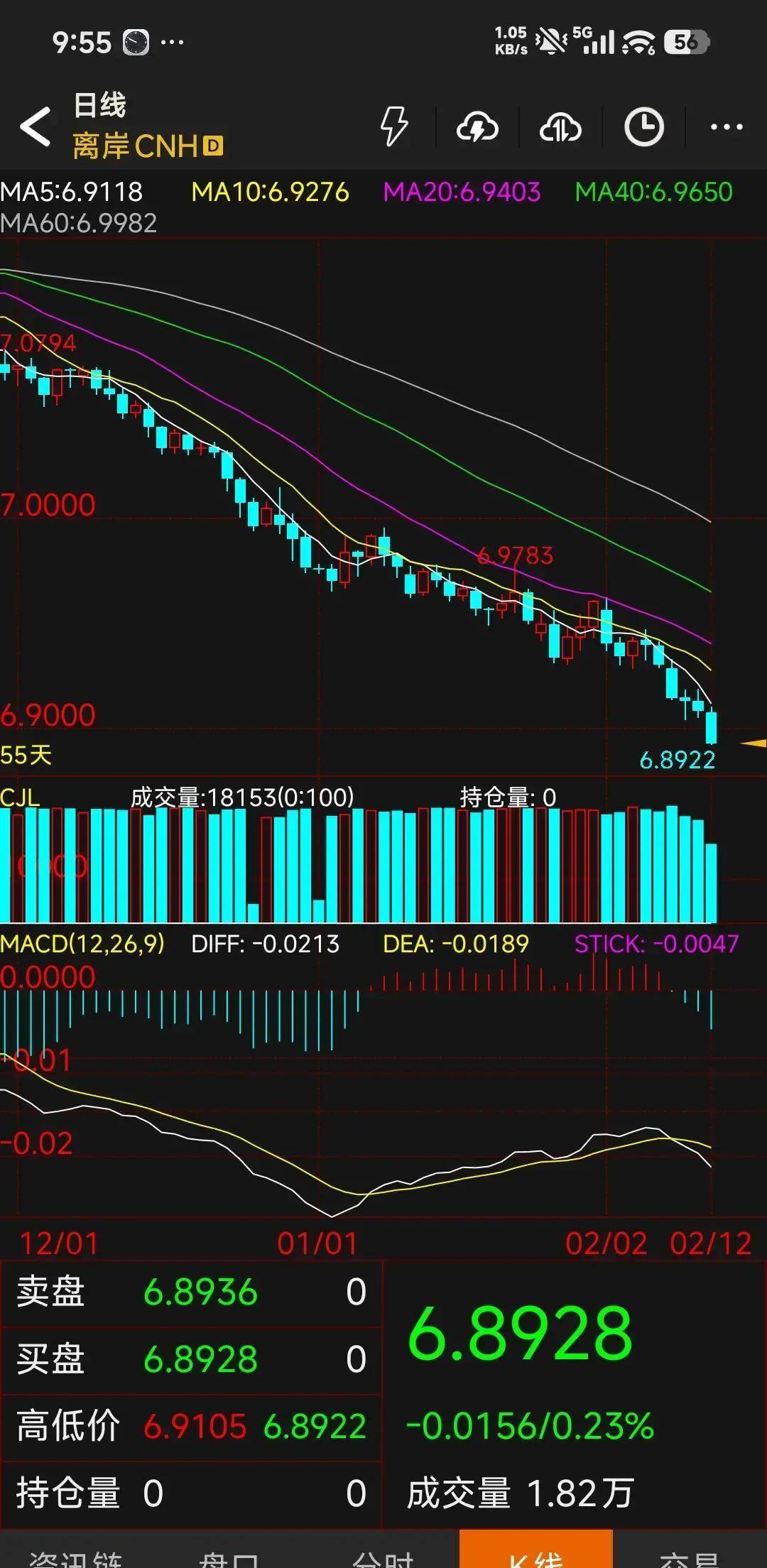
离岸人民币破6.89!三股力量推升A股,四大板块暗藏玄机
Sou Hu Cai Jing· 2026-02-14 05:12
Core Viewpoint - The offshore RMB has strengthened significantly, breaking the 6.89 mark, driven by reduced expectations for Fed rate hikes, continuous foreign capital inflow, and steady improvement in the Chinese economy, making RMB a focal point in the market [1] Group 1: Aviation Industry - The aviation sector is highly sensitive to exchange rates, with costs for aircraft, fuel, and parts typically settled in USD; RMB appreciation reduces financial burdens for companies [4] - China National Airlines, China Southern Airlines, and China Eastern Airlines benefit from this appreciation, with China National Airlines' USD debt constituting 60% of its liabilities, leading to significant profit increases with every 1% rise in RMB [4] - China Southern Airlines, due to its large fleet, sees even more pronounced profit increases, while China Eastern Airlines also experiences improved profitability from reduced fuel costs and exchange gains [4] Group 2: Paper Industry - The paper industry is directly impacted by RMB appreciation, as pulp prices are closely tied to USD, with over 60% of pulp imported; a stronger RMB effectively lowers raw material costs [4] - Companies like Sun Paper, which has a high self-sufficiency rate, can see immediate profit increases with slight RMB appreciation, while others heavily reliant on imports, such as Hengda New Materials, benefit significantly from reduced cost pressures [4] Group 3: Outbound Tourism - The outbound tourism sector reacts quickly to exchange rate changes; a stronger RMB makes international travel, including flights and accommodations, more affordable, increasing consumer interest [5] - China Duty Free Group stands out as a major beneficiary, with rising demand for duty-free shopping, while China Youth Travel Service also benefits from improved product value and increased orders due to RMB appreciation [5] Group 4: Financial Sector - The financial sector is an indirect beneficiary of RMB strength, attracting foreign capital, particularly from funds focused on long-term asset allocation [5] - Major banks like Industrial and Commercial Bank of China maintain stable profits, while retail banks like China Merchants Bank see increased foreign holdings; China Ping An benefits from the appreciation of overseas investments when converted to RMB [5] Group 5: Market Sentiment and Future Outlook - The recent RMB appreciation signals a shift in investor sentiment, moving from passive observation to active evaluation of Chinese asset safety and value [6] - The sustainability of this appreciation and its ability to translate into real profits for companies remains uncertain, but if it continues, sectors like aviation, paper, tourism, and finance could enter a new valuation cycle [7] - The market's response to the RMB's strength reflects a broader confidence returning, with questions about how long this confidence can last and its potential impact on corporate earnings [7]

平安人寿:杨铮拟卸任董事长职务,副董事长蔡霆代行董事长职责
2 1 Shi Ji Jing Ji Bao Dao· 2026-02-14 04:49
公开资料显示,杨铮自1994年7月加入平安,曾任平安人寿董事长、平安健康险董事长、平安产险总经理、平安银行东区事业部副总经理、平 安产险总经理助理兼北区事业部总经理、平安产险上海分公司总经理、平安人寿临时负责人等职务。 平安人寿表示,杨铮在担任公司董事长期间主导推动公司"渠道+产品"战略落地显效,对杨铮任职期间所作的贡献表示感谢。杨铮到龄退休 后,根据平安人寿《公司章程》的规定,由副董事长蔡霆代为履行董事长职责。 数据显示,2025年前三季度,平安人寿代理人渠道新业务价值同比增长23.3%,代理人人均新业务价值同比增长29.9%,银保渠道新业务价值 同比增长170.9%,产能持续提升。银保渠道、社区金融服务及其他等渠道,贡献了平安人寿新业务价值的35.1%。截至2025年三季度末,平安 人寿总资产超过5.8万亿元。 日前,中国平安人寿保险股份有限公司(下称"平安人寿"或"公司")宣布,杨铮退休后返聘任职期满,拟卸任公司董事长、董事等相关职务。 副董事长兼副总经理蔡霆代行董事长职责。 平安人寿表示,目前公司正有序推进董事长的聘任工作,后续将按照相关法律法规规定和监管要求及时履行信息披露义务。 南方财经全媒体记者 ...

平安人寿:杨铮返聘期满,拟卸任董事长职务
Jin Rong Jie· 2026-02-14 03:24
据澎湃新闻,日前,平安人寿宣布,杨铮退休后返聘任职期满,拟卸任公司董事长、董事等相关职务。 平安人寿副董事长兼副总经理蔡霆代行董事长职责。平安人寿对此表示,公司不断加强公司领导班子建 设,推进公司战略落地,迈向高质量发展。目前公司正有序推进董事长的聘任工作,后续将按照相关法 律法规规定和监管要求及时履行信息披露义务。杨铮到龄退休后,根据平安人寿《公司章程》的规定, 由副董事长蔡霆代为履行董事长职责。 关键词阅读:平安人寿 杨峥 董事长 责任编辑:栎树 平安人寿网站显示,杨峥,1964年2月生,于1994年7月加入平安,曾任平安健康险董事长、平安产险总 经理、平安银行东区事业部副总经理、平安产险总经理助理兼北区事业部总经理、平安产险上海分公司 总经理、平安人寿临时负责人等职。 蔡霆,1985年10月生,现任平安人寿副董事长、副总经理。其于2014年11月加入平安,曾任平安集团首 席创新执行官办公室项目经理、平安集团战略发展中心研究助理/高级项目经理、平安集团员工服务部 副总经理(主持工作)、平安银行人力资源部总经理、平安集团副首席财务执行官、平安人寿董事长特 别助理、平安人寿总经理助理。 ...
2025年1-12月青海省原保险保费收入共计128.45亿元,同比增长4.8%
Chan Ye Xin Xi Wang· 2026-02-14 02:13
2020年-2025年青海省累计原保险保费收入统计图 数据来源:国家金融监督管理总局,智研咨询整理 知前沿,问智研。智研咨询是中国一流产业咨询机构,十数年持续深耕产业研究领域,提供深度产业研 究报告、商业计划书、可行性研究报告及定制服务等一站式产业咨询服务。专业的角度、品质化的服 务、敏锐的市场洞察力,专注于提供完善的产业解决方案,为您的投资决策赋能。 相关报告:智研咨询发布的《2026-2032年中国保险行业发展分析及投资前景预测报告》 2025年1-12月青海省原保险保费收入共计128.45亿元,同比增长4.8%,青海省累计原保险保费收入不同 险种类别中寿险占比最高,为54.76亿元,占比42.63%。 上市企业:天茂集团(000627),中国平安(601318),中国人保(601319),新华保险(601336), 中国太保(601601),中国人寿(601628) ...

2025年1-12月宁夏回族自治区原保险保费收入共计272.06亿元,同比增长6.61%
Chan Ye Xin Xi Wang· 2026-02-14 02:13
2020年-2025年宁夏回族自治区累计原保险保费收入统计图 数据来源:国家金融监督管理总局,智研咨询整理 知前沿,问智研。智研咨询是中国一流产业咨询机构,十数年持续深耕产业研究领域,提供深度产业研 究报告、商业计划书、可行性研究报告及定制服务等一站式产业咨询服务。专业的角度、品质化的服 务、敏锐的市场洞察力,专注于提供完善的产业解决方案,为您的投资决策赋能。 上市企业:天茂集团(000627),中国平安(601318),中国人保(601319),新华保险(601336), 中国太保(601601),中国人寿(601628) 相关报告:智研咨询发布的《2026-2032年中国保险行业发展分析及投资前景预测报告》 2025年1-12月宁夏回族自治区原保险保费收入共计272.06亿元,同比增长6.61%,宁夏回族自治区累计 原保险保费收入不同险种类别中寿险占比最高,为143.85亿元,占比52.87%。 ...

2025年1-12月重庆市原保险保费收入共计1227.42亿元,同比增长6.98%
Chan Ye Xin Xi Wang· 2026-02-14 02:05
上市企业:天茂集团(000627),中国平安(601318),中国人保(601319),新华保险(601336), 中国太保(601601),中国人寿(601628) 数据来源:国家金融监督管理总局,智研咨询整理 知前沿,问智研。智研咨询是中国一流产业咨询机构,十数年持续深耕产业研究领域,提供深度产业研 究报告、商业计划书、可行性研究报告及定制服务等一站式产业咨询服务。专业的角度、品质化的服 务、敏锐的市场洞察力,专注于提供完善的产业解决方案,为您的投资决策赋能。 相关报告:智研咨询发布的《2026-2032年中国保险行业发展分析及投资前景预测报告》 2025年1-12月重庆市原保险保费收入共计1227.42亿元,同比增长6.98%,重庆市累计原保险保费收入不 同险种类别中寿险占比最高,为721.44亿元,占比58.78%。 2020年-2025年重庆市累计原保险保费收入统计图 ...
