华大智造

Search documents
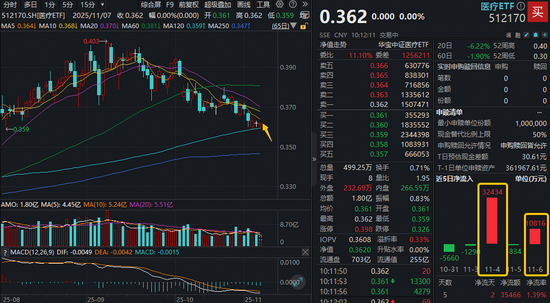
医疗考验半年线支撑!512170宽幅溢价,最新单日再获逾亿元资金增仓!
Xin Lang Ji Jin· 2025-11-07 02:21
Core Viewpoint - The medical sector in A-shares is experiencing a period of adjustment, with mixed performance among individual stocks, but there are signs of potential recovery and growth in earnings and profits in the future [1][3]. Group 1: Market Performance - On November 7, A-shares opened lower, with the Shanghai Composite Index falling below 4000 points, while the medical sector continued its consolidation trend [1]. - The largest medical ETF (512170) showed narrow fluctuations in the morning session, testing support at the six-month line, indicating renewed interest from investors [1]. - After a significant inflow of over 320 million yuan on Tuesday, the ETF attracted an additional 100 million yuan yesterday, suggesting ongoing accumulation by investors [1]. Group 2: Earnings Growth - Analysts predict that the pharmaceutical industry is entering a new cycle of "sustained and high-quality" revenue and profit growth, supported by the ongoing performance recovery in the medical sector [3]. - Among the 50 constituent stocks of the medical ETF (512170), 45 reported profits, with 17 achieving double-digit year-on-year net profit growth. Notably, Zhaoyan New Drug and Meien Health saw net profit growth rates of 214.79% and 110.53%, respectively [3][4]. Group 3: Valuation Insights - The current PE valuation of the medical ETF (512170) stands at 33.29 times, which is still below over 66% of the time in the past decade, indicating potential for valuation recovery [5]. - The medical sector is characterized as a "new quality productive force," poised for high-quality development, with expectations for higher, more certain, and sustained profit quality in the future [4]. Group 4: ETF Overview - As of October 31, 2025, the medical ETF has a scale of 25.6 billion yuan, making it the largest in the market among medical ETFs [6].

研判2025!中国分子育种行业发展背景、发展历程、市场现状及未来趋势分析:受益于政策、技术等多重利好因素,市场规模大幅增长,行业发展前景广阔[图]
Chan Ye Xin Xi Wang· 2025-11-07 01:13
Core Insights - China is the world's second-largest seed demand country, but the trend of de-globalization is shifting global industrial chain layouts from "efficiency first" to "safety first," creating uncertainty in international trade [1][8] - The Chinese government places high importance on seed industry development, emphasizing the need for self-sufficiency in seed sources and technological independence [1][8] - Molecular breeding technology is seen as a key solution to address challenges in the seed industry and promote rural revitalization [1][8] Molecular Breeding Industry Overview - Molecular breeding, also known as gene engineering breeding, involves manipulating DNA at the molecular level to create new varieties with desired traits [2][3] - The industry is supported by various government policies, including the "14th Five-Year Plan for Bioeconomic Development" and the "Plan for Accelerating the Construction of an Agricultural Power" [9][10] Market Status - The market size of China's molecular breeding industry is projected to grow from 700 million yuan in 2020 to 3 billion yuan in 2024, with a compound annual growth rate (CAGR) of 43.9% [11] - By 2024, molecular marker-assisted breeding is expected to dominate the market with a 70% share, followed by transgenic technology at 20% and gene editing technology at approximately 10% [11][12] Development Background - China's seed industry faces significant challenges, including reliance on foreign sources for high-end seed varieties and competition from multinational seed companies [7][8] - The government has intensified support for breeding work, focusing on developing original breeding technologies and improving research and commercialization integration [9][10] Future Trends - The molecular breeding industry is expected to reach a market size of 20 billion yuan by 2029, driven by advancements in gene editing and sequencing technologies [15][16] - The integration of molecular breeding with big data and artificial intelligence is anticipated to enhance breeding precision and efficiency [15][16]

医疗器械板块11月6日跌0.31%,丹娜生物领跌,主力资金净流出6.38亿元
Zheng Xing Xing Ye Ri Bao· 2025-11-06 08:51
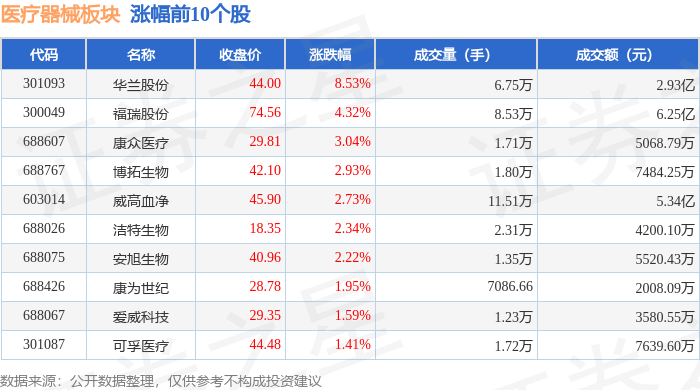
Core Viewpoint - The medical device sector experienced a slight decline of 0.31% on November 6, with Danaher Biomedical leading the losses, while the overall market indices showed gains, with the Shanghai Composite Index up by 0.97% and the Shenzhen Component Index up by 1.73% [1][2]. Group 1: Market Performance - The Shanghai Composite Index closed at 4007.76, increasing by 0.97% [1]. - The Shenzhen Component Index closed at 13452.42, increasing by 1.73% [1]. - The medical device sector saw a net outflow of 638 million yuan from major funds, while retail investors contributed a net inflow of 446 million yuan [2][3]. Group 2: Individual Stock Performance - Hualan Co., Ltd. (301093) saw a significant increase of 8.53%, closing at 44.00 yuan with a trading volume of 67,500 shares and a transaction value of 293 million yuan [1]. - Danaher Biomedical (920009) led the declines with a drop of 4.69%, closing at 83.50 yuan and a trading volume of 24,900 shares, resulting in a transaction value of 206 million yuan [2]. - Other notable gainers included Furuida (300049) with a 4.32% increase and a closing price of 74.56 yuan, and Kangzhong Medical (688607) with a 3.04% increase, closing at 29.81 yuan [1][2]. Group 3: Fund Flow Analysis - Major funds showed a net outflow in several stocks, including Furuida with a net outflow of 23.99 million yuan, while retail investors showed a net inflow of 25.27 million yuan [3]. - Dongfulong (300171) experienced a net inflow of 21.17 million yuan from major funds, indicating positive sentiment towards the stock [3]. - The overall trend indicates a mixed sentiment in the medical device sector, with some stocks attracting retail interest despite the overall outflow from major funds [2][3].



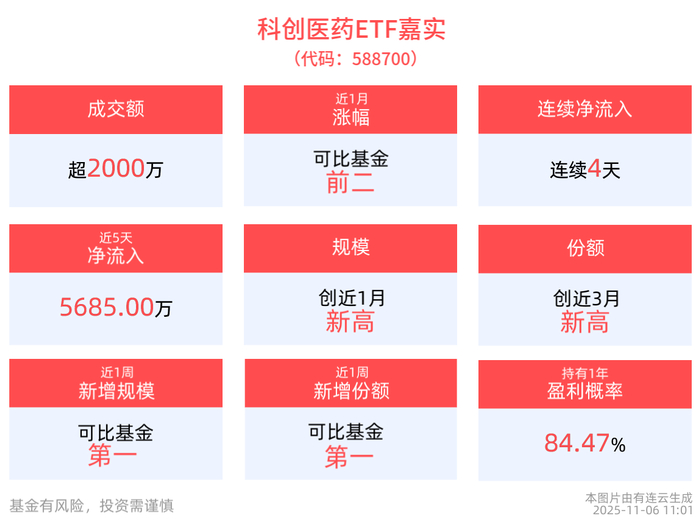
机构称医药板块近期已呈现结构性修复趋势,科创医药ETF嘉实(588700)盘中蓄势,近4日合计“吸金”5685.00万元
Xin Lang Cai Jing· 2025-11-06 03:23
Core Viewpoint - The biopharmaceutical sector on the STAR Market has shown mixed performance, with the STAR Biopharmaceutical Index declining by 0.60% as of November 6, 2025, while individual stocks exhibited varied movements, indicating a potential for structural recovery in the sector [1][4]. Group 1: Market Performance - The STAR Biopharmaceutical Index decreased by 0.60% as of November 6, 2025, with stocks like Huaheng Biological leading gains at 2.86%, while Yifang Biological experienced the largest decline [1]. - The Jiashi STAR Biopharmaceutical ETF recorded a turnover of 6.67% and a transaction volume of 21.39 million yuan, reaching a new high of 322 million yuan in scale, ranking first among comparable funds [3]. - The Jiashi STAR Biopharmaceutical ETF has seen a net inflow of 56.85 million yuan over the past four days, with a peak single-day net inflow of 16.85 million yuan [3]. Group 2: Fund Performance - As of November 5, 2025, the Jiashi STAR Biopharmaceutical ETF has achieved a one-year net value increase of 26.53%, with the highest monthly return since inception being 23.29% and the longest consecutive monthly gain lasting seven months [3]. - The average monthly return during the rising months of the Jiashi STAR Biopharmaceutical ETF is 7.85% [3]. Group 3: Industry Outlook - Recent adjustments in the pharmaceutical sector are attributed to a recovery in capital market financing and an increase in the scale of innovative drug exports, leading to a rebound in domestic innovative drug research and development [3]. - The outlook for the innovative drug sector remains focused on business development (BD) expectations, with BD activities typically accounting for about 40% of annual transactions in the fourth quarter [3]. - According to data, the top ten weighted stocks in the STAR Biopharmaceutical Index account for 49.74% of the index, indicating a concentration of investment in key players [4][6].



上证早知道|利好卫星导航产业链,京津冀部署;关于机器人,王兴兴发声;高德、小鹏,大消息
Shang Hai Zheng Quan Bao· 2025-11-05 22:58
Group 1 - The Beijing-Tianjin-Hebei region aims to establish a North Star space-time industry cluster with a scale exceeding 200 billion yuan by 2027, promoting the application of over 800,000 new-type Beidou independent positioning terminal products [2][7] - The action plan includes nurturing 10 leading enterprises and 50 "specialized, refined, distinctive, and innovative" companies in the Beidou application industry [7] - The satellite navigation industry chain is expected to experience rapid growth due to the increasing demand from smartphones, consumer electronics, and specialized industries, supported by technology, demand, and policy [7] Group 2 - Gaode, a subsidiary of Alibaba, has entered the Robotaxi market, partnering with XPeng to provide L4 autonomous driving services, marking a significant step in the intelligent driving sector [9][10] - The global Robotaxi and fully autonomous driving market is projected to reach approximately $300 billion by 2035, with the domestic market expected to approach 500 billion yuan by 2030 [10] - The collaboration between Gaode and XPeng represents the first instance of a "mobility platform + pre-installed mass-produced Robotaxi" model, indicating a shift towards a technology and ecosystem service approach [10] Group 3 - Yushun Technology's founder predicts an average growth rate of 50%-100% for individual companies in the domestic smart robotics sector, driven by supportive policies [5] - The development of embodied robots is currently at a stage similar to the early years before the release of ChatGPT, with the robot model being a critical factor for future advancements [5] - XPeng aims to achieve mass production of advanced humanoid robots by the end of 2026, collaborating with Baosteel to explore industrial applications [11]



松禾资本厉伟:做创业者身边最坚定的“时间合伙人”
Shang Hai Zheng Quan Bao· 2025-11-05 18:41
Core Insights - The article emphasizes the importance of patience in technology investment, highlighting that successful investment requires a long-term commitment and understanding of the industry dynamics [2][4][9] Investment Philosophy - The founder of Songhe Capital, Li Wei, believes that technology investment is not a gamble but requires professionalism, courage, and patience [4][9] - Professionalism is crucial as different technology sectors require specialized knowledge and expertise [4] - Courage is necessary to support companies through their non-linear growth paths, which may deviate from initial expectations [4] - Patience is essential, as high-tech companies often take years to mature, with some requiring over a decade from angel investment to IPO [4][9] Investment Focus - As of September 2025, Songhe Capital has invested in over 200 technology companies, including notable firms like SenseTime, Aibee, and Defang Nano [2][4] - The investment strategy focuses on three main areas: digital technology centered on artificial intelligence, precision medicine based on genetic testing, and breakthroughs in innovative materials [9] Entrepreneurial Support - Li Wei views investors as companions to entrepreneurs, providing support and guidance throughout different stages of a company's growth [5][7] - The article illustrates the collaborative relationship between Songhe Capital and its portfolio companies, such as BGI Genomics, where the firm provided crucial funding and resources to overcome challenges [3][6] Market Trends - The article discusses the long-term nature of technological innovation, emphasizing that sectors like information technology, optical chips, aerospace, synthetic biology, and artificial intelligence are characterized by extended development cycles [9] - Li Wei stresses the need for Chinese companies to master hard technology to compete globally, aligning investment strategies with national priorities and macro trends [9]


2025年药品目录谈判协商结束,科创医药ETF嘉实(588700)调整蓄势,机构:中国创新药行业正经历“量变引起质变”趋势
Xin Lang Cai Jing· 2025-11-05 03:30
Core Insights - The Shanghai Stock Exchange Sci-Tech Innovation Board Biopharmaceutical Index decreased by 1.41% as of November 5, 2025, with Huatai Medical leading the gain at 3.87% while Sangfor Biopharma experienced the largest decline at 6.88% [1][5]. Group 1: ETF Performance - The Jiashi Sci-Tech Medicine ETF recorded a turnover of 9.7% during the trading session, with a total transaction value of 29.81 million yuan [4]. - The latest scale of the Jiashi Sci-Tech Medicine ETF reached 307 million yuan, with a total of 273 million shares outstanding [4]. - Over the past three days, the Jiashi Sci-Tech Medicine ETF has seen continuous net inflows, with a peak single-day net inflow of 14.39 million yuan, totaling 39.99 million yuan [4]. - As of November 4, 2025, the Jiashi Sci-Tech Medicine ETF's net value increased by 29.72% over the past year [4]. Group 2: Industry Trends - The Chinese innovative drug industry is undergoing a transformation driven by factors such as international expansion, continuous data catalysts, and the launch of new products [5]. - The focus of the innovative drug market has shifted from broad valuation recovery to the fundamental performance of companies, emphasizing those with excellent clinical data, strong commercialization capabilities, and successful international expansion potential [5]. Group 3: Key Stocks - As of October 31, 2025, the top ten weighted stocks in the Shanghai Stock Exchange Sci-Tech Innovation Board Biopharmaceutical Index accounted for 49.74% of the index, with leading companies including United Imaging Healthcare and BeiGene [5][7]. - The performance of individual stocks varied, with United Imaging Healthcare showing a slight increase of 0.11%, while Sangfor Biopharma saw a significant decline of 6.88% [7].
医疗设备行业——2025医药三季报分析电话会
2025-11-05 01:29
Summary of Medical Device Industry Conference Call Industry Overview - The medical device industry is showing signs of recovery, although gross margins have declined due to centralized procurement and equipment update procurement impacts [1][2] - Tendering activities have continued to recover, with winning bid amounts increasing by 32% year-on-year in the first three quarters, particularly in CT and MRI, which saw growth exceeding 70% [1][2] Key Performance Metrics - Overseas business has become a growth engine, with a 22% increase in the first three quarters, as core projects in North America, Europe, and Asia-Pacific enter a concentrated implementation phase, improving order-to-revenue conversion efficiency [1][2] - The international revenue share of Mindray's medical imaging line reached 61%, while United Imaging's overseas business grew by 42% [1][4] Segment Performance - Various sub-sectors have shown differentiated performance: - Medical imaging equipment (e.g., United Imaging, Mindray, and Kaili) has rebounded - Conventional medical devices and home medical devices have benefited from national subsidy policies - Rehabilitation equipment, particularly Weisi Medical, reported a 12% revenue growth in Q3 [1][3][4] - Mindray's Q3 performance was strong, with expectations for increased revenue growth in Q4; Kaili Medical saw significant increases in bid amounts for ultrasound and endoscope products [1][5] Future Trends and Challenges - The trend of companies expanding overseas is expected to continue, although macroeconomic conditions and geopolitical conflicts pose challenges [1][6] - The recovery in tendering is anticipated to translate into revenue in Q4, with companies actively positioning high-end product lines such as the ultrasound 8,090 platform and endoscope 650 series, expected to ramp up in 2026 [1][6][10] Rehabilitation Equipment Sector - The rehabilitation equipment sector faces pressure overall, but companies like Weisi Medical have shown good performance with a 12% year-on-year growth [8] - Brain-computer interface technology is viewed as a new growth engine for the rehabilitation equipment sector, with companies like Xiangyu and Mailande actively investing in this area [7][8] High-End Product Lines - Companies have demonstrated significant performance in high-end product lines such as MRI, CT, and molecular imaging [9] - For instance, 3T MRI and dual-source dual-width CT products have shown strong sales in 2025, despite some fluctuations in overseas business due to regional conflicts [9] Company-Specific Highlights - Mindray's overall performance in Q3 was impressive, with a 24% year-on-year revenue increase and domestic business growth of approximately 75% [5] - Kaili Medical's highlights include significant bids for soft endoscopes and new product sales, with expectations for continued focus on high-end products in 2026 [10] - Yuyue Medical achieved steady growth of around 10% in Q3, focusing on markets in the Belt and Road Initiative, Europe, North America, and South America [11] - Wandong Medical faced a double-digit revenue decline in Q3 due to DRG reform impacts but is expected to see improved performance in Q4 as centralized procurement peaks [13] Conclusion - The medical device industry is on a recovery path with varying performances across segments and companies, driven by overseas expansion and high-end product development, while facing challenges from market dynamics and geopolitical factors [1][6][8]





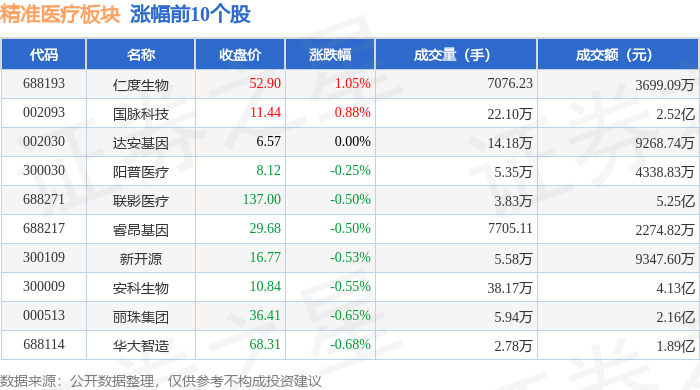
精准医疗板块11月4日跌1.77%,透景生命领跌,主力资金净流出9.79亿元
Sou Hu Cai Jing· 2025-11-04 08:57
Market Overview - The precision medicine sector experienced a decline of 1.77% on November 4, with TuoJing Life leading the drop [1][2] - The Shanghai Composite Index closed at 3960.19, down 0.41%, while the Shenzhen Component Index closed at 13175.22, down 1.71% [1] Stock Performance - Notable stock performances in the precision medicine sector included: - RenDu Bio (688193) closed at 52.90, up 1.05% with a trading volume of 7076.23 hands and a transaction value exceeding 36.99 million yuan [1] - TuoJing Life (300642) closed at 22.73, down 2.86% with a trading volume of 78,200 hands and a transaction value of 178 million yuan [2] - Other companies like DaAn Gene (002030) and Anke Bio (300009) showed minimal changes, with DaAn Gene remaining flat at 6.57 and Anke Bio down 0.55% to 10.84 [1][2] Capital Flow - The precision medicine sector saw a net outflow of 979 million yuan from institutional investors, while retail investors contributed a net inflow of 642 million yuan [2][3] - Specific stock capital flows indicated: - GuoMai Technology (002093) had a net inflow of 8.61 million yuan from institutional investors, while retail investors saw a net outflow of 15.98 million yuan [3] - TuoJing Life experienced minimal net inflow from institutional investors at 25,000 yuan, with retail investors also showing a slight outflow [3]



科创创新药大幅异动,百利天恒跌5%,科创创新药ETF汇添富(589120)跌超3%,资金连续5日重手增仓!医保谈判进行中,创新药板块新催化将至?
Sou Hu Cai Jing· 2025-11-04 08:01
Core Viewpoint - The A-share market experienced a volatile correction, particularly affecting the "Innovative Drug 20CM New Species" sector, with the ETF Huatai-PineBridge (589120) declining by 3.07% over two consecutive days, despite a net inflow of over 80 million yuan in the past five days, indicating continued optimism among investors [1][4][5]. Market Performance - The Huatai-PineBridge Innovative Drug ETF (589120) saw most of its constituent stocks decline, with notable drops including Baidu Tianheng down over 5% and Bory Pharmaceutical down over 4% [3]. - The ETF's trading volume exceeded 75 million yuan, with a closing premium rate of 0.15%, suggesting strong market sentiment despite the overall downturn [1][4]. Industry Trends - As the fourth quarter progresses, the innovative drug sector faces pressure due to reduced risk appetite among investors, although the long-term growth trend remains intact [4]. - Ongoing negotiations for the 2025 medical insurance directory are expected to catalyze growth in the innovative drug sector, with a significant increase in the number of drugs being submitted for approval [4][6]. Institutional Interest - Institutional investors continue to show strong enthusiasm for innovative drugs, with the proportion of biotech holdings in all funds increasing by 2.61 percentage points in Q3 2025 [5]. - The innovative drug sector is seen as a new growth curve for Chinese pharmaceutical companies, with traditional firms successfully transitioning to innovation [6]. Global Positioning - Chinese companies are making significant strides in international academic influence, with a notable increase in presentations at major conferences like ASCO and ESMO [7]. - The number and value of license-out transactions for innovative drugs have reached new highs, indicating a robust global market presence [7]. Future Outlook - The innovative drug sector is projected to continue its upward trajectory, supported by favorable policies, technological advancements, and increasing demand driven by an aging population [6][7]. - The market for innovative drugs is expected to grow significantly, with estimates suggesting a potential market size of 1.5 trillion USD by 2030, providing substantial opportunities for investment [7].