
吉林化纤

Search documents
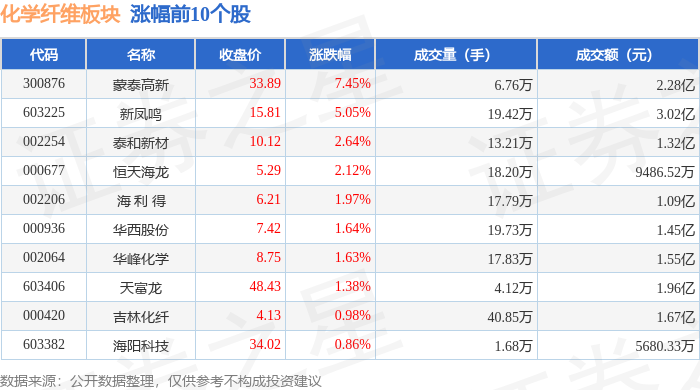
化学纤维板块10月23日涨0.85%,蒙泰高新领涨,主力资金净流出8503.54万元
Zheng Xing Xing Ye Ri Bao· 2025-10-23 08:14
Group 1 - The chemical fiber sector increased by 0.85% on October 23, with Montai High-tech leading the gains [1] - The Shanghai Composite Index closed at 3922.41, up 0.22%, while the Shenzhen Component Index closed at 13025.45, also up 0.22% [1] - Montai High-tech's stock price rose by 7.45% to 33.89, with a trading volume of 67,600 hands and a transaction value of 228 million yuan [1] Group 2 - The chemical fiber sector experienced a net outflow of 85.0354 million yuan from main funds, while retail investors saw a net inflow of 64.18 million yuan [2] - The stock of Zhongfu Shenying fell by 3.28% to 25.68, with a trading volume of 63,300 hands and a transaction value of 163 million yuan [2] - The trading data indicates a mixed performance among individual stocks, with some experiencing significant declines while others showed modest gains [2][3] Group 3 - Main funds showed a net inflow of 9.2529 million yuan for Heng Tian Hai Long, while retail investors had a net outflow of 578.58 million yuan [3] - Taihe New Materials had a net inflow of 873.11 million yuan from main funds, but also saw a net outflow from retail investors [3] - The overall fund flow indicates varying levels of investor confidence across different stocks within the chemical fiber sector [3]


首创证券:风电装机容量提升带动风机叶片需求增长 重点关注增强材料的碳纤维产业链
智通财经网· 2025-10-23 02:22
Core Insights - The wind power industry is experiencing significant growth, with global installed capacity reaching 1,134.76 GW in 2024, a year-on-year increase of 11.28% [1] - China's wind power installed capacity is projected to reach 579.02 GW by August 2025, reflecting a year-on-year growth of 22.12% [1] - The demand for wind turbine blades is expected to rise due to the increasing installed capacity of wind power in China [1] Wind Power Industry Overview - In 2024, global new wind power installations reached a historical high of 117 GW, with China's new installations at 78.79 GW [1] - The International Energy Agency (IEA) forecasts a compound annual growth rate of approximately 12% for the wind power sector from 2023 to 2030 [1] Wind Turbine Blade Components - Wind turbine blades account for about 22% of the total cost of wind power systems, making them a core component [2] - The largest cost component in wind turbine systems is the tower, which constitutes approximately 29% of the total cost [2] Material Composition - The primary matrix material used in wind turbine blades is epoxy resin, which has the highest cost share at around 33% [2] - Glass fiber remains the dominant reinforcement material, while carbon fiber is gaining traction due to its advantages in larger blades [2] Core Materials in Wind Turbine Blades - Core materials, which account for about 25% of the cost, include balsa wood and PVC foam, with PET foam emerging as a potential alternative [3] - Balsa wood is primarily imported from Ecuador, while the PVC foam market is undergoing domestic substitution efforts [3]

研判2025!中国新能源汽车热塑性复合材料行业政策、市场规模、重点企业分析及发展前景展望:新能源汽车快速发展,推动热塑性复合材料需求持续增长[图]
Chan Ye Xin Xi Wang· 2025-10-23 01:35
Core Insights - The article highlights the transformative role of thermoplastic composites in the automotive manufacturing landscape, particularly in the context of the electric vehicle (EV) industry, emphasizing their advantages in lightweighting, recyclability, and safety performance [1][9]. Industry Overview - Thermoplastic composites are defined as composite materials made from thermoplastic polymers reinforced with various fibers, such as carbon and glass fibers, specifically applied in the EV sector [3]. - The market size for China's thermoplastic composites in the EV sector is projected to reach 13.4 billion yuan in 2024, with a year-on-year growth of 13.4%, and is expected to grow to 16.7 billion yuan by 2025 [1][9]. Industry Policies - Recent policies, such as the Shanghai government's action plan for high-quality development in low-altitude economy, emphasize the integration of advanced materials like thermoplastic composites into strategic development [4]. - The Ministry of Industry and Information Technology's plan for the construction materials industry supports the application of composite materials in various sectors, including automotive [5]. Industry Value Chain - The thermoplastic composites industry in China has established a complete value chain, from raw material supply (fibers and resins) to manufacturing and final application in EVs [6]. - Carbon fiber, a key reinforcement material, significantly enhances the mechanical properties and lightweight characteristics of composites, contributing to the performance of EV components [6]. Market Trends - The global market for thermoplastic composites in the EV sector is expected to grow from 52.11 million tons in 2024 to 58.28 million tons in 2025, and further to 94.35 million tons by 2030 [8][9]. - The rapid growth in EV production and sales in China, from 340,500 units in 2015 to 12.89 million units in 2024, drives the demand for thermoplastic composites [6]. Competitive Landscape - The industry features a mix of international leaders like DuPont and domestic players such as Kingfa Technology and Nanjing Julong, creating a diverse competitive environment [10]. - Kingfa Technology reported a revenue of 31.64 billion yuan in the first half of 2025, reflecting a year-on-year growth of 35.5% [11]. Future Development Trends - Innovations in material systems are anticipated, including the development of self-healing and shape-memory thermoplastic composites, enhancing safety and longevity [12]. - The integration of digital and biological manufacturing technologies is expected to revolutionize production processes, leading to intelligent upgrades in composite manufacturing [14]. - A new circular economy model is being proposed, focusing on programmable degradation materials and blockchain technology for material traceability, aligning with the environmental goals of the EV industry [15].




回望“十四五”,想起总书记这句话丨经济发展取得新成效 “要守牢实体经济这个根基”
Ren Min Ri Bao· 2025-10-20 02:37
Group 1 - The core direction for Jilin City's development is to strengthen the foundation of the real economy, promote the transformation of traditional industries, enhance advantageous industries, and cultivate new productive forces [1][2] - Jilin City is focusing on the transformation and upgrading of traditional industries, with significant investments such as the 33.9 billion yuan project by PetroChina Jilin Petrochemical, which aims to transition from refining to chemicals and high-end materials [2][3] - The steel industry in Jilin City is undergoing a shift from "incremental development" to "reduction and optimization," with companies like Jilin Jianlong Steel receiving support for digital transformation and intelligent upgrades [3][5] Group 2 - Jilin City is actively fostering new industries by emphasizing independent innovation, with a focus on converting scientific achievements into practical applications, resulting in 206 local technology transformations and a 22.9% increase in technology contract transaction volume [6] - The first International Conference on Urban Low-altitude Transportation was held in Jilin City, highlighting the interest in carbon fiber cooperation, particularly from Jilin Chemical Fiber Group, which is expanding its market through partnerships with low-altitude economy enterprises [6] - Since the 14th Five-Year Plan, China's industrial added value has increased from 31.3 trillion yuan to 40.5 trillion yuan, showcasing the country's manufacturing strength and the importance of the real economy as a pillar of national prosperity [6]


经济发展取得新成效 “要守牢实体经济这个根基”
Ren Min Ri Bao· 2025-10-19 22:16
Group 1 - The core message emphasizes the importance of maintaining a strong real economy while promoting the transformation of traditional industries and the cultivation of new productive forces in Jilin Province [1][2] - Jilin City, historically an industrial hub, faces challenges due to its heavy reliance on traditional industries and competition issues, but is now focusing on high-quality development through innovation and enterprise support [2][3] - The transformation project by PetroChina Jilin Petrochemical, with a total investment of 33.9 billion, aims to shift from refining to chemicals and high-end materials, marking a significant step in the city's industrial upgrade [2][3] Group 2 - Traditional industries in Jilin City are undergoing upgrades to foster new productive forces, with a focus on revitalizing older enterprises through digital and intelligent transformations [3][4] - Jilin Jianlong Steel is adapting to the steel industry's shift from growth to optimization, utilizing expert consultations and funding for digital transformation, resulting in a 17.1% increase in hot-rolling efficiency [3] - Jilin City is actively promoting innovation by aligning technology transfer with enterprise needs, achieving 206 local technology transfers and a 22.9% increase in technology contract transaction value this year [4]
“化工城”吉林探索“材料之王”应用新赛道
Zhong Guo Xin Wen Wang· 2025-10-19 02:01
Core Insights - The carbon fiber industry in Jilin City is expanding into consumer markets, transforming high-tech materials into everyday products like bicycles, ski boards, and luggage, making them more accessible to consumers [1][3] - Jilin's carbon fiber production capacity has surpassed 300,000 tons, capturing about half of the domestic market share, with applications extending from aerospace to various sectors including energy, transportation, and sports [3][4] - The establishment of the "CF Carbon Fiber Sports Equipment Alliance" aims to enhance product performance and market competitiveness by integrating resources from over 20 companies [4] Industry Developments - The carbon fiber products are characterized by their lightweight and high strength, with examples including bicycles that weigh only 6-7 kg and ski boards that are one-third lighter yet three times stronger than traditional materials [1][3] - Jilin City is targeting a total industrial output value of 30 billion yuan by 2030, indicating a strong commitment to the growth of the carbon fiber sector [4] - New product launches are anticipated, including components for buses, drone blades, hockey sticks, and automotive wheels, reflecting the industry's innovative capabilities [4]
Canopy Hot Button Report positive on supply chain transformation
Yahoo Finance· 2025-10-16 11:43
Core Insights - The report highlights a significant transformation in the fashion sector, with a rise from zero low-risk Green Shirt producers in 2016 to 21 in 2025, and an increase in commercial-scale Next Gen fibre lines from none to 16 [1][2] Group 1: Industry Progress - The 2025 Hot Button Report analyzes the efforts of MMCF producers to reduce sourcing from ancient and endangered forests while promoting low-carbon, circular Next Gen alternatives, covering 98% of global MMCF production [2] - Nearly 70% of producers have achieved Green, Partial Dark Green, or Dark Green status, a notable improvement from nine years ago, with Lenzing and Tangshan Sanyou leading the rankings [3] - The proportion of Green Shirt-rated production has increased to 54% by 2025, with contributions from 30 global MMCF producers, including two new entrants [4] Group 2: Key Developments - The report indicates that 16 Next Generation MMCF product lines are now commercially available, reflecting growth compared to the previous year [6] - Tangshan Sanyou has developed a new type of Next Generation lyocell, while Xinxiang Chemical Fiber has opened a facility in China utilizing juncao grass for MMCF production [6] - Initiatives such as Circulose Forward and Circ Fiber Club have been launched to foster cooperation throughout the supply chain, alongside increased testing and use of Circulose and Circ Next Generation fibres [6]
吉林化纤(000420):公司简评报告:粘胶长丝盈利稳定,碳纤维景气有望触底反弹
Capital Securities· 2025-10-14 13:31
Investment Rating - The investment rating for the company is "Add" [1] Core Views - The profitability of viscose filament remains stable, and the carbon fiber industry is expected to rebound from its low point [4] - The company reported a revenue of 2.635 billion yuan for the first half of 2025, a year-on-year increase of 48.39%, while the net profit attributable to shareholders was 22 million yuan, a year-on-year decrease of 45.08% [6] - The viscose filament segment continues to be the main source of profit for the company, contributing 1.484 billion yuan in revenue in the first half of 2025, accounting for 56.3% of total revenue [6] - The carbon fiber segment has shown significant growth, with revenue reaching 443 million yuan in the first half of 2025, a year-on-year increase of 368.31% [6] - The company is expected to achieve net profits of 56 million yuan, 110 million yuan, and 188 million yuan for 2025, 2026, and 2027 respectively, with corresponding EPS of 0.02, 0.04, and 0.08 yuan [6] Financial Summary - Revenue projections for the company are as follows: 3.883 billion yuan in 2024, 5.340 billion yuan in 2025, 5.775 billion yuan in 2026, and 6.282 billion yuan in 2027, with growth rates of 3.9%, 37.5%, 8.1%, and 8.8% respectively [5] - The company's net profit is projected to grow significantly, with a forecasted increase of 102.2% in 2025 and 96.0% in 2026 [5] - The current price-to-earnings (PE) ratio is 1,085.98, with future PE ratios expected to decrease to 183, 93, and 54 for the years 2025, 2026, and 2027 respectively [5]

2025年1-8月中国化学纤维产量为5773.4万吨 累计增长5.5%
Chan Ye Xin Xi Wang· 2025-10-09 03:31
Core Viewpoint - The report highlights the growth trajectory of China's chemical fiber industry, projecting a production increase and providing insights into market dynamics from 2025 to 2031 [1] Industry Overview - In August 2025, China's chemical fiber production reached 7.45 million tons, marking a year-on-year growth of 7.1% [1] - Cumulatively, from January to August 2025, the total production of chemical fibers in China was 57.734 million tons, reflecting a growth of 5.5% [1] Companies Mentioned - Listed companies in the chemical fiber sector include Xinxiang Chemical Fiber (000949), Hengli Petrochemical (600346), Huafeng Superfiber (300180), Rongsheng Petrochemical (002493), Jilin Chemical Fiber (000420), Tongkun Co. (601233), Zhongtai Chemical (002092), Nanjing Chemical Fiber (600889), Taihe New Materials (002254), and Aoyang Health (002172) [1] Research Report - The report titled "Analysis of the Market Operation Status and Investment Prospects of China's Chemical Fiber Industry from 2025 to 2031" was published by Zhiyan Consulting, a leading industry consulting firm in China [1]


2025年1-8月中国合成纤维产量为5277.3万吨 累计增长5.7%
Chan Ye Xin Xi Wang· 2025-10-09 03:25
Core Insights - The article discusses the growth and current status of China's synthetic fiber industry, highlighting production statistics and future trends [1] Industry Overview - In August 2025, China's synthetic fiber production reached 6.8 million tons, marking a year-on-year increase of 7.5% [1] - From January to August 2025, the cumulative production of synthetic fibers in China was 52.773 million tons, reflecting a cumulative growth of 5.7% [1] Companies Mentioned - The article lists several companies involved in the synthetic fiber industry, including Hengyi Petrochemical, Rongsheng Petrochemical, Xin Fengming, Tongkun Co., Hengli Petrochemical, Jilin Chemical Fiber, Huafeng Chemical, Aoyang Health, Taihe New Materials, and Jiangnan High Fiber [1] Research Report - The insights are based on a report by Zhiyan Consulting titled "2025-2031 China Synthetic Fiber Industry Market Status Investigation and Development Trend Judgment Report" [1]


