大成基金

Search documents
首批浮动费率基金业绩分化悬殊:华商致远回报A涨59%领跑,广发价值稳进A跌8%垫底,安信、银华旗下产品落后
Xin Lang Cai Jing· 2025-12-17 07:59
Core Insights - The first batch of floating fee rate funds has shown significant performance differentiation, highlighting the varying capabilities of fund managers in terms of positioning, sector allocation, and market judgment [1][9] Performance Overview - As of December 16, 2025, out of 26 funds, 19 achieved positive returns while 7 reported negative returns. The top performer, Huashang Zhiyuan Return A, delivered a remarkable return of 58.90%, followed by Xin'ao Advantage Industry A at 36.86% and E Fund Growth Progress A at 34.98% [2][10] - Other notable performers include Jiashi Growth Win A and Invesco Great Wall Growth, both exceeding 23% returns. Conversely, funds like Guangfa Value Steady A and Yinhua Growth Smart A reported negative returns of -8.32% and -3.35%, respectively [2][10] - The overall distribution of fund returns is characterized by a "middle large, both ends small" pattern, with most funds yielding between -0.1% and 7% [2][10] Fund Size and Performance Relationship - Notably, high-performing funds are not exclusively large. Huashang Zhiyuan Return A, with a size of 2.838 billion yuan, is the largest, while Jiashi Growth Win A, with a size of 406 million yuan, achieved a return of 32.88%, demonstrating the agility of smaller funds in volatile markets [2][10] Investment Strategies - Top-performing funds tend to focus on high-growth sectors. For instance, Huashang Zhiyuan Return A has concentrated holdings in AI computing-related stocks, with significant contributions from stocks like Zhongji Xuchuang and Shijia Photon, which saw increases of 45.39% and 40.17% over the past three months [3][11] - Xin'ao Advantage Industry A has a high concentration in semiconductor storage, with key stocks like Demingli and Jiangbolong rising by 55.43% and 119.02%, respectively. However, this strategy also led to volatility, as some holdings experienced declines of 13% to 21% [5][13] - E Fund Growth Progress A adopts a more balanced approach, diversifying across sectors such as optical communication and consumer electronics, successfully capturing gains from leading stocks [6][15] Underperforming Funds - Underperforming funds often remain focused on traditional industries or deviate from market trends. Guangfa Value Steady A has a significant allocation to liquor stocks, which have generally declined over 10% in the past three months, contrasting sharply with the strong performance of technology sectors [7][16] - Yinhua Growth Smart A is heavily invested in the real estate sector and certain pharmaceutical stocks, with some holdings experiencing declines as steep as 44.58%, indicating a lack of timely adjustments to market shifts [8][17] Conclusion - The short-term performance of the first batch of floating fee rate funds reflects a collision of different investment strategies and market styles in 2025. Funds aligned with the technology growth narrative performed strongly, while those focused on traditional value or balanced strategies lagged behind [9][17]


“学习贯彻四中全会精神”专栏 | 大成基金:践行金融报国 赋能实体经济
Zhong Guo Zheng Quan Bao· 2025-12-17 00:15
编者按 强大的专业能力是金融服务实体经济的前提和保障。大成基金认为,对于公募基金而言,卓越的投研能 力、科学的风控体系以及与之相匹配的资产管理规模,共同构成了服务实体经济的"硬实力"。没有持续 提升的管理规模作为根基,服务实体经济就会流于空谈。 近年来,公募基金行业正主动开展一场深刻的自我变革:积极推动"平台式、一体化、多策略"投研体系 建设,全面推进中长期考核激励机制,持续强化业绩比较基准的重要作用,不断夯实合规风控管理举 措。这一系列扎实的内功修炼,推动公募基金管理规模持续提升,也直接转化为服务实体经济的强大动 能。 为深入学习贯彻党的二十届四中全会精神,中国证券报联合中国证券投资基金业协会推出"学习贯彻四 中全会精神"专栏,邀请部分有代表性的基金管理公司,围绕全会作出的重大战略部署,分享公司组织 学习、深化认识的心得体会,探讨将全会精神转化为服务实体经济、推动基金行业高质量发展具体实践 的思路与规划,努力为全面建设社会主义现代化国家贡献基金力量。 党的二十届四中全会围绕推进中国式现代化作出全面部署,明确提出坚持把发展经济的着力点放在实体 经济上,并就加强建设金融强国进行了专门部署,对金融工作提出更高要求 ...
基金经理薪酬大变革:业绩定“钱途”,不赚钱就降!谁还能逆袭涨薪?
Sou Hu Cai Jing· 2025-12-16 23:33
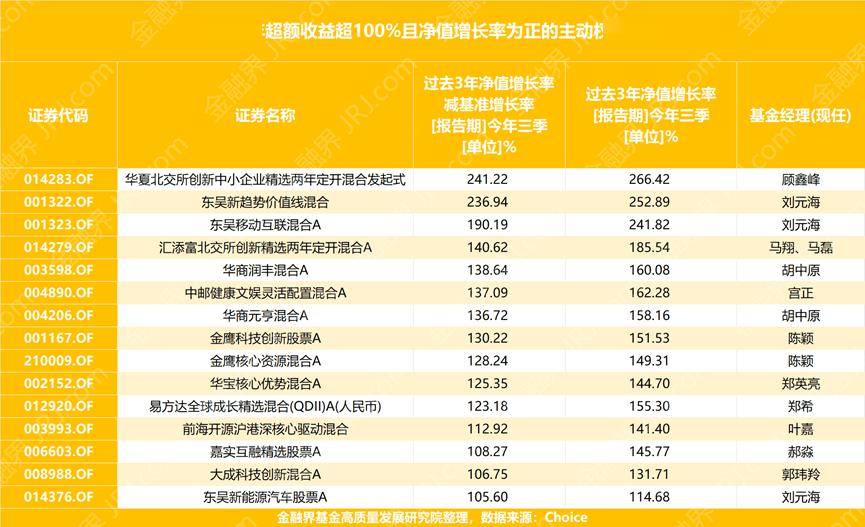
Group 1 - The core viewpoint of the news is the comprehensive restructuring of the compensation system in the fund industry, focusing on long-term performance, as outlined in the revised guidelines by the Asset Management Association of China [1] - The revised guidelines state that the performance assessment for fund managers will heavily depend on long-term results, with at least 80% of the performance weight based on results over three years [1] - Specific performance criteria are established: if a fund's performance lags the benchmark by more than 10% with negative returns, the performance pay will decrease by at least 30%; if the performance is below the benchmark but with positive returns, pay will still decrease; and only significant outperformance with positive returns will lead to pay increases [1] Group 2 - As of December 6, among the 1163 actively managed equity funds with over three years of management, 387 funds (23.96%) underperformed their benchmarks and had negative returns, which would result in a pay cut of at least 30% for their managers according to the new guidelines [1] - Conversely, 668 funds (41.36%) generated profits and outperformed the market, qualifying their managers for potential pay increases [1] - A list of fund managers most likely to receive pay increases includes those managing funds with over 100% excess returns and positive net value growth over the past three years, such as Gu Huofeng and Liu Yuanmu, with their respective funds showing excess returns of 241.22% and 236.94% [2]
大成基金: 践行金融报国 赋能实体经济
Zhong Guo Zheng Quan Bao· 2025-12-16 20:34
Core Viewpoint - The article emphasizes the importance of aligning the public fund industry with the strategic directives from the 20th Central Committee of the Communist Party of China, focusing on serving the real economy and promoting high-quality development in the fund industry [2][8]. Group 1: Service to the Real Economy - The public fund industry is tasked with the mission of supporting the real economy, which is essential for its own sustainable growth [3]. - Dachen Fund recognizes the need to enhance the quality and effectiveness of its services to the real economy, aiming to direct financial resources towards innovative and growth-oriented sectors [3][4]. - The company aims to integrate the service to the real economy into its development strategy and daily operations, aligning with the construction of a modern industrial system [3][4]. Group 2: Strengthening Professional Capabilities - Strong professional capabilities are deemed essential for financial services to effectively support the real economy, including excellent research and investment capabilities, a scientific risk control system, and a matching asset management scale [4]. - Dachen Fund has been actively transforming its operations by developing a comprehensive investment research system and enhancing compliance and risk management measures [4]. - The company has seen its total management scale for equity products reach 300 billion yuan, doubling over the past three years, and its fixed-income products reach 400 billion yuan, also nearly doubling [4]. Group 3: Strategic Focus on Key Areas - Dachen Fund is committed to focusing on key strategic areas such as technology finance, green finance, and pension finance, aligning its investment practices with national strategic goals [6][7]. - The company has increased its asset allocation in the information technology sector, with a growing proportion of its public funds directed towards this area [6]. - In green finance, Dachen Fund has integrated ESG factors into its investment decision-making process and has seen its assets in green finance-related funds nearly double over the past three years [6][7]. Group 4: Product Innovation - Product innovation is identified as a crucial approach for public funds to enhance their service to the real economy, addressing the diverse and complex financing needs of market participants [7]. - Dachen Fund has developed a range of innovative products, including ETFs focused on technology and green finance, to better meet the financing demands of strategic sectors [7]. - The company has actively participated in the development of multi-layered capital markets, launching various funds and engaging in new stock issuances and refinancing activities [7]. Group 5: Future Outlook - Looking ahead, Dachen Fund plans to continue its commitment to the principles outlined in the 20th Central Committee's directives, focusing on enhancing professional investment capabilities and innovating practices to contribute to the real economy and national strategies [8].
践行金融报国 赋能实体经济
Zhong Guo Zheng Quan Bao· 2025-12-16 20:19
Core Viewpoint - The article emphasizes the importance of public funds in supporting the real economy and highlights the commitment of Dachen Fund to align its operations with national strategies for high-quality economic development [1][2]. Group 1: Service to the Real Economy - Dachen Fund recognizes that serving the real economy is a fundamental mission of public funds, essential for their own prosperity and development [2]. - The company aims to enhance the quality and effectiveness of its services to the real economy, leveraging its market power to guide financial resources towards innovative and growth-oriented sectors [2][3]. - Dachen Fund's management of various equity products has reached a total scale of 300 billion, doubling in size over the past three years, which enhances its ability to support corporate financing [3]. Group 2: Professional Capability Enhancement - Strong professional capabilities are deemed essential for financial services to the real economy, with Dachen Fund emphasizing the importance of excellent research and investment capabilities, a scientific risk control system, and a matching asset management scale [2][3]. - The company has been actively transforming its investment research system to improve its service quality and adapt to the evolving market demands [3]. Group 3: Strategic Focus and Innovation - Dachen Fund is committed to focusing on key strategic areas, aligning its investment practices with national strategic deployments, and accurately seizing opportunities in the financial sector [3][4]. - The company has significantly increased its investment in technology sectors, with the proportion of assets allocated to information technology rising continuously over the past three years [4]. - Dachen Fund has developed a range of innovative financial products, including ETFs focused on technology and green finance, to better meet the diverse financing needs of the market [5]. Group 4: Future Outlook - Looking ahead, Dachen Fund plans to continue its commitment to serving the real economy, enhancing its professional investment capabilities, and contributing to national strategies and the growth of residents' wealth [6].
大成恒生科技ETF:抛开争议,客观审视被动产品的价值
Shen Zhen Shang Bao· 2025-12-16 10:37
Core Viewpoint - The recent controversy surrounding the Dachen Fund's Hang Seng Technology ETF (159740) reflects a significant divergence in investor sentiment, occurring as the Hang Seng Technology Index has fallen over 16% from its year-to-date high, indicating a potential value reassessment phase for the asset [1] Group 1: Market Sentiment and Valuation - Investor opinions are sharply divided, with some believing that the valuation bottom has been reached and others cautioning against potential losses [1] - The current PE (TTM) of the Hang Seng Technology Index is 23.72, which is at a low percentile compared to the past decade, suggesting a window for rational investors to reassess their allocation [1][3] Group 2: Index Composition and Growth Potential - The Hang Seng Technology Index tracks leading technology stocks listed in Hong Kong, focusing on sectors such as internet, fintech, cloud computing, e-commerce, and digital business, representing core assets of China's new economy [2] - Historical data shows that the index's high growth is often accompanied by periodic adjustments, with a 45% increase in the first three quarters of 2025 followed by a normal market correction [2] Group 3: Investment Efficiency and Risk Management - The index employs a quarterly adjustment mechanism and an 8% weight cap for component stocks, ensuring a focus on quality technology assets while effectively diversifying investment risk [2] - The top ten constituents of the index include major companies like Meituan, Tencent, and Alibaba, with a balanced weight distribution [2] Group 4: Valuation Advantage and Long-term Support - The Hang Seng Technology Index's current valuation provides a safety margin for long-term investors, with a PE of 23.72 compared to the Nasdaq 100's 35.75, indicating a clear valuation advantage [3] - Factors such as accelerated AI commercialization, supportive policies from the 14th Five-Year Plan, and continuous inflow of southbound capital provide long-term support for the index [3] Group 5: Passive Investment Products and Timing Strategies - In a volatile market, passive investment products are becoming effective tools for investors to implement timing strategies due to their high liquidity [4] - The Dachen Hang Seng Technology ETF (159740) ranks first in trading volume in the Shenzhen market, with a circulating share count of 25.133 billion as of December 12 [4] Group 6: Benefits of High Liquidity - High liquidity offers three main advantages for investors: immediate trading capability, cost control through narrow bid-ask spreads, and price stability that aligns closely with index movements [5] - The ETF's closing price of 0.739 yuan on December 12 indicates a minimal tick change of 0.135%, facilitating frequent adjustments without significant transaction costs [5] Group 7: Transparency and Decision-making - The transparency of passive investment products reduces the complexity of timing decisions, allowing investors to focus on market trends rather than product uncertainties [6] - The dynamic optimization mechanism of the index, with a maximum individual stock weight of 8%, ensures it accurately reflects the performance of core technology assets, serving as a reliable market indicator [6]
中证A50指数ETF今日合计成交额8.12亿元,环比增加35.14%
Zheng Quan Shi Bao Wang· 2025-12-16 09:51
Summary of Key Points Core Viewpoint - The trading volume of the China Securities A50 Index ETF reached 812 million yuan today, marking a 35.14% increase compared to the previous trading day [1]. Trading Volume Analysis - The Dachen China Securities A50 ETF (159595) had a trading volume of 244 million yuan, an increase of 123 million yuan, representing a 101.40% rise [1]. - The Ping An China Securities A50 ETF (159593) recorded a trading volume of 138 million yuan, up by 39.56 million yuan, with a 40.39% increase [1]. - The Fortune China Securities A50 ETF (159591) saw a trading volume of 37.27 million yuan, increasing by 20.45 million yuan, which is a 121.57% rise [1]. - Other ETFs such as the Xinhua China Securities A50 ETF (560820) and the China Merchants China Securities A50 ETF (512250) experienced significant increases in trading volume of 423.97% and 201.33%, respectively [1]. Market Performance - As of market close, ETFs tracking the China Securities A50 Index averaged a decline of 1.08%, with the Xinhua China Securities A50 ETF (560820) and the Bosera China Securities A50 ETF (561750) leading the declines at 1.68% and 1.22%, respectively [1].
深证100指数ETF今日合计成交额2.95亿元,环比增加33.55%
Zheng Quan Shi Bao Wang· 2025-12-16 09:51
Group 1 - The total trading volume of the Shenzhen 100 Index ETF reached 295 million yuan today, an increase of 74.03 million yuan compared to the previous trading day, representing a growth rate of 33.55% [1] - Specifically, the E Fund Shenzhen 100 ETF (159901) had a trading volume of 240 million yuan today, up by 70.34 million yuan from the previous day, with a growth rate of 41.47% [1] - The Southern Shenzhen 100 ETF (159212) recorded a trading volume of 36.14 million yuan, an increase of 3.61 million yuan, with a growth rate of 11.10% [1] Group 2 - The Hua Bao Shenzhen 100 ETF (159716) saw a trading volume of 3.01 million yuan, which is an increase of 1.60 million yuan, resulting in a growth rate of 112.69% [1] - The Shenzhen 100 Index (399330) closed down by 1.36%, while the average decline of related ETFs tracking the Shenzhen 100 Index was 1.23% [1] - The ETFs with the largest declines today included the Fortune Shenzhen 100 ETF (159211) and the Rongtong Shenzhen 100 ETF (159219), which fell by 1.40% and 1.31%, respectively [1]
ETF市场上周净流入128亿元,QDII股票ETF“吸金”领衔,中证A500净流入96亿元
Ge Long Hui· 2025-12-16 00:00
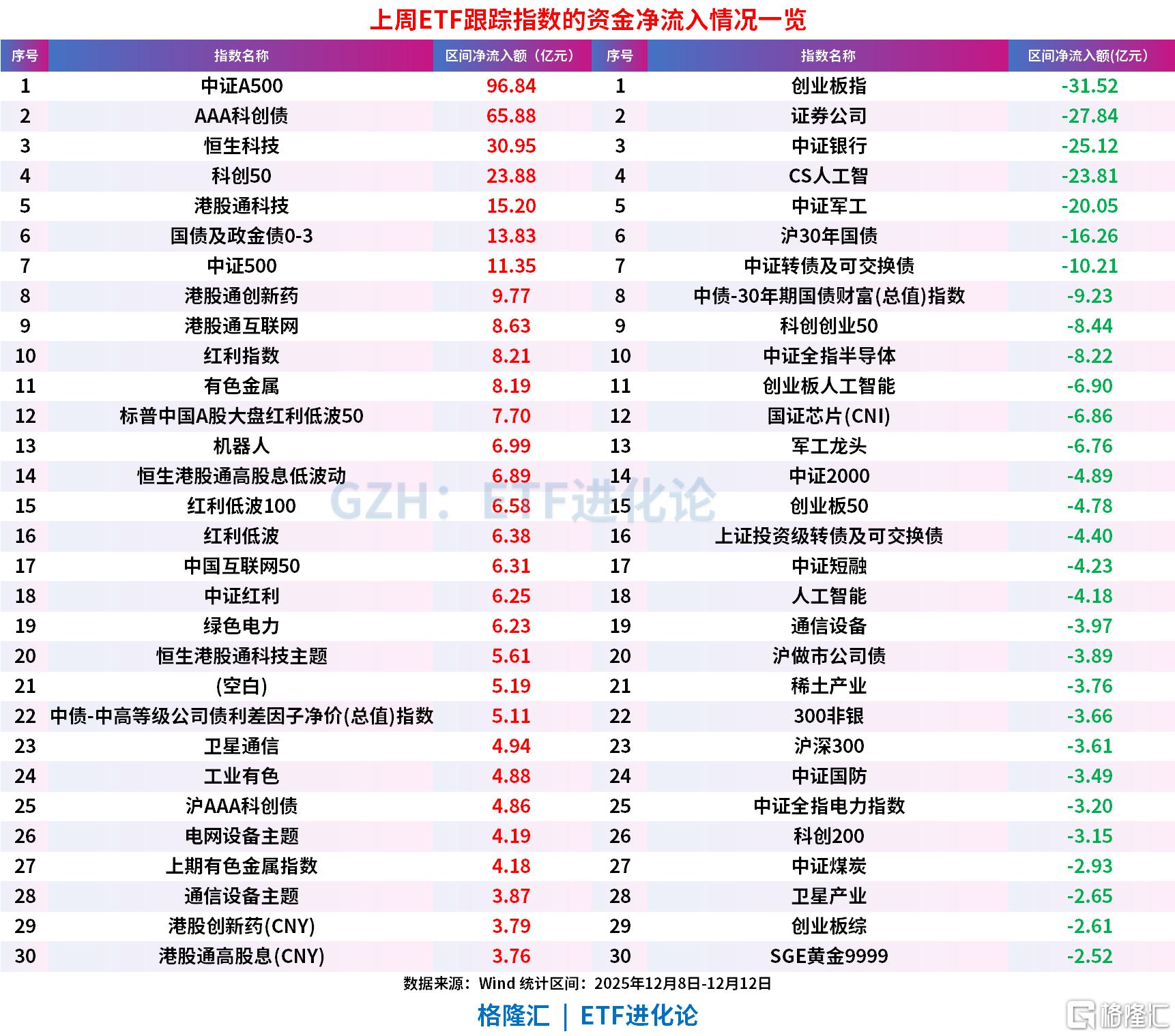
Market Performance - The A-share market showed a mixed performance last week, with the ChiNext Index, STAR 50, and CSI 500 leading in returns at 2.74%, 1.72%, and 1.01% respectively, while the Shanghai Composite Index, CSI 300, and CSI 1000 lagged with returns of -0.34%, -0.08%, and 0.39% respectively [1] - In terms of sectors, telecommunications, defense and military, and electronics performed well with returns of 5.92%, 3.57%, and 2.51% respectively, while coal, oil and petrochemicals, and textiles and apparel had poor performance with returns of -3.80%, -3.43%, and -2.68% respectively [1] Fund Flows - The ETF market saw a net inflow of 128.9 billion yuan last week, with money market ETFs contributing 5.19 billion yuan, stock ETFs 24.11 billion yuan, QDII stock ETFs 53.88 billion yuan, commodity ETFs 2.41 billion yuan, and bond ETFs 43.3 billion yuan [2] - Major indices such as CSI A500, AAA Sci-Tech Bonds, Hang Seng Technology, STAR 50, and others experienced significant net outflows, with CSI A500 seeing a net outflow of 96.84 billion yuan [2][5] ETF Performance - The median weekly return for stock ETFs was 0.20%, with ChiNext ETFs showing the highest median return of 2.76% [11] - Technology ETFs had a median return of 1.46%, while chip ETFs also performed well with a median return of 2.69% [11] - Several communication and artificial intelligence ETFs saw substantial weekly gains, with the Communication Equipment ETF rising by 7.30% and various ChiNext AI ETFs also showing strong performance [12][13] New Fund Launches - A total of 61 funds were reported last week, including 1 REIT, 2 QDIIs, and 5 FOFs, with new ETFs focused on various sectors such as non-ferrous metals and public utilities [18] - The HuaTai BaRui CSI A500 ETF became the first to surpass 30 billion yuan in size, reaching 307.04 billion yuan [18] - The Hong Kong Stock Exchange launched its first stock index, the Hong Kong Stock Exchange Technology 100 Index, aimed at reflecting the performance of the largest 100 technology-related companies listed in Hong Kong [18]
ETF周评| “硬科技”表现亮眼 跨境型ETF获百亿资金青睐
Sou Hu Cai Jing· 2025-12-15 11:18
Market Performance - A-shares showed mixed performance last week, with the Shanghai Composite Index declining by 0.34%, while the Shenzhen Component Index rose by 0.84%, driven by growth sectors like telecommunications and electronics [2] - The ChiNext Index performed particularly well, with a weekly increase of 2.74% [2] ETF Performance - Notable ETFs included the Communication Equipment ETF (159583.SZ), which gained 7.30%, the ChiNext AI ETF (159242.SZ) with a 7.07% increase, and the Sci-Tech Semiconductor ETF (588170.SH) rising by 6.35% [2][3] - Cross-border ETFs and bond ETFs were the main beneficiaries of net inflows, with cross-border ETFs seeing a net inflow of 10.642 billion yuan [2][6] AI Sector Insights - The AI sector emerged as a key investment theme for 2025, with the ChiNext AI ETF (159242.SZ) leading the market with a 7.07% weekly gain [3] - The driving forces behind this trend include significant investments by global cloud computing giants in AI capabilities and accelerated capital expenditures in the industry [3][4] - The AI application landscape is transitioning from experimental stages to large-scale implementation, presenting structural growth opportunities [3] Semiconductor Sector Developments - The semiconductor materials and equipment sector showed significant recovery, with the Sci-Tech Semiconductor ETF (588170.SH) increasing by 6.35% [3] - Key factors driving this sector include the acceleration of the AI computing arms race, ongoing demand for storage solutions, and the rapid development of domestic intelligent computing centers [4] Fund Flows and ETF Size Changes - The A500 ETF from Huatai-PineBridge (563360.SH) became the first in the market to exceed 30 billion yuan in size, growing by 4.126 billion yuan to reach 32.525 billion yuan [12][13] - Conversely, the CSI 300 ETF (159919.SZ) saw a significant reduction in size, decreasing by 3.006 billion yuan [12][14] - The overall trend indicates a preference for broad-based index ETFs, while sector-specific ETFs like the securities and banking ETFs faced substantial outflows [9][11]