喜临门

Search documents
喜临门(603008) - 2025 Q3 - 季度财报
2025-10-29 07:50
Financial Performance - The company's operating revenue for the third quarter reached ¥2,175,649,653.16, an increase of 7.78% compared to the same period last year[5] - The total profit for the quarter was ¥140,260,200.62, reflecting a decrease of 8.50% year-over-year[5] - The net profit attributable to shareholders was ¥132,823,081.77, down 6.10% from the previous year[5] - The basic earnings per share for the quarter was ¥0.35, a decline of 5.41% compared to the same period last year[5] - Total operating revenue for the first three quarters of 2025 reached ¥6,196,159,568.23, an increase of 3.68% compared to ¥5,976,242,905.26 in the same period of 2024[19] - Net profit for the first three quarters of 2025 was ¥394,503,766.49, compared to ¥379,398,133.42 in 2024, representing a growth of 3.08%[20] - Basic earnings per share for the first three quarters of 2025 were ¥1.07, an increase from ¥0.99 in the same period of 2024[22] - The company reported a total comprehensive income of ¥401,279,505.23 for the first three quarters of 2025, compared to ¥372,320,073.18 in 2024, reflecting an increase of 7.4%[20] Assets and Liabilities - The total assets at the end of the reporting period amounted to ¥8,737,944,418.90, a decrease of 1.87% from the end of the previous year[6] - The total assets of the company decreased to RMB 8,737,944,418.90 from RMB 8,904,781,941.06, indicating a reduction of about 1.9%[16] - Total liabilities decreased to ¥4,773,365,452.88 in 2025 from ¥4,983,821,714.47 in 2024, a reduction of approximately 4.22%[17] - The total liabilities decreased to RMB 4,760,389,754.52 from RMB 4,883,254,511.66, indicating a decline of about 2.5%[16] - Total non-current assets were reported at RMB 3,977,554,664.38, a decrease from RMB 4,021,527,429.40, reflecting a decline of approximately 1.1%[16] Shareholder Information - The number of ordinary shareholders at the end of the reporting period was 15,978[11] - The largest shareholder, Zhejiang Huayi Intelligent Manufacturing Co., Ltd., holds 22.83% of the shares, totaling 84,799,659 shares[12] Cash Flow - Cash flow from operating activities for the year-to-date was ¥114,620,025.34, an increase of 183.13% compared to the same period last year[5] - Cash inflow from operating activities for the first three quarters of 2025 reached approximately ¥7.04 billion, an increase of 7.45% compared to ¥6.55 billion in the same period of 2024[23] - Net cash flow from operating activities was ¥114.62 million, significantly up from ¥40.48 million in the first three quarters of 2024, marking an increase of 183.5%[23] - Total cash inflow from investment activities was approximately ¥289.08 million, a substantial increase from ¥94.53 million in the previous year, reflecting a growth of 205.4%[24] - Cash inflow from financing activities totaled approximately ¥2.98 billion, up from ¥2.84 billion in the first three quarters of 2024, indicating an increase of 4.9%[24] Expenses - Research and development expenses for the first three quarters of 2025 were ¥132,537,008.43, compared to ¥125,344,028.93 in 2024, indicating an increase of 5.5%[19] - The company reported a total of RMB 36,927,271.40 in payable employee compensation, down from RMB 82,395,871.25, reflecting a decrease of approximately 55.2%[16] - The company paid approximately ¥183.69 million for the purchase of fixed assets and intangible assets, a decrease from ¥279.51 million in the first three quarters of 2024[24] Borrowings - Short-term borrowings decreased to RMB 1,146,102,533.33 from RMB 1,391,381,828.99, representing a decline of approximately 17.7%[16] - The company’s long-term borrowings rose to ¥863,531,580.56 in 2025 from ¥261,265,558.33 in 2024, showing a significant increase of 230.5%[17]

喜临门(603008.SH)发布前三季度业绩,归母净利润3.99亿元,增长6.45%
智通财经网· 2025-10-29 07:45
智通财经APP讯,喜临门(603008.SH)发布2025年三季度报告,该公司前三季度营业收入为61.96亿元, 同比增长3.68%。归属于上市公司股东的净利润为3.99亿元,同比增长6.45%。归属于上市公司股东的扣 除非经常性损益的净利润为3.94亿元,同比增长7.62%。基本每股收益为1.07元。 ...
喜临门:第三季度净利润为1.33亿元,同比下降6.10%
Xin Lang Cai Jing· 2025-10-29 07:43
喜临门公告,第三季度营收为21.76亿元,同比增长7.78%;净利润为1.33亿元,同比下降6.10%。前三 季度营收为61.96亿元,同比增长3.68%;净利润为3.99亿元,同比增长6.45%。 ...
2025年中国智能床垫行业:AI赋能,床垫智能化大势所趋(精华版)
Tou Bao Yan Jiu Yuan· 2025-10-28 14:18
Investment Rating - The report indicates a positive investment outlook for the smart mattress industry in China, driven by consumer upgrades and advancements in AI technology [2]. Core Insights - The Chinese smart mattress industry is experiencing rapid growth due to rising health awareness, the emergence of the sleep economy, and the deep integration of AI in home settings. Smart mattresses are transitioning from niche products to mainstream consumer goods, with increasing market penetration [2]. - The industry is characterized by strong resilience and significant pricing power, with a current market penetration rate of 60% for mattresses and only 0.2% for smart mattresses, indicating substantial growth potential [4][5]. - The AI mattress market is projected to grow from 7.5 billion yuan in 2021 to 43.9 billion yuan by 2030, with a penetration rate increasing from 1.7% to 14.0% [5][50]. Summary by Sections Industry Overview - The smart mattress industry is propelled by consumer demand for health and wellness products, with a notable focus on sleep quality. The market is evolving with the integration of technologies such as 5G, IoT, and big data [2][3]. Consumer Behavior - Sleep issues are prevalent across generations, with younger individuals tending to stay up late and older adults experiencing frequent awakenings. The demand for home hardware, particularly smart mattresses, is growing as consumers seek solutions to improve sleep quality [3][16]. Market Dynamics - The mattress industry shows strong resilience during economic downturns, maintaining positive growth even when the real estate market is under pressure. The market is currently fragmented, with leading brands like Mousse and Xilinmen competing in a diverse landscape [4][35]. Technological Evolution - The development of AI mattresses has progressed through three stages: foundational sensing, data insights, and AI-driven sleep management. The focus is now on personalized solutions that adapt to individual sleep patterns [38][40]. Competitive Landscape - The Chinese mattress market remains relatively fragmented compared to the U.S., where a few brands dominate. The concentration ratio (CR5) in China is gradually increasing, indicating potential for further market consolidation [35][37].
2025年睡眠健康品牌推荐:从智能监测到个性化干预的全周期管理
Tou Bao Yan Jiu Yuan· 2025-10-27 14:24
Investment Rating - The report does not explicitly provide an investment rating for the sleep health industry Core Insights - The sleep health industry is focused on improving and maintaining individual sleep quality, driven by increasing consumer demand for quality sleep and technological advancements [5][11] - The market size is projected to grow from 344.68 billion RMB in 2019 to 532.11 billion RMB in 2024, with a compound annual growth rate (CAGR) of 9.07%, and further to 754.12 billion RMB by 2029, with a CAGR of 7.19% [11][13] - The industry is experiencing a shift from single product manufacturing to intelligent solutions, with a focus on personalized and technology-driven products [12][13] Market Background - The sleep health industry encompasses a range of activities and services aimed at improving sleep quality and addressing sleep disorders [6] - The evolution of sleep medicine has progressed significantly since the 19th century, with notable advancements in sleep monitoring technologies [7][8] Market Status - The market is characterized by a growing awareness of sleep health among consumers, with various methods being adopted to improve sleep quality [12] - The demand for sleep health products is driven by a high prevalence of sleep issues, with 48.5% of the population experiencing sleep disturbances [16] Market Competition - The competitive landscape includes major players such as 喜临门, 鱼跃医疗, and 慕思, each with unique strengths in product development and market positioning [21][22] - The evaluation of companies in the industry is based on market capitalization, revenue, and patent counts, indicating their competitive strength and innovation capabilities [17][20] Development Trends - Technological innovation is driving product upgrades, with advancements in sensor technology and AI enhancing sleep monitoring and personalized solutions [35] - A diversified product and service ecosystem is emerging, catering to various consumer needs, including sleep monitoring devices and nutritional supplements [36] - The integration of online and offline sales channels is becoming prevalent, enhancing consumer experience and accessibility to sleep health products [37]
家居用品板块10月27日涨1.64%,美之高领涨,主力资金净流出2.08亿元
Zheng Xing Xing Ye Ri Bao· 2025-10-27 08:25
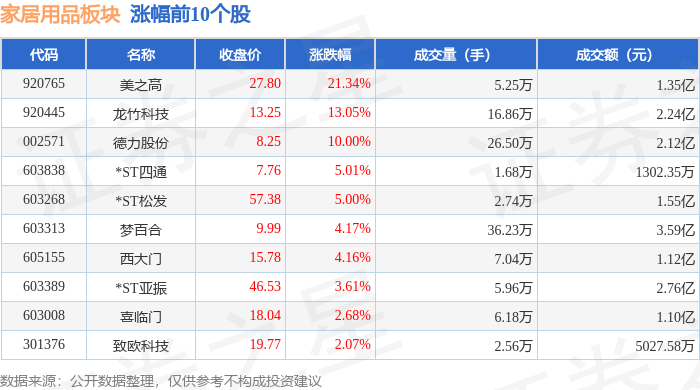
Market Overview - The home goods sector increased by 1.64% on October 27, with Meizhi leading the gains [1] - The Shanghai Composite Index closed at 3996.94, up 1.18%, while the Shenzhen Component Index closed at 13489.4, up 1.51% [1] Top Gainers - Meizhi (920765) closed at 27.80, up 21.34% with a trading volume of 52,500 shares and a turnover of 135 million yuan [1] - Longzhu Technology (920445) closed at 13.25, up 13.05% with a trading volume of 168,600 shares and a turnover of 224 million yuan [1] - Delixi Co., Ltd. (002571) closed at 8.25, up 10.00% with a trading volume of 265,000 shares and a turnover of 212 million yuan [1] Top Losers - Dinggu Zhichuang (300749) closed at 9.75, down 6.43% with a trading volume of 223,000 shares and a turnover of 219 million yuan [2] - Tianzhen Co., Ltd. (301356) closed at 24.46, down 3.81% with a trading volume of 57,400 shares and a turnover of 143 million yuan [2] - C. Marco Polo (001386) closed at 27.52, down 3.57% with a trading volume of 353,900 shares and a turnover of 989 million yuan [2] Capital Flow - The home goods sector experienced a net outflow of 208 million yuan from institutional investors, while retail investors saw a net inflow of 210 million yuan [2] - The detailed capital flow for selected stocks shows varying levels of net inflow and outflow among institutional, speculative, and retail investors [3]


喜临门涨2.05%,成交额4811.50万元,主力资金净流入424.84万元
Xin Lang Cai Jing· 2025-10-27 02:52
Core Viewpoint - The stock of Xilinmen has shown a positive trend with a year-to-date increase of 10.41%, reflecting investor interest and market activity [1][2]. Company Overview - Xilinmen Furniture Co., Ltd. is located in Shaoxing, Zhejiang Province, and was established on November 6, 1996. It was listed on July 17, 2012. The company specializes in the research, production, and sales of mattresses, soft beds, and hotel furniture, along with cultural media-related businesses [1]. - The main revenue composition of the company includes: mattresses 60.37%, soft beds and accessories 27.93%, sofas 8.24%, wooden furniture 1.91%, and others 1.55% [1]. Financial Performance - For the first half of 2025, Xilinmen achieved an operating income of 4.021 billion yuan, representing a year-on-year growth of 1.59%. The net profit attributable to the parent company was 266 million yuan, with a year-on-year increase of 14.04% [2]. - Since its A-share listing, Xilinmen has distributed a total of 802 million yuan in dividends, with 414 million yuan distributed over the past three years [3]. Stock Market Activity - As of October 27, Xilinmen's stock price was 17.93 yuan per share, with a market capitalization of 6.603 billion yuan. The stock has seen a trading volume of 48.115 million yuan and a turnover rate of 0.74% [1]. - The stock has appeared on the "Dragon and Tiger List" twice this year, with the most recent appearance on August 21, where it recorded a net purchase of 62.778 million yuan [1]. Shareholder Information - As of June 30, 2025, the number of shareholders for Xilinmen was 15,700, a decrease of 1.69% from the previous period. The average circulating shares per person were 23,660, down by 0.31% [2]. - Notably, Hong Kong Central Clearing Limited has exited the list of the top ten circulating shareholders [3].
“十五五”规划点名 十万亿级市场启幕 脑机接口升维“国家战略”
Hua Xia Shi Bao· 2025-10-27 00:32
Core Viewpoint - The article discusses the comprehensive deployment of China's 15th Five-Year Plan, emphasizing the development of a modern industrial system, a strong domestic market, and coordinated regional development, with a particular focus on emerging industries like brain-computer interfaces (BCIs) as a key driver for economic growth [1][3][6]. Industry Development - The 15th Five-Year Plan highlights the importance of brain-computer interfaces, which are expected to transition from cutting-edge technology to large-scale applications, becoming a crucial pillar for high-quality economic development in China [6][8]. - The BCI industry is projected to create a market scale in the hundreds of billions, generating numerous high-skilled job opportunities and establishing a new competitive advantage for China in global technology [6][7]. Policy Support - The implementation of the "Implementation Opinions" in 2025 marked a significant leap in policy support for the BCI industry, elevating it to a national strategic level with clear goals for technological breakthroughs and international competitiveness by 2030 [4][6]. - The policy framework includes five key tasks, three major projects, and 17 specific measures to create a closed-loop system of research, industry, and application, fostering the integration of BCIs with traditional industries [4][7]. Market Potential - Companies are actively exploring the commercial potential of BCIs, with various business models emerging, including partnerships for medical applications and consumer electronics [7]. - The BCI market is expected to expand significantly during the 15th Five-Year Plan, driven by decreasing costs and standardization, transitioning from niche applications to mainstream adoption [7][8]. Technological Advancements - The BCI system is categorized into non-invasive, partially invasive, and fully invasive devices, with advancements expected in precision, safety, and accessibility during the 15th Five-Year Plan [6][7]. - Collaboration between academia and industry is anticipated to accelerate breakthroughs in critical areas such as electrode materials and signal decoding efficiency, enhancing the overall performance of BCI technologies [6][7].
十五五”规划点名,十万亿级市场启幕,脑机接口升维“国家战略
Hua Xia Shi Bao· 2025-10-26 00:38
Group 1: Core Economic and Social Development Strategies - The "15th Five-Year Plan" emphasizes the construction of a modern industrial system, a strong domestic market, and coordinated regional development [1] - The plan aims to cultivate emerging and future industries, with a focus on sectors like quantum technology, bio-manufacturing, hydrogen energy, nuclear fusion, brain-machine interfaces, embodied intelligence, and 6G mobile communication [2][5] Group 2: Brain-Machine Interface (BMI) Industry Development - The BMI technology is recognized for its potential to transform economic structures and improve social welfare, with applications in medical rehabilitation and industrial manufacturing [2] - The "Implementation Opinions" issued in July 2025 will elevate the BMI industry to a national strategic level, aiming for breakthroughs in core technologies by 2027 and positioning the industry among the world's leaders by 2030 [3][5] - The BMI industry is projected to create a market scale in the hundreds of billions, generating numerous high-skilled jobs and enhancing China's competitive edge in global technology [5][6] Group 3: Policy and Market Support - The policy framework for BMI has evolved from local pilot projects to a comprehensive national strategy, fostering a collaborative environment among various government departments [3] - Local governments are responding rapidly, with initiatives like the establishment of specialized action plans and funding to support BMI innovation and development [3][4] - The integration of AI with BMI is expected to enhance the efficiency of brain signal decoding, leading to significant advancements in the industry [5][6] Group 4: Commercialization and Market Applications - Companies are exploring diverse business models in the BMI sector, including partnerships for clinical applications and consumer products, indicating a dual focus on B2B and B2C markets [6] - The BMI technology is anticipated to transition from niche applications to widespread use, aligning with China's goals for health and digital economy [6][7] - The current trajectory of BMI development in China highlights significant advancements in medical applications, particularly in areas like Parkinson's disease and mental health, supported by strong policy and market demand [6][7]
“十五五”规划点名,十万亿级市场启幕,脑机接口升维“国家战略”
Hua Xia Shi Bao· 2025-10-25 09:45
Core Viewpoint - The article discusses the comprehensive deployment of China's 15th Five-Year Plan, emphasizing the development of a modern industrial system, a strong domestic market, and coordinated regional development, with a particular focus on emerging industries like brain-machine interfaces [2][3][4]. Industry Development - The 15th Five-Year Plan aims to cultivate new pillar industries, with a focus on future industries such as quantum technology, bio-manufacturing, hydrogen energy, nuclear fusion, brain-machine interfaces, embodied intelligence, and 6G mobile communication [3][4]. - Brain-machine interface technology is highlighted for its potential to transform economic structures and improve societal welfare, enabling applications in medical rehabilitation, industrial manufacturing, and consumer electronics [3][4]. Policy Support - The brain-machine interface has been officially recognized as a future industry by the Ministry of Industry and Information Technology and other departments, marking its entry into national strategic planning [4][5]. - The "Implementation Opinions" released in July 2025 set clear goals for the brain-machine interface industry, aiming for breakthroughs in core technologies by 2027 and positioning the industry among the world's leaders by 2030 [4][5]. Market Potential - The brain-machine interface industry is projected to create a market scale in the hundreds of billions, generating numerous high-skilled job opportunities and establishing a new competitive advantage for China in global technology [6][7]. - The industry is expected to evolve towards more precise, safer, and more accessible technologies during the 15th Five-Year Plan, with significant advancements in hardware and software capabilities [6][7]. Commercial Applications - Companies are actively engaging in the brain-machine interface space, with various business models targeting both B2B and B2C markets, including medical rehabilitation and consumer electronics [7][8]. - Examples of commercial initiatives include partnerships for developing implantable systems, clinical transformation centers, and innovative products like brain-controlled games and smart mattresses [7][8]. Conclusion - The emphasis on brain-machine interfaces in the 15th Five-Year Plan signifies a shift from following to leading in this technology, aligning with China's development philosophy centered on improving human welfare [8].