
中国建筑

Search documents
房屋建设板块12月30日跌1.09%,宁波建工领跌,主力资金净流出2.15亿元
Zheng Xing Xing Ye Ri Bao· 2025-12-30 09:07
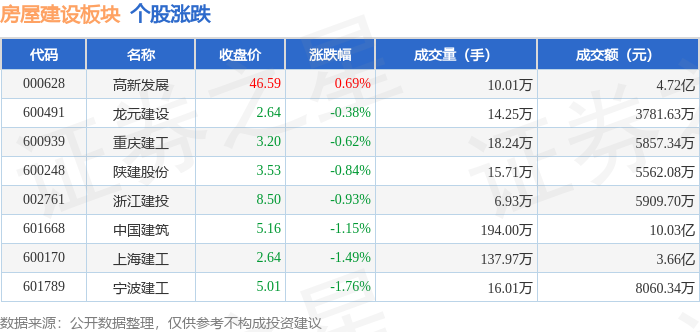
Market Overview - The housing construction sector declined by 1.09% compared to the previous trading day, with Ningbo Construction leading the decline [1] - The Shanghai Composite Index closed at 3965.12, down 0.0%, while the Shenzhen Component Index closed at 13604.07, up 0.49% [1] Stock Performance - Key stocks in the housing construction sector showed varied performance, with the following notable changes: - Gaoxin Development: Closed at 46.59, up 0.69% with a trading volume of 100,100 shares and a transaction value of 472 million [1] - Longyuan Construction: Closed at 2.64, down 0.38% with a trading volume of 142,500 shares and a transaction value of 37.82 million [1] - China State Construction: Closed at 5.16, down 1.15% with a trading volume of 1,940,000 shares and a transaction value of 1.003 billion [1] - Ningbo Construction: Closed at 5.01, down 1.76% with a trading volume of 160,100 shares and a transaction value of 80.60 million [1] Capital Flow - The housing construction sector experienced a net outflow of 215 million from main funds, while retail investors saw a net inflow of 77.03 million [1] - The following details highlight the capital flow for key stocks: - Gaoxin Development: Main funds net inflow of 29.88 million, retail net outflow of 29.77 million [2] - Longyuan Construction: Main funds net inflow of 2.13 million, retail net inflow of 0.33 million [2] - Ningbo Construction: Main funds net outflow of 14.37 million, retail net inflow of 11.29 million [2] - China State Construction: Main funds net outflow of 1.67 billion, retail net inflow of 44.44 million [2]


丰台楼市,库存破万套
Sou Hu Cai Jing· 2025-12-30 04:16
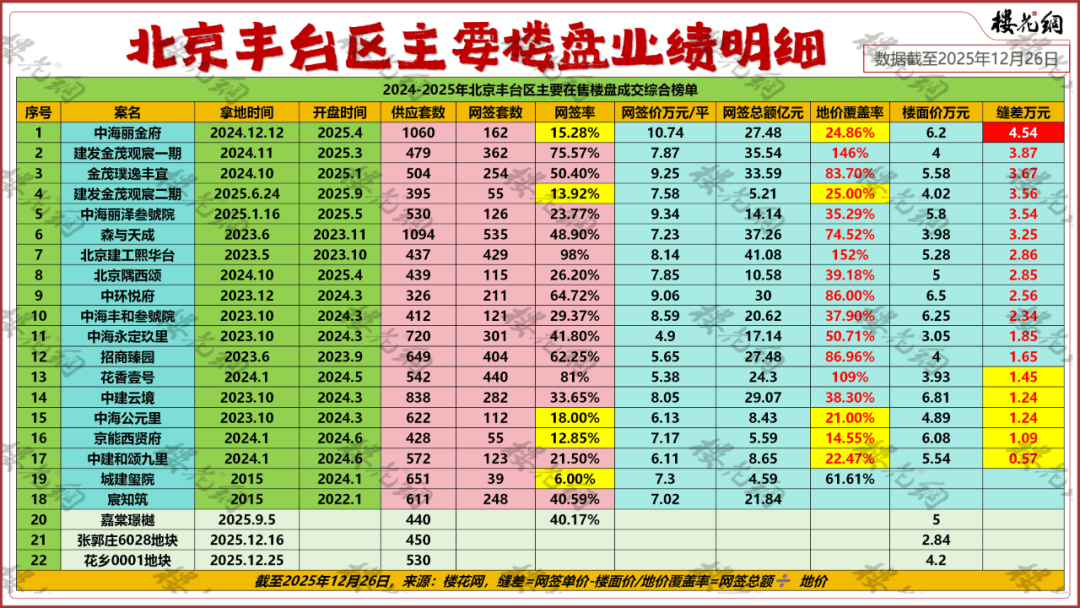
Core Insights - The acquisition of the Huaxiang 0001 land parcel by Beijing Construction Group is seen as a significant event in the Fengtai real estate market, with a notably low floor price of 42,000 yuan per square meter, which is expected to disrupt the local market dynamics [2][12][26] Group 1: Market Overview - Fengtai's real estate market is currently sluggish, with a total of 12,729 units available across 19 projects, and an expected new inventory exceeding 10,000 units [20][21] - The average signing rate for the 19 projects is 40.19%, with the top three projects achieving rates of 98%, 81%, and 75.57% respectively [21][22] - The average land price coverage rate across 17 projects is 61.61%, indicating a competitive pricing environment [23] Group 2: Impact of Huaxiang 0001 Land Parcel - The Huaxiang 0001 land parcel's pricing strategy is expected to significantly impact nearby projects, particularly Beijing Yuxi Song, which is already facing challenges with a signing rate of 26.2% and an average price of 78,500 yuan per square meter [15][26] - The introduction of the Huaxiang 0001 parcel is likely to create a competitive pricing pressure on existing developments, categorized into three tiers based on their vulnerability to this new entry [12][26] - The projected pricing for the new development is suggested to be around 75,000 yuan per square meter, which would still allow for profitability given the low floor price [10][12] Group 3: Key Metrics for Analysis - Three critical metrics for understanding the Fengtai market are the signing rate, land price coverage rate, and price gap (缝差) [21][26] - The maximum price gaps among the projects indicate varying levels of pricing strength, with the highest gaps being 45,400 yuan, 38,700 yuan, and 36,700 yuan per square meter for specific projects [24] - The analysis suggests that projects like Xihua Tai, Guancheng Phase I, and Huaxiang No. 1 are positioned as the biggest winners in the current market landscape [26]
中国建筑:目前公司围绕老年友好型社区建设、居家养老空间改造、适老化设施集成等方向开展系统研究
Zheng Quan Ri Bao Wang· 2025-12-29 12:16
Core Viewpoint - The company is actively conducting systematic research on the construction of elderly-friendly communities, home care space renovation, and the integration of age-friendly facilities in response to the transformation of China's population structure [1] Group 1 - The company is focusing on elderly-friendly community construction as part of its strategic initiatives [1] - Systematic research is being carried out in areas such as home care space renovation and age-friendly facility integration [1] - The related work is progressing steadily according to plan [1]

房屋建设板块12月29日涨0.27%,中国建筑领涨,主力资金净流出1091.22万元
Zheng Xing Xing Ye Ri Bao· 2025-12-29 09:06
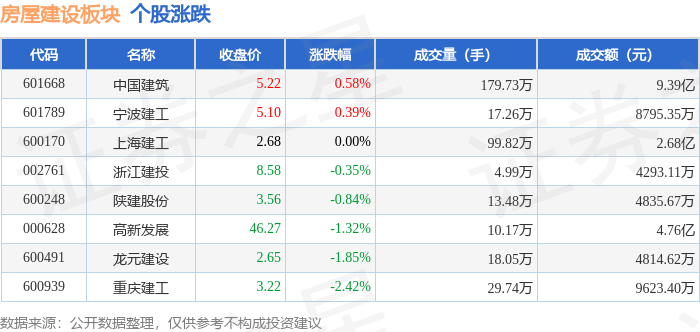
Group 1 - The housing construction sector increased by 0.27% on December 29, with China State Construction leading the gains [1] - The Shanghai Composite Index closed at 3965.28, up 0.04%, while the Shenzhen Component Index closed at 13537.1, down 0.49% [1] - Key stocks in the housing construction sector showed mixed performance, with China State Construction closing at 5.22, up 0.58%, and several others like Shaanxi Construction and High-tech Development experiencing declines [1] Group 2 - The net capital flow in the housing construction sector showed a net outflow of 10.91 million yuan from main funds, while retail investors had a net inflow of 8.52 million yuan [1] - Detailed capital flow data indicated that China State Construction had a net inflow of 50.19 million yuan from main funds, despite a net outflow from retail investors [2] - Other companies like Shaanxi Construction and Chongqing Construction experienced significant net outflows from main funds, indicating varying investor sentiment across the sector [2]
安全舒适、绿色智慧的“好房子”如何建
Ren Min Ri Bao· 2025-12-29 04:47
提升建造和服务水平。我国稳步发展装配式建筑,开展智能建造试点,实施政府采购支持绿色建材促进 建筑品质提升政策,通过积极推广新型建造方式,有力保障住房建设质量。此外,开展完整社区建设试 点,补齐停车充电、休闲健身等服务设施短板。实施物业服务质量提升行动,引导各地规范物业服务行 为,提升小区环境卫生、共有设施设备运行维护水平。 "'好房子'建设首先要坚持问需于民,满足百姓需求。各地方和企业在制定相关标准的过程中,要将调 研了解群众需求作为主要工作。"住房城乡建设部标准定额司相关负责人介绍,例如,中国建筑集团有 限公司开展问卷调查,梳理上百项住房领域的群众需求,在此基础上构建"好房子"营造体系,从好设 计、好建造、好材料和好运维等方面,提出支撑"好房子"建设的技术路径与举措。 鼓励因地制宜。"好房子"建设应避免大呼隆、一刀切,不同地方、不同价位、不同面积要有不同的"好 房子"。目前,各地因地制宜分类开展"好房子"建设探索实践。其中,福建省推动福州市、厦门市等地 加快完善配套政策,选取部分保障性住房项目作为"好房子"试点。北京市开展"原拆原建"改造,推动老 房子变"好房子",例如桦皮厂8号楼危旧房改建等项目,运用混凝 ...
2026财政政策持续积极,洁净室需求持续提升
Guotou Securities· 2025-12-28 12:31
Investment Rating - The report maintains an investment rating of "Leading the Market - A" for the construction industry, indicating an expected return that will outperform the CSI 300 index by 10% or more over the next six months [6]. Core Insights - The 2026 fiscal policy is set to remain proactive, with a focus on increasing fiscal spending and optimizing government bond tools to enhance local financial capabilities. This is expected to support economic growth and improve the construction industry's operational conditions [18][11]. - Infrastructure investment has shown signs of recovery, with November data indicating a month-on-month improvement. The construction sector is anticipated to stabilize as policies aimed at debt reduction and "anti-involution" continue to be implemented [2][11]. - The demand for cleanroom construction is expected to rise due to increased capital expenditures in the semiconductor and cloud service sectors, driven by rapid advancements in AI technology [3][15]. Summary by Sections Industry Dynamics - The national fiscal work conference highlighted the achievements of 2025 and outlined the key tasks for 2026, emphasizing a more active fiscal policy to stimulate consumption and manage risks in key areas [18]. - The construction industry is expected to benefit from a combination of improved fiscal policies and a recovering investment environment, leading to marginal improvements in operational performance [2][11]. Market Performance - The construction industry saw a weekly increase of 2.26%, outperforming the CSI 300 index, with the decoration and renovation sector showing the highest growth at 11.37% [20][21]. - The overall industry valuation metrics indicate a TTM P/E ratio of 12.47 and a P/B ratio of 0.83, with several companies showing low valuations, suggesting potential investment opportunities [24][28]. Key Companies to Watch - Recommended companies include low-valuation state-owned enterprises such as China State Construction, China Communications Construction, and China Railway Construction, which are expected to benefit from improved cash flow and profitability [11][13]. - Cleanroom engineering leaders like Yaxin Integration and Shenghui Integration are highlighted for their potential growth due to increasing demand in the semiconductor sector [3][15].





2025上市公司碳排放排行榜暨双碳领导力榜
Cai Jing Wang· 2025-12-26 14:51
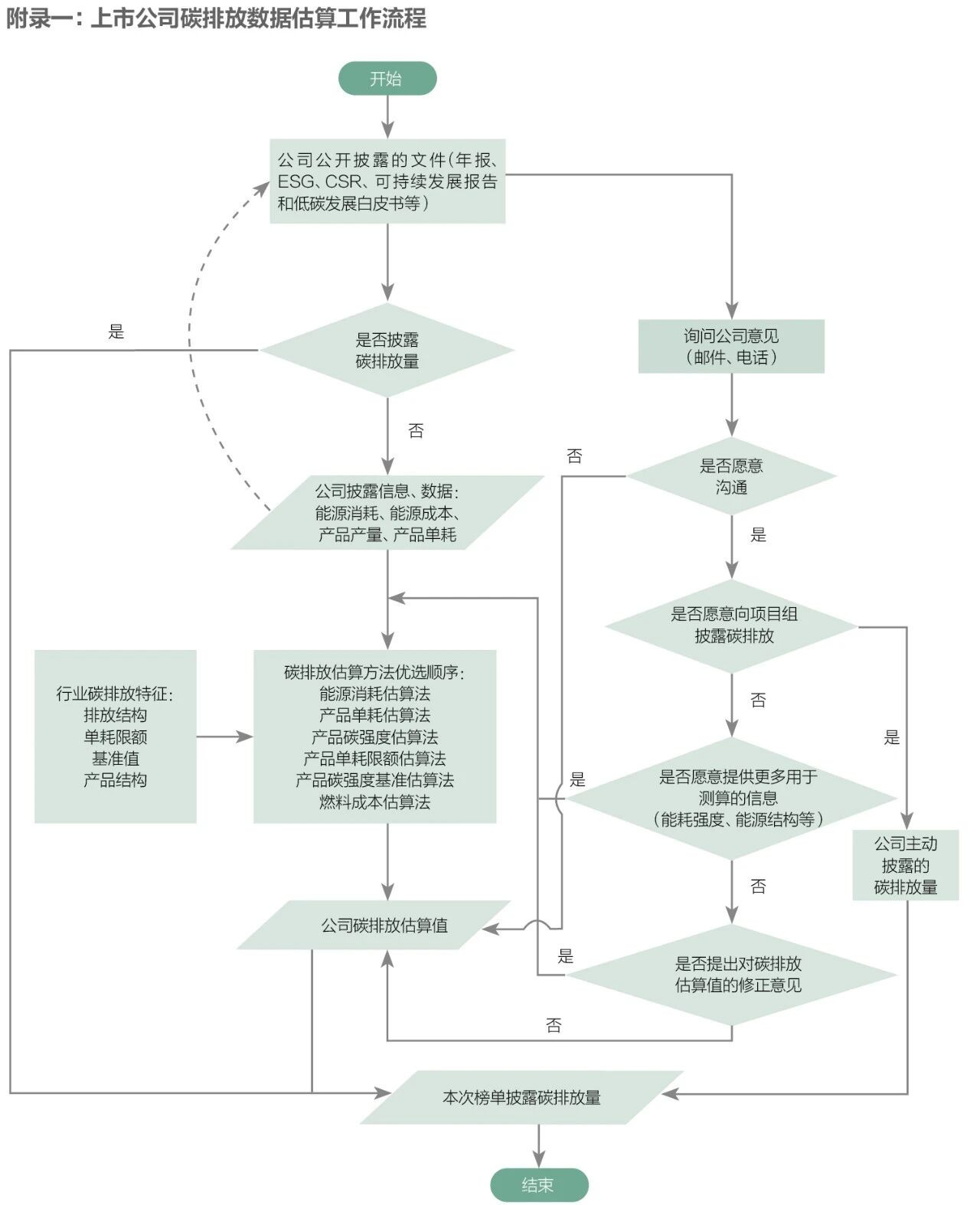
Core Insights - The total carbon emissions of the top 100 listed companies in China for 2024 are projected to be 5.134 billion tons, a decrease of 2.7 million tons compared to 2023, indicating a potential peak in emissions [1][6][11] - The disclosure rate of carbon emissions among these companies has increased from 43% in 2021 to an expected 80% by 2025, reflecting a growing awareness and commitment to carbon reduction [1][5][23] Group 1: Carbon Emissions Overview - The carbon emissions of the top 100 listed companies in 2024 are 5.134 billion tons, which is a 0.52% decrease from 5.161 billion tons in 2023 [6][11] - The top ten companies account for approximately 38% of the total emissions, highlighting the concentration of emissions among a few major players [2][6] - The threshold for inclusion in the carbon emissions ranking has decreased to 10.3128 million tons in 2024, down from 11.5329 million tons in 2023, indicating a reduction in emissions intensity among leading high-carbon companies [6][11] Group 2: Industry Emission Trends - The power industry remains the largest contributor to carbon emissions, accounting for approximately 2.29 billion tons in 2024, maintaining a significant share of the total emissions [15] - The cement industry follows with emissions of about 770 million tons, continuing a downward trend for four consecutive years [15] - The steel industry has seen a notable decrease in emissions, returning to levels close to those of 2022, with emissions around 580 million tons [15][18] Group 3: Carbon Efficiency Metrics - The average carbon efficiency of the top 100 companies in 2024 is 0.399 million yuan per ton, remaining stable compared to 0.40 million yuan per ton in 2023 [20][21] - The carbon efficiency has improved by 10.83% from 2021 to 2024, indicating a positive trend in decoupling economic output from carbon emissions [20] - Seven industries have shown improvements in carbon efficiency, with the chemical industry achieving the most significant increase, reaching 0.39 million yuan per ton, the highest in three years [20][21] Group 4: Disclosure and Transparency - In 2024, 80 companies disclosed their carbon emissions data, an increase from 65 in 2023, achieving the highest disclosure rate in four years [23] - The disclosure rate for the power industry is 77.42%, while the cement industry leads with 85.71%, consistently above the average [26] - A-share companies have seen a significant rise in disclosure rates, from 16.67% in 2021 to 70.97% in 2024, indicating improved transparency in carbon reporting [26][27]




房屋建设板块12月26日跌0.23%,重庆建工领跌,主力资金净流出732.52万元
Zheng Xing Xing Ye Ri Bao· 2025-12-26 09:07
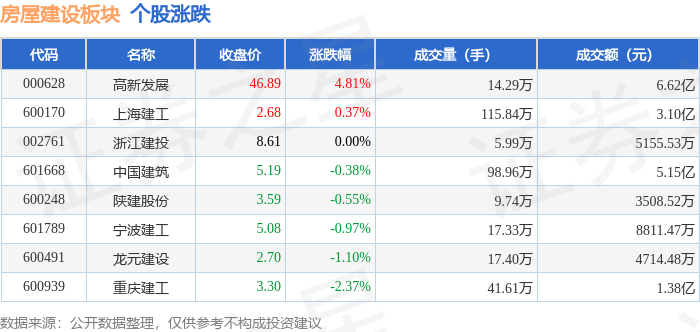
Core Viewpoint - The housing construction sector experienced a decline of 0.23% on December 26, with Chongqing Construction leading the drop, while the Shanghai Composite Index rose by 0.1% and the Shenzhen Component Index increased by 0.54% [1] Group 1: Market Performance - The closing price for the Shanghai Composite Index was 3963.68, and for the Shenzhen Component Index, it was 13603.89 [1] - High-tech Development saw a significant increase of 4.81%, closing at 46.89, while Chongqing Construction fell by 2.37%, closing at 3.30 [1] - The trading volume for High-tech Development was 142,900 shares, with a transaction value of 662 million yuan [1] Group 2: Capital Flow - The housing construction sector had a net outflow of 7.3252 million yuan from main funds, while retail investors saw a net inflow of 52.2298 million yuan [1] - High-tech Development had a main fund net inflow of 77.3998 million yuan, but retail funds saw a net outflow of 37.3425 million yuan [2] - Chongqing Construction experienced a net outflow of 8.9380 million yuan from main funds, with a retail net inflow of 9.5688 million yuan [2]

稳经营、提质效 中央企业推动关键产业向新向优
Ren Min Ri Bao· 2025-12-26 05:45
Core Insights - Central enterprises are expected to play a crucial role in supporting the high-quality development of the economy and improving people's livelihoods, as emphasized by General Secretary Xi Jinping [1] Group 1: Strengthening Scale and Capability - The total assets of central enterprises have exceeded 90 trillion yuan, marking significant growth [2] - Central enterprises have successfully launched various innovative projects, including the world's first commercial supercritical carbon dioxide power generation unit and the largest green hydrogen-ammonia integrated project [2] - Research and development expenditures have surpassed 5 trillion yuan, with an annual investment growth rate in emerging industries exceeding 20% [2] Group 2: Industrial Upgrading and Innovation - Central enterprises are focusing on technological innovation to enhance industrial capabilities, with 438 technology breakthroughs reported this year [3] - The implementation of AI technologies has led to the establishment of over 800 application scenarios and the creation of 1,854 smart factories [3] - Energy efficiency has improved, with energy consumption and carbon emissions per unit of output decreasing by 12.8% and 13.9% respectively during the "14th Five-Year Plan" period [3] Group 3: Strategic Function and Governance - Nine new central enterprises have been established as part of the ongoing reform of state-owned enterprises, with a focus on strategic restructuring [4] - The management levels of central enterprises have been streamlined to a maximum of four tiers, enhancing operational efficiency [5] - The State-owned Assets Supervision and Administration Commission (SASAC) has implemented a more scientific regulatory approach, including a tailored assessment for each enterprise [5]
稳经营、提质效——中央企业推动关键产业向新向优
Ren Min Ri Bao· 2025-12-26 04:43
Core Insights - Central enterprises are expected to enhance their roles in serving the national economic development and improving people's livelihoods, contributing significantly to China's modernization efforts [1] Group 1: Strengthening Scale and Capability - Central enterprises have seen their total assets exceed 90 trillion yuan, with significant advancements in various sectors, including the successful operation of the world's first commercial supercritical carbon dioxide power generation unit and the launch of the largest green hydrogen-ammonia integrated project [2] - The cumulative R&D expenditure of central enterprises has surpassed 5 trillion yuan, with an annual investment growth rate in emerging industries exceeding 20% [2] - The number of technology talents in central enterprises has increased by nearly 50%, enhancing their scale, value creation capabilities, and brand influence [2] Group 2: Industrial Upgrading and Innovation - Central enterprises are focusing on technological innovation to drive industrial transformation, with 438 technology breakthroughs achieved this year [3] - The implementation of the "Artificial Intelligence +" initiative has led to over 800 application scenarios and the establishment of 1,854 smart factories [3] - During the "14th Five-Year Plan" period, energy consumption per unit of output and carbon dioxide emissions per unit of output have decreased by 12.8% and 13.9%, respectively [3] Group 3: Strategic Function and Governance - The establishment of 9 new central enterprises has been completed as part of the deepening reform of state-owned enterprises, with a focus on strategic restructuring [4] - The management levels of central enterprises are now controlled within four tiers, improving management efficiency and transparency [5] - The State-owned Assets Supervision and Administration Commission (SASAC) has implemented a more scientific regulatory approach, including a tailored assessment for each enterprise and the establishment of a national property information database [5]



