DeepMind

Search documents
X @Decrypt
Decrypt· 2025-09-19 20:40
Google's DeepMind uncovered surprising solutions to the equations governing fluid dynamics, potentially accelerating vehicle design, improving weather forecasting, and forging a new path for scientific discovery. https://t.co/1NHV0By1Ds ...

X @Decrypt
Decrypt· 2025-09-19 18:39
Google DeepMind AI Cracks Century-Old Fluid Mysteries, Pointing to New Era in Science► https://t.co/ewDzkZH429 https://t.co/ewDzkZH429 ...
X @Demis Hassabis
Demis Hassabis· 2025-09-17 17:38
RT Sundar Pichai (@sundarpichai)Incredible milestone: an advanced version of Gemini 2.5 Deep Think achieved gold-medal performance at the ICPC World Finals, a top global programming competition, solving an impressive 10/12 problems. Such a profound leap in abstract problem-solving - congrats to @googledeepmind! ...
The Most Underrated AI Model
20VC with Harry Stebbings· 2025-09-17 05:00
I definitely feel like a lot of the Gemini Flash models are also extraordinary and underappreciated on Evals, especially their small models I'm always amazed with. So, if I had to choose, maybe not a company, but especially set of models, I think the DeepMind team did a really phenomenal job on a lot of those smaller models. ...


一文读懂GPT-5的绝招,这是决定AI未来的隐形武器
3 6 Ke· 2025-09-16 10:43
Core Insights - The article discusses the significance of the "Universal Verifier" in the evolution of AI models, particularly in the context of GPT-5 and its performance enhancements [2][3] - It highlights the limitations of previous reinforcement learning methods, particularly "Reinforcement Learning with Verifiable Rewards" (RLVR), in complex real-world scenarios where answers are not binary [2][4] - The article outlines two main approaches to developing the Universal Verifier: enhancing the evaluation criteria and allowing models to self-assess their outputs [36][44] Group 1: Universal Verifier and Its Importance - The Universal Verifier is seen as a potential breakthrough in AI, addressing the shortcomings of RLVR by enabling models to evaluate answers in a more nuanced manner [2][10] - The need for a more sophisticated evaluation system arises from the complexity of real-world problems, especially in fields like healthcare and education, where answers are not simply right or wrong [2][11] - The article emphasizes that understanding the Universal Verifier is crucial for grasping the future of AI technology and competition [3] Group 2: Approaches to Developing the Universal Verifier - The first approach involves using large language models (LLMs) as judges to create a more complex evaluation standard, which has been explored in various research papers [4][5][6] - The second approach focuses on self-assessment, where models evaluate their own outputs based on internal confidence levels, reducing reliance on external validation [44][45] - The RaR (Rubrics as Rewards) framework is introduced as a method to create detailed scoring criteria for evaluating model outputs, leading to significant performance improvements in specific domains [19][21][22] Group 3: Performance Improvements and Results - The article presents data showing that models trained using the RaR framework achieved substantial performance gains, with scores in medical evaluations increasing nearly fourfold [21][22] - Comparisons with other evaluation methods indicate that RaR outperformed traditional approaches, demonstrating its effectiveness in complex reasoning tasks [22][24] - The Rubicon framework further enhances the scoring system by incorporating over 10,000 evaluation criteria, leading to improved performance in subjective areas like creative writing [27][28] Group 4: Future Directions and Challenges - The article discusses the limitations of current approaches, noting that while RaR and Rubicon show promise, they still rely on expert-defined criteria, which may hinder scalability [69][70] - The INTUITOR method represents a shift towards internal feedback mechanisms, allowing models to learn without predefined answers, but it also faces challenges in generalizability [59][60] - The OaK architecture is proposed as a long-term vision for AI, aiming for a system that learns and evolves through interaction with the environment, though it remains a distant goal [70][77]
Google to invest £5 billion in UK AI as Trump heads for state visit
CNBC· 2025-09-16 08:59
Core Viewpoint - Google, through its parent company Alphabet, announced a £5 billion ($6.8 billion) investment in the U.K. for artificial intelligence development, coinciding with U.S. President Donald Trump's state visit [1][2] Group 1: Investment Details - The £5 billion investment will support the development of AI technologies and is expected to create 8,250 jobs annually in U.K. businesses [3] - A new state-of-the-art data center will be opened in Waltham Cross, approximately 12 miles (19 kilometers) north of central London, to meet the growing demand for AI-powered services [2][3] Group 2: Economic Impact - The investment is projected to contribute £400 billion to the U.K. economy by 2030, enhancing critical social services [4] - U.K. Finance Minister Rachel Reeves described the investment as a "powerful vote of confidence" in the U.K. economy and the partnership with the U.S. [3]

2025年9月15日全球科技新闻汇总
Haitong Securities International· 2025-09-15 08:07
Investment Rating - The report does not explicitly provide an investment rating for the industry Core Insights - Japan's Ministry of Economy, Trade and Industry announced subsidies exceeding 500 billion yen (approximately $3.64 billion) for Micron's next-generation DRAM R&D and mass production [21] - Micron plans to invest 1.5 trillion yen by the end of the 2029 fiscal year to enhance production capacity at its Hiroshima plant, aiming for a monthly output of 40,000 advanced DRAM wafers [22] - Apple is expected to introduce chips using TSMC's 2-nanometer process in 2026, securing nearly half of TSMC's initial capacity, which will strengthen TSMC's market position [26][29] - xAI has laid off over 500 data labelers to focus on expanding its team of Specialist AI Tutors for the Grok model [34][35] - Google is shifting its TPU strategy to a "Hardware-as-a-Service" model, deploying TPUs in third-party data centers while retaining ownership, aiming to penetrate NVIDIA's market [38][42] Summary by Sections Japan's Semiconductor Industry - The Japanese government will subsidize one-third of Micron's production line equipment investment, with a maximum of 500 billion yen [23] - The total amount of subsidies to Micron has reached 774.5 billion yen, ensuring a stable supply of semiconductors crucial for economic security [24] Apple and TSMC - Apple's new product strategy includes a "three-tier version" of its A-series processors, enhancing product differentiation and potentially impacting future M-series processors [28][30] - The tiering strategy may complicate product naming and positioning, leading to a reliance on benchmark tests rather than model numbers [33] xAI and AI Industry - xAI's restructuring involves significant layoffs in its data labeling team, which was the largest department, indicating a shift in focus towards specialized AI roles [34][36] Google TPU Strategy - Google's TPU strategy involves a partnership model where TPUs are deployed in third-party data centers, allowing for revenue sharing while avoiding direct competition with NVIDIA [41][42] - This approach lowers capital expenditure barriers for partners and expands the potential customer base for Google TPUs [43][46]


谷歌靠Nano Banana超越ChatGPT,登顶苹果App Store第一,玩疯了玩疯了
3 6 Ke· 2025-09-15 07:33
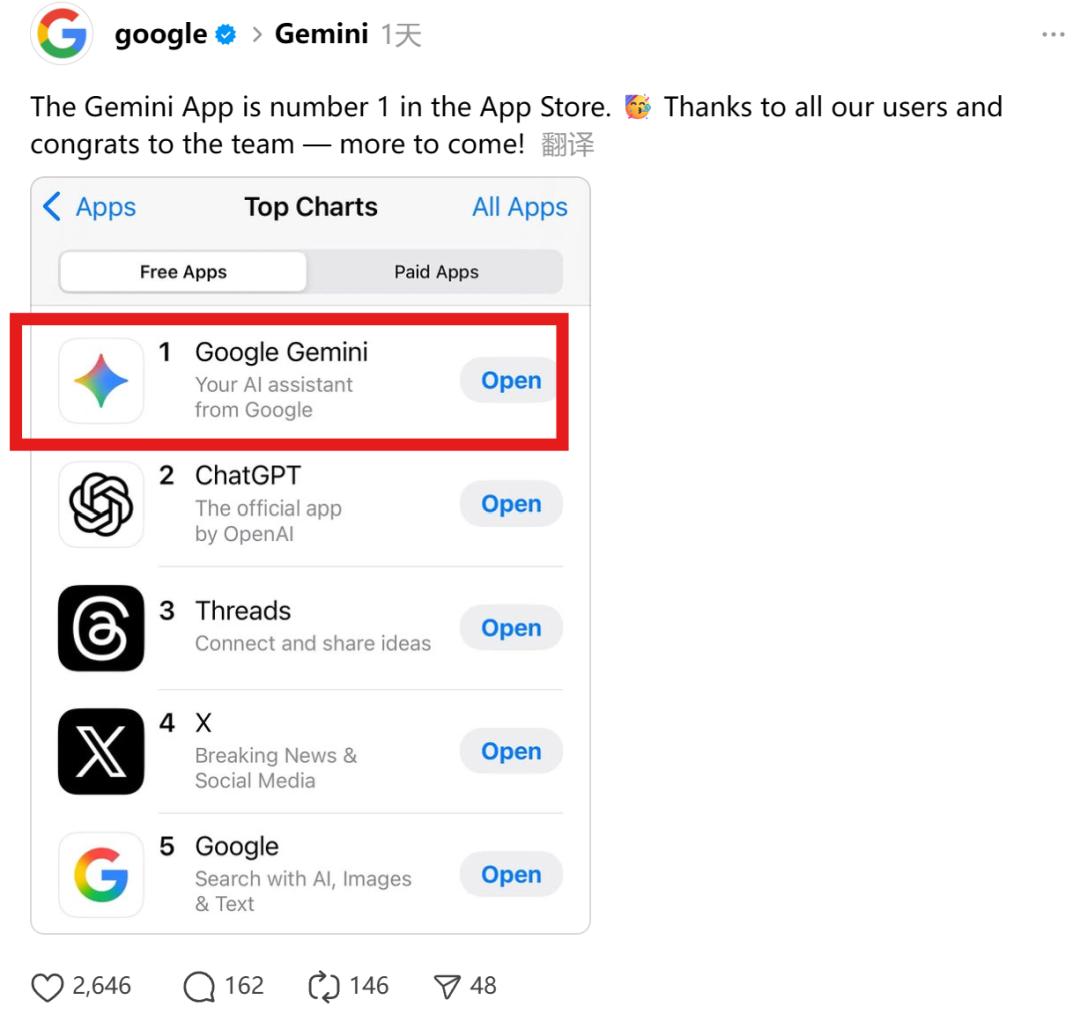
霸榜苹果应用榜的ChatGPT,终于被真·超越了! Nano Banana掀起破圈热潮之后,谷歌Gemini登顶成新王。 并且不止美区,包括在印度、加拿大、摩洛哥等地,Gemini全部实现登顶。 而一切的一切都要归功于:Nano Banana太好用(而且免费)。 正如此前"吉卜力玩法"带动ChatGPT用户增长一样,谷歌8月推出的图像生成工具Nano Banana目前也被外界认为是驱动Gemini此轮爆发的最关键因素。 短短不到一个月,Gemini应用程序在此期间新增用户2300万,Nano Banana也被用于编辑超过5亿张图片。 甚至DeepMind CEO哈萨比斯也在最新采访中表示,Nano Banana是同类产品中最好的。 而像包括Vercel CEO在内的网友们,更是对Nano Banana的作用大力肯定: 所以,迄今为止Nano Banana都有哪些玩法,哪些提示词效果更佳? 是时候全面总结、盘点一下了~ 想必大家最近的社媒都被Nano Banana美式证件照刷屏了,不会吧不会吧,屏幕前的你还没有跟上这波潮流?提示词在此,速来~ 次元壁什么的,在Nano Banana面前都得认输,2D人物化身漫展 ...
DeepMind哈萨比斯最新认知都在这里了
量子位· 2025-09-15 05:57
Core Insights - The discussion emphasizes the potential of achieving Artificial General Intelligence (AGI) within the next decade, which could usher in a new scientific renaissance and significant advancements across various fields such as energy and health [2][7][51] - Current AI systems, while advanced, lack true creativity and the ability to generate new hypotheses, which are essential characteristics of AGI [5][34] Group 1: AGI Development - Demis Hassabis predicts that AGI could be realized around 2030, but current AI systems are not yet at a "PhD-level intelligence" due to their limited capabilities in various domains [4][35] - The construction of AGI requires a comprehensive understanding of the physical world, not just abstract concepts like language or mathematics [6][22] - Hassabis believes that the arrival of AGI will lead to a "scientific golden age," providing immense benefits to humanity [7][51] Group 2: DeepMind's Role - DeepMind is viewed as a central engine within Alphabet, integrating various AI teams to develop models like Gemini, which are now embedded in Google's ecosystem [15] - The team at DeepMind consists of approximately 5,000 members, primarily engineers and researchers, focusing on advancing AI technologies [16] Group 3: Innovations in AI Models - The Genie 3 model represents a breakthrough in creating interactive virtual environments based on textual descriptions, showcasing the ability to generate realistic physical interactions [17][20] - The development of mixed models, which combine learning components with established solutions, is seen as crucial for advancing AGI [45][47] Group 4: Future of Robotics - Hassabis envisions a future where robots can understand and interact with the physical world through language commands, enhancing their utility in everyday tasks [23][25] - The design of humanoid robots is considered beneficial for navigating human environments, while specialized robots will still have their unique applications [26][27] Group 5: AI in Drug Development - DeepMind is working on transforming drug development processes, aiming to reduce the timeline from years to weeks or days, leveraging breakthroughs like AlphaFold [41][43] - Collaborations with pharmaceutical companies are underway to advance research in areas such as cancer and immunology [44] Group 6: Energy Efficiency and AI - The conversation highlights the importance of energy efficiency in AI systems, with advancements in model architecture and hardware optimization potentially mitigating energy demands [49][50] - Hassabis believes that the contributions of AI to energy efficiency and climate change will outweigh its energy consumption in the long run [50] Group 7: Creative Tools and User Experience - The future of creative tools like Nano Banana is characterized by their ability to allow users to interact intuitively, enabling rapid iterations and creative processes [38][39] - These tools are designed to democratize creativity, making advanced capabilities accessible to a broader audience while enhancing the productivity of professional creators [39][40]

腾讯研究院AI速递 20250915
腾讯研究院· 2025-09-14 16:01
Group 1 - OpenAI and Microsoft have released a non-binding cooperation memorandum addressing key issues such as cloud service hosting, intellectual property ownership, and AGI control, but the final cooperation agreement is still pending [1] - OpenAI plans to establish a public benefit corporation (PBC) with a valuation exceeding $100 billion, where a non-profit organization will hold equity and maintain control, becoming one of the most resource-rich charitable organizations globally [1] - OpenAI faces significant cost pressures, expecting to burn through $115 billion before 2029, with $100 billion needed for server leasing in 2030, leaving little room for error in the coming years [1] Group 2 - Utopai, the world's first AI-native film studio founded by a former Google X team, has generated $110 million in revenue from two film projects and secured a spot at the Cannes Film Festival [2] - Utopai has overcome three major challenges in AI video generation: consistency, controllability, and narrative continuity, achieving millisecond-level lip-sync precision with 3D data training [2] - The company positions itself as a content + AI provider rather than a pure tool supplier, receiving support from top Hollywood resources, including an Oscar-nominated screenwriter for the film "Cortes" [2] Group 3 - MiniMax has launched its new music generation model, Music 1.5, capable of creating complete songs up to 4 minutes long, featuring strong control, natural-sounding vocals, rich arrangements, and clear song structure [3] - The model supports customizable music features across "16 styles × 11 emotions × 10 scenes," enabling the generation of different vocal tones and the inclusion of Chinese traditional instruments [3] - MiniMax's multi-modal self-developed capabilities are now available to global developers via API, applicable in various scenarios such as professional music creation, film and game scoring, and brand-specific audio content [3] Group 4 - Meituan's first AI Agent product, "Xiao Mei," has entered public testing, allowing users to order coffee, find restaurants, and plan breakfast menus through natural language commands, significantly simplifying the ordering process [4] - "Xiao Mei" is based on Meituan's self-developed Longcat model (with 560 billion total parameters), capable of fully automating the selection to payment process based on user preferences and location [4] - Despite the advancements, the AI Agent currently has limitations, such as handling complex ambiguous requests and lacking voice response capabilities, with plans for future optimization in personalization and proactive service [4] Group 5 - Xiaohongshu's audio technology team has released the next-generation dialogue synthesis model, FireRedTTS-2, addressing issues like poor flexibility, frequent pronunciation errors, unstable speaker switching, and unnatural prosody [5][6] - The model has been trained on millions of hours of voice data, supporting sentence-by-sentence generation and multi-speaker tone switching, capable of mimicking voice tones and speaking habits from a single audio sample [6] - FireRedTTS-2 has achieved industry-leading levels in both subjective and objective evaluations, supporting multiple languages including Chinese, English, and Japanese, and serves as an industrial-grade solution for AI podcasting and dialogue synthesis applications [6] Group 6 - Bilibili has open-sourced its new zero-shot voice synthesis model, IndexTTS2, addressing industry pain points by achieving millisecond-level precise duration control for AI dubbing [7] - The model employs a "universal and compatible autoregressive architecture for voice duration control," achieving a duration error rate of 0.02%, and utilizes a two-stage training strategy to decouple emotion and speaker identity [7] - The system consists of three core modules: T2S (text to semantics), S2M (semantics to mel-spectrogram), and BigVGANv2 vocoder, allowing for emotional control in a straightforward manner, with significant implications for cross-language industry applications [7] Group 7 - Meta AI has released the MobileLLM-R1 series of small parameter-efficient models, including sizes of 140M, 360M, and 950M, optimized for mathematics, programming, and scientific questions [8] - The largest 950M model was pre-trained using approximately 2 trillion high-quality tokens (with a total training volume of less than 5 trillion), achieving performance comparable to or better than the Qwen3 0.6B model trained on 36 trillion tokens [8] - The model outperforms Olmo 1.24B by five times and SmolLM2 1.7B by two times on the MATH benchmark, demonstrating high token efficiency and cost-effectiveness, setting a new benchmark among fully open-source models [8] Group 8 - An AI agent named "Gauss" completed a mathematical challenge that took Terence Tao's team 18 months to solve, formalizing the strong prime number theorem (PNT) in Lean in just three weeks [9] - Developed by a company founded by Christian Szegedy, an author of the ICML'25 time verification award, Gauss generated approximately 25,000 lines of Lean code, including thousands of theorems and definitions [9] - Gauss can assist top mathematicians in formal verification, breaking through core challenges in complex analysis, with plans to increase the total amount of formalized code by 100 to 1,000 times in the next 12 months [9] Group 9 - Sequoia Capital USA has interpreted the new AI landscape following the release of GPT-5 by OpenAI, which allows for a more natural interaction resembling conversations with a PhD-level expert, incorporating "thinking" capabilities and a unified model to reduce hallucinations [10][11] - Other players have also launched strategic new products ahead of the release, including Anthropic's Claude Opus 4.1 targeting high-risk enterprise scenarios and Google's Gemini 2.5 Deep Think and Genie 3 enhancing reasoning and simulation capabilities [10][11] - The new AI landscape has been reshaped, with OpenAI dominating both open and closed AI ecosystems, Anthropic focusing on enterprise-level precision and stability, and Google emphasizing long-term foundational research [11] Group 10 - DeepMind's science lead, Pushmeet Kohli, revealed that the team targets three types of problems: transformative challenges, those recognized as unsolvable in 5-10 years, and those that DeepMind is confident it can quickly tackle [12] - The team has successfully transferred capabilities from specialized models like AlphaProof to the Gemini general model, achieving International Mathematical Olympiad gold medal levels with DeepThink [12] - The future goal is to create a "scientific API" that allows global scientists to share AI capabilities, lowering research barriers and enabling ordinary individuals to contribute to Nobel-level achievements [12]