Workspace

Search documents
Check Point Software Technologies (NasdaqGS:CHKP) FY Conference Transcript
2026-03-02 14:07
Summary of Check Point Software Technologies FY Conference Call Company Overview - **Company**: Check Point Software Technologies (NasdaqGS:CHKP) - **Industry**: Cybersecurity - **Conference Date**: March 02, 2026 Key Points Company Evolution and Management - Check Point has evolved over its 32-33 years, starting as the creator of the modern firewall and consolidating with other firewall providers like Fortinet, Palo Alto, and Cisco [21][22] - The new CEO, appointed last year, has focused on building a customer-centric approach and enhancing the go-to-market strategy [23] AI and Cybersecurity Strategy - AI is viewed as a significant game changer for cybersecurity, with both positive and negative implications [24][25] - Check Point's AI strategy includes four pillars: connectivity (hybrid mesh network), Workspace (user-based technologies), CTEM (continuous threat exposure management), and AI integrated across all technologies [25][29] Financial Guidance and Performance - For FY 2026, Check Point provided guidance including cash flow and subscription revenue, aiming for a revenue growth midpoint of around 6% [36] - The company finished the previous year with 6% revenue growth and 9% billings growth [36] Emerging Technologies and Subscription Growth - Subscription revenue is expected to grow, with emerging technologies like SASE and CTEM growing over 40% and making up about 30% of the subscription line [45][46] - The subscription line is divided into two buckets: attached subscriptions (70%) and emerging technologies (30%) [45] SASE Strategy - SASE is seen as complementary to the firewall, providing flexibility for users in various locations [52] - Check Point's acquisition of Perimeter 81 aimed to enhance its SASE platform, which has been retooled for enterprise needs [58] Pricing Strategy and Cost Management - A 5% price increase was implemented at the beginning of the year, with no immediate need for further increases anticipated [66] - The company expects a headwind of about 1% on gross margin due to component inflation in the second half of the year [66] Margin and Growth Trade-offs - Check Point is willing to trade margin for growth, with a current margin guidance of around 39.40% for the year [78] - The company aims for double-digit growth, emphasizing the importance of investing in growth ahead of time [80] Capital Allocation and Acquisitions - Check Point has a $2 billion convertible note for general corporate use and potential M&A, with a focus on acquiring technologies that enhance its platform [84] - The company conducts about $1.3 billion in share buybacks annually, reducing share count by 3%-5% [86] Final Message to Investors - Check Point is positioned for future growth, moving away from being perceived as a predictable company to one that is dynamic and focused on delivering a protective platform [89]

Xcel Energy to Power New Google Data Center in Minnesota
Businesswire· 2026-02-24 14:05
Core Insights - Xcel Energy has signed an agreement to power a new Google data center in Pine Island, Minnesota, which will significantly contribute to the state's economy and clean energy goals [1][2] - The partnership aims to ensure that the new energy demands do not increase costs for existing customers while maintaining reliable service [3] Economic Impact - The data center is expected to drive economic development in Minnesota, with incentives for data center operations balancing environmental considerations [5] - The agreement includes a $50 million investment towards Xcel Energy's Capacity*Connect Program to enhance grid reliability [3] Clean Energy Initiatives - Xcel Energy and Google will bring 1,900 megawatts of new clean energy to the grid, including 1,400 MW of wind, 200 MW of solar, and 300 MW of long-duration energy storage [3] - The project features the world's largest battery installation by gigawatt-hour capacity, a 300 megawatt Form Energy iron-air battery system, designed to store energy for extended periods [4] Regulatory Aspects - The Electric Service Agreement will be submitted for review to the Minnesota Public Utilities Commission, which must approve the agreement for it to take effect [5]




Why Smart Money Buys When AI Stocks Pull Back
Yahoo Finance· 2026-02-21 16:00
Core Viewpoint - The recent decline in tech and AI stocks, driven by high valuations and insufficient revenue growth, presents potential investment opportunities for long-term investors who focus on fundamentals rather than short-term price fluctuations [1][4][5]. Group 1: Market Trends - Over the past two years, AI stocks experienced a surge as investors sought to capitalize on the next tech boom, leading to rapidly climbing valuations [1]. - Recent selloffs in tech and AI stocks are attributed to heavy investments in AI that have pressured margins without generating adequate revenue or earnings growth [4]. - Factors contributing to the selloff include profit-taking by large funds, a market shift towards defensive and value stocks, and geopolitical uncertainties [4]. Group 2: Long-term Investment Perspective - Long-term investors recognize that market corrections do not undermine the long-term potential of established players like Alphabet [5]. - Alphabet's stock has shown a 745% return over the last decade, supported by consistent revenue and earnings growth, strong cash flow, and a clear long-term growth trajectory [6]. - The company's revenue increased from $74.9 billion in fiscal 2015 to a projected $402 billion in fiscal 2025, with earnings per share rising from $1.14 to $10.81 during the same period [6]. Group 3: Alphabet's AI Leadership - Despite the tech selloff, Alphabet reported a strong quarter, indicating robust growth in its AI initiatives across all major business lines [7]. - Alphabet has been integrating AI into its products since 2017, establishing itself as a full-stack AI leader with proprietary technology and a diverse range of AI-powered offerings [7].
Gemini API暴涨140%!谷歌商业化狂飙,直面挑战OpenAI
Ge Long Hui· 2026-01-20 08:47
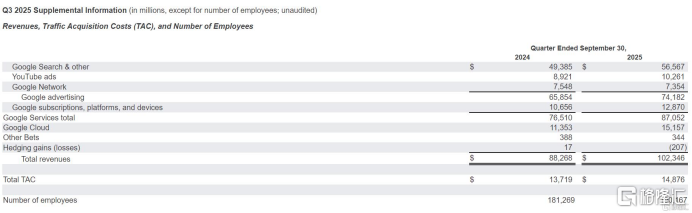
Group 1 - The commercialization of Google's Gemini series large models is experiencing explosive growth, with API calls increasing from 35 billion at the launch of Gemini 2.5 to 85 billion by August, representing a growth of over 140% [1] - Gemini Enterprise Edition has reached 1,500 companies with 8 million subscribers and over 1 million online registered users [1][4] - Google plans to highlight the growth performance of Gemini Enterprise Edition in its Q4 2025 financial report scheduled for February 4 [1] Group 2 - The strong growth of Gemini API is attributed to Google's strategic depth in the AI sector, which drives customers' investments in Google Cloud storage and database products, boosting core server sales [3] - Google has established a dual strategy of "model iteration + ecosystem integration" since the launch of the Gemini multimodal large model at the end of 2023 [3] - A partnership with Apple has been formed, where the next-generation Apple foundational model will be built on Gemini and cloud technology, with Apple paying $1 billion annually [3] Group 3 - Google is gradually shifting focus from the consumer market to the enterprise market, with mixed feedback from customers regarding the Gemini Enterprise Edition [4] - The third-quarter financial report showed Google Cloud revenue of $15.16 billion, a year-on-year increase of 34%, with AI-related revenue reaching "tens of billions of dollars" per quarter [6][8] - Advertising remains the primary revenue source for Alphabet, with Q3 advertising revenue reaching $74.18 billion, a year-on-year increase of 12.6% [8] Group 4 - The AI industry is currently facing intense competition, with Google needing to contend with rivals such as OpenAI, Amazon, and Anthropic [9] - Concerns regarding monopoly have arisen from Google's collaboration with Apple, with critics highlighting the concentration of power due to Google's ownership of Android and Chrome [10][11] - Google is actively appealing against a federal ruling regarding its monopoly behavior, arguing that users choose Google voluntarily and that the ruling does not consider the rapid pace of industry innovation [12]
LSEG出席陆家嘴金融沙龙:以AI+数据战略共筑上海国际金融中心未来
Refinitiv路孚特· 2025-12-11 06:02
Core Viewpoint - The article emphasizes the importance of data-driven financial information services and risk management in the context of building Shanghai as a global financial center, highlighting the role of advanced technologies like AI and cloud computing in enhancing financial services and risk management systems [1][7]. Group 1: Event Overview - The 40th "Lujiazui Financial Salon" was held in Shanghai, focusing on "Global Financial Center Construction - Data-Driven Financial Information Services and Risk Management" [1]. - The event gathered experts from various fields, including financial infrastructure, international financial information platforms, and local fintech companies, to discuss the transformation of the global financial landscape [1]. Group 2: LSEG's Role and Contributions - LSEG covers over 70 million financial products globally, connects more than 500 exchanges, and possesses over 4 petabytes of historical data, including 6 million economic indicators across various dimensions such as market sentiment analysis and ESG [3]. - LSEG aims to leverage high-quality data to drive AI applications in risk management, data extraction, customer service operations, and innovative product development, supporting the intelligent transformation of financial markets in the Asia-Pacific region [3]. Group 3: Tradeweb's Insights - Tradeweb's daily trading volume reaches $2.9 trillion, providing cross-asset trading and data services that enhance transaction execution efficiency for institutions [3]. - The integration of electronic trading and AI is highlighted as a means to improve cross-border trading efficiency and transparency, facilitating data-driven decision-making [5]. Group 4: Expert Discussions - Experts unanimously agree that data is the cornerstone for Shanghai's development as a global financial center, with high-quality, standardized, and secure financial data being crucial for market efficiency and risk management [7]. - The experiences of mature markets like London and New York are suggested as references for Shanghai in building a financial information hub [7]. Group 5: LSEG's Global Presence - LSEG is a leading global financial market infrastructure and data provider, operating across Europe, the Americas, Asia-Pacific, and emerging markets [9]. - The company’s capabilities span data, indices, capital formation, trading execution, clearing, and risk management, supporting clients in achieving sustainable growth [8].

Is Gemini Enterprise a Game Changer for Alphabet?
The Motley Fool· 2025-12-09 18:00
Core Insights - Gemini Enterprise is Alphabet's strategic initiative to enhance its position in the enterprise AI sector, focusing on integrating AI into daily workflows for employees [1][4][16] - The platform aims to transform Google Cloud from a third player into a market leader, potentially creating a significant profit engine for Alphabet [2][16] - Gemini Enterprise offers a unified AI layer that enhances communication, content creation, data analysis, automation, and development tools, differentiating Google from competitors [5][9] Enterprise AI Integration - Gemini Enterprise is designed to embed AI deeply into existing tools like Gmail, Docs, Sheets, Drive, and Calendar, increasing switching costs for enterprises [9][10] - The platform aims to shift Workspace from being a "good alternative" to a "strategic necessity" for businesses [10][12] - Future developments may include AI agents capable of completing entire workflows autonomously, representing a significant commercial opportunity [11][12] Competitive Landscape - The launch of Gemini Enterprise occurs in a highly competitive environment, with Microsoft, OpenAI, and AWS as key rivals [14][15] - Success will depend on delivering reliability, cost efficiency, and secure data handling, as enterprises are cautious adopters [15][17] - Gemini Enterprise's potential as a game changer hinges on its execution and the perceived value it offers to businesses [16][17]

英霸已老,谷王当立 | 财经峰评
Tai Mei Ti A P P· 2025-12-07 14:39
Core Viewpoint - The competition in the AI sector is shifting from a focus on computing power to application capabilities, with Google emerging as a formidable competitor to NVIDIA through its Gemini 3 model and TPU technology [2][4]. Group 1: Company Strategies - NVIDIA has historically dominated the AI landscape with its GPU technology and CUDA platform, but faces increasing competition from Google, which is leveraging its TPU and Gemini 3 model to challenge NVIDIA's supremacy [2]. - Google has developed its TPU over a decade, achieving a superior performance-to-efficiency ratio compared to general-purpose GPUs, allowing it to carve out a unique niche in the AI hardware market [2][3]. - Google is now offering its TPU for rent to other companies like Meta, indicating a strategic shift to expand its influence in the AI hardware space [2]. Group 2: Technological Advancements - The Gemini 3 model excels in reasoning, multi-modal capabilities, and programming, enabling AI to transition from merely answering questions to actively performing tasks [3]. - The integration of TPU training with the Gemini 3 model creates a self-reinforcing loop that enhances chip iteration, contrasting with NVIDIA's more loosely connected investment model [3]. Group 3: Market Positioning - Google's ecosystem, which includes platforms like YouTube, Android, and cloud services, provides a vast distribution network for Gemini 3, allowing for immediate monetization and significant user engagement [3]. - Google's cloud AI revenue has reportedly reached several billion dollars per quarter, reflecting a year-over-year growth of over 200%, showcasing its effective commercialization strategy [3]. Group 4: Long-term Vision - Alphabet is investing hundreds of billions annually in AI infrastructure, including TPU factories and data centers, to build a resilient industry presence [3]. - The comprehensive approach of Google, from foundational chips to application scenarios, positions it strongly against competitors, emphasizing a "fully controllable" supply chain [3]. Group 5: Industry Dynamics - The AI landscape is evolving into a multi-faceted competitive environment where application scenarios are becoming more critical than raw computing power [4][5]. - The shift in investment focus from hardware-centric companies like NVIDIA to software-driven entities like OpenAI reflects a broader trend in the industry [4].


LSEG to integrate financial data into ChatGPT in AI push
Yahoo Finance· 2025-12-03 13:15
Core Insights - LSEG is integrating its financial data and analytics into ChatGPT, enhancing its commitment to artificial intelligence in financial markets [1][2] - The partnership will allow ChatGPT users with LSEG credentials to access market data and news from LSEG's products, starting with a phased rollout on December 8 [2] Company Strategy - LSEG aims to distribute its licensed data more widely through AI platforms, responding to the financial services industry's push to adopt generative AI tools for rapid market analysis [2] - The integration will utilize a Model Context Protocol connector, facilitating seamless communication between AI models and various tools and data [2]
LSEG招聘 | 创造长远机会,发挥您的潜力
Refinitiv路孚特· 2025-12-01 06:32
Core Viewpoint - London Stock Exchange Group (LSEG) is a leading global financial market infrastructure and data provider, committed to driving financial stability and empowering economies for sustainable growth [2][11]. Group 1: Company Overview - LSEG operates in over 65 countries with more than 26,000 employees, emphasizing values of integrity, collaboration, excellence, and transformation [4][11]. - The company provides a wide range of services across the financial market value chain, including data, indices, analytics, capital formation, trading execution, clearing, and risk management [11][12]. Group 2: Business Segments - **Data and Analytics**: LSEG is one of the world's leading financial information providers, delivering over 200 billion data updates daily through various products and services, supporting clients in making informed decisions [13]. - **FTSE Russell**: A global leader in benchmark and index provision, offering solutions for measuring investment performance and aiding in asset allocation and risk management [14]. - **Risk Intelligence**: Provides comprehensive risk solutions to help organizations manage risks effectively, including due diligence and identity verification services [15]. - **Capital Markets**: Facilitates capital raising and transfer across multiple asset classes and regions, featuring electronic trading platforms for various financial products [16]. - **Post-Trade Services**: Offers services that exceed expectations, assisting clients in managing financial resources, reducing risks, and ensuring regulatory compliance throughout the trading lifecycle [17][18].

Is Gemini a Game Changer for Alphabet?
The Motley Fool· 2025-11-29 20:43
Core Insights - Alphabet is at a pivotal moment, with the rise of generative AI reshaping user behavior and challenging its traditional business model [1][8] - Gemini is introduced as a unified family of AI models designed to enhance various Alphabet products and services, raising questions about its potential impact on the company's future trajectory [2][15] Alphabet's Ecosystem and Strategic Advantage - Gemini's integration across Alphabet's ecosystem allows it to enhance products like Google Search, YouTube, Android, Workspace, and Google Cloud, providing a significant strategic advantage [3][4] - The ability to distribute new AI capabilities instantly to billions of users without starting from scratch is a key benefit, focusing on improving product utility and monetization rather than just technical performance [4][5] Search Modernization and Competitive Position - Gemini aims to modernize search by making it more conversational and context-aware, adapting to user behavior changes while retaining users within Alphabet's ecosystem [8][9] - This modernization is crucial as competitors can create AI-first experiences without the constraints of existing ad revenue models, posing a threat to Alphabet's traditional search economics [8][9] Commercial Opportunities in Google Cloud - The most significant financial impact of Gemini may come from its enterprise adoption through Google Cloud, offering a comprehensive AI solution that could enhance market share and margins [10][11] - If widely adopted, Gemini could transform Google Cloud into a major profit engine, reducing Alphabet's reliance on advertising and creating a more balanced business model [11][12] Risks and Execution Challenges - Despite the potential benefits, there are risks associated with AI-native competitors innovating faster and enterprises opting for open-source or lower-cost models [13][14] - If execution falters, Gemini may only serve as a defensive tool rather than a catalyst for growth, leading to incremental improvements rather than significant performance changes [14][16] Long-term Value and Investor Considerations - Gemini represents a critical AI initiative for Alphabet, with the potential to modernize search and enhance user loyalty while competing in enterprise AI [15][16] - The success of Gemini will depend on Alphabet's ability to execute effectively across its various fronts, shaping the company's future in a rapidly evolving technology landscape [15][16]