重庆银行

Search documents
重庆农商行:聘任刘祎为副行长
Bei Jing Shang Bao· 2025-12-23 12:57
北京商报讯(记者宋亦桐周义力)12月23日,重庆农商行发布公告,该行第五届董事会第六十六次会议审 议通过了《关于聘任重庆农村商业银行股份有限公司副行长的议案》,董事会同意聘任刘祎为该行副行 长,刘祎的任职资格尚需监管机构核准,其任期自核准之日起生效。 公开资料显示,刘祎,男,汉族,1980年2月生,中共党员,本科学历,硕士学位,现任重庆农商行党 委委员。曾任重庆银行(601963)黔江支行行长助理,重庆银行彭水支行副行长(主持工作)、行长、党 支部书记,重庆银行高新区支行党支部书记、行长,重庆银行九龙坡支行党支部书记、行长,重庆市江 北区金融工作办公室党组书记、主任,重庆江北嘴中央商务区管委会办公室党组书记、主任,重庆市江 北区政府党组成员、副区长。 ...

宁夏银川:智慧医养下沉基层 织密全民健康保障网
Zhong Guo Xin Wen Wang· 2025-12-22 10:30
Core Viewpoint - The article highlights the efforts of Yinchuan City in Ningxia to enhance healthcare services through the integration of smart healthcare and community-based medical services, aiming to improve accessibility and quality of care for the elderly population [2][5][7]. Group 1: Smart Healthcare Initiatives - Yinchuan City has implemented a "135 Smart Healthcare" model, which includes a central smart hub that collects nine vital signs through smart wristbands, creating AI-generated health profiles for monitoring and intervention [5]. - The local health center has provided healthcare services to 643 elderly individuals, established 12 family beds, and conducted over 920 home visits, achieving a 98.2% coverage rate for elderly family doctor contracts [5]. Group 2: Integration of Medical and Financial Services - The city has innovated a "Medical-Bank Cooperation" model, allowing citizens to handle over 20 insurance-related services at banks, significantly improving the efficiency of healthcare access [6]. - By December 2025, Yinchuan had processed 13,500 related insurance transactions, with a 98% "one-time handling" rate for high-frequency services [6]. Group 3: Community Health Management - The city aims to increase the standardized management rate of elderly patients to over 60% by 2026 and achieve full coverage of contracted services by 2027 [5]. - The establishment of a network of healthcare services extending from urban to rural areas is underway, with a focus on enhancing the management of chronic diseases among the elderly [6][7].


重庆银行(01963) - 海外监管公告 - 关於实施2025年三季度权益分派时「重银转债」停止转股...
2025-12-22 10:06
香港交易及結算所有限公司及香港聯合交易所有限公司對本公告的內容概不負責,對其 準確性或完整性亦不發表任何聲明,並明確表示,概不就因本公告全部或任何部分內容 而產生或因倚賴該等內容而引致的任何損失承擔任何責任。 BANK OF CHONGQING CO., LTD.* 重慶銀行股份有限公司* ( 於 中 華 人 民 共 和 國 註 冊 成 立 的 股 份 有 限 公 司 ) 证券代码:601963 证券简称:重庆银行 公告编号:2025-075 可转债代码:113056 可转债简称:重银转债 (股份代號:1963) 海外監管公告 本公告乃重慶銀行股份有限公司*(「本行」)根據香港聯合交易所有限公司證券上市規則第 13.10B條而作出。 茲載列本行在上海證券交易所網站刊發之《關於實施2025年三季度權益分派時「重銀轉債」 停止轉股的提示性公告》,僅供參閱。 代表董事會 重慶銀行股份有限公司* 董事長 楊秀明 中國重慶,2025年12月22日 於本公告刊發日期,本行的執行董事為楊秀明先生、高嵩先生及侯曦蒙女士;本行的非 執行董事為黃漢興先生、郭喜樂先生、吳珩先生、付巍先生、周宗成先生及余華先生; 本行的獨立非執行董 ...
重庆银行(601963) - 关于实施2025年三季度权益分派时“重银转债”停止转股的提示性公告
2025-12-22 08:45
证券代码:601963 证券简称:重庆银行 公告编号:2025-075 可转债代码:113056 可转债简称:重银转债 重庆银行股份有限公司 关于实施 2025 年三季度权益分派时 "重银转债"停止转股的提示性公告 本行董事会及全体董事保证本公告内容不存在任何虚假记载、误导性陈述或 者重大遗漏,并对其内容的真实性、准确性和完整性承担法律责任。 重要内容提示: 证券停复牌情况:适用 因实施 2025 年三季度普通股权益分派,重庆银行股份有限公司(以下简称"本 行")的相关证券停复牌情况如下:自 2025 年三季度权益分派实施公告前一日(2025 年 12 月 26 日)至权益分派股权登记日期间,"重银转债"将停止转股。本次权益 分派股权登记日后的第一个交易日起"重银转债"恢复转股。 | 证券代码 | 证券简称 | 停复牌类型 | 停牌起始日 | 停牌期间 | 停牌终止日 | 复牌日 | | --- | --- | --- | --- | --- | --- | --- | | 113056 | 重银转债 | 可转债转股停牌 | 2025/12/26 | | | | 联系电话:023-63367417 特此公告。 ...
重庆银行跌2.07%,成交额5310.15万元,主力资金净流出561.06万元
Xin Lang Cai Jing· 2025-12-22 03:19
截至9月30日,重庆银行股东户数3.63万,较上期增加6.17%;人均流通股53243股,较上期减少6.01%。 2025年1月-9月,重庆银行实现营业收入117.40亿元,同比增长10.40%;归母净利润48.79亿元,同比增 长10.19%。 分红方面,重庆银行A股上市后累计派现68.80亿元。近三年,累计派现42.29亿元。 重庆银行今年以来股价涨22.83%,近5个交易日跌1.80%,近20日跌2.42%,近60日涨19.93%。 资料显示,重庆银行股份有限公司位于香港铜锣湾希慎道33号利园1期19楼1918室,成立日期1996年9月 2日,上市日期2021年2月5日,公司主营业务涉及重庆银行股份有限公司主要在中国从事提供公司及个 人银行产品和服务以及资金市场业务。该公司通过三个业务部门运营。公司银行业务部从事向公司类客 户提供金融产品和服务业务,包括存款和贷款。零售业务部从事向个人客户提供金融产品和服务业务,包 括存款和贷款。资金业务部从事同行拆借、债券投资交易、回购交易以及外汇买卖交易业务。主营业务 收入构成为:公司银行业务75.09%,个人银行业务16.94%,资金业务7.72%,未分配0.25 ...
银行周报(2025/12/15-2025/12/19):11月收支表:债券投资增长提速,中小银行面临存款流失-20251221
GUOTAI HAITONG SECURITIES· 2025-12-21 07:40
Investment Rating - The report assigns an "Accumulate" rating for the banking sector [6] Core Insights - The report highlights a trend of deposit migration from small and medium-sized banks to larger banks, with a notable increase in financial bonds issued by large banks due to capital replenishment needs [2][3] - On the asset side, there is a slowdown in long-term loans from large banks and a significant reduction in short-term loans from small banks, attributed to risk considerations and weak consumer loan demand [4] Summary by Sections 1. November Income and Expenditure Table - Personal deposits decreased by 106.5 billion yuan year-on-year, with demand for both current and fixed-term savings declining [3] - Corporate deposits saw a year-on-year decrease of 49.4 billion yuan, with a notable increase in fixed-term deposits from large banks [3] - Non-bank deposits decreased by 10.6 billion yuan, indicating a trend of residents moving their deposits from small banks to larger banks [3] - Financial bonds increased by 160.4 billion yuan year-on-year, primarily driven by large banks issuing more perpetual bonds and TLAC bonds [3] 2. Asset Side Analysis - Total loans decreased by 421.6 billion yuan year-on-year, with short-term loans seeing a significant reduction of 241.6 billion yuan [4] - Large banks experienced a larger decrease in long-term loans, with a year-on-year reduction of 291.8 billion yuan, influenced by weaker real estate sales [4] - Bond investments increased by 525.3 billion yuan year-on-year, with large banks and small banks growing their bond investments by 159.3 billion yuan and 366 billion yuan respectively [4] 3. Investment Recommendations - The report suggests focusing on three investment themes: 1. Identifying banks with potential for performance growth, recommending Ningbo Bank and China Merchants Bank [4] 2. Emphasizing banks with convertible bond expectations, recommending Industrial Bank, Chongqing Bank, and Changshu Bank [4] 3. Continuing dividend strategies, recommending Bank of Communications, Jiangsu Bank, Chongqing Rural Commercial Bank, and Shanghai Rural Commercial Bank [4]
机构密集调研银行股 息差改善成市场关注焦点
Zhong Guo Jing Ying Bao· 2025-12-20 04:00
Core Viewpoint - Several brokerage firms, funds, and insurance asset management institutions are evaluating listed banks to optimize asset allocation and investment strategies for the coming year, with a focus on net interest margin performance [1] Group 1: Net Interest Margin Stability - Multiple banks have indicated that net interest margins have shown signs of stabilization in Q3, with a narrowing of the overall decline and an improvement in funding costs expected over the next three years [1] - Hangzhou Bank reported that its net interest margin remained stable at the end of Q3 compared to the end of Q2, with a marginal narrowing of the annual decline expected [1] - Suzhou Bank stated that its net interest margin has narrowed less than the industry average this year, supporting growth in net interest income [2] Group 2: Strategies for Managing Interest Margin - Banks are actively exploring ways to alleviate interest margin pressure through optimizing asset-liability structures and enhancing non-interest income [1] - Chongqing Rural Commercial Bank noted that its Q3 interest margin stabilized due to a slowdown in the decline of asset yields and a faster decrease in liability interest rates [2] - Ouyang Rihui emphasized the importance of increasing the proportion of intermediary business income and investing in information technology to improve interest margin management [3] Group 3: Regional Banks' Performance - The Q3 reports of listed banks show structural differentiation in net interest margins, with some regional banks experiencing improvement [3] - A report indicated that net interest margins for city commercial banks and rural commercial banks continued to stabilize in the first three quarters of 2025, with a decrease in the cost of interest-bearing liabilities [4] - Some regional banks, such as Jiangyin Bank and Chongqing Bank, reported an increase in net interest margins at the end of Q3 compared to the end of Q2 [3][4] Group 4: Future Outlook - Some banks anticipate that the trend of improving interest margins will continue into 2026, with Qingnong Commercial Bank indicating that its interest margin is expected to remain stable [5] - Factors such as the repricing of existing loans and adjustments in deposit pricing strategies are expected to support net interest margins moving forward [5]




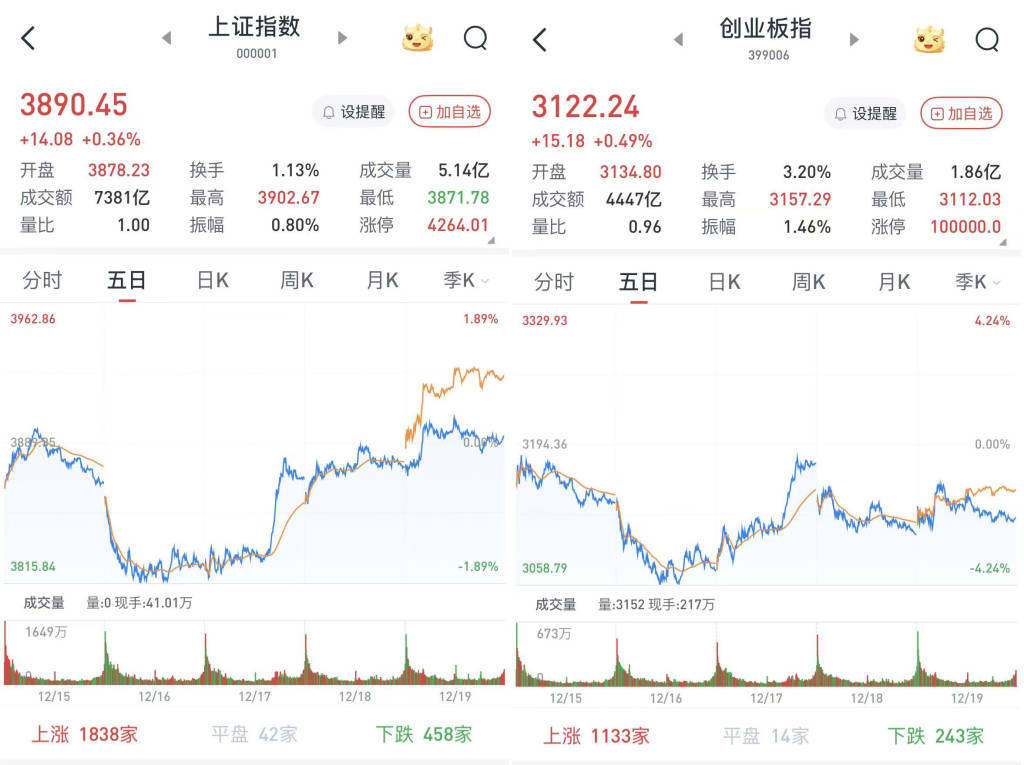
A股高开高走,三大股指收涨:大消费爆发,4476股飘红
Sou Hu Cai Jing· 2025-12-19 07:26
据大智慧VIP,两市及北交所共有97只股票涨幅在9%以上,10只股票跌幅在9%以上。 商贸零售大幅上涨,银行煤炭逆市下跌 在板块方面,商贸零售继续猛攻大幅上涨,德必集团(300947)、合百集团(000417)、中央商场(600280)、上海九百(600838)、若羽臣 (003010)、东百集团(600693)等涨停或涨超10%。据商务部新闻办公室12月18日消息,近日,商务部办公厅、财政部办公厅印发《关于做好 消费新业态新模式新场景试点有关工作的通知》,在北京等50个城市开展消费新业态新模式新场景试点(以下简称"三新"试点)。12月17日,商 务部会同财政部召开"三新"试点工作部署推进会。会议强调,各试点城市要进一步完善实施方案,建立健全工作推进和保障机制,抓紧出台试点 资金(项目)管理办法,紧扣"三新"试点支持方向,精心筛选支持项目,强化项目动态管理。 A股三大股指12月19日集体小幅高开。盘初短暂停留后,大消费走强带动股指早盘强势上攻。午后震荡回落,涨幅明显收窄。 从盘面上看,大消费爆发,零售、免税店方向领涨;海南自贸区、核聚变、稀土永磁、两岸融合、智能驾驶概念股活跃。算力硬件产业链调整, CPO、存 ...
多地已启动!消费贷贴息扩容
Zhong Guo Zheng Quan Bao· 2025-12-19 04:31
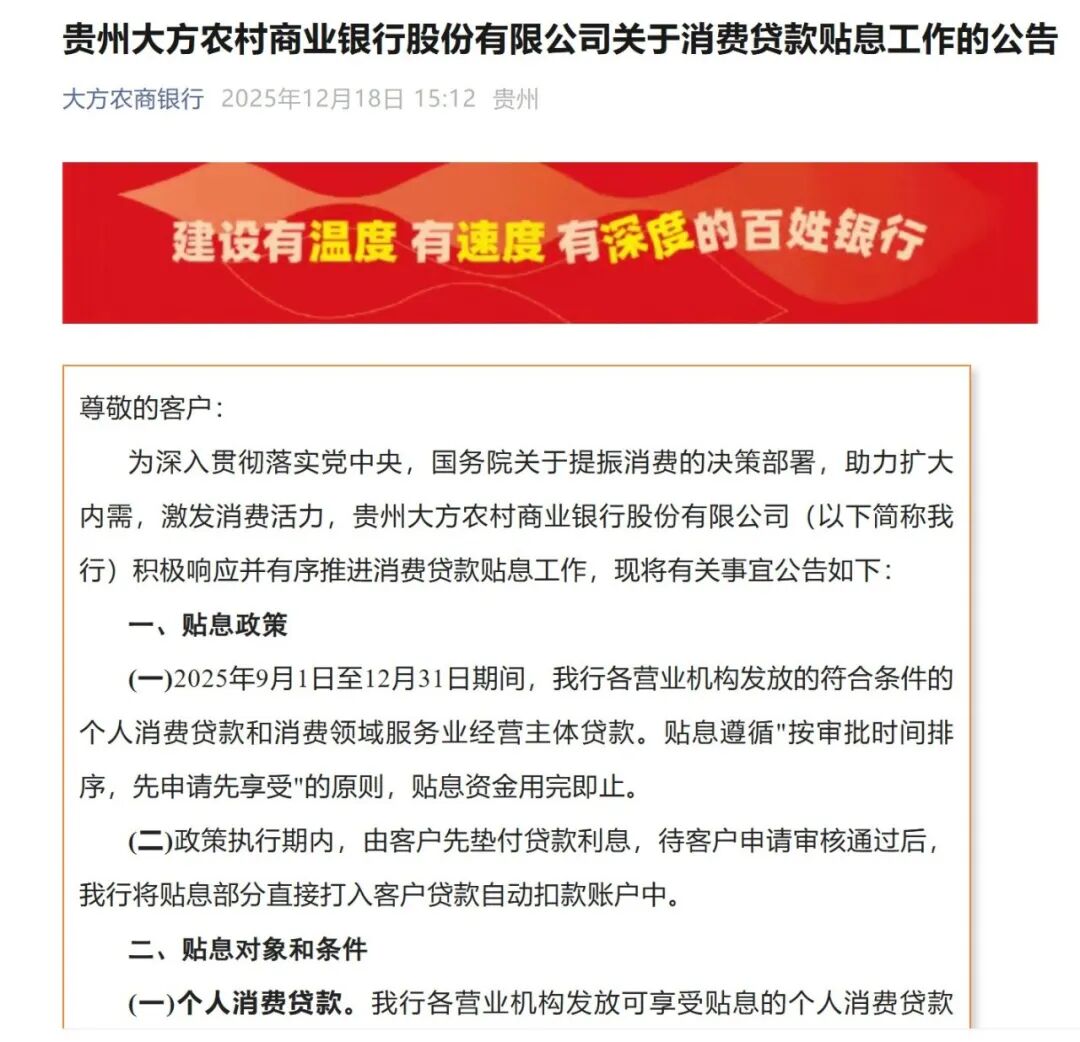
Core Viewpoint - Multiple regions in China, including Guizhou, Sichuan, and Chongqing, have initiated local consumer loan interest subsidy policies to stimulate consumption, with a focus on supporting personal consumption loans and loans for service industry entities [1][5][6]. Group 1: Policy Implementation - Guizhou Dafa Rural Commercial Bank announced a subsidy policy for personal consumer loans issued between September 1 and December 31, 2025, with an annual subsidy rate of 1% [1]. - Sichuan's local government has set a subsidy period from October 1, 2025, to March 31, 2026, for personal consumer loans obtained from local banks, excluding credit card business, with funding shared between provincial and municipal levels [5]. - Chongqing's subsidy policy covers a longer period from September 1, 2025, to August 31, 2026, including local banks such as Chongqing Bank and Chongqing Rural Commercial Bank as loan processing institutions [5]. Group 2: Regional Response - Local banks in Sichuan, Chengdu, Chongqing, and Guizhou have begun to issue notifications to start accepting applications for consumer loan interest subsidies [5]. - The implementation of these local subsidy policies is a response to national policy guidance aimed at enhancing consumer spending [6][7]. Group 3: Future Expectations - More regions are expected to follow suit with similar consumer loan subsidy policies, tailored to local fiscal capabilities and consumer market characteristics [6][7]. - The core value of local subsidies lies in their ability to precisely match local consumption needs, allowing regional banks to enhance customer engagement and service loyalty [7].
三地同步发力!消费贷新政落地,中小银行助力政策触达“最后一公里”
Xin Lang Cai Jing· 2025-12-19 02:50
Core Viewpoint - The consumer loan interest subsidy policy is being implemented at the local level, with provinces like Sichuan, Chongqing, and Guizhou initiating provincial subsidy programs, marking a further refinement of the national policy [2][10]. Group 1: Policy Implementation - Sichuan, Chongqing, and Guizhou have launched provincial subsidy programs for consumer loans, including local small and medium-sized banks as processing institutions [3][11]. - The subsidy period for Sichuan is from October 1, 2025, to March 31, 2026, while Chongqing's period is from September 1, 2025, to August 31, 2026, and Guizhou's is from September 1, 2025, to December 31, 2025 [3][11]. - The core standard for the subsidy is a 1% annual interest subsidy rate, not exceeding 50% of the loan contract interest rate, consistent with national standards [5][13]. Group 2: Market Impact - The inclusion of local policies is expected to create a structural impact, leading to a policy overlay effect that lowers consumer credit interest rates and stimulates demand [4][12]. - This policy shift breaks the initial trend where national subsidies primarily benefited large national banks, providing local banks with competitive tools and preventing excessive market concentration [5][13]. - The initiative encourages financial institutions to innovate products based on regional consumption characteristics, leading to a more diverse and balanced financial support network for consumption [5][13]. Group 3: Future Outlook - The Ministry of Commerce and other regulatory bodies have emphasized the need for collaboration among financial policies to guide credit funds towards key consumption areas [6][14]. - Experts predict that more provinces, especially economically significant ones, will adopt similar policies, with a focus on green and digital consumption [6][14]. - There is a strong motivation for regions with weak consumption recovery or those looking to enhance local commercial vitality to implement similar measures, creating a synergistic effect between national and local subsidies [6][14]. Group 4: Challenges for Local Banks - Local banks face both opportunities and challenges from this policy, as it provides a short-term growth window but also highlights their limitations in customer base, risk control technology, and product capabilities compared to larger banks [7][15]. - The policy's benefits may be temporary, and local banks must enhance their digital operations and service capabilities to retain customers after the policy period ends [7][15]. - Recommendations for local banks include leveraging policy benefits for rapid digital upgrades, building a "credit + scenario" ecosystem, and strengthening risk control and unique capabilities to avoid dependency on subsidies [7][15].