顺鑫农业

Search documents
A股白酒股普涨,舍得酒业涨超7%
Ge Long Hui A P P· 2025-08-25 02:07
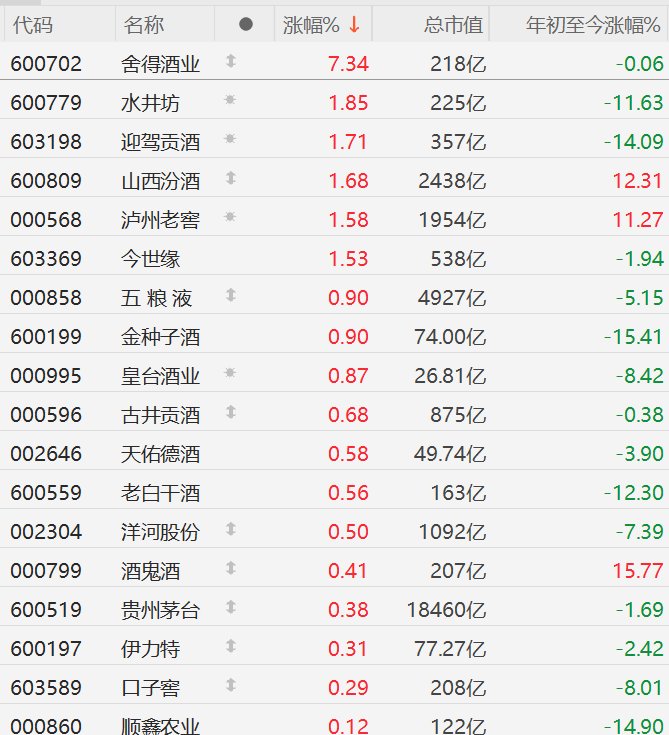
Group 1 - The core viewpoint of the article highlights a significant increase in the A-share market for liquor stocks, with Shede Liquor leading the gains by over 7% [1] - Other notable performers include Shui Jing Fang, Shanxi Fen Jiu, Ying Jia Gong Jiu, and Luzhou Laojiao, all experiencing gains of over 1% [1] Group 2 - Shede Liquor (600702) saw a rise of 7.34%, with a total market capitalization of 21.8 billion and a year-to-date change of -0.06% [2] - Shui Jing Fang (600779) increased by 1.85%, with a market cap of 22.5 billion and a year-to-date decline of -11.63% [2] - Ying Jia Gong Jiu (603198) rose by 1.71%, with a market cap of 35.7 billion and a year-to-date decline of -14.09% [2] - Shanxi Fen Jiu (600809) increased by 1.68%, with a market cap of 243.8 billion and a year-to-date increase of 12.31% [2] - Luzhou Laojiao (000568) rose by 1.58%, with a market cap of 195.4 billion and a year-to-date increase of 11.27% [2] - Other companies such as Jinzhongzi Jiu (600199) and Gujing Gong Jiu (000596) also showed minor increases, with market caps of 7.4 billion and 87.5 billion respectively [2]





白酒板块8月22日涨0.87%,*ST岩石领涨,主力资金净流入3082.53万元
Zheng Xing Xing Ye Ri Bao· 2025-08-22 08:39
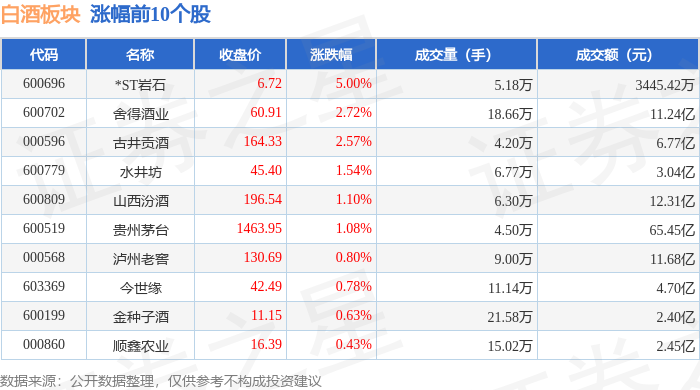
Core Viewpoint - The liquor sector experienced a rise of 0.87% on August 22, with *ST Rock leading the gains, while the Shanghai Composite Index rose by 1.45% and the Shenzhen Component Index increased by 2.07% [1]. Group 1: Liquor Sector Performance - The top-performing stock in the liquor sector was *ST Rock, closing at 6.72 with a gain of 5.00% and a trading volume of 51,800 shares [1]. - Other notable performers included Sharde Wine V, which closed at 60.91 with a 2.72% increase, and Gujing Gongjiu, which rose by 2.57% to close at 164.33 [1]. - The overall trading volume for the liquor sector was significant, with Guizhou Moutai achieving a trading volume of 45,000 shares and a closing price of 1463.95, reflecting a 1.08% increase [1]. Group 2: Capital Flow Analysis - The liquor sector saw a net inflow of main funds amounting to 30.83 million yuan, while retail investors contributed a net inflow of 24.6 million yuan [2]. - Conversely, there was a net outflow of 277 million yuan from speculative funds, indicating a mixed sentiment among different types of investors [2]. - The overall capital flow dynamics suggest a strong interest from retail investors despite the outflow from speculative funds [2].




猪肉概念21日主力净流出1.97亿元,牧原股份、顺鑫农业居前
Sou Hu Cai Jing· 2025-08-21 08:04
序号代码名称最新价涨跌幅主力净流入主力净占比1002100天康生物6.61.072467.41万元9.41%2600975新 五丰6.470.621664.68万元5.92%3603717天域生物8.552.271509.48万元9.71%4002840华统股份 10.750.191368.62万元10.32%5002311海大集团60.220.871161.37万元3.17%6000735罗 牛 山6.440.94684.38 万元3.36%7002157正邦科技2.91.05649.50万元1.74%8300761立华股份19.711.86572.66万元1.67%9002385 大北农4.220.72526.59万元0.92%10603609禾丰股份8.940.68479.32万元6.42% 来源:金融界 8月21日,猪肉概念上涨0.75%,今日主力资金流出1.97亿元,概念股28只上涨,6只下跌。 主力资金净流出居前的分别为牧原股份(1.99亿元)、顺鑫农业(2979.91万元)、新希望(1936.05万 元)、得利斯(1393.17万元)、京基智农(974.31万元)。 ...






猪肉概念19日主力净流入482.43万元,牧原股份、海大集团居前
Sou Hu Cai Jing· 2025-08-19 07:51
序号代码名称最新价涨跌幅主力净流入主力净占比1002714牧原股份46.710.821.22亿元6.8%2002311海大 集团59.881.911.15亿元22.34%3000876新 希 望9.830.924099.52万元9.4%4000860顺鑫农业 16.131.131780.33万元4.42%5600073光明肉业7.721.311383.10万元8.3%6605296神农集团32.340.811340.91 万元9.47%7603477巨星农牧20.870.341180.37万元4.14%8000735罗 牛 山6.370.0760.46万元4.53%9002982 湘佳股份16.18-0.25441.11万元4.47%10002726龙大美食5.45-0.18280.21万元2.76% 来源:金融界 8月19日,猪肉概念上涨0.22%,今日主力资金流入482.43万元,概念股19只上涨,10只下跌。 主力资金净流入居前的分别为牧原股份(1.22亿元)、海大集团(1.15亿元)、新希望(4099.52万 元)、顺鑫农业(1780.33万元)、光明肉业(1383.1万元)。 ...


调整再出发:上一轮白酒低谷期复盘
2025-08-18 01:00
Summary of the White Liquor Industry Conference Call Industry Overview - The white liquor industry is undergoing a slow adjustment that began in 2021, currently showing a U-shaped bottom pattern, but it has not yet confirmed a bottom [1][5][9] - The implementation of a liquor ban in Q2 2025 has accelerated the adjustment in the white liquor industry, impacting demand, sales, and wholesale prices [1][3][22] - The adjustment period is expected to be a critical window for observing whether the industry can completely clear out [1][9] Key Points and Arguments - Compared to the previous cycle (2012-2016), the current adjustment is characterized by a U-shaped bottom rather than a V-shaped bottom, indicating a longer and more complex recovery process [1][9][10] - High-end liquor and strong regional liquor brands have shown greater resilience during the adjustment, demonstrating leading advantages in fundamentals, stock prices, and market positioning [1][6][18] - The current cycle has not yet fully bottomed out, with the Shenyuan White Liquor Index and wholesale prices still showing potential for further decline [1][7][10] - The second and third quarters of 2025 may see limited declines in financial reports, but the difficulty in narrowing future declines is significant [1][9][10] Historical Context - The previous adjustment cycle from 2012 to 2016 was relatively quick, lasting about two to three years, with significant declines in wholesale prices, stock prices, and financial reports [2][13] - The current cycle has seen a similar mid-to-high double-digit decline in stock prices and valuations, with a faster pace of fund liquidation in 2025 compared to the previous cycle [3][11][21] Performance Indicators - The performance of high-end liquor brands has been stable, quickly adapting to new high-end consumption scenarios, while mid-range liquor has suffered the most due to policy impacts [15][16] - The overall performance of white liquor stocks has shown a significant decline, with high-end brands like Moutai maintaining positive growth through strategic distribution [16][17] Future Outlook - High-end and strong regional liquor brands are expected to continue showing faster recovery and greater elasticity in the market [18] - The industry is anticipated to enter a new upward repair cycle following the current adjustment, contingent on the successful clearing of the market [22][23] Additional Insights - The current adjustment has been influenced by external factors and policies, particularly the liquor ban, which has expedited the industry's clearing process [22] - The ideal signal for determining the industry bottom would be simultaneous bottoming of financial reports and wholesale prices, which is currently being monitored [23]
茅台最大的难题,是年轻人不会在小红书上晒茅台
虎嗅APP· 2025-08-15 13:56
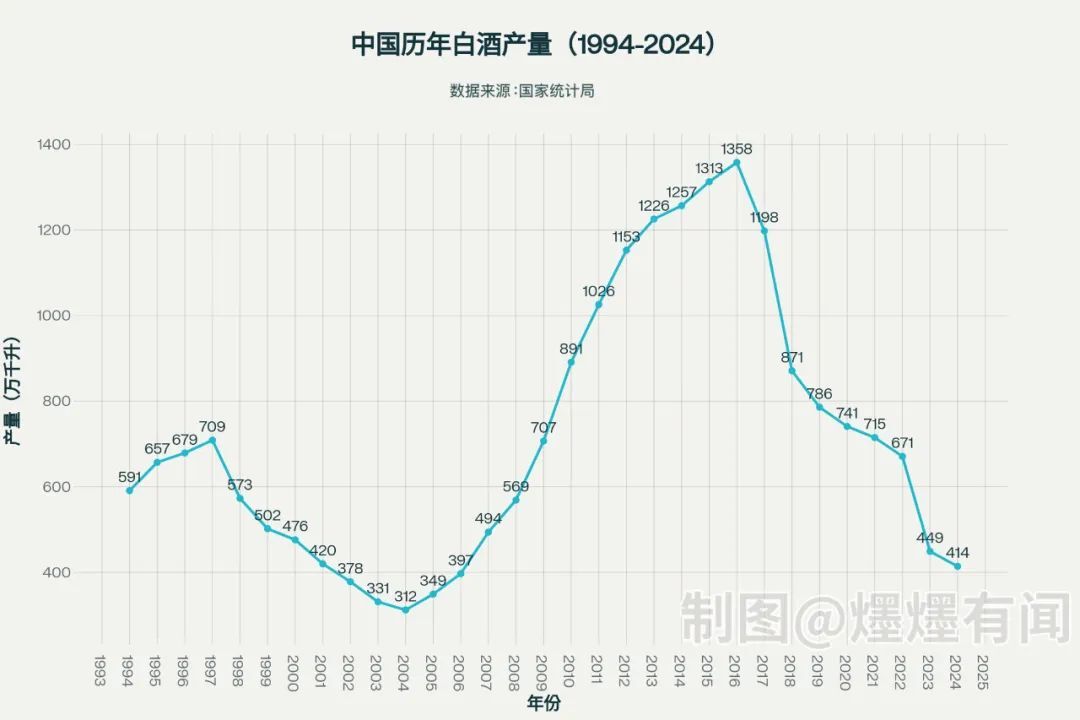
Core Viewpoint - The article discusses the decline of the Chinese liquor industry, particularly the white liquor segment, highlighting the shift in consumer preferences among the younger generation, which is leading to a significant drop in white liquor consumption and production [5][8][37]. Industry Overview - In the first half of 2023, the production of white liquor in China decreased by 5.8% year-on-year, totaling 1.916 million kiloliters, with June's production down 6.5% compared to the previous year [5][6]. - This marks the ninth consecutive year of production decline in the white liquor industry, with projections indicating that total annual production may not exceed 4 million kiloliters, a level not seen in nearly 20 years [6][8]. Company Performance - Kweichow Moutai reported a 9.1% increase in revenue for the first half of 2023, but this is the first time in a decade that its growth rate has fallen to single digits [9]. - Moutai's contract liabilities dropped to 5.507 billion yuan, a decrease of 42.59%, indicating reduced willingness from distributors to prepay for products due to declining sales [9][10]. - Other leading companies like Wuliangye and Shanxi Fenjiu also experienced slowed growth, while smaller companies faced severe profit declines, with some reporting net profit halving or even losses [11][12]. Consumer Behavior - The younger generation, particularly those aged 18-30, is showing a preference for lower-alcohol beverages and is less inclined to consume traditional white liquor, which is often associated with formal dining and business settings [14][15][23]. - Research indicates that 83% of young consumers prefer beverages with an alcohol content below 20%, with beer, fruit wine, and cocktails being more popular than white liquor [25][30]. Market Trends - The market for low-alcohol beverages is projected to grow significantly, with a compound annual growth rate of 25%, while traditional white liquor is experiencing a contraction [26][30]. - New brands targeting younger consumers are emerging, offering products that align with their preferences for lower prices and more casual consumption experiences [30][31]. Strategic Shifts - Traditional liquor companies are attempting to adapt by introducing lower-alcohol products and modern packaging, but these efforts often fail to resonate with younger consumers who seek authentic and relatable brands [28][29]. - The article emphasizes that the liquor industry is undergoing a structural adjustment, with traditional white liquor's market share declining as new beverage categories gain traction among younger consumers [37][38].


茅台最大的难题,是年轻人不会在小红书上晒茅台
Tai Mei Ti A P P· 2025-08-15 00:31
Core Viewpoint - The Chinese liquor industry, particularly the baijiu segment, is experiencing a significant decline in production and consumption, primarily driven by changing preferences among younger consumers who are moving away from traditional high-alcohol spirits [1][4][31]. Industry Overview - In the first half of 2023, the production of baijiu in China decreased by 5.8% year-on-year, totaling 1.916 million kiloliters, with June's production dropping by 6.5% [1][2]. - This marks the ninth consecutive year of declining production in the baijiu industry, with projections suggesting that total production for the year may not exceed 4 million kiloliters, a level not seen in nearly 20 years [2][4]. Company Performance - Kweichow Moutai reported a 9.1% increase in revenue for the first half of 2023, but this is the first time in a decade that its growth rate has fallen to single digits [4][5]. - Moutai's contract liabilities dropped to 5.507 billion yuan, a 42.59% decrease, indicating reduced willingness among distributors to prepay for products [4][5]. - Other leading companies like Wuliangye and Shanxi Fenjiu also showed slower growth, while smaller firms faced severe profit declines, with some reporting net profit halving or even dropping by over 90% [5][6]. Consumer Behavior - The younger demographic (ages 18-30) represents a significant portion of the potential alcohol market, contributing over 400 billion yuan, yet only 18% of baijiu consumers belong to this age group [6][19]. - Young consumers prefer lower-alcohol beverages and are increasingly drawn to products like craft beer, fruit wine, and cocktails, which are perceived as more enjoyable and suitable for casual settings [18][19][24]. Market Trends - The market for low-alcohol beverages is projected to grow significantly, with a compound annual growth rate of 25%, while traditional baijiu is experiencing a contraction [24][31]. - New brands targeting younger consumers are emerging, offering products that align with their preferences for lower prices and more casual consumption experiences [24][31]. Strategic Shifts - Traditional baijiu companies are attempting to adapt by introducing lower-alcohol products and modern packaging, but these efforts often fail to resonate with younger consumers who seek authentic and relatable brands [21][22][30]. - The marketing strategies of established baijiu brands remain rooted in traditional approaches, which may not effectively engage the younger audience that prioritizes convenience and modern consumption habits [26][30].
白酒股昨天冲上年线又栽了!成阻力20天线又成避风港,还能信吗
Sou Hu Cai Jing· 2025-08-14 03:03
Core Viewpoint - The liquor industry is experiencing a severe downturn, with signs of a bubble burst becoming increasingly evident, characterized by weak stock prices, high inventory levels, shrinking consumption, and significant policy risks [2] Group 1: Market Dynamics - Major funds have exited the market, with northbound capital selling off Kweichow Moutai for three consecutive months, while domestic institutional positions have dropped to a two-year low [3] - The liquor sector saw a net outflow of 1.2 billion yuan, yet 620,000 retail investors flocked to buy Wuliangye, becoming potential victims of market manipulation [3] Group 2: Inventory and Pricing Issues - Wuliangye's inventory has surged to 17.5 billion yuan, a 39% year-on-year increase, equating to 120 days of stock, significantly exceeding the safety threshold of 20 days [5] - Kweichow Moutai's wholesale price has plummeted to 700 yuan, impacting Wuliangye's market share, while distributors face severe financial strain, as evidenced by a 58% drop in prepayments for Xinxin Agriculture [5] Group 3: Consumption Trends - Liquor consumption is declining annually by 5%, with younger consumers showing more interest in beverages like milk tea than in Moutai [6] - Business banquets have significantly decreased, and weddings are increasingly opting for red wine over traditional liquor, further exacerbating the industry's challenges [6] Group 4: Market Manipulation - Speculative funds are creating a false market recovery appearance through small upward price movements, luring retail investors to buy in before a potential crash [7] - The liquor index has struggled around the 9000-point mark, with multiple failed attempts to break through, indicating a lack of market confidence [7] Group 5: Industry Challenges - The liquor industry's predicament is more concerning than that of the gaming sector, which has shown resilience through innovation despite facing regulatory challenges [8] - Kweichow Moutai remains reliant on its legacy, while second-tier brands are embroiled in price wars, lacking the ability for cultural expansion or technological breakthroughs [8] Group 6: Investment Considerations - Investors looking to buy into the liquor market should be cautious and monitor three critical thresholds: Moutai's wholesale price must exceed 2000 yuan, liquor inventory should drop below 100 days, and the liquor index needs to break through 9500 points [9] - Current prices for Wuliangye at 123 yuan are still considered inflated, with a potential "golden pit" only appearing if prices fall below 100 yuan [10]
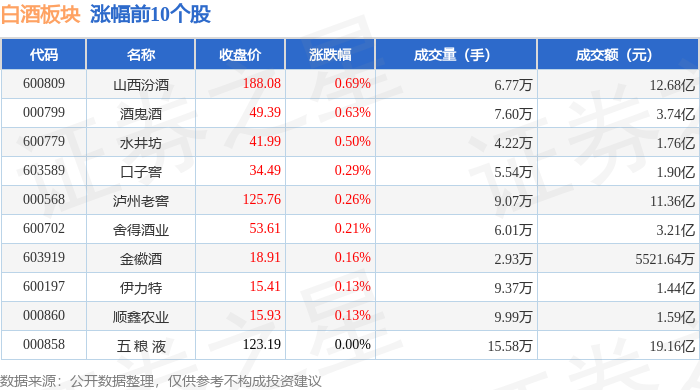
白酒板块8月13日跌0.65%,*ST岩石领跌,主力资金净流出17.58亿元
Zheng Xing Xing Ye Ri Bao· 2025-08-13 08:31
Market Overview - The liquor sector experienced a decline of 0.65% on August 13, with *ST Rock leading the drop [1] - The Shanghai Composite Index closed at 3683.46, up 0.48%, while the Shenzhen Component Index closed at 11551.36, up 1.76% [1] Liquor Sector Performance - Key liquor stocks showed mixed performance, with Shanxi Fenjiu closing at 188.08, up 0.69%, and Wuliangye remaining unchanged at 123.19 [1][2] - The trading volume and turnover for major stocks included Shanxi Fenjiu with 67,700 shares traded and a turnover of 1.268 billion yuan, and Wuliangye with 155,800 shares and a turnover of 1.916 billion yuan [1][2] Capital Flow Analysis - The liquor sector saw a net outflow of 1.758 billion yuan from institutional investors, while retail investors contributed a net inflow of 286 million yuan [2][3] - Notable individual stock capital flows included *ST Rock with a net outflow of 11.2673 million yuan from institutional investors, and a net inflow of 799.42 million yuan from retail investors [3]

茅台也扛不住,中报业绩降速
Zhong Guo Ji Jin Bao· 2025-08-12 14:38
Core Viewpoint - Guizhou Moutai's revenue for the first half of 2025 increased by 9.16% year-on-year, with net profit rising by 8.89% [2][3] Financial Performance - Total revenue reached 91.094 billion yuan, a 9.16% increase compared to the previous year [2][3] - Net profit attributable to shareholders was 45.403 billion yuan, up 8.89% year-on-year [2][3] - Operating income for the first half was 89.389 billion yuan, reflecting a 9.10% growth [3] - Total profit amounted to 62.778 billion yuan, marking a 9.03% increase [3] - Cash flow from operating activities decreased by 64.18%, totaling 13.119 billion yuan [3] - Total assets decreased by 2.24% to 292.258 billion yuan, while net assets increased by 2.38% to 238.647 billion yuan [3] Market Context - The white liquor industry is undergoing significant adjustments, with 60% of companies experiencing price inversion, indicating supply-demand imbalances [8] - Moutai's price has dropped by 36.15% since 2022, reflecting changes in consumption scenarios [8] - The company set a revenue growth target of approximately 9% for 2025, lower than previous years' targets of around 15% [8][4] Product Performance - Moutai liquor generated 75.590 billion yuan in revenue, a 10.24% increase, while series liquor revenue was 13.763 billion yuan, up 4.69% [10] - Direct sales channels contributed 40.010 billion yuan, growing by 18.63%, while wholesale channels contributed 49.343 billion yuan, increasing by 2.83% [10] - The "i Moutai" platform generated 10.760 billion yuan in revenue, reflecting a 4.98% increase [10] Production and Cash Position - Moutai liquor production reached approximately 43,700 tons, up 11.76%, while series liquor production was about 29,600 tons, increasing by 30.40% [11] - Cash on hand was 51.645 billion yuan, down 12.90% from the previous year, accounting for 17.67% of total assets [12] Strategic Initiatives - Moutai is adapting to market changes through innovative strategies, including partnerships with e-commerce platforms and new product launches [14] - The introduction of a high-end product priced at 7,000 yuan aims to target the luxury market [14] - The "1×4" packaging design is intended to capture high-net-worth consumers in smaller gatherings [16] Industry Outlook - Other liquor companies are facing poor performance, with several reporting significant declines in revenue and profit [18][20] - The overall sentiment in the white liquor market suggests a potential recovery in the second half of 2026, with expectations for improved conditions [21]