
中国海防

Search documents
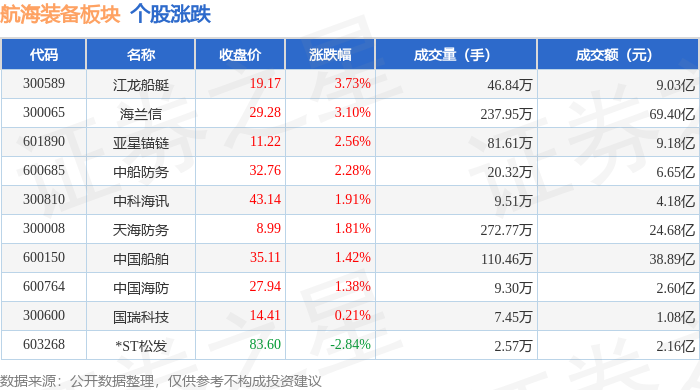
航海装备板块2月4日涨1.5%,江龙船艇领涨,主力资金净流出3.92亿元
Zheng Xing Xing Ye Ri Bao· 2026-02-04 08:57
Core Viewpoint - The maritime equipment sector experienced a 1.5% increase on February 4, with Jianglong Shipbuilding leading the gains. The Shanghai Composite Index closed at 4102.2, up 0.85%, while the Shenzhen Component Index closed at 14156.27, up 0.21% [1]. Group 1: Market Performance - Jianglong Shipbuilding (300589) closed at 19.17, up 3.73% with a trading volume of 468,400 shares and a transaction value of 903 million yuan [1]. - Hailan Technology (300065) closed at 29.28, up 3.10% with a trading volume of 2,379,500 shares and a transaction value of 6.94 billion yuan [1]. - Yaxing Guolian (601890) closed at 11.22, up 2.56% with a trading volume of 816,100 shares and a transaction value of 91.8 million yuan [1]. - China Shipbuilding (600150) closed at 35.11, up 1.42% with a trading volume of 1,104,600 shares and a transaction value of 3.889 billion yuan [1]. Group 2: Capital Flow - The maritime equipment sector saw a net outflow of 392 million yuan from institutional investors, while retail investors contributed a net inflow of 267 million yuan [1]. - Jianglong Shipbuilding had a net inflow of 82.05 million yuan from retail investors, but a net outflow of 19.95 million yuan from speculative funds [2]. - China Shipbuilding experienced a net inflow of 1.02 million yuan from institutional investors, but a net outflow of 2.55 million yuan from speculative funds [2].







新发ETF,背后“买主”浮出水面
Sou Hu Cai Jing· 2026-02-03 13:06
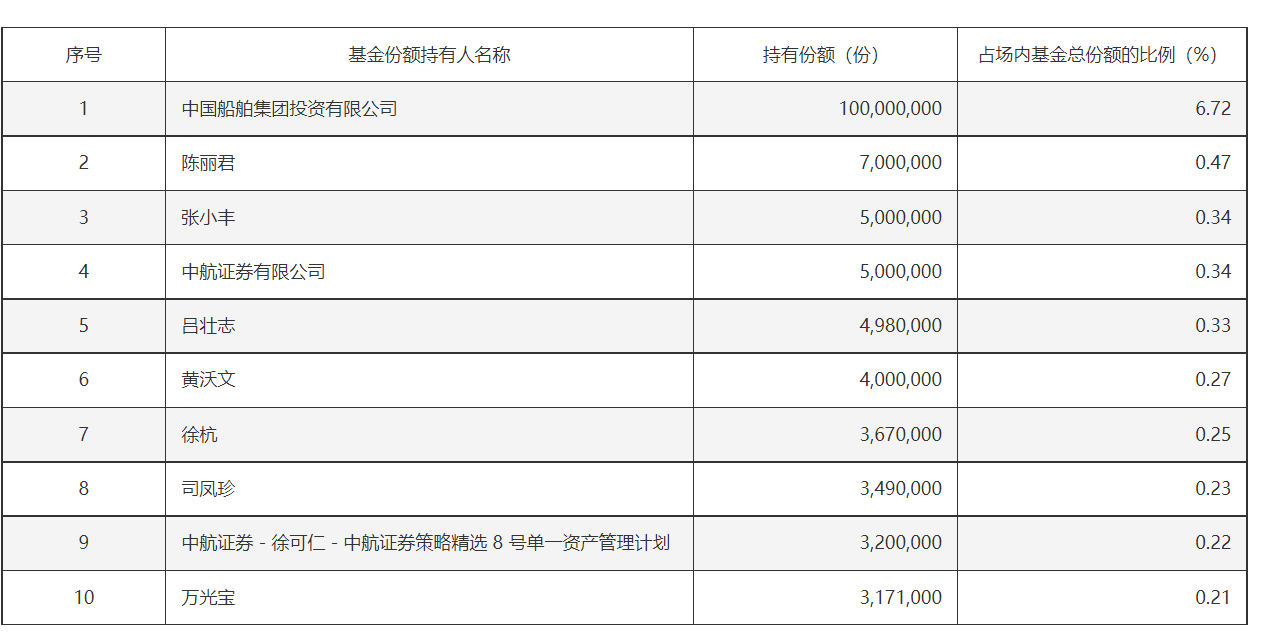
Group 1 - The core point of the article highlights the recent surge in newly launched ETFs, with significant investments from institutional players like China Shipbuilding Group Investment Co., which purchased 100 million yuan in the Fortune China Securities Intelligent Shipbuilding Industry ETF [2][3] - The Fortune China Securities Intelligent Shipbuilding Industry ETF is the first ETF focused on shipbuilding, comprising 40 representative listed companies in the shipbuilding industry, reflecting the overall performance of the sector [4][5] - As of February 2, 2023, the top ten holdings of the ETF include major companies such as China Power, China Shipbuilding, and China Ship Defense, indicating a strong focus on the industrial sector [5][7] Group 2 - Recent data shows a significant outflow from broad-based ETFs, with a net outflow of 16.349 billion yuan on February 2, 2023, particularly affecting the Southern CSI 500 ETF and Huatai-PB CSI 300 ETF [10] - In contrast, certain thematic industry ETFs have attracted substantial inflows, with the Guotai Communication ETF seeing a net inflow of 1.399 billion yuan on the same date [10] - From January 14 to February 2, 2023, stock-type ETFs experienced a cumulative net outflow exceeding 830 billion yuan, while some thematic ETFs attracted over 10 billion yuan each [10][11] Group 3 - The number of ETFs with assets exceeding 100 billion yuan has significantly decreased, with only three ETFs surpassing this threshold as of February 2, 2023 [11] - The market outlook suggests that sectors such as AI, solid-state batteries, robotics, and innovative pharmaceuticals are expected to present investment opportunities, with AI being a key focus area for 2026 [12]
下一个国家级战略主线:深海科技(附42页PPT)
材料汇· 2026-02-02 14:42
Core Viewpoint - The article emphasizes the strategic importance of deep-sea technology as a national priority, highlighting its potential in resource security, defense, and the development of a blue economy [14][23][57]. Group 1: Deep-Sea Technology as a National Strategy - Deep-sea technology is positioned as a key national strategic focus, alongside commercial aerospace and low-altitude economy [14]. - The government has initiated large-scale application demonstrations for new technologies in deep-sea industries, marking a significant policy shift [14][23]. - Recent government reports have highlighted deep-sea technology for the first time, indicating its importance in future industrial development [14][23]. Group 2: Resource Security and Global Competition - The U.S. and Japan are actively pursuing deep-sea resource exploration, indicating a competitive landscape for global marine resources [25][31]. - The article notes that the U.S. has significant deep-sea mineral resources, with estimates suggesting over 1 billion tons of polymetallic nodules in its offshore areas [30]. - Japan plans to initiate experimental drilling for rare earth elements in its exclusive economic zone, aiming to reduce reliance on imports from China [31]. Group 3: Defense and National Security - The article discusses the need for enhanced underwater defense capabilities, as current security measures are deemed insufficient [50]. - The concept of a "water under the national gate" highlights vulnerabilities in underwater security, necessitating a robust defense strategy [50]. - The U.S. and Japan have established comprehensive military strategies focused on deep-sea operations, enhancing their maritime control [48][50]. Group 4: Blue Economy and Industrial Development - The blue economy is projected to be a trillion-dollar industry, with significant growth potential in sectors like deep-sea mining, aquaculture, and marine tourism [18][24]. - The deep-sea industry chain encompasses everything from basic materials to high-end equipment manufacturing, indicating a complex and interdisciplinary approach [73][74]. - The article outlines various emerging sectors within the blue economy, including deep-sea wind power and marine biotechnology [68][72]. Group 5: Policy and Regulatory Framework - Multiple regions in China are developing policies to promote deep-sea technology, with plans focusing on marine economic development and innovation [11][12]. - The article lists specific policy documents from provinces like Hainan and Shandong that aim to enhance deep-sea technology capabilities [13]. - The government's strategic plans emphasize the integration of deep-sea technology into broader economic and environmental goals [61].

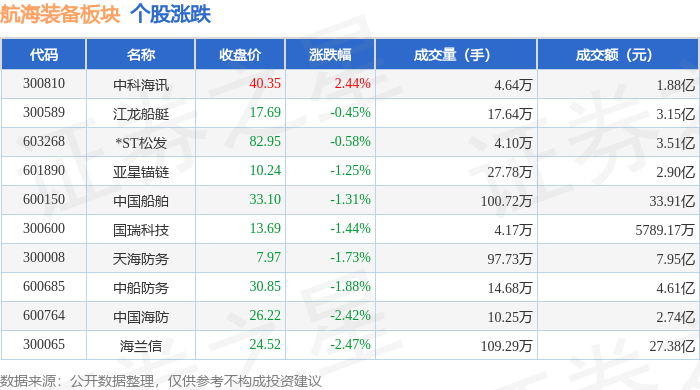
航海装备板块2月2日跌1.4%,海兰信领跌,主力资金净流出2.22亿元
Zheng Xing Xing Ye Ri Bao· 2026-02-02 09:15
Core Viewpoint - The maritime equipment sector experienced a decline of 1.4% on February 2, with Hailanxin leading the drop, while the Shanghai Composite Index fell by 2.48% and the Shenzhen Component Index decreased by 2.69% [1] Group 1: Market Performance - The closing price of Zhongke Haixun was 40.35, with an increase of 2.44%, while Jianglong Shipbuilding closed at 17.69, down by 0.45% [1] - The overall trading volume in the maritime equipment sector showed significant activity, with China Shipbuilding recording a volume of 1,007,200 shares and a transaction value of 3.391 billion [1] - The sector saw a net outflow of 222 million from main funds, while retail investors contributed a net inflow of 133 million [1] Group 2: Fund Flow Analysis - China Shipbuilding had a net inflow of 16.68 million from main funds, while it faced a net outflow of 40.28 million from speculative funds [2] - Hailanxin experienced a significant net outflow of 136 million from main funds, but had a net inflow of 99.66 million from speculative funds [2] - The overall fund flow indicates a mixed sentiment, with retail investors showing a preference for certain stocks despite the overall decline in the sector [2]

中国海防(600764) - 中国海防关于为所属子公司提供担保的进展公告
2026-02-02 09:00
证券代码:600764 证券简称: 中国海防 公告编号:2026-003 中国船舶重工集团海洋防务与信息对抗股份有限公司 关于为所属子公司提供担保的进展公告 本公司董事会及全体董事保证本公告内容不存在任何虚假记载、误导性陈述或 者重大遗漏,并对其内容的真实性、准确性和完整性承担法律责任。 二、被担保人基本情况 1.单位名称:中船辽海装备有限责任公司 重要内容提示: 一、担保情况概述 公司第九届董事会第三十六次会议、2024年年度股东大会审议通过 了《关于2025年度为所属子公司提供担保额度上限的议案》,同意在核 定的担保额度范围内对公司下属子公司辽海装备的融资授信事宜提供 1 被担保人名称:被担保人为中国船舶重工集团海洋防务与信息 对抗股份有限公司(以下简称"公司"或"中国海防")控股子 公司中船辽海装备有限责任公司(以下简称"辽海装备")。 本次担保金额及已实际为其提供的担保余额:公司本次为辽海 装备提供担保额为人民币 3,000 万元;截至本公告披露日,公 司为辽海装备提供担保金额共计人民币 15,500 万元。 本次担保是否有反担保:本次担保存在反担保。 公司不存在逾期对外担保情况。 特别风险提示:被担 ...
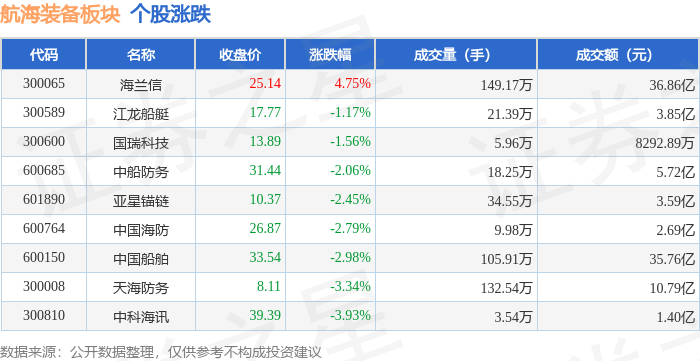
航海装备板块1月30日跌2.54%,中科海讯领跌,主力资金净流出4.35亿元
Zheng Xing Xing Ye Ri Bao· 2026-01-30 09:00
Market Overview - The marine equipment sector experienced a decline of 2.54% on January 30, with Zhongke Haixun leading the drop [1] - The Shanghai Composite Index closed at 4117.95, down 0.96%, while the Shenzhen Component Index closed at 14205.89, down 0.66% [1] Stock Performance - Key stocks in the marine equipment sector showed varied performance, with Hailanxin rising by 4.75% to a closing price of 25.14, while other stocks like China Shipbuilding and Tianhai Defense saw declines of 2.98% and 3.34%, respectively [1] - The trading volume and turnover for major stocks were significant, with China Shipbuilding recording a turnover of 3.576 billion yuan [1] Capital Flow - The marine equipment sector saw a net outflow of 435 million yuan from main funds, while retail investors contributed a net inflow of 281 million yuan [1] - Detailed capital flow data indicates that Hailanxin had a net inflow of 4.36 billion yuan from main funds, while stocks like China Shipbuilding and Tianhai Defense experienced significant net outflows of 6.32 billion yuan and 1.15 billion yuan, respectively [2]

中国海防:公司已建立规范的财务管理以及内部控制制度
Zheng Quan Ri Bao Wang· 2026-01-29 13:41
证券日报网讯1月29日,中国海防(600764)在互动平台回答投资者提问时表示,公司已建立规范的财 务管理以及内部控制制度,拥有独立的财务核算管理系统。公司会不断提高财务数字化、智能化的水 平,持续提升公司财务管理能力。 ...
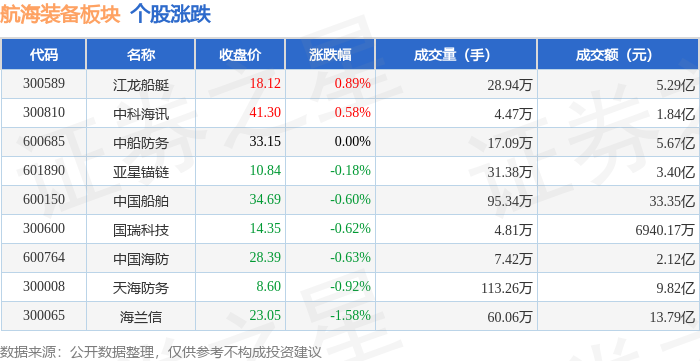
航海装备板块1月28日跌0.57%,海兰信领跌,主力资金净流入7416.14万元
Zheng Xing Xing Ye Ri Bao· 2026-01-28 09:04
Market Overview - The marine equipment sector experienced a decline of 0.57% on January 28, with Hailanxin leading the drop [1] - The Shanghai Composite Index closed at 4151.24, up 0.27%, while the Shenzhen Component Index closed at 14342.9, up 0.09% [1] Individual Stock Performance - Jianglong Shipbuilding (300589) closed at 18.12, with an increase of 0.89% and a trading volume of 289,400 shares, totaling a transaction value of 529 million yuan [1] - Zhongke Haixun (300810) closed at 41.30, up 0.58%, with a trading volume of 44,700 shares and a transaction value of 184 million yuan [1] - China Shipbuilding (600150) closed at 34.69, down 0.60%, with a trading volume of 953,400 shares and a transaction value of 3.335 billion yuan [1] - Hailanxin (300065) closed at 23.05, down 1.58%, with a trading volume of 600,600 shares and a transaction value of 1.379 billion yuan [1] Capital Flow Analysis - The marine equipment sector saw a net inflow of 74.16 million yuan from institutional investors, while retail investors experienced a net outflow of 32.28 million yuan [1] - China Shipbuilding (600150) had a net inflow of 1.88 billion yuan from institutional investors, but a net outflow of 134 million yuan from retail investors [2] - Jianglong Shipbuilding (300589) recorded a net inflow of 26.14 million yuan from institutional investors and a net outflow of 59.44 million yuan from retail investors [2] - Hailanxin (300065) faced a significant net outflow of 920.08 million yuan from institutional investors, while retail investors had a net inflow of 89.72 million yuan [2]
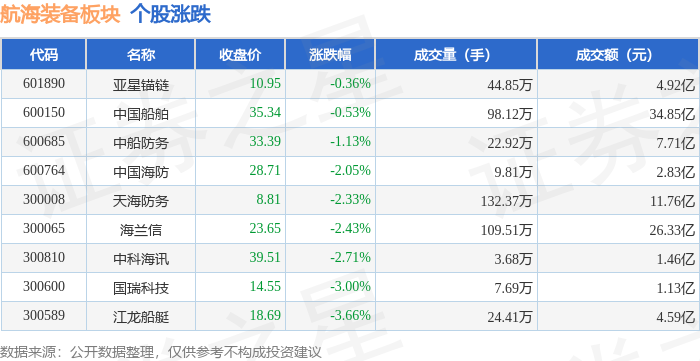
航海装备板块1月26日跌0.91%,江龙船艇领跌,主力资金净流出3.06亿元
Zheng Xing Xing Ye Ri Bao· 2026-01-26 09:41
Core Viewpoint - The maritime equipment sector experienced a decline of 0.91% on January 26, with Jianglong Shipbuilding leading the losses. The Shanghai Composite Index closed at 4132.61, down 0.09%, while the Shenzhen Component Index closed at 14316.64, down 0.85% [1]. Group 1: Market Performance - The maritime equipment sector's stocks showed varied performance, with significant declines in several key companies, including Jianglong Shipbuilding, which fell by 3.66% to a closing price of 18.69 [1]. - The trading volume for Jianglong Shipbuilding was 244,100 shares, with a transaction value of 459 million yuan [1]. - Other notable declines included China Shipbuilding, down 0.53% to 35.34 yuan, and China Marine Defense, down 1.13% to 33.39 yuan [1]. Group 2: Capital Flow - The maritime equipment sector saw a net outflow of 306 million yuan from main funds, while retail investors contributed a net inflow of 283 million yuan [1]. - Among individual stocks, China Shipbuilding had a main fund net inflow of 42.99 million yuan, but also saw a retail net outflow of 15.03 million yuan [2]. - Jianglong Shipbuilding experienced a significant main fund net outflow of 50.92 million yuan, despite a retail net inflow of 52.71 million yuan [2].
商业航天和商发两机景气持续,重视海外共振赛道机遇
GF SECURITIES· 2026-01-25 12:48
Core Insights - The report emphasizes the ongoing prosperity in the commercial aerospace and military sectors, highlighting opportunities in overseas markets and the importance of technological advancements in the industry [2][3] Group 1: Industry Overview - The commercial aerospace sector is experiencing upward momentum, driven by SpaceX's advancements in reusable rocket technology, which could reduce space access costs by 100 times [13] - The military aviation sector is expected to benefit from increased demand for large aircraft and military trade, with significant growth anticipated in 2026 [14] - The report identifies a focus on supply chain reforms and the integration of AI technologies as key trends shaping the future of the defense and aerospace industries [15] Group 2: Investment Recommendations - The report recommends companies that align with the "S-curve" evolution, focusing on supply chain reforms and automation, including firms like航发动力 (Aero Engine Corporation) and 中航沈飞 (AVIC Shenyang Aircraft Corporation) [15] - Companies positioned for expansion in military trade and civil aviation, such as 国睿科技 (Guorui Technology) and 中国动力 (China Power), are highlighted for their growth potential [15] - Emerging industries like commercial aerospace, AI, and quantum computing are also recommended, with firms like 睿创微纳 (Ruichuang Micro-Nano) and 菲利华 (Feilihua) noted for their innovative capabilities [15] Group 3: Company Valuations and Financial Analysis - 航发动力 (Aero Engine Corporation) is projected to have a 2025E EPS of 0.22 CNY, with a PE ratio of 216.82 for 2025 [6] - 中航高科 (AVIC High-tech) is expected to achieve a 2025E EPS of 0.90 CNY, with a PE ratio of 29.16 for 2025 [6] - The report provides detailed financial metrics for various companies, indicating growth in EPS and improvements in PE ratios across the sector, reflecting a positive outlook for the defense and aerospace industries [6]


