火炬电子

Search documents
商业航天新材料深度:陶瓷基复材开启黄金十年(附企业)
材料汇· 2026-02-04 15:14
Core Viewpoint - Ceramic Matrix Composites (CMC) exhibit excellent high-temperature performance and have broad applications in commercial aerospace, aviation, nuclear power, and automotive sectors, with significant market potential. China leads in brake and thermal protection for aircraft but lags in aviation engine applications [3][4]. Group 1: CMC Characteristics and Applications - CMC is defined as composites that incorporate reinforcing materials into a ceramic matrix, resulting in superior properties such as high-temperature resistance, low density, high specific strength, and oxidation resistance [4][15]. - SiCf/SiC composites are a research focus due to their enhanced oxidation resistance and longevity, making them ideal for high-temperature applications [4][21]. - In the aerospace sector, SiCf/SiC is recognized as an ideal material for the hot end of aviation engines, already in mass production for static components, with ongoing exploration for rotating parts [5][25]. - In nuclear energy, SiCf/SiC composites are considered ideal candidates for reactor cladding and control rods due to their high melting point and excellent neutron irradiation stability [5][44]. Group 2: Market Growth and Trends - The global CMC market was valued at $11.9 billion in 2022 and is projected to grow at a CAGR of 10.5%, reaching $21.6 billion by 2028, with the highest market share in defense and aerospace applications [6]. - The demand for CMC in China's aviation engine sector is expected to reach a turning point in 2024, driven by technological advancements and cost reductions [11][9]. Group 3: CMC Production and Industry Landscape - CMC production involves complex processes with high barriers to entry, including fiber preparation, preform weaving, interface layer preparation, matrix preparation, and densification [7][8]. - GE has established a vertically integrated CMC supply chain, producing 20 tons of CMC prepreg and 10 tons of SiC fibers annually, with a tenfold increase in CMC component production expected over the next decade [8][39]. - China's CMC industry is relatively complete, with advancements in the production of second-generation SiC fibers and ongoing development of third-generation fibers, although industrial-scale production remains a challenge [9][10]. Group 4: Investment Opportunities - The potential for growth in China's aviation engine sector for CMC is significant, with upstream raw material demand expected to increase as applications mature [11][9]. - As CMC manufacturing technologies improve and fiber costs decrease, midstream CMC component manufacturers are poised for rapid development [11].






军工电子板块2月4日跌0.27%,*ST铖昌领跌,主力资金净流出30.46亿元
Zheng Xing Xing Ye Ri Bao· 2026-02-04 08:57
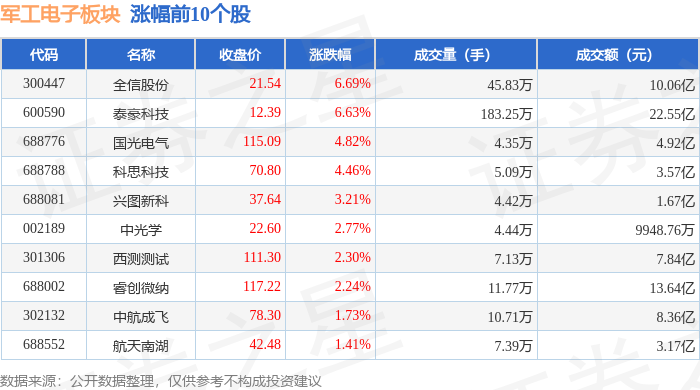
Market Overview - The military electronics sector experienced a decline of 0.27% on February 4, with *ST Chengchang leading the drop [1] - The Shanghai Composite Index closed at 4102.2, up 0.85%, while the Shenzhen Component Index closed at 14156.27, up 0.21% [1] Stock Performance - Notable gainers in the military electronics sector included: - Quanxin Co., Ltd. (300447) with a closing price of 21.54, up 6.69% and a trading volume of 458,300 shares, totaling 1.006 billion yuan [1] - Taimeng Technology (600590) closed at 12.39, up 6.63% with a trading volume of 1,832,500 shares, totaling 2.255 billion yuan [1] - Guoguang Electric (688776) closed at 115.09, up 4.82% with a trading volume of 43,500 shares, totaling 492 million yuan [1] Fund Flow Analysis - The military electronics sector saw a net outflow of 3.046 billion yuan from institutional investors, while retail investors contributed a net inflow of 2.105 billion yuan [2] - The top stocks by net inflow from retail investors included: - Ruichuang Micro-Nano (688002) with a net inflow of 110 million yuan [3] - Xicet Testing (301306) with a net inflow of 102 million yuan [3] - Taimeng Technology (600590) with a net inflow of approximately 89.38 million yuan [3]


猎鹰9号“急刹车”:火箭回收安全警钟敲响,新材料成破局关键(附企业清单)
材料汇· 2026-02-03 16:01
Core Viewpoint - The article discusses the safety challenges associated with the recovery of reusable rockets, particularly focusing on the recent anomaly experienced by SpaceX's Falcon 9 rocket, and emphasizes the critical role of advanced materials in addressing these safety issues [4][5][7]. Group 1: Safety Challenges in Rocket Recovery - The recovery process of reusable rockets is a comprehensive "extreme challenge" that involves various safety risks related to material performance during re-entry, propulsion, and landing phases [7]. - Key safety pain points are identified in three dimensions: re-entry phase, propulsion phase, and landing phase, each presenting unique material-related challenges [7]. Re-entry Phase - During re-entry, the rocket's surface can experience temperatures between 1500°C and 2000°C, necessitating heat protection materials that are not only heat-resistant but also lightweight and reusable [10]. - The Falcon 9 has faced issues with thermal protection coatings degrading after multiple uses, highlighting the inadequacy of traditional materials [10]. Propulsion Phase - The engine components must withstand extreme temperatures (1000°C to 3000°C) and pressures, leading to material fatigue and potential failures such as propellant leaks [12][13]. - The recent anomaly in the Falcon 9's second stage ignition is suspected to be linked to material fatigue, emphasizing the need for robust engine materials [13]. Landing Phase - The landing system must absorb impact forces, requiring materials that are strong, lightweight, and capable of withstanding repeated use [16]. - Previous incidents have shown that inadequate material strength in landing gear can lead to failures, underscoring the importance of material integrity [16]. Group 2: Role of New Materials in Enhancing Safety - New material technologies are crucial for addressing the safety challenges in rocket recovery, with ongoing research leading to the development of high-performance materials for various critical applications [18]. Heat Protection Materials - Advanced heat protection materials include ceramic matrix composites, which offer high-temperature resistance and reusability, significantly improving safety during re-entry [20]. - Carbon-carbon composites are also highlighted for their superior heat resistance, being used in critical areas like the rocket's nose cone [22]. Propulsion System Materials - Innovations in high-temperature alloys and nanocrystalline materials are being developed to enhance engine component durability and reliability under extreme conditions [25]. - New sealing materials, such as fluororubber and PTFE composites, are designed to maintain performance under varying temperatures and prevent leaks [28]. Structural and Buffering Materials - The use of composite materials in landing gear and rocket structures enhances strength and reduces weight, improving overall safety during landing [29]. - The integration of aluminum foam materials in landing gear systems is noted for its ability to absorb impact energy effectively [29]. Group 3: Comparative Analysis and Industry Insights - A comparison of domestic and international advancements in new materials reveals that while the U.S. has a head start in certain areas, China has made significant strides in developing cost-effective and innovative materials for rocket recovery [33]. - The recent SpaceX incident serves as a reminder that safety must remain a priority in the pursuit of cost efficiency in commercial spaceflight, with material innovation being a key factor in achieving this balance [34].

振华科技:首次覆盖报告高可靠电子元器件筑基,军民电子需求支撑长期成长-20260203
GUOTAI HAITONG SECURITIES· 2026-02-03 00:25
Investment Rating - The report assigns a "Buy" rating to the company with a target price of 71.40 CNY [5][11][15]. Core Insights - The company has a strong foothold in the defense technology industry, focusing on basic components and electronic functional materials, which are widely used in key national projects and civilian applications. The steady growth of the defense budget and demand from various downstream sectors support the company's resilience and growth potential [2][11][23]. - The company is expected to achieve net profits of 9.41 billion CNY, 11.14 billion CNY, and 11.78 billion CNY from 2025 to 2027, with corresponding EPS of 1.70 CNY, 2.01 CNY, and 2.13 CNY [11][15]. - The company is positioned as a leading supplier of high-reliability electronic components, benefiting from a comprehensive product portfolio and strong system-level support capabilities [11][23]. Financial Summary - Total revenue is projected to be 7,789 million CNY in 2023, with a decrease to 5,219 million CNY in 2024, followed by a gradual increase to 7,051 million CNY by 2027, reflecting a compound annual growth rate (CAGR) of 14.0% from 2025 to 2027 [4][17]. - Net profit attributable to shareholders is forecasted to decline to 970 million CNY in 2024, before recovering to 1,178 million CNY by 2027 [4][17]. - The company’s net asset return rate is expected to stabilize around 6.7% from 2026 onwards [4]. Business Overview - The company specializes in new electronic components, which accounted for nearly 100% of its revenue in 2024, highlighting its market dominance in this sector [35]. - The company’s product offerings include resistors, capacitors, integrated circuits, and electronic functional materials, which are essential for both military and civilian applications [23][31]. - The company is actively investing in R&D to enhance its product capabilities and maintain its competitive edge in high-reliability electronic components [11][33]. Industry Outlook - The electronic components industry is expected to continue expanding, driven by increasing demand across various sectors, including consumer electronics, automotive electronics, and industrial automation [39][43]. - The global electronic components market is projected to grow from 448.4 billion USD in 2026 to 870.93 billion USD by 2035, with a CAGR of 7.2% [43]. - The company is well-positioned to benefit from structural growth opportunities in the electronic components sector, particularly in the context of rising defense budgets and advancements in technology [11][39].

东兴证券晨报-20260130
Dongxing Securities· 2026-01-30 08:10
Core Insights - The report highlights the ongoing development of U.S.-China relations, with President Trump planning a visit to China in April, which is seen as beneficial for both nations [2] - The People's Bank of China is actively engaging with global financial leaders, indicating a focus on macroeconomic policies and trade relations [2] - The Chinese government is prioritizing the service sector in 2026, aiming to expand market access and promote digital trade [2] - The State-owned Assets Supervision and Administration Commission is working on initiatives to optimize the layout of state-owned enterprises, with significant investment planned for R&D and asset growth [2] - The report emphasizes the importance of the photovoltaic industry and the need for regulatory measures to ensure healthy competition [2] Company Insights - TikTok has established a joint venture in the U.S. for data security, indicating a strategic move to enhance its operational transparency [5] - China National Petroleum Corporation has achieved large-scale production of high-end materials, reducing reliance on imports for strategic industries [5] - SpaceX is preparing for a significant IPO, aiming for a valuation of approximately $1.5 trillion, which reflects its growth potential in the commercial space sector [5] - China Aerospace Science and Technology Corporation is focusing on enhancing its commercial launch capabilities, with ambitious goals for the next decade [5] Banking Sector Insights - The report indicates a slight increase in the proportion of active funds in the banking sector, with a total market value of 1.61 trillion yuan allocated to A-shares [6] - The concentration of holdings among the top five banks has decreased, with notable fluctuations in individual bank positions [7] - Northbound capital has seen a net reduction in bank stocks, with significant decreases in holdings for certain banks [8] - The banking sector is expected to benefit from macroeconomic policies aimed at improving credit conditions and stabilizing net interest margins [8][9]






军工电子板块1月29日跌2.56%,火炬电子领跌,主力资金净流出26.89亿元
Zheng Xing Xing Ye Ri Bao· 2026-01-29 09:03
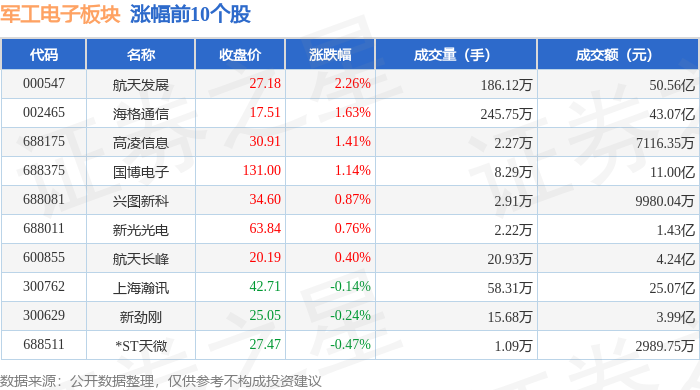
Market Overview - The military electronics sector experienced a decline of 2.56% on January 29, with Torch Electronics leading the drop [1] - The Shanghai Composite Index closed at 4157.98, up 0.16%, while the Shenzhen Component Index closed at 14300.08, down 0.3% [1] Stock Performance - Notable gainers in the military electronics sector included: - Aerospace Development (Code: 000547) with a closing price of 27.18, up 2.26% and a trading volume of 1.8612 million shares, totaling 5.056 billion yuan [1] - Haige Communication (Code: 002465) closed at 17.51, up 1.63% with a trading volume of 2.4575 million shares, totaling 4.307 billion yuan [1] - Significant decliners included: - Torch Electronics (Code: 603678) closed at 38.93, down 10.01% with a trading volume of 393,200 shares, totaling 1.579 billion yuan [3] - Fuguijie (Code: 688272) closed at 30.03, down 9.68% with a trading volume of 50,500 shares [3] Capital Flow - The military electronics sector saw a net outflow of 2.689 billion yuan from institutional investors, while retail investors contributed a net inflow of 1.691 billion yuan [5] - Key stocks with notable capital flows included: - Aerospace Development had a net inflow of 370 million yuan from institutional investors, but a net outflow of 806.22 million yuan from retail investors [5] - Haige Communication experienced a net inflow of 278 million yuan from institutional investors, with a net outflow of 759.12 million yuan from retail investors [5] ETF Performance - Aerospace ETF (Product Code: 159227) tracked the national aerospace industry index and saw a 5-day change of 3.00%, with a reduction of 53 million shares, resulting in a net redemption of 78.67 million yuan [7] - General Aviation ETF (Product Code: 159230) tracked the national general aviation industry index, with a 5-day change of 2.17% and a net redemption of 5.55 million yuan [8]
火炬电子今日跌停,有4家机构专用席位净卖出1.68亿元
Xin Lang Cai Jing· 2026-01-29 09:00
火炬电子今日跌停,成交额15.79亿元,换手率8.27%,盘后龙虎榜数据显示,沪股通专用席位卖出 4081.70万元,2家机构专用席位净买入1.01亿元,有4家机构专用席位净卖出1.68亿元。 ...
A股商业航天股集体回调,顺灏股份跌超7%
Ge Long Hui· 2026-01-29 06:48
Group 1 - The A-share market experienced a collective pullback in the commercial aerospace sector, with several companies hitting their daily limit down [1] - Notable declines included Beihua Co. and Torch Electronics, which both reached the daily limit down, while Hongyuan Electronics, Tongda Co., and Kunheng Shunwei fell over 8% [1] - Other companies such as Gaode Infrared and Shunhao Co. dropped more than 7%, and Jiuding New Materials, BaoTi Co., Tengjing Technology, Changying Tong, Qianzhao Optoelectronics, Changguang Huaxin, and Huafeng Technology saw declines exceeding 6% [1]


火炬电子2026年1月29日跌停分析
Xin Lang Cai Jing· 2026-01-29 06:46
Group 1 - The core point of the article is that Torch Electronics (stock code: sh603678) hit the daily limit down on January 29, 2026, with a closing price of 38.93 yuan, reflecting a decline of 9.99% and a total market capitalization of 18.519 billion yuan [1][2]. Group 2 - The reasons for the stock's limit down include significant financial issues, such as a net loss of 12.1982 million yuan for its subsidiary Shanghai Torch Group in the first three quarters of 2025, which negatively impacts the overall profitability of the company [2]. - The company has a high guarantee ratio, with total external guarantees amounting to 1.872 billion yuan, representing 34.13% of its net assets, which poses potential risks [2]. - The operating cash flow for the first three quarters of 2025 showed a net outflow of 107 million yuan, a year-on-year decrease of 118.79%, indicating substantial cash flow pressure [2]. - The competitive environment in the electronic components industry is challenging, with increasing competition affecting market share and profit margins, which may be reflected in the stock price [2]. - The company's new ceramic concept did not align with market hotspots on January 29, 2026, leading to underperformance in related sectors and dragging down Torch Electronics [2]. - There was a net outflow of 15.15% in market funds as of December 26, 2025, indicating short-term capital withdrawal from the market [2]. - Technical indicators such as MACD death cross and BOLL channel breakdown may have triggered investor sell-offs, contributing to the limit down [2].
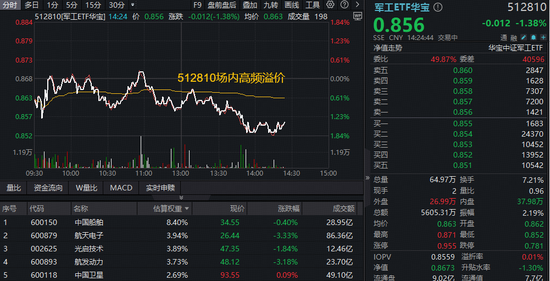
中国商火决战可回收火箭:2026全力突破!军工ETF华宝(512810)下探区间高频溢价!
Xin Lang Cai Jing· 2026-01-29 06:36
1月29日午后,军工板块加速走低,军工ETF华宝(512810)一度下探逾1.7%失守20日线,场内高频溢 价,或有资金逢跌吸筹。 成份股跌多涨少,显著分化,航天科技逆势涨停,火炬电子触及跌停。大权重普跌,航天电子、航发动 力跌逾2%。 消息面并无利空,军工行情波动或受市场风偏短线变化影响。相反,商业航天等军工新质生产力领域利 好不断。 1月28日,中国航天科技集团商业火箭公司召开年度工作会议,明确2026年将全力突破可重复使用技 术,坚决打赢主力箭首飞及回收攻坚战。公司强调将高效履行商业发射使命,提升我国规模化进入空间 的能力,标志着中国版"可回收火箭"进入关键冲刺阶段。 C919也有催化。据市场消息,中国商飞今年将加快国产大飞机C919的生产与交付节奏,交付目标定为 28架或以上。年初以来已有两架 C919下线并进入交付流程,如若维持这一节奏,商飞今年有望实现每 10至15天生产一架 C919。 数据来源: iFinD ,截至 2026.1.18 。上述含量占比指数分别为商业航天指数( 886078 )、低空经济指数 ( 886067 )、大飞机指数( 885566 )、卫星导航指数( 885574 )、 ...