DeepMind

Search documents
为什么春晚的机器人不“僵”了?具身智能正在经历一场大脑进化
机器人大讲堂· 2026-02-19 00:00
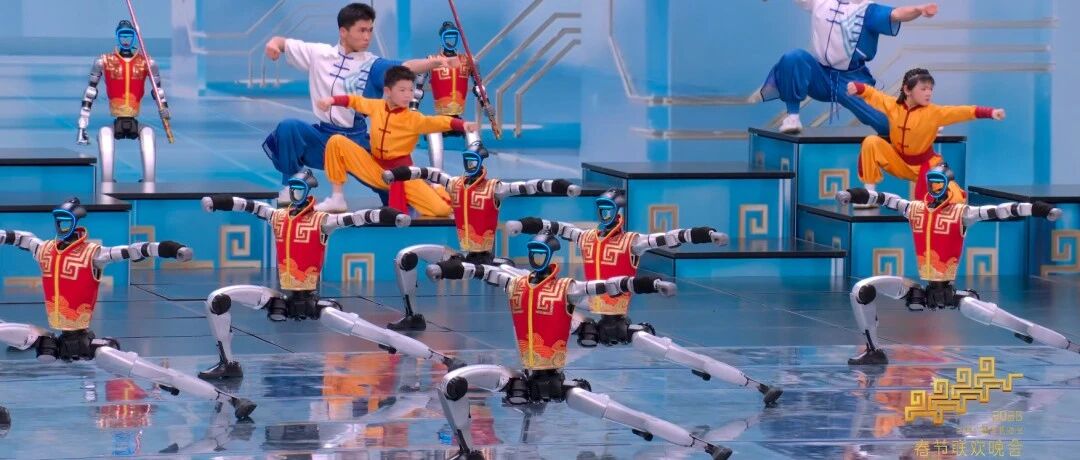
Core Viewpoint - The evolution of humanoid robots is moving from performance in controlled environments to practical applications in real-world scenarios, emphasizing the need for robots to understand and predict physical interactions [5][6][26]. Group 1: Humanoid Robot Performance - The performance of humanoid robots at the Spring Festival Gala has shown significant advancements, with previous years featuring coordinated movements and complex formations [1][2]. - This year's robots demonstrated a level of agility and responsiveness that suggests a breakthrough in their control algorithms and hardware integration [5]. Group 2: Challenges in Real-World Applications - Despite advancements, the transition from staged performances to real-world applications remains challenging, as robots must navigate unpredictable environments like factories and homes [5][6]. - Current humanoid robots lack the ability to understand physical laws, which limits their effectiveness in dynamic settings [13][22]. Group 3: VLA Paradigm and Industry Anxiety - The dominant paradigm for embodied intelligence is the Visual-Language-Action (VLA) model, which is currently highly competitive [7]. - Companies like Ant Group and Horizon are developing advanced VLA models that enhance spatial awareness and adaptability across different robotic configurations [8][10]. Group 4: Transition to World Models - The industry is recognizing the need to evolve from VLA to embodied world models that allow robots to simulate and predict physical interactions [14][15]. - Ant Group's LingBot-World is a notable example, providing a high-fidelity simulation environment for robots to learn and adapt without real-world consequences [16]. Group 5: Impact on Industry Scalability - The shift from action mapping to physical pre-simulation is expected to reduce the data requirements for training new skills significantly, from thousands of examples to just 30-50 [23]. - Robots equipped with predictive capabilities have shown a high success rate in complex tasks, achieving over 91% in multi-task scenarios [24]. Group 6: Conclusion and Future Directions - The journey of humanoid robots is transitioning from mere demonstrations to practical applications, with a focus on understanding physical laws and improving operational capabilities in real-world environments [26][28]. - The ongoing debate about the best approaches for robotic intelligence continues, with various strategies being explored to enhance performance in unpredictable settings [27].

Google's DeepMind CEO Demis Hassabis warns of dangers in AI. 👀
Yahoo Finance· 2026-02-18 19:27
I think we're going to enter in the next probably 10 years this new a new golden era for scientific discovery almost a new renaissance using these tools incredible tools um like AlphaFold but I hope that will be the first of many uh that can massively speed up our research and accelerate scientific discovery across almost uh any subject area. I think we're on the cusp of an absolutely incredible transformation um that's going to uh uh uh bring incredible benefits in science and medicine specifically is what ...

25万人将涌入,印度首次举办超大规模AI峰会
Di Yi Cai Jing· 2026-02-17 08:21
Group 1 - The Indian Artificial Intelligence Impact Summit is the largest of its kind in India, expecting 250,000 attendees from around the world [1] - Major tech companies like Google, Microsoft, and Amazon plan to invest a total of $68 billion in AI and cloud infrastructure in India by 2030 [1] - Key speakers at the summit include leaders from Google, OpenAI, Anthropic, and DeepMind, highlighting India's ambition in the AI sector [3] Group 2 - India aims to leverage AI for economic growth and attract investments, focusing on the deployment of advanced AI models rather than developing foundational models [3] - The IT industry in India, valued at nearly $300 billion, faces challenges with potential revenue losses of 50% in call centers due to AI adoption [4] - Over 60% of Global Capability Centers (GCCs) established in India in the past two years are focused on AI, data, digital engineering, or product development [4] Group 3 - The Indian government is actively seeking to establish domestic supply chains to attract investments from major tech companies, including a recent $18 billion semiconductor investment project [4] - The support from the government is seen as a guarantee for multinational companies to diversify their operations in India [4] - The summit is expected to lead to significant announcements of investments in AI data centers and large-scale infrastructure agreements [4]

印度首次举办超大规模AI峰会,25万人将涌入,仍缺全球领先大模型
Di Yi Cai Jing Zi Xun· 2026-02-17 07:05
Group 1 - The AI Impact Summit in India is the largest of its kind in the country, expecting 250,000 attendees from around the world [1] - Major tech companies like Google, Microsoft, and Amazon plan to invest a total of $68 billion in AI and cloud infrastructure in India by 2030 [1] - Key speakers at the summit include leaders from Google, OpenAI, Anthropic, and DeepMind, highlighting India's commitment to leveraging AI for human-centric missions [3] Group 2 - India has not yet developed a globally dominant AI model, with the US and China leading in large model technology [3] - The Indian government is encouraged to focus on "innovative applications" rather than investing heavily in developing new large models [3] - India has a significant potential consumer market for AI, with over 72 million daily ChatGPT users expected by the end of 2025, making it one of OpenAI's largest user markets [3] Group 3 - The Indian IT industry, valued at nearly $300 billion, faces challenges from AI adoption, with call centers potentially experiencing a 50% revenue loss by 2030 [4] - The rise of Global Capability Centers (GCCs) in India is shifting focus towards AI, data, digital engineering, and product development, with over 60% of new GCCs established in these areas [4] - It is projected that over 80% of GCCs will be AI-driven within the next 6 to 8 months [4] Group 4 - India is actively seeking to establish domestic supply chains to attract investments from major tech companies, recently approving a $18 billion semiconductor investment project [5] - Government support for technology is seen as a guarantee for multinational companies to diversify their operations in India [5] - The summit is expected to lead to significant announcements of investments in AI data centers and large-scale infrastructure agreements [5]
Our latest reports on robots | 60 Minutes Full Episodes
60 Minutes· 2026-02-14 12:01
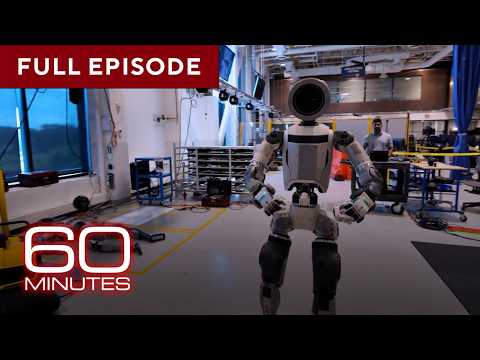
For decades, engineers have been trying to create robots that look and act human. Now, rapid advances in artificial intelligence are taking humanoids from the lab to the factory floor. As fears grow that AI will displace workers, a global race is underway to develop human-like robots able to do human jobs. Competitors include Tesla, startups backed by Amazon and Nvidia and stateup supported Chinese companies. Boston Dynamics is a frontr runner. The Massachusetts company valued at more than a billion dollars ...
情人节最硬核“Kiss”!中国AI突破300年亲吻数难题,连刷多维度纪录
量子位· 2026-02-14 08:13
亲吻数又叫牛顿数,是希尔伯特第十八问题(球体堆积)的局部形式,和通信技术中的"比特拥挤"问题是同一套底层逻辑。 闻乐 发自 凹非寺 量子位 | 公众号 QbitAI 情人节到了… 那咱也来应应景,讲讲亲吻这件事—— AI的打开方式。 你或许知道,数学上有个正经问题叫做 亲吻数(Kissing Number Problem) ,卡了人类300多年,但就在最近,被 中国AI 狠狠推了一 把。 简单说,它研究的是:在n维空间中,一个球体周围,最多能有多少个和它大小相同的球体,刚好与它相切(kiss),不重叠的那种 。 它源自于1694年,牛顿和格雷戈里两位大佬的争吵: 在三维空间里,一个球周围到底能放12个,还是13个同款球?牛顿坚持12,格雷戈里不服,结果谁也没能当场辩过谁。 直到1953年,数学家用了 258年 时间才严格证明牛顿是对的。 就连2022年获得 菲尔兹奖 的玛丽娜·维亚佐夫斯卡, 正是凭借解决8维和24维空间的最密球体堆积问题,摘得桂冠。 但再往高维走,人类的直觉就崩了。在过去近50年里,亲吻数构造仅有7次实质性进展,而且每一次的方法都完全不同,在临近维度上难以迁 移与复用。 现在,僵局被打破了。 ...

X @Demis Hassabis
Demis Hassabis· 2026-02-13 00:48
RT Simon Willison (@simonw)Genuinely very impressed by the SVG of a pelican riding a bicycle I just got out of Google's new Gemini 3 Deep Think model https://t.co/xmaz3hlfkJ ...
X @Demis Hassabis
Demis Hassabis· 2026-02-12 21:01
Thrilled to announce a big upgrade to Gemini 3 Deep Think that hits new records on the most rigorous benchmarks in maths, science & reasoning - including 84.6% on ARC-AGI-2, 48.4% Humanity’s Last Exam without tools, and 3455 Elo rating on Codeforces! https://t.co/D3FuMwaLpr ...
X @Demis Hassabis
Demis Hassabis· 2026-02-12 19:53
RT François Chollet (@fchollet)The new Gemini Deep Think is achieving some truly incredible numbers on ARC-AGI-2. We certified these scores in the past few days. https://t.co/Q9qeJbCObK ...
MOSS孙天祥新公司要让AI自己写100篇论文,还要全网直播一个月
3 6 Ke· 2026-02-12 09:52
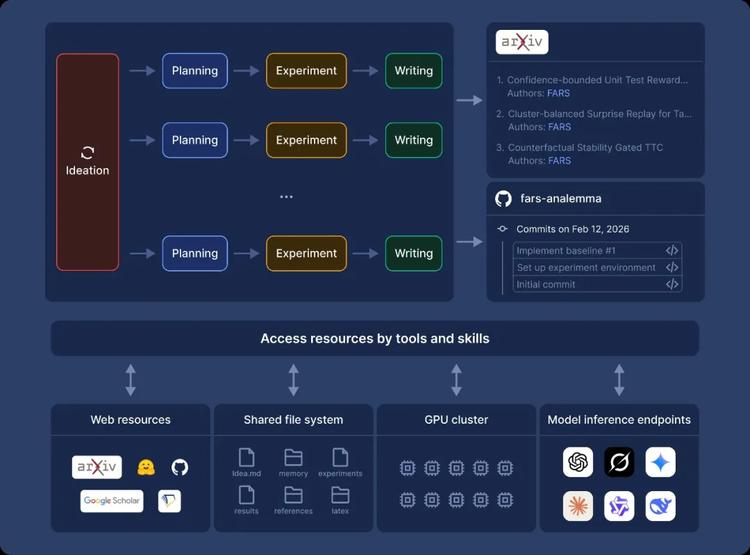
Core Insights - The article discusses a month-long live demonstration of an AI system named FARS, which aims to autonomously conduct the entire research process, producing 100 complete research papers without human intervention [1][20]. Company Overview - Analemma, the company behind FARS, was founded less than a year ago and has secured tens of millions of dollars in angel funding from notable investors such as Sequoia China and Meituan [1]. - The founder, Tianxiang Sun, was a key developer of MOSS, a significant model in the AI field, which gained attention for its capabilities [11][12]. Technology and Architecture - FARS, or Fully Automated Research System, is a multi-agent system composed of four modules: Ideation, Planning, Experiment, and Writing, which collaborate in a shared file system [2][4]. - The system utilizes APIs from various closed-source models, including Claude, GPT, and Gemini, along with self-developed models for certain tasks [5]. Research Focus and Methodology - FARS focuses on AI research itself, allowing for fully automated experiments that do not require physical laboratories [8]. - The system is designed to produce "short papers" that emphasize clear hypotheses and reliable validation, diverging from traditional academic publishing norms [7]. Quality Control and Evaluation - Each paper produced by FARS will undergo review by at least three team members with over five years of research experience before being uploaded to arXiv, ensuring a level of quality control [8]. - The team plans to invite peer reviews rather than submitting to traditional academic conferences, focusing on the practical citation and value of the results [8]. Competitive Landscape - FARS is part of a growing trend in automated research systems, competing with others like Sakana AI's AI Scientist and AI-Researcher from Hong Kong University [17][19]. - Unlike its competitors, FARS aims for real-time, large-scale, and fully transparent public deployment, which is a bold move in the field [19]. Future Directions - The live demonstration of FARS will begin on the company's website and social media platforms, marking a significant step in evaluating the system's capabilities [20]. - The results of this experiment could provide insights into the potential of AI to conduct research autonomously, a question that remains to be answered through the quality of the 100 papers produced [20][21].