Instacart

Search documents
Instacart unveils clean room solution in latest bid to CPG advertisers
Yahoo Finance· 2026-01-08 11:18
Core Insights - Retail media is projected to grow nearly 20% by 2025, indicating strong investment interest from advertisers [3] - Instacart's new Data Hub aims to enhance transparency and provide valuable insights into consumer behavior for brands and agencies [3][4] Group 1: Retail Media Growth - Retail media is gaining traction as a marketing channel, with increased investments from advertisers [3] - eMarketer forecasts a growth rate of nearly 20% for retail media by 2025 [3] Group 2: Instacart's Data Hub - Instacart's Data Hub is designed to merge first-party data with Instacart's signals in a privacy-safe environment, allowing for analysis of shopping behaviors and product affinities [5] - The Data Hub will provide insights into customer behaviors such as lifetime value, new-to-brand purchasers, and repurchase frequency [7] - Instacart has piloted the Data Hub with select agencies and brands, receiving positive feedback from executives at WPP Media and Pacvue [7] Group 3: Advertiser-Friendliness - Instacart is positioning itself as an advertiser-friendly option by introducing tools like the Consumer Insights Portal, which offers real-time insights into consumer behavior [6] - The integration of retail media network data into TikTok's Ads Manager platform is a notable feature of Instacart's strategy [6]
AI重构C端医疗
Hua Er Jie Jian Wen· 2026-01-08 06:53
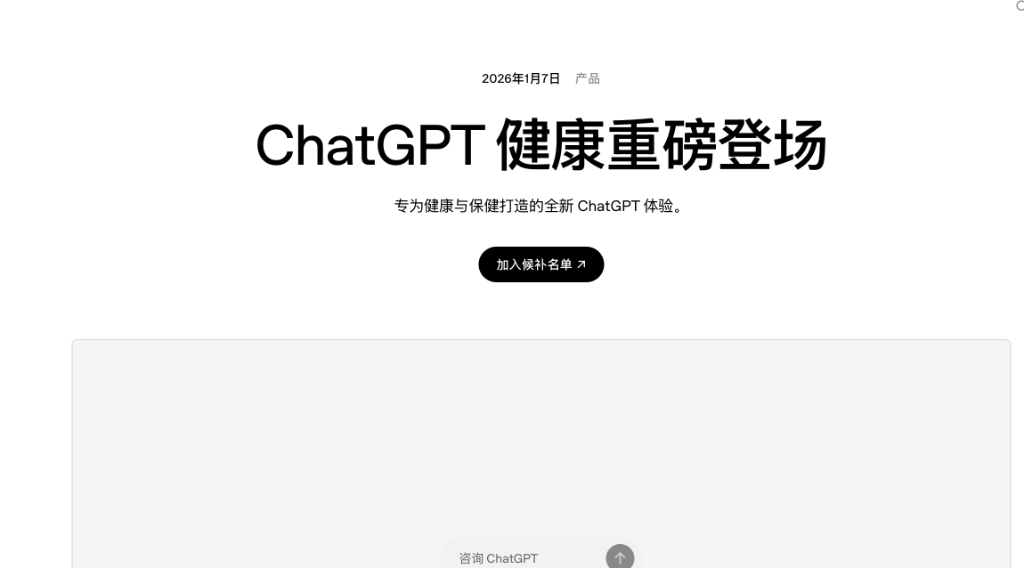
Core Insights - The perception that digital healthcare is a false proposition is being challenged by the surge in AI-driven healthcare demand, which has been historically underestimated due to high entry barriers and low frequency of medical needs [1] - The emergence of AI healthcare solutions like Ant Group's "Afu" and OpenAI's Health signifies a shift from traditional search engine-dominated medical information to AI agents managing personal health [5][16] Group 1: Ant Group's "Afu" - Ant Group's "Afu" saw its monthly active users double to over 30 million within a month, with daily inquiries exceeding 10 million [2][6] - "Afu" integrates with major smart device brands and connects to 5,000 hospitals and 300,000 doctors, providing a comprehensive healthcare service from monitoring to consultations [8] - A significant 55% of "Afu" users come from third-tier cities, highlighting the demand for accessible healthcare solutions in underserved markets [8] Group 2: OpenAI's Health - OpenAI launched ChatGPT Health on January 7, 2026, creating a separate entry point for health-related inquiries to address privacy concerns [3][9] - The architecture of ChatGPT Health ensures that health-related data is stored separately, preventing any cross-contamination with other data, thus fostering user trust [10] - OpenAI partnered with b.well Connected Health to address the challenge of fragmented medical data, allowing users to access their medical records seamlessly [12][13] Group 3: AI Healthcare Functionality - ChatGPT Health aims to manage the entire lifecycle of user health by integrating static medical records and dynamic physiological data [14] - The service can generate personalized health recommendations and actionable plans, demonstrating a significant advancement over traditional healthcare models [15] - Both "Afu" and ChatGPT Health are evolving to provide end-to-end healthcare services, reflecting a common demand for AI-driven healthcare solutions in both Eastern and Western markets [15] Group 4: Valuation Logic in AI Healthcare - The competitive landscape of healthcare is shifting from search engine-based information retrieval to conversational AI services, diminishing the value of traditional health information platforms [17] - The role of offline service providers is transforming as they become data asset managers rather than just service providers, emphasizing the value of high-quality real-world data [18] - Trust is becoming a critical currency in AI healthcare, with privacy assurances and data handling practices being central to user engagement and future monetization strategies [19]

美媒实测:ChatGPT内置应用体验不佳 难撼动苹果App Store地位
Feng Huang Wang· 2026-01-03 14:52
Core Insights - OpenAI CEO Sam Altman aims to create an app store that can compete with Apple, but early tests indicate significant challenges ahead [1] - The integration of ChatGPT with various applications is seen as a step towards transforming human-computer interaction, posing a potential threat to Apple's ecosystem [2] Group 1: OpenAI's Strategy - Altman believes that the real competition lies with Apple rather than Google, as OpenAI's vision includes evolving ChatGPT into an operating system [3] - OpenAI is collaborating with former Apple chief designer Jony Ive to develop hardware aimed at replacing the iPhone [3] - Analysts suggest that whoever controls access to popular online services will hold a valuable position in the digital landscape, currently dominated by Apple [3] Group 2: Application Performance - Testing revealed that traditional applications are still too powerful to be quickly replaced, with many ChatGPT integrations struggling to perform effectively [2] - Users experienced difficulties when trying to use Uber through ChatGPT, as it required multiple steps and did not allow direct booking [5] - Similar issues were noted with OpenTable and Tripadvisor, where users faced errors and delays, contradicting the goal of simplifying tasks through AI [6] Group 3: Successful Integrations - ChatGPT's integration with Instacart was notably successful, allowing users to create meal plans and add items to their cart seamlessly [7] - Instacart's collaboration with OpenAI improved significantly after a key executive transitioned from Instacart to OpenAI, facilitating better integration [8] - The successful integration of applications like Instacart may pose a growing concern for Apple, although using traditional iPhone apps remains easier for users [8]

Feds are hunting teenage hackers
Fortune· 2026-01-01 11:27
Core Insights - The article discusses the rise of a criminal organization known as "The Com," which recruits young individuals, primarily teenagers, to conduct ransomware attacks against major corporations, exploiting their technical skills and naivety [3][4][19]. Recruitment and Operations - The Com prioritizes female candidates and offers training for inexperienced individuals, with compensation of $300 per successful call, paid in cryptocurrency [2][19]. - The organization has infiltrated U.S. and UK companies with a combined market cap exceeding $1 trillion, targeting around 120 companies, including well-known brands like Nike and Louis Vuitton [3][4]. Tactics and Techniques - The Com employs sophisticated social engineering tactics, utilizing platforms like LinkedIn and Slack to gather information about employees and corporate structures [7][10]. - Members of the group often mimic legitimate help desk calls to extract sensitive information from employees, exploiting the asymmetry in authentication processes [11][20]. Youth Involvement and Risks - Many of the young recruits are unaware of the severe legal consequences, with some facing federal charges and significant prison sentences for their involvement [4][17]. - The article highlights that the recruitment often begins in gaming communities, where young individuals are groomed for cybercrime [15][23]. Gender Dynamics - The organization has seen an increase in female participation, which is strategically leveraged for social engineering due to societal biases that underestimate women [19][22]. - Despite the growing number of female recruits, the leadership remains predominantly male, and women are often not given opportunities for advancement within the organization [22]. Parental Awareness and Cybersecurity - Parents often remain unaware of their children's involvement in cybercrime until law enforcement intervenes, highlighting a gap in monitoring online behavior [6][26]. - The complexity of online crimes makes it difficult for parents to recognize warning signs, necessitating a more proactive approach to cybersecurity at home [25][26].


数字经济双周报(2025年第23期):美国启动“科技力量”计划,展开举国AI动员-20251224
Yin He Zheng Quan· 2025-12-24 07:00
Group 1: U.S. AI Initiatives - The U.S. government has launched the "U.S. Tech Force" program to mobilize national AI capabilities, involving agencies like OPM, OMB, GSA, and OSTP[7] - The program includes 28 initial private sector partners such as Adobe, Amazon Web Services, and AMD, with plans for further expansion[7] - This initiative reflects a broader trend of nations reorganizing resources as AI evolves from an industrial tool to a foundational national capability[10] Group 2: Global AI Developments - China is focusing on AI, computing power, and data as key components of its "14th Five-Year Plan," indicating a consensus on digital economic development[3] - The EU is advancing its AI governance framework, with a focus on enforceable regulations and expanding computational power[20] - Other countries, including South Korea and Japan, are enhancing their AI and semiconductor competitiveness through national capital and institutional tools[22][23] Group 3: AI Governance and Infrastructure - The U.S. is moving towards a unified AI governance framework, with federal oversight of AI regulation marking a new phase in governance[17] - The expansion of AI infrastructure in Europe is characterized by a dual approach of sovereign power and commercial capital[21] - AI safety and data governance are transitioning from principles to actionable tools, indicating a systematic approach to regulation[15]
Instacart scraps AI pricing tests after backlash over grocery price swings
Fastcompany· 2025-12-22 21:11
Core Viewpoint - Instacart has decided to discontinue the use of an AI-powered price testing program for retailers, following an investigation that revealed significant price discrepancies for groceries purchased through its platform [1][2][3]. Group 1: Pricing Policy Changes - Effective immediately, retailers are no longer allowed to use Eversight technology for price testing on Instacart, which previously led to different prices for the same item at the same store [2]. - The company emphasized that now, customers shopping for the same items at the same time from the same store will see identical prices, addressing customer concerns about pricing inconsistencies [3][7]. Group 2: Investigation and Regulatory Scrutiny - The decision to end price testing comes after a Consumer Reports and Groundwork Collaborative investigation found that algorithmic pricing could result in price differences of up to 23% for the same items [3]. - Instacart is under scrutiny from lawmakers and the Federal Trade Commission (FTC) regarding its pricing practices, with Rep. Angie Craig demanding answers and the FTC sending a civil investigative demand [5][6]. Group 3: Trust and Customer Relations - The company aims to regain customer trust by clarifying that it does not allow price testing based on supply and demand, personal data, demographics, or individual shopping behavior [7]. - Instacart stated that customers should not have to second-guess the prices they see, reinforcing its commitment to transparency [7]. Group 4: Market Reaction - Following the announcement, Instacart's shares fell approximately 2% during mid-day trading but have nearly recovered from a previous 6% decline related to the price testing study [8].


Instacart Ends Price Testing Following Consumer Reports Study
PYMNTS.com· 2025-12-22 20:36
Core Viewpoint - Instacart has decided to suspend its price testing practice on its grocery delivery platform following customer feedback and an investigation into its pricing practices [1][2][3]. Group 1: Pricing Practices - The decision to halt price testing comes after a Consumer Reports investigation revealed that customers were seeing different prices for the same items from the same stores, which raised concerns among consumers [2][4]. - Instacart acknowledged that the tests conducted with a limited number of retail partners did not meet customer expectations, especially during a time when families are trying to maximize their grocery budgets [3][4]. - The company clarified that moving forward, customers shopping for the same items at the same time from the same store location will see the same prices, eliminating price discrepancies [3][4]. Group 2: Regulatory Context - The announcement follows a $60 million settlement with the Federal Trade Commission (FTC) regarding allegations of false advertising practices, although Instacart denied any wrongdoing [5][6]. - Consumer Reports highlighted concerns about potential "surveillance pricing," but Instacart stated that its pricing practices do not fall under this category [5].

Instacart ends AI-driven pricing tests that drove up costs for some shoppers
CNBC· 2025-12-22 14:46
Core Viewpoint - Instacart will stop using AI-driven pricing tests on its grocery delivery platform due to scrutiny from a study and criticism from lawmakers [1][2] Group 1: Company Actions - The company announced that retailers can no longer utilize its Eversight technology for pricing experiments, effective immediately [1] - Instacart acquired Eversight for $59 million in 2022, which allowed retailers to conduct pricing tests [2] Group 2: Customer Impact - The company acknowledged that the pricing tests led to different prices for the same item at the same store, which caused confusion among customers [2] - Instacart emphasized the importance of trust, transparency, and affordability, especially during challenging economic times for families [2] Group 3: Technology Purpose - The technology was initially intended to help retailers enhance sales and growth while providing customers with the best deals [3]

Instacart ends AI-driven price experiments after criticism
Reuters· 2025-12-22 14:43
Core Viewpoint - Instacart is discontinuing its price testing strategy that displayed varying prices for groceries to different shoppers, following backlash regarding its artificial intelligence practices [1] Group 1 - The decision to end the price tests comes after criticism from users and stakeholders about the fairness and transparency of the pricing model [1] - Instacart's approach involved using artificial intelligence to determine pricing, which led to concerns over potential discrimination among customers [1] - The company aims to enhance customer trust and satisfaction by standardizing prices across its platform [1]

Lina Khan: Trump’s antitrust enforcers are ‘handing out special favors to corporate lawbreakers’
MSNBC· 2025-12-20 19:41
Antitrust Enforcement & Market Dynamics - The report highlights concerns that PepsiCo allegedly gave Walmart preferential pricing, disadvantaging smaller grocery stores and leading to consumers outside Walmart paying more for Pepsi products [2] - The discussion emphasizes that the lack of enforcement of price discrimination laws has led to consolidation in the grocery industry, particularly in rural areas, resulting in food deserts and increased pricing power for large retailers [7] - The report mentions a proposed merger between Kroger and Albertson's faced significant public opposition due to concerns about layoffs, reduced food options, and higher prices [10] Algorithmic Price Fixing & Consumer Exploitation - Algorithmic price fixing by companies like Real Page is estimated to have caused Americans to overpay by $3 billion in rent [12] - In Phoenix, residents were found to be overpaying their rent by 30% due to algorithmic price fixing [12] - Instacart is accused of using surveillance pricing, leveraging personal data to charge different prices for the same product to different customers [16] - The increasing collection of digital data allows firms to create detailed profiles of individuals, enabling them to exploit consumers by charging prices based on their willingness to pay [18] State-Level Actions & Policy Recommendations - States are taking action by passing new laws to protect citizens from algorithmic price fixing and surveillance pricing [20] - The Democratic Party is urged to prioritize holding corporations accountable for lawbreaking that inflates prices for consumers [14] - The report advocates for assertive efforts by lawmakers and law enforcers to address the challenges posed by algorithmic and surveillance pricing [17]